Quick Verdict: A Full-Size Hybrid Sedan That Still Delivers
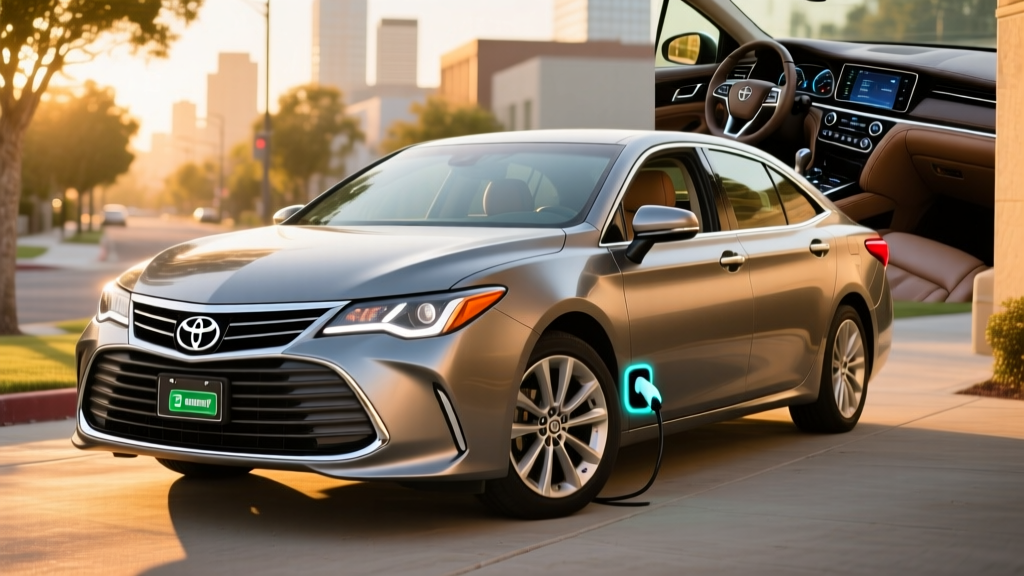
The 2016 Toyota Avalon Hybrid Limited sits at the intersection of full-size sedan comfort and genuine fuel efficiency. As Toyota's flagship hybrid sedan of its generation, it pairs a 2.5-liter four-cylinder engine with an electric motor for an EPA-estimated 40 MPG combined — a remarkable figure for a car weighing over 3,600 pounds with a spacious rear seat and a 15.4-cubic-foot trunk. In 2026, a well-maintained example represents one of the most cost-effective ways to drive a large, comfortable, efficient car without plugging in or worrying about charging infrastructure.
This guide covers the Avalon Hybrid's real-world fuel economy, its proven hybrid battery system, long-term reliability expectations, and how it stacks up against modern PHEVs and full EVs for today's buyers.
| Specification | Value |
|---|---|
| Powertrain Type | Conventional Hybrid (HEV) — no plug-in |
| Engine | 2.5L inline-4 (Atkinson cycle) |
| Combined System Horsepower | 200 HP |
| EPA MPG (City / Highway / Combined) | 40 / 39 / 40 |
| Hybrid Battery | 1.6 kWh Nickel-Metal Hydride (NiMH) |
| Transmission | eCVT (planetary gearset) |
| 0–60 mph | ~8.0 seconds |
| Drivetrain | Front-wheel drive |
| Cargo Volume | 15.4 cu ft |
| Curb Weight | ~3,638 lbs |
| Original MSRP (Limited trim) | ~$42,770 |
| Typical 2026 Used Price Range | $13,000–$19,000 |
| Hybrid Battery Warranty (Original) | 8 years / 100,000 miles (10 yr/150k in CARB states) |
Fuel Economy: EPA Ratings vs. Real-World MPG
The EPA rates the 2016 Avalon Hybrid at 40 MPG city, 39 MPG highway, and 40 MPG combined, per fueleconomy.gov. Unlike most conventional vehicles, hybrids like the Avalon often meet or even exceed their EPA city rating in real-world driving because stop-and-go traffic triggers frequent regenerative braking, which recaptures energy that would otherwise be lost as heat.
| Driving Scenario | Expected MPG | Notes |
|---|---|---|
| EPA City | 40 | Official rating |
| EPA Highway | 39 | Official rating |
| EPA Combined | 40 | Official rating |
| Real-World City (mixed traffic) | 38–43 | Regen braking boosts efficiency in stop-and-go |
| Real-World Highway (70–75 mph) | 35–38 | Aerodynamic drag and sustained speed reduce hybrid advantage |
| Cold Weather (below 30°F) | 33–37 | Engine runs more often for cabin heat; battery less efficient |
| Overall Owner Average | 38–41 | Consistent with Fuelly owner-reported data |
With a 15.9-gallon fuel tank, the Avalon Hybrid delivers roughly 600–640 miles of total range under normal conditions. That's enough for most drivers to go two to three weeks between fill-ups, and it eliminates range anxiety entirely — you refuel at any gas station in under five minutes.
HEV vs. PHEV vs. EV: Where the Avalon Hybrid Fits
The 2016 Avalon Hybrid is a conventional hybrid electric vehicle (HEV). It does not plug in, has no electric-only driving range to speak of, and cannot be charged from a wall outlet or public charger. The small 1.6 kWh NiMH battery charges exclusively through regenerative braking and the gasoline engine. Toyota never produced a plug-in hybrid (PHEV) version of the Avalon.
| Feature | HEV (Avalon Hybrid) | PHEV (e.g., RAV4 Prime) | BEV (e.g., Tesla Model 3) |
|---|---|---|---|
| Plugs In? | No | Yes (Level 1/2) | Yes (Level 1/2/DC) |
| Electric-Only Range | ~1 mile at low speed | 25–42 miles typical | 250–370 miles typical |
| Battery Size | 1.6 kWh (NiMH) | 13–18 kWh (lithium-ion) | 50–100 kWh (lithium-ion) |
| Refueling / Recharging | Gas station only | Gas + plug-in | Plug-in only |
| Home Charging Needed? | No | Recommended for EV range | Essential |
| Federal Tax Credit (New) | None | Up to $7,500 (§30D) | Up to $7,500 (§30D) |
| Best For | No plug access; wants simplicity | Short commutes + road trips | Home charging + mostly electric |
Choose the Avalon Hybrid (HEV) if: You don't have access to home or workplace charging, you want a large comfortable sedan, you drive a mix of city and highway miles, and you want zero lifestyle change compared to a gas car — just better fuel economy.
Consider a PHEV if: You have a garage or driveway where you can install a Level 2 charger, your daily commute is under 35 miles round-trip, and you still want the flexibility of a gas engine for road trips.
Consider a full EV (BEV) if: You have reliable home charging, want to eliminate gasoline entirely, and are ready to plan around DC fast-charging on longer trips.
Powertrain and Driving Experience
The Avalon Hybrid uses Toyota's well-proven Hybrid Synergy Drive system. The 2.5-liter inline-four operates on the Atkinson cycle — a combustion strategy that sacrifices some peak power for significantly better thermal efficiency. Combined with the electric motor integrated into the transaxle, total system output is 200 horsepower.
The eCVT (electronically controlled continuously variable transmission) is not a belt-driven CVT like those in some competitors. Instead, it uses a planetary gearset that seamlessly blends engine and motor power. There are no fixed gears, no shift shock, and no rubber-band sensation. Acceleration is linear and adequate: the 0–60 mph time of approximately 8.0 seconds is relaxed but perfectly sufficient for highway merging and passing.
Three driving modes are available:
- EV Mode: Forces electric-only driving at very low speeds (under ~25 mph, for roughly one mile if the battery is sufficiently charged). Useful for creeping through a parking garage or residential street.
- Eco Mode: Softens throttle response and reduces HVAC power to maximize fuel economy.
- Sport Mode: Sharpens throttle response and increases steering weight for a slightly more engaged feel.
The Limited trim adds SofTex-trimmed heated and ventilated front seats, a 7-inch touchscreen with navigation, a JBL premium audio system, and Toyota's Safety Sense-inspired features including blind-spot monitoring and rear cross-traffic alert. It rides on 17-inch alloy wheels with low-rolling-resistance tires that prioritize efficiency over grip.
Hybrid Battery: Lifespan, Warranty, and Replacement Cost
The Avalon Hybrid's 1.6 kWh nickel-metal hydride (NiMH) battery pack is positioned behind the rear seat. Unlike the lithium-ion packs in modern EVs and PHEVs, this NiMH pack is small, robust, and proven over millions of Toyota hybrid vehicles dating back to the original 1997 Prius.
Battery Warranty Coverage
Toyota originally warranted the Avalon Hybrid battery for 8 years / 100,000 miles in most states, and 10 years / 150,000 miles in states that follow California Air Resources Board (CARB) emissions rules — including California, New York, Massachusetts, Connecticut, Maine, Maryland, New Jersey, Oregon, Rhode Island, Vermont, and Washington. For a 2016 model, the original factory warranty has now expired in most cases (as of 2024–2026), but the battery's real-world lifespan typically far exceeds these terms.
Real-World Battery Longevity
Toyota's NiMH hybrid batteries have demonstrated exceptional longevity in fleet and owner data. It's common for these packs to last 150,000 to 200,000+ miles before any significant capacity loss. The battery management system keeps the pack in a narrow state-of-charge window (roughly 40–80%), which dramatically reduces stress on the cells and prevents the deep cycling that degrades lithium-ion batteries faster.
Key factors that extend hybrid battery life:
- Moderate climates: Extreme heat accelerates NiMH degradation more than cold does. Garage parking helps in hot states like Arizona and Texas.
- Regular driving: Hybrids that sit unused for weeks at a time can develop cell imbalance. Driving the car at least a few times per week keeps the pack healthy.
- No user maintenance needed: The battery is sealed and requires no coolant top-ups or conditioning cycles.
Battery Replacement Cost
If the hybrid battery does eventually fail, replacement options for the 2016 Avalon Hybrid include:
| Option | Estimated Cost | Warranty |
|---|---|---|
| New OEM Toyota battery (dealer) | $3,000–$4,000 (parts + labor) | 3 years / 36,000 miles |
| Refurbished / remanufactured battery | $1,500–$2,500 (parts + labor) | 1–3 years typical |
| Individual cell module replacement (specialist shop) | $500–$1,200 | Varies by shop |
Independent hybrid specialist shops can often diagnose and replace only the weak cell modules within the pack rather than the entire assembly, saving significant money. This is a well-understood repair in the Toyota hybrid ecosystem.
Reliability and Long-Term Ownership Costs
The 2016 Avalon Hybrid benefits from one of the strongest reliability reputations in the automotive industry. Toyota's hybrid powertrain has been refined over two decades, and the Avalon's conventional automatic-style eCVT eliminates the belt-and-cone failure mode that plagues some competitors' CVTs. The NHTSA gave the 2016 Avalon a 5-star overall safety rating.
Routine maintenance is minimal compared to a conventional gas car:
- Oil changes: Every 10,000 miles with 0W-20 synthetic (the Atkinson-cycle engine runs clean and cool).
- No spark plug replacements until ~120,000 miles (iridium plugs).
- Brake pads last longer than on gas-only cars because regenerative braking handles much of the deceleration. Owners routinely report 80,000–100,000 miles on original brake pads.
- No transmission fluid changes required under normal driving conditions per Toyota's maintenance schedule.
Estimated Annual Operating Costs
At 40 MPG combined and a national average of $3.20/gallon (2026), the Avalon Hybrid costs roughly $1,040 per year in fuel for a driver covering 13,000 miles annually. A comparable gas-only full-size sedan averaging 25 MPG would cost about $1,664 per year — a savings of over $600 annually in fuel alone.
Tax Credits and Incentives
Because the 2016 Avalon Hybrid is a conventional HEV that does not plug in, it does not qualify for the federal §30D new clean vehicle tax credit (up to $7,500) or the §25E used clean vehicle credit (up to $4,000). These credits, as outlined on IRS.gov, require the vehicle to have a plug — meaning only PHEVs and BEVs are eligible.
Some states and municipalities have offered rebates or HOV lane access for conventional hybrids in the past, but most of these programs have shifted to prioritize plug-in vehicles. Check your state's energy or environmental agency website for any remaining hybrid-specific incentives, though they are increasingly rare in 2026.
The financial case for the used Avalon Hybrid rests on its low purchase price, excellent fuel economy, minimal maintenance costs, and outstanding reliability — not on tax incentives.
Pros
- EPA 40 MPG combined — outstanding for a full-size sedan
- No plug-in required; zero lifestyle change vs. a gas car
- Proven hybrid system with 200,000+ mile battery longevity
- Spacious rear seat and 15.4 cu ft trunk (battery doesn't eat cargo room)
- Quiet, comfortable ride quality; strong NVH isolation
- Regenerative braking extends brake pad life significantly
- Low annual maintenance costs
- 5-star NHTSA safety rating
Cons
- 200 HP feels adequate but not quick — 8-second 0–60
- No plug-in option; no electric-only commuting range
- No federal tax credit eligibility (HEV)
- Infotainment system is dated by 2026 standards (no Apple CarPlay/Android Auto)
- Highway MPG drops to mid-30s at sustained 75+ mph speeds
- Original factory hybrid battery warranty has expired on most examples
- Low-rolling-resistance tires trade grip for efficiency
Who Should Buy the 2016 Avalon Hybrid Limited?
This car is ideal for a specific buyer profile: someone who wants a comfortable, spacious, fuel-efficient sedan without changing their refueling habits. If you live in an apartment without charging access, drive a mix of city and highway miles, and value low running costs and Toyota reliability, the Avalon Hybrid is difficult to beat at its 2026 used-market prices of $13,000–$19,000.
It's also a strong choice for:
- Rideshare and taxi drivers who rack up high city miles and benefit from the 40 MPG city rating and extended brake life.
- Retirees and long-distance drivers who want a smooth, quiet highway cruiser with 600+ mile range.
- Second-car buyers who want a reliable, low-maintenance daily driver without investing in home charging infrastructure.
It's not the right choice if you want to drive primarily on electricity, need the latest infotainment features, or want a vehicle eligible for federal tax credits. For those needs, a used PHEV like the Toyota RAV4 Prime or a full EV like the Chevrolet Bolt or Tesla Model 3 may be more appropriate.
Frequently Asked Questions
How many MPG does the 2016 Toyota Avalon Hybrid get?
The EPA rates it at 40 MPG city, 39 MPG highway, and 40 MPG combined. In real-world driving, most owners report 38–41 MPG overall, with city driving sometimes exceeding the EPA rating thanks to regenerative braking. Highway driving at 75 mph typically yields 35–38 MPG.
Does the 2016 Avalon Hybrid plug in?
No. The Avalon Hybrid is a conventional hybrid (HEV). It charges its small battery through regenerative braking and the gasoline engine. You never need to plug it in — just fill it with gas like any other car.
How far can the Avalon Hybrid drive on electric only?
In EV mode, the Avalon Hybrid can creep along at very low speeds (under ~25 mph) for roughly one mile if the battery is fully charged. This is useful for parking garages or quiet residential streets, but it is not a viable electric commuting solution. There is no meaningful electric-only range for daily driving.
Is the 2016 Avalon Hybrid reliable, and what does battery replacement cost?
Yes — Toyota's hybrid system is among the most reliable powertrains ever mass-produced. The NiMH hybrid battery commonly lasts 150,000–200,000+ miles. If replacement is eventually needed, expect $3,000–$4,000 for a new OEM battery at a dealer, $1,500–$2,500 for a refurbished unit, or $500–$1,200 for individual cell module replacement at a specialist shop.
Does the 2016 Avalon Hybrid qualify for any tax credit?
No. Federal clean vehicle tax credits (§30D for new, §25E for used) require a plug-in vehicle — either a PHEV or a BEV. As a conventional hybrid, the Avalon Hybrid does not qualify. Some states may have offered hybrid incentives historically, but most have transitioned to plug-in-only programs by 2026.
How does the Avalon Hybrid compare to a modern PHEV or EV?
The Avalon Hybrid trades electric-only range and tax credit eligibility for simplicity and zero infrastructure requirements. A modern PHEV like the Toyota Prius Prime offers 40+ miles of electric range but requires home charging to realize its benefits. A full EV like the Tesla Model 3 eliminates gasoline entirely but requires reliable charging access. The Avalon Hybrid is the lowest-friction path to excellent fuel economy — no plugs, no apps, no charging planning.
What maintenance does the Avalon Hybrid require?
Routine maintenance includes oil changes every 10,000 miles, tire rotations, cabin air filter replacement, and standard brake inspections. Brake pads typically last 80,000–100,000 miles due to regenerative braking. The hybrid battery and eCVT require no scheduled maintenance. Overall annual maintenance costs are among the lowest in the full-size sedan segment.