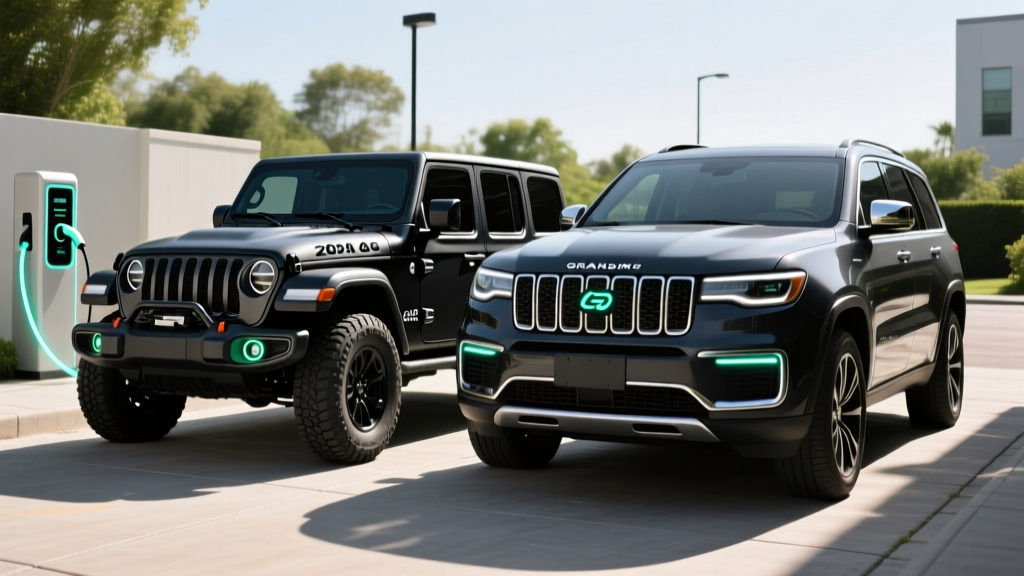
Jeep's electrified lineup centers on two plug-in hybrid models wearing the 4xe badge: the rugged Wrangler 4xe and the family-oriented Grand Cherokee 4xe. If you're researching Jeep hybrid deals, understanding the exact specs, real-world efficiency, and federal tax credit eligibility is essential before stepping into a dealership. This guide breaks down both models with the numbers that matter.
HEV vs PHEV: What Jeep Actually Offers
Before hunting for deals, clarify what you're looking at. Jeep does not currently sell a conventional hybrid (HEV) that charges itself through regenerative braking alone. Every electrified Jeep on the market is a plug-in hybrid (PHEV) — meaning it has a larger battery you charge from an external source, delivering meaningful electric-only driving before the gasoline engine takes over.
- HEV (conventional hybrid): No plug. Small battery (~1–2 kWh). Regenerates energy from braking. Typical electric assist only at low speeds. Think Toyota RAV4 Hybrid.
- PHEV (plug-in hybrid): Requires plugging in. Larger battery (17+ kWh in Jeep's case). Delivers 25+ miles of pure electric driving. Gasoline engine provides extended range. This is the 4xe system.
If you see a listing for a "Jeep hybrid," it's almost certainly a 4xe PHEV. You'll need access to a standard 120V outlet (Level 1) or a 240V Level 2 charger to realize the electric-range benefits.
2026 Wrangler 4xe: Specs, Range, and Efficiency
| Spec | 2026 Wrangler 4xe |
|---|---|
| Powertrain | 2.0L turbo I4 + two electric motors + 8-speed auto |
| Combined Horsepower | 375 hp / 470 lb-ft torque |
| Battery (usable) | 17.3 kWh (NMC lithium-ion) |
| EPA Electric-Only Range | 22 miles |
| Total Combined Range | ~370 miles |
| EPA MPGe (electric + gas) | 49 MPGe |
| EPA MPG (gas-only, combined) | 20 MPG |
| Level 2 Charge Time (0–100%) | ~2 hours at 7.2 kW |
| DC Fast Charging | Not available |
| Towing Capacity | 3,500 lbs |
| Starting MSRP (Willys 4xe) | ~$51,790 |
Real-World Range Reality: The EPA's 22-mile electric estimate holds up reasonably well in mild weather around town. Expect 18–20 miles in cold conditions (below 40°F) or at sustained highway speeds above 65 mph, where the boxy Wrangler's aerodynamic drag works against efficiency. Once the battery depletes, real-world gas-only MPG drops to roughly 18–19 combined in mixed driving — the Wrangler's weight and brick-like profile exact a penalty.
The Wrangler 4xe's 2.0-liter turbocharged four-cylinder pairs with an electric motor integrated into the transmission housing and a second motor/generator at the engine. The result is 375 horsepower and an impressive 470 lb-ft of torque — more low-end grunt than the V6 gas model, which matters on trails. The 4xe system retains full 4WD capability, including the Rubicon's front and rear locking differentials and electronic sway-bar disconnect.
2026 Grand Cherokee 4xe: Specs, Range, and Efficiency
| Spec | 2026 Grand Cherokee 4xe |
|---|---|
| Powertrain | 2.0L turbo I4 + two electric motors + 8-speed auto |
| Combined Horsepower | 375 hp / 470 lb-ft torque |
| Battery (usable) | 17.3 kWh (NMC lithium-ion) |
| EPA Electric-Only Range | 26 miles |
| Total Combined Range | ~440 miles |
| EPA MPGe (electric + gas) | 56 MPGe |
| EPA MPG (gas-only, combined) | 23 MPG (city 23 / hwy 24) |
| Level 2 Charge Time (0–100%) | ~2 hours at 7.2 kW |
| DC Fast Charging | Not available |
| Towing Capacity | 6,000 lbs |
| Starting MSRP (Base 4xe) | ~$60,490 |
The Grand Cherokee 4xe uses the same powertrain architecture as the Wrangler but benefits from a more aerodynamic body and slightly better weight distribution. The result: 26 miles of electric range and better gas-only fuel economy once the battery is depleted. According to fueleconomy.gov, the Grand Cherokee 4xe achieves 23 MPG combined in charge-sustaining (gas-only) mode — a meaningful advantage over the Wrangler for daily commuting.
Real-World Range Reality: Owners who charge nightly and commute under 25 miles round-trip report burning very little gasoline during the work week. In cold weather, expect electric range to drop to roughly 20–22 miles. Highway driving at 75+ mph in gas mode yields closer to 21–22 MPG. The Grand Cherokee 4xe rewards drivers who treat it as an EV for short trips and a hybrid for longer hauls.
Federal Tax Credit: Do Jeep 4xe Models Qualify?
This is where deal-hunters need to pay close attention. Under the current IRS §30D Clean Vehicle Credit rules, the Jeep Wrangler 4xe and Grand Cherokee 4xe face eligibility challenges:
- MSRP Cap: SUVs must be under $80,000. Most 4xe trims clear this, but fully loaded Grand Cherokee 4xe Summit Reserve models can push past the limit.
- Income Cap: Modified AGI must not exceed $150,000 (single), $225,000 (head of household), or $300,000 (joint).
- Battery Sourcing: Critical minerals and battery components must meet escalating domestic-content thresholds. Jeep 4xe models have faced sourcing-rule restrictions that can reduce or eliminate the credit — verify current-year eligibility on the IRS qualified vehicle list before assuming you'll receive the full $7,500.
- Point-of-Sale Transfer: If eligible, you can transfer the credit to the dealer at purchase, reducing your out-of-pocket cost immediately rather than waiting for tax filing.
Bottom line for deal-seekers: Jeep dealerships frequently advertise "$7,500 off" using the federal credit. Confirm the specific VIN appears on the IRS qualified list and that your income falls within limits. State incentives (Colorado, California, and others) may stack on top — check your state's energy office for current programs.
Finding the Best Jeep Hybrid Deals
With both 4xe models now several years into production, deal structures have evolved. Here's what to look for in 2026:
- Dealer discounting: Wrangler 4xe inventory has been high since late 2024, and dealers are more willing to negotiate below MSRP — especially on mid-tier trims like Sahara 4xe. Expect $2,000–$5,000 off sticker before incentives on well-stocked lots.
- Stellantis loyalty cash: Jeep's parent company periodically offers $1,000–$2,000 loyalty bonuses for current Stellantis owners, stackable with federal credits.
- Lease deals: The Grand Cherokee 4xe has appeared in lease promotions with money factors that effectively price below purchase when you factor depreciation. Compare the lease's total cost against a purchase with the tax credit applied.
- Model-year clearance: As Jeep updates trims and option packages, outgoing model-year units carry the deepest discounts. A leftover prior-year Wrangler 4xe Rubicon can save $4,000–$7,000 versus a freshly built unit.
Always negotiate the out-the-door price before discussing the federal tax credit. The credit is yours — it should not be used to offset a higher negotiated price.
Battery Warranty and Long-Term Reliability
Jeep 4xe Battery Warranty: Both the Wrangler and Grand Cherokee 4xe carry a 10-year / 100,000-mile hybrid battery warranty (8 years / 100,000 miles in states that don't follow California emissions standards). This covers battery capacity loss below a defined threshold — typically around 70% of original capacity — as well as defects in the electric motors, power inverter, and onboard charger.
The 17.3 kWh NMC battery pack is liquid-cooled, which helps manage degradation. Real-world data from early 2021–2022 Wrangler 4xe owners shows minimal capacity loss in the first 3–4 years of ownership when following normal charging habits. Replacement cost for a 4xe battery pack, if needed out of warranty, is estimated at $8,000–$12,000 including labor — a figure worth factoring into long-term ownership plans if you intend to keep the vehicle past the warranty period.
Reliability has been mixed. The 4xe powertrain adds complexity — there are more potential failure points than in a conventional gas Wrangler. Common early complaints included software glitches in the hybrid control module and occasional charging-port issues. Jeep issued several technical service bulletins (TSBs) to address these. Check the NHTSA recall database for the specific model year you're considering.
Who Should Buy a Jeep 4xe — And Who Shouldn't
Choose the Wrangler 4xe if:
- You want genuine off-road capability with electric-assisted torque for trail crawling
- Your daily commute is under 20 miles and you can charge at home
- You want to reduce fuel costs without range anxiety on road trips
- You value the Wrangler's removable top/doors and don't mind the efficiency trade-offs of a boxy shape
Choose the Grand Cherokee 4xe if:
- You need a three-row-optional family SUV with better on-road manners
- Your commute is under 25 miles and you want to drive mostly on electricity during the week
- You tow up to 6,000 lbs and want electric torque assist for trailer launches
- You prioritize cabin refinement and tech over off-road prowess
Consider a full EV instead if:
- You have reliable home charging and rarely drive over 250 miles between charges
- You want zero tailpipe emissions and minimal maintenance (no oil changes, no gas engine upkeep)
- You're eligible for the full $7,500 credit on a BEV with fewer sourcing-rule complications (e.g., Tesla Model Y, certain GM EVs)
Stick with a gas Wrangler or Grand Cherokee if:
- You cannot charge at home or at work — a PHEV you never plug in is just a heavier, less efficient gas car
- You regularly drive 400+ miles in remote areas with no charging infrastructure
- The price premium of the 4xe system (typically $4,000–$6,000 over gas equivalents) doesn't pencil out in fuel savings for your mileage
Frequently Asked Questions
How many MPG does the Jeep 4xe get?
The Wrangler 4xe achieves 20 MPG combined in gas-only mode and 49 MPGe when factoring in electric driving. The Grand Cherokee 4xe delivers 23 MPG combined (city 23 / highway 24) in gas mode and 56 MPGe overall. Real-world results vary: city driving with regular charging yields dramatically lower gas consumption, while highway-only road trips return figures near the gas-only MPG ratings.
How far can a Jeep 4xe go on electric only?
The Wrangler 4xe provides 22 miles of EPA-rated electric range; the Grand Cherokee 4xe delivers 26 miles. Cold weather, high speeds, and aggressive driving reduce these figures by 10–20%. For commutes within these distances, daily plug-in charging means you may go weeks without visiting a gas station.
Does the Jeep 4xe qualify for the $7,500 federal tax credit?
Eligibility depends on current-year battery sourcing rules under IRS §30D, your income, and the vehicle's MSRP. Jeep 4xe models have faced partial or full credit disqualification in some years due to critical-mineral sourcing requirements. Always verify the specific VIN on the IRS qualified vehicle list before finalizing a purchase. Point-of-sale transfer is available if the vehicle qualifies.
How long does the Jeep 4xe battery last and what does replacement cost?
Jeep warranties the 4xe battery for 10 years / 100,000 miles (in CARB states) or 8 years / 100,000 miles (federal emissions states). The liquid-cooled NMC pack shows minimal degradation in early ownership based on owner reports. Out-of-warranty replacement is estimated at $8,000–$12,000. Proper charging habits — avoiding prolonged 100% or 0% states of charge — help maximize longevity.
Can the Jeep 4xe DC fast charge?
No. Neither the Wrangler 4xe nor the Grand Cherokee 4xe supports DC fast charging. The onboard charger maxes out at 7.2 kW on Level 2 (240V), taking roughly 2 hours for a full charge. On a standard 120V Level 1 outlet, a full charge takes approximately 12 hours — essentially overnight. This is adequate for daily top-ups but means you cannot rapidly recharge on a road trip.
Is the Jeep 4xe good for off-roading?
The Wrangler 4xe Rubicon retains every off-road hardware advantage of its gas counterpart: Dana 44 axles, front and rear electronic lockers, electronic sway-bar disconnect, and 33-inch tire clearance. The instant electric torque at low RPM is actually an advantage in rock crawling. The battery pack is mounted under the rear seats and skid-plated. Water fording depth is slightly reduced to 30.8 inches (vs. 33 inches on the gas Rubicon) due to the battery's position. The Grand Cherokee 4xe offers competent light off-road ability but is not a serious trail vehicle.