Quick Verdict: The Grand Cherokee 4xe in Numbers
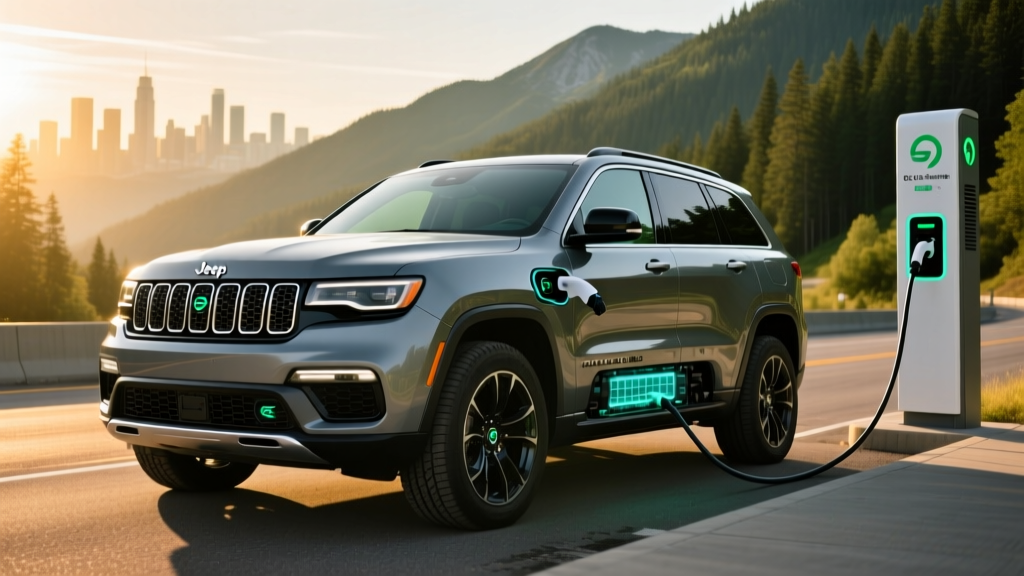
The Jeep Grand Cherokee 4xe is one of the few plug-in hybrid (PHEV) midsize SUVs that pairs genuine off-road capability with meaningful electric-only commuting range. For 2026, it remains the only electrified Grand Cherokee Jeep offers — there is no conventional hybrid (HEV) version. Buyers searching for "Jeep Grand Cherokee hybrid MPG" are almost always looking at the 4xe, so let's put the exact figures on the table.
With a 14.0 kWh (usable) lithium-ion battery pack and a turbocharged 2.0-liter inline-four paired with two electric motors, the Grand Cherokee 4xe delivers an EPA-estimated 56 MPGe combined when operating in electric-assist mode and 23 MPG combined once the battery is depleted and it runs as a conventional hybrid. Electric-only range sits at an EPA-rated 26 miles, with a total combined range of approximately 440 miles.
| Spec | Value |
|---|---|
| Powertrain | 2.0L turbo I-4 + 2 electric motors (PHEV) |
| Combined Horsepower | 375 hp / 470 lb-ft torque |
| Battery (Usable) | 14.0 kWh lithium-ion (NMC) |
| EPA Electric Range | 26 miles |
| EPA MPGe (Charge-Sustaining + EV) | 56 MPGe combined |
| EPA MPG (Gas Only / Battery Depleted) | 23 combined (21 city / 24 hwy) |
| Total Range | ~440 miles |
| Level 2 Charge Time (0–100%) | ~2 hours at 7.2 kW |
| DC Fast Charging | Not supported |
| 0–60 mph | 6.0 seconds |
| Towing Capacity | 6,000 lbs (properly equipped) |
| Battery Warranty | 10 years / 100,000 miles |
| Base MSRP (2026) | ~$62,095 (incl. destination) |
HEV vs PHEV: Why the Grand Cherokee Only Comes as a Plug-In
It's a common point of confusion. A conventional hybrid (HEV) — like the Toyota RAV4 Hybrid — never plugs in. It uses a small battery recharged by regenerative braking and the engine, and it typically improves fuel economy by 20–35% over a gas-only equivalent. You simply fuel up and drive.
A plug-in hybrid (PHEV) like the Grand Cherokee 4xe has a much larger battery (14.0 kWh usable here) that you can plug in to recharge. This gives you a meaningful electric-only driving range (26 miles) for short commutes before the gas engine ever starts. Once that electric range is used up, the vehicle operates as a conventional hybrid, blending engine and motor power.
At a Glance: HEV vs PHEV vs BEV
| Factor | HEV (Conventional Hybrid) | PHEV (Grand Cherokee 4xe) | BEV (Full Electric) |
|---|---|---|---|
| Plugs In? | No | Yes (optional but recommended) | Yes (required) |
| Electric-Only Range | ~1 mile at low speed | 26 miles | 200–400+ miles |
| Gas Engine? | Yes | Yes | No |
| Typical Combined MPG | 35–50 MPG | 23 MPG (gas) / 56 MPGe (EV+gas) | N/A (MPGe only) |
| Home Charging Needed? | No | Strongly recommended | Yes |
| Federal Tax Credit | None | Up to $3,750 (§30D, if eligible) | Up to $7,500 (§30D, if eligible) |
The Grand Cherokee does not offer an HEV variant. If you want an electrified Jeep SUV, the 4xe PHEV is your option. If you want a conventional hybrid midsize SUV from another brand, competitors like the Toyota Highlander Hybrid (35 MPG combined) or Hyundai Santa Fe Hybrid (36 MPG combined) are alternatives — but neither offers the off-road hardware or towing capacity of the Grand Cherokee.
Jeep Grand Cherokee 4xe MPG: The Full EPA Breakdown
PHEV fuel economy is reported two ways, and both matter depending on how you drive:
| Mode | City | Highway | Combined |
|---|---|---|---|
| Charge-Depleting (EV + Gas blended) | 56 MPGe combined | ||
| Charge-Sustaining (Gas Only, Battery Empty) | 21 MPG | 24 MPG | 23 MPG |
What this means in practice: If your daily commute is under 26 miles round-trip and you plug in every night, you may use almost no gasoline for weeks. The 56 MPGe figure reflects that blended operation. But once the battery is depleted — on a long road trip, for example — the 4xe operates as a 4,700-pound turbo-hybrid and returns 23 MPG. That's respectable for its class, but it's not a Prius.
Real-World MPG vs EPA Estimates
EPA Combined (gas only): 23 MPG
Real-world expectation: Owners typically report 22–26 MPG in mixed driving once the battery is depleted. City-heavy routes with frequent regen braking push the number higher; sustained 75+ mph highway driving drops it to 20–22 MPG. Cold weather (below 30°F) reduces electric-only range by roughly 20–30%, meaning the engine fires sooner and gas MPG dips slightly.
Like most PHEVs, the Grand Cherokee 4xe rewards city driving. Regenerative braking recaptures energy in stop-and-go traffic, and the electric motor handles low-speed acceleration where gas engines are least efficient.
Electric-Only Range, Charging, and Battery Specs
The 4xe's 14.0 kWh usable battery (gross capacity is approximately 17.3 kWh, with a software buffer to protect longevity) delivers an EPA-rated 26 miles of electric-only range. That covers the average American's one-way commute, according to Census Bureau data showing a median commute of about 16 miles.
Charging is straightforward but limited to Level 1 and Level 2:
| Level | Power Source | Charge Rate | 0–100% Time | Miles Added/Hour |
|---|---|---|---|---|
| Level 1 | 120V household outlet | ~1.4 kW | ~10–12 hours | ~5–6 mi/hr |
| Level 2 | 240V home or public station | 7.2 kW | ~2 hours | ~13 mi/hr |
| DC Fast Charge | — | Not supported | — | — |
The Grand Cherokee 4xe uses a J1772 connector for Level 2 AC charging — the standard for all non-Tesla PHEVs and BEVs in North America. It does not support DC fast charging, which is common for PHEVs; their smaller batteries don't justify the added cost and weight of DC hardware. A full recharge on a home Level 2 station takes roughly two hours, easily done overnight or during a workday.
Home charging setup: A basic Level 2 wall connector (240V, 32A) costs $300–$600 for the unit, with professional installation running $500–$2,000 depending on your electrical panel's capacity and the distance from panel to garage. Most 4xe owners find a 32A charger more than sufficient given the 7.2 kW onboard charger limit.
Powertrain and Performance
The 4xe powertrain is no efficiency-only compromise. The turbocharged 2.0-liter inline-four produces 270 hp on its own, but combined with the two electric motors (one integrated into the transmission, one on the front axle), total system output reaches 375 horsepower and 470 lb-ft of torque. That's more torque than the V8-powered Grand Cherokee of the previous generation.
Jeep rates the 0–60 mph sprint at 6.0 seconds — quick for a three-row-capable midsize SUV. The electric motor delivers instant torque off the line, making the 4xe feel notably more responsive than its gas-only siblings in daily driving.
The 4xe retains Jeep's Quadra-Trac II 4x4 system and available air suspension, so off-road capability (Trail Rated on certain trims) is preserved. Towing capacity is rated at 6,000 pounds when properly equipped — adequate for most boat and camper trailers.
Pricing, Trims, and Federal Tax Credit Eligibility
The 2026 Grand Cherokee 4xe starts at approximately $62,095 (including destination) for the base trim and climbs past $80,000 for the Summit Reserve. Key trims include the 4xe, Trailhawk 4xe, Overland 4xe, and Summit Reserve 4xe.
Federal §30D Tax Credit for PHEVs (2026 Rules)
The Grand Cherokee 4xe may qualify for a partial federal tax credit, but eligibility depends on several factors that change frequently under current IRS rules:
- Credit amount: Up to $3,750 for PHEVs meeting partial critical-mineral or battery-component sourcing requirements (full $7,500 requires meeting both thresholds)
- MSRP cap: SUVs must have an MSRP at or below $80,000 to qualify — this eliminates some higher 4xe trims
- Buyer income cap: Modified AGI must not exceed $150,000 (single), $225,000 (head of household), or $300,000 (joint)
- Battery sourcing: Critical minerals and battery components must meet phased-in domestic/FEOC-compliant sourcing thresholds — Jeep's supply chain compliance varies by model year and batch
- Point-of-sale transfer: Eligible buyers can transfer the credit to the dealer at purchase for an immediate price reduction rather than waiting to claim it on their tax return
Always verify current eligibility at IRS.gov or with a tax professional before purchasing. Sourcing rules tighten annually.
Reliability, Battery Warranty, and Replacement Costs
PHEV reliability is a top buyer concern, and the Grand Cherokee 4xe has a mixed record. The powertrain itself — the 2.0L turbo and electric motor integration — has proven generally robust, but the 4xe shares the broader Grand Cherokee platform's history of middling build quality and intermittent electrical gremlins reported by some owners on NHTSA's complaint database.
Battery Warranty and Lifespan
Warranty: The high-voltage battery pack is covered for 10 years or 100,000 miles (whichever comes first), with a capacity retention threshold of 70%. If the battery degrades below 70% of original capacity within that period, Jeep will repair or replace it at no cost.
Expected lifespan: PHEV batteries experience less stress than full EV batteries because the system uses a smaller portion of total capacity in daily cycling. Most 4xe batteries should outlast the warranty period with minimal degradation — typically 5–10% loss over 100,000 miles based on owner data from similar Stellantis PHEV platforms.
Replacement cost: Out of warranty, a Grand Cherokee 4xe battery replacement runs approximately $8,000–$12,000 for the pack, plus $1,000–$2,000 in labor. This is a worst-case scenario and relatively rare for vehicles within the first decade of ownership.
The conventional hybrid components (regenerative braking system, electric motor, power electronics) carry the standard 8-year / 100,000-mile hybrid component warranty. For comparison, Toyota covers its hybrid batteries for 10 years / 150,000 miles, which remains the industry benchmark.
Who Should Buy the Grand Cherokee 4xe?
The PHEV Decision Framework
Choose the Grand Cherokee 4xe if:
- Your daily commute is under 30 miles round-trip and you have access to Level 2 charging at home or work
- You need genuine towing capacity (6,000 lbs) and off-road capability that no BEV crossover currently matches at this price point
- You take regular road trips where BEV charging infrastructure is sparse or inconvenient
- You want to reduce gasoline consumption significantly without committing to full electric
Choose a full BEV (like the Rivian R1S or Tesla Model X) if:
- You have reliable home charging and your daily driving rarely exceeds 200 miles
- You want zero tailpipe emissions and minimal powertrain maintenance
- You qualify for the full $7,500 federal credit on a BEV
Choose a conventional HEV (like the Toyota Highlander Hybrid) if:
- You cannot install a home charger (apartment, street parking)
- You want hybrid efficiency without ever thinking about plugging in
- Lower purchase price is a priority (HEVs carry a smaller premium over gas models)
Stick with the gas-only Grand Cherokee if:
- You drive mostly highway miles at sustained speeds (the PHEV advantage shrinks)
- The $10,000+ price premium over the gas model doesn't pencil out given your annual mileage
Pros
- 26 miles of electric-only range covers most commutes gas-free
- 375 hp / 470 lb-ft — strong acceleration and towing
- Retains Trail Rated off-road capability
- No range anxiety on road trips — gas engine takes over seamlessly
- 10-year / 100,000-mile battery warranty
- Potential partial federal tax credit (up to $3,750)
Cons
- 23 MPG gas-only is average, not exceptional, for a hybrid SUV
- No DC fast charging — limits on-the-go top-ups
- High starting price (~$62,095) with the PHEV premium
- Some higher trims exceed the $80,000 MSRP cap for tax credit eligibility
- Reliability ratings trail Toyota/Honda hybrid benchmarks
- Electric range drops 20–30% in cold weather
Frequently Asked Questions
How many MPG does the Jeep Grand Cherokee hybrid get?
The 2026 Grand Cherokee 4xe achieves an EPA-estimated 56 MPGe combined when using both electric and gas power. Once the battery is depleted and the vehicle runs on gasoline alone, it returns 23 MPG combined (21 city / 24 highway). There is no conventional hybrid (non-plug-in) Grand Cherokee — the 4xe is the only electrified option.
How far can the Grand Cherokee 4xe go on electric only?
The EPA rates the Grand Cherokee 4xe at 26 miles of electric-only range. In real-world conditions, expect 20–26 miles depending on temperature, terrain, and driving style. Highway driving at 70+ mph and cold weather below freezing will reduce this to roughly 18–21 miles.
Does the Jeep Grand Cherokee 4xe qualify for a tax credit?
It may qualify for a partial federal tax credit of up to $3,750 under IRS §30D rules, depending on battery sourcing compliance, your income level, and the trim's MSRP (must be $80,000 or below for SUVs). Eligibility rules change as sourcing requirements tighten. Verify current status at IRS.gov before purchasing.
Is the Grand Cherokee 4xe reliable, and what does battery replacement cost?
The 4xe powertrain has been generally reliable, though the Grand Cherokee platform has historically scored below average in J.D. Power and Consumer Reports reliability surveys. The high-voltage battery is warranted for 10 years / 100,000 miles (70% capacity retention). Out-of-warranty replacement costs approximately $8,000–$12,000 for the battery pack, though full replacements within the first decade are uncommon.
Do I have to plug in the Grand Cherokee 4xe?
You don't have to, but you should. The 4xe operates as a conventional hybrid if you never plug it in, returning about 23 MPG. Plugging in regularly (even on a standard 120V outlet overnight) unlocks the 26 miles of electric-only range and the 56 MPGe rating — that's where the fuel savings come from. If you can't plug in at all, a conventional HEV from another brand may be a better fit.
Can the Grand Cherokee 4xe DC fast charge?
No. The 4xe supports Level 1 (120V) and Level 2 (240V, up to 7.2 kW) AC charging only. A full Level 2 charge takes approximately 2 hours. DC fast charging is not available, which is typical for PHEVs with smaller battery packs.
How does the 4xe compare to a full EV for daily commuting?
If your commute is under 26 miles and you charge nightly, the 4xe operates almost identically to a full EV — silent, electric, zero tailpipe emissions on that trip. The advantage over a BEV is the gas engine backup for longer trips, eliminating range anxiety. The trade-off is higher maintenance complexity (gas engine + electric powertrain) and lower efficiency once the battery is depleted compared to a dedicated BEV's MPGe.
Sources: EPA Fuel Economy — Jeep Grand Cherokee 4xe, Jeep Grand Cherokee 4xe Official Page, IRS Clean Vehicle Credits (§30D).