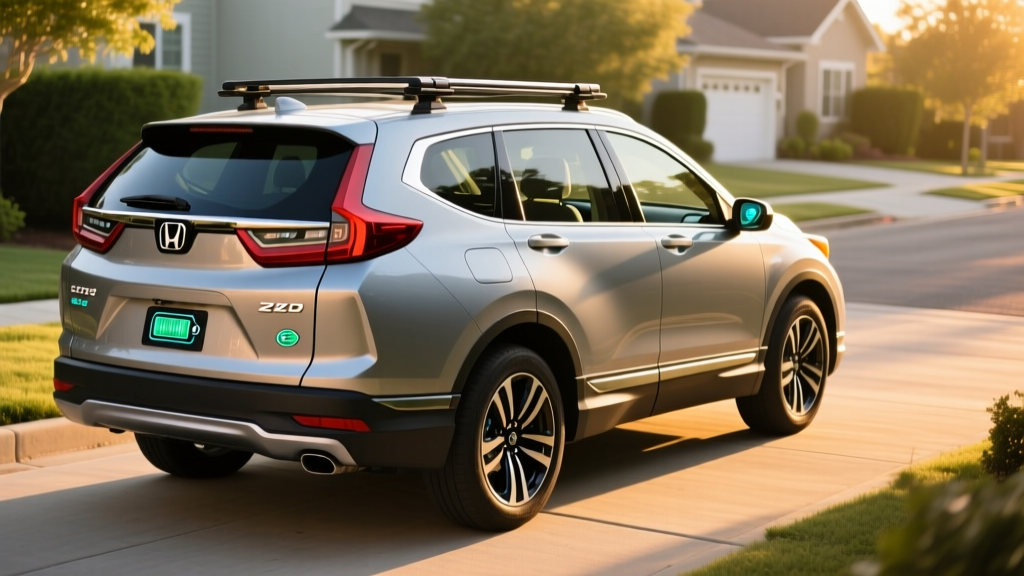
The Honda CR-V has long been the default compact crossover for practical buyers, and the hybrid variant has become the volume seller in the lineup. For 2026, the Honda CR-V 2026 hybrid SUV carries over the proven fourth-generation two-motor hybrid system that debuted with this generation, pairing a 2.0-liter Atkinson-cycle engine with dual electric motors for a combined 204 horsepower. With EPA ratings hitting 40 MPG combined on front-wheel-drive trims, it sits near the top of the compact hybrid SUV segment alongside the Toyota RAV4 Hybrid and Hyundai Tucson Hybrid.
This guide breaks down the 2026 CR-V Hybrid's real-world fuel economy, powertrain specs, battery longevity, pricing, and whether it makes more sense than a PHEV or full EV for your driving routine.
2026 Honda CR-V Hybrid Fuel Economy: EPA vs. Real World
The 2026 CR-V Hybrid is available in front-wheel drive (FWD) and all-wheel drive (AWD) configurations across Sport, Sport-L, and Sport Touring trims. The FWD models deliver the highest EPA ratings, while AWD variants sacrifice roughly 3 MPG combined for the traction benefit.
| Drivetrain | City MPG | Highway MPG | Combined MPG |
|---|---|---|---|
| FWD (Sport, Sport-L) | 43 | 36 | 40 |
| AWD (Sport, Sport-L, Sport Touring) | 40 | 34 | 37 |
Source: EPA fueleconomy.gov
Powertrain Breakdown: Engine, Motors, and 204 Horsepower
The 2026 CR-V Hybrid uses Honda's fourth-generation two-motor hybrid system, which operates primarily as a series hybrid at low-to-moderate speeds (the engine acts as a generator while the drive motor propels the wheels) and switches to a parallel configuration at highway speeds via a lockup clutch.
| Specification | Detail |
|---|---|
| Engine | 2.0L DOHC Atkinson-cycle 4-cylinder |
| Engine Output | 145 hp @ 6,100 rpm / 134 lb-ft torque |
| Drive Motor | 181 hp / 247 lb-ft torque |
| Combined System Output | 204 hp / 247 lb-ft torque |
| Transmission | Electronic CVT (e-CVT, no traditional gears) |
| 0-60 MPH | ~7.6 seconds |
| Hybrid Battery | ~1.1 kWh lithium-ion (self-charging HEV) |
| Towing Capacity | 1,000 lbs (hybrid trims) |
The drive motor's 247 lb-ft of torque is available from near-zero RPM, giving the CR-V Hybrid a responsive feel off the line that belies its 204 hp combined rating. The e-CVT is smooth and drone-free compared to older CVT designs, thanks to the simulated shift points Honda programs under hard acceleration.
HEV vs. PHEV: Why the CR-V Hybrid Is Not a Plug-In
A critical distinction for shoppers cross-researching the CR-V lineup: the 2026 Honda CR-V Hybrid is a conventional hybrid (HEV), not a plug-in hybrid (PHEV). It does not have a charge port, cannot be plugged in, and has no meaningful electric-only driving range.
HEV vs. PHEV at a Glance
| Feature | HEV (CR-V Hybrid) | PHEV (e.g., Toyota RAV4 Prime) |
|---|---|---|
| Plug-in Charging | No — self-charging via engine + regen | Yes — Level 1/Level 2 charge port |
| Electric-Only Range | ~1 mile at very low speeds | 35-42 miles typical (segment) |
| Battery Size | ~1.1 kWh | 15-19 kWh typical |
| DC Fast Charging | N/A | Rarely available in compact PHEVs |
| Federal Tax Credit (§30D) | Not eligible | Up to $7,500 (if criteria met) |
| Best For | No home charging access, simplicity | Home chargers, short commutes |
Honda does not currently offer a CR-V PHEV in the United States. If plug-in capability and electric-only commuting are priorities, competitors like the Toyota RAV4 Prime (42 miles EV range, when available) or the Hyundai Tucson PHEV (33 miles EV range) are the alternatives to evaluate.
Pricing, Trims, and Tax Credit Eligibility
The 2026 CR-V Hybrid is offered in three trims, all positioned above the gasoline-only CR-V base models. Pricing reflects Honda's strategy of making the hybrid the premium powertrain option.
| Trim | FWD MSRP | AWD MSRP |
|---|---|---|
| Sport Hybrid | $36,395 | $37,895 |
| Sport-L Hybrid | $38,895 | $40,395 |
| Sport Touring Hybrid | N/A | $43,295 |
Prices include destination charge. Dealer markups or discounts may apply.
Battery Longevity, Warranty, and Replacement Costs
Hybrid battery degradation is the most common concern among first-time hybrid buyers. The CR-V Hybrid's ~1.1 kWh lithium-ion battery pack is small and conservatively managed — it never fully charges or fully depletes, which dramatically extends cycle life.
Honda Hybrid Battery Warranty
- Hybrid Battery: 8 years / 100,000 miles (10 years / 150,000 miles in CARB states including CA, NY, MA, and others)
- Hybrid System Components: 8 years / 100,000 miles
- Powertrain: 5 years / 60,000 miles
- Limited Vehicle: 3 years / 36,000 miles
CARB states with extended 10-year hybrid battery coverage: CA, CO, CT, ME, MD, MA, NJ, NY, OR, RI, VT, WA, and others adopting California emissions standards.
Based on long-term data from Honda's hybrid fleet (Accord Hybrid, Insight, prior CR-V Hybrids), the battery packs routinely exceed 150,000 miles with minimal capacity loss. The small battery size means that if replacement is ever needed out of warranty, the cost is substantially lower than a full EV battery swap — typically $2,000 to $4,000 for parts and labor at a Honda dealer, compared to $10,000-$20,000+ for a BEV pack.
Driving Impressions and Daily Livability
The 2026 CR-V Hybrid drives with the composure expected of a best-selling compact SUV. The electric motor's instant torque makes merging and city acceleration feel effortless, and the transition between EV mode, hybrid mode, and engine-direct-drive mode is nearly imperceptible from the driver's seat.
Honda Sensing (the brand's ADAS suite) is standard across all trims and includes adaptive cruise control, lane-keeping assist, collision mitigation braking, and traffic sign recognition. This is a SAE Level 2 driver-assistance system — the driver must remain fully engaged with hands on the wheel and eyes on the road at all times. It is not autonomous or self-driving.
Cargo space remains competitive at 39.3 cubic feet behind the rear seats and 76.5 cubic feet with the rear seats folded, matching the gas-only CR-V since the hybrid battery is packaged under the cargo floor.
Who Should Buy the CR-V Hybrid vs. a PHEV or Full EV?
Choose the CR-V Hybrid If:
- You lack access to home or workplace charging (apartment, street parking)
- You want EV-like city MPG without plugging in
- Your daily driving is a mix of city and highway with no predictable short commute
- You want proven reliability with minimal new technology risk
- Budget is $36K-$43K and you don't qualify for EV tax credits
Consider a PHEV or Full EV If:
- You have Level 2 home charging and a commute under 35 miles (PHEV)
- You want to drive on electricity alone most days (PHEV or BEV)
- You qualify for the $7,500 federal tax credit, offsetting a BEV's higher price
- You want zero tailpipe emissions in daily driving (BEV)
- Long-term fuel cost savings are a top priority (BEV wins on $/mile)
The CR-V Hybrid occupies the sweet spot for buyers who want dramatically better fuel economy than a gas-only SUV but can't or won't deal with charging infrastructure. At 37-40 MPG combined, a driver covering 15,000 miles annually will use roughly 375-405 gallons of fuel per year — compared to 577 gallons in a gas-only compact SUV rated at 26 MPG combined. At $3.50/gallon, that's a savings of approximately $600-$700 per year in fuel alone.
Frequently Asked Questions
How many MPG does the 2026 Honda CR-V Hybrid get?
The FWD CR-V Hybrid achieves an EPA-estimated 43 city / 36 highway / 40 combined MPG. AWD models are rated at 40 city / 34 highway / 37 combined. Real-world city driving often matches or exceeds these numbers, while sustained highway speeds above 70 MPH may yield 2-4 MPG below the highway rating.
Can the 2026 CR-V Hybrid be plugged in?
No. The CR-V Hybrid is a conventional self-charging hybrid (HEV). It has no charge port. The small battery recharges through regenerative braking and the gasoline engine. Honda does not sell a CR-V plug-in hybrid (PHEV) in the US market for 2026.
How long will the CR-V Hybrid battery last?
Honda warranties the hybrid battery for 8 years/100,000 miles (10 years/150,000 miles in CARB states). Real-world data from Honda's hybrid lineup shows these batteries regularly exceed 150,000 miles. If replacement is needed out of warranty, expect $2,000-$4,000 — far less than an EV battery replacement.
Does the 2026 CR-V Hybrid qualify for a federal tax credit?
No. The IRS §30D Clean Vehicle Credit applies only to plug-in vehicles (BEVs and PHEVs) that meet battery sourcing, MSRP, and buyer income requirements. The CR-V Hybrid is a conventional HEV and is not eligible. Check fueleconomy.gov for current credit-eligible vehicles.
Is the CR-V Hybrid better than the gas-only CR-V?
For most buyers, yes. The hybrid delivers roughly 40% better combined fuel economy (40 vs. 28 MPG combined), smoother acceleration from electric motor torque, and a relatively modest price premium of approximately $1,500-$2,000 over comparable gas trims. The fuel savings typically recoup the price premium within 2-3 years of average driving.
What is the 0-60 time for the CR-V Hybrid?
The 2026 CR-V Hybrid reaches 0-60 MPH in approximately 7.6 seconds. While not a performance vehicle, the electric motor's instant 247 lb-ft of torque gives it strong initial acceleration that feels quicker than the number suggests in everyday driving.