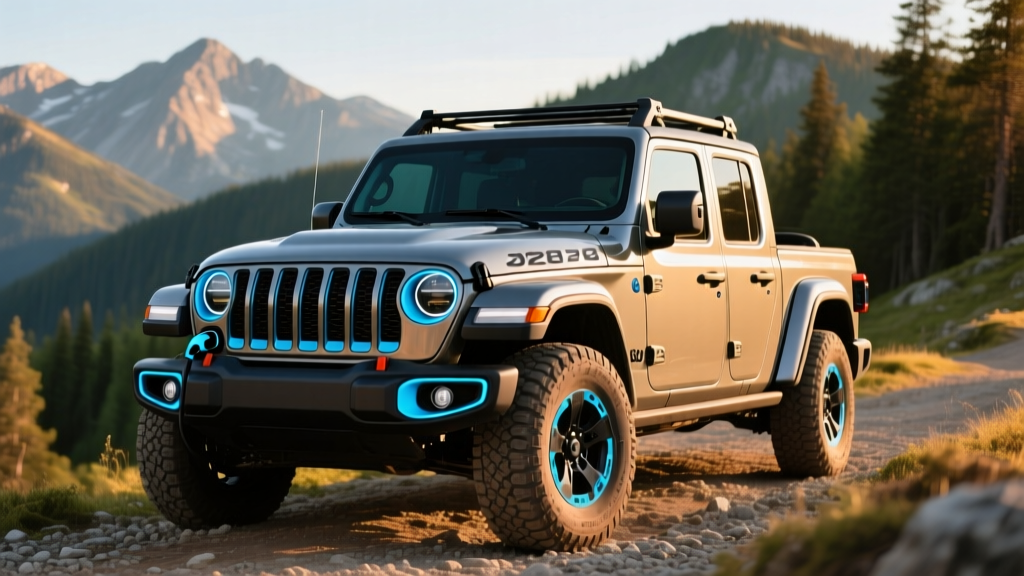
The midsize pickup segment has finally gotten serious about electrification. For buyers searching for a Jeep truck hybrid, the answer in 2026 centers on one vehicle: the Jeep Gladiator 4xe, a plug-in hybrid (PHEV) version of Jeep's body-on-frame workhorse. There is no conventional hybrid (HEV) Gladiator — Jeep's truck electrification strategy is all-in on the plug-in 4xe architecture borrowed and adapted from the Wrangler 4xe platform.
This guide breaks down everything a truck buyer needs to know: real-world MPG, electric-only range, battery specs, charging logistics, towing implications, pricing, and whether the §30D federal tax credit applies. If you've been weighing a Jeep truck hybrid against a Ford Maverick Hybrid, Toyota Tacoma i-FORCE MAX, or a full EV pickup like the Rivian R1T, this is your spec-driven decision framework.
HEV vs. PHEV: What Jeep Truck Buyers Need to Know
Before diving into specs, it's critical to understand the distinction between hybrid types, because Jeep only offers one for its truck lineup:
Conventional Hybrid (HEV)
Uses a small battery (typically 1–2 kWh) recharged by regenerative braking and the engine. No plug required. Examples in the truck segment: Ford Maverick Hybrid, Toyota Tacoma i-FORCE MAX. Better fuel economy than gas-only, but zero electric-only driving.
Plug-In Hybrid (PHEV) — Jeep Gladiator 4xe
Uses a larger battery (17.3 kWh usable) that can be plugged in to recharge. Delivers a meaningful electric-only range (EPA-estimated 28 miles) before the 2.0L turbo engine engages. Can operate as a pure EV for short commutes, then functions as a hybrid for longer trips.
The Gladiator 4xe is strictly a PHEV. You can drive it without ever plugging it in — it will function as a conventional hybrid — but you'd be leaving its best feature on the table. The entire value proposition hinges on plug-in electric miles for daily driving.
2026 Jeep Gladiator 4xe: Powertrain and Performance Specs
The Gladiator 4xe pairs Jeep's proven 2.0-liter turbocharged inline-four with two electric motors integrated into an 8-speed automatic transmission housing. Here's the full spec breakdown:
| Specification | 2026 Jeep Gladiator 4xe |
|---|---|
| Engine | 2.0L Turbo I-4 + 2 electric motors |
| Combined Horsepower | 375 hp |
| Combined Torque | 470 lb-ft |
| Battery (Usable) | 17.3 kWh (NMC lithium-ion) |
| Transmission | 8-speed automatic (TorqueFlite) |
| Drivetrain | 4WD (Selec-Trac or Rock-Trac depending on trim) |
| 0–60 mph | |
| Max Towing Capacity | ~5,000 lbs (reduced from gas model's 7,700 lbs) |
| Payload Capacity | ~1,100 lbs |
| Ground Clearance | 10.0 in (Rubicon trim) |
The 470 lb-ft of torque is available almost instantly thanks to the electric motors, making the Gladiator 4xe feel significantly quicker off the line than the 3.6L V6 gas model (285 hp, 260 lb-ft). The trade-off is weight: the battery pack and electric hardware add roughly 600 lbs, which impacts towing capacity and highway efficiency once the battery is depleted.
Fuel Economy: EPA MPG and Real-World Expectations
PHEV fuel economy is reported in two ways: MPGe (miles per gallon equivalent, when operating on combined electric + gas power with a full battery) and gas-only MPG (charge-sustaining mode, when the battery is depleted). Here's how the Gladiator 4xe stacks up:
| Metric | City | Highway | Combined |
|---|---|---|---|
| MPGe (battery + gas) | 49 MPGe (combined) | ||
| Gas-only MPG (depleted battery) | 20 | 22 | 21 |
| Electric-only range | 28 miles (EPA est.) | ||
| Total range (full tank + full battery) | ~370 miles | ||
Real-world reality check: The 49 MPGe figure assumes you start with a full battery and drive within the electric range. If your commute is under 28 miles round-trip and you charge nightly, you may burn almost zero gasoline on weekdays. However, once the battery depletes, the 21 MPG combined figure is the one that matters for road trips and towing — and that's a modest improvement over the gas V6 Gladiator's 19 MPG combined, per fueleconomy.gov.
In cold weather (below 32°F), expect electric-only range to drop to approximately 20–23 miles due to reduced battery efficiency and cabin heating demands. Highway driving at 75+ mph with a depleted battery may return closer to 18–19 MPG given the Gladiator's aerodynamic profile and weight.
Electric-Only Range and Charging: The Daily-Commute Question
The 28-mile EPA electric range is the defining spec for PHEV ownership. According to EPA data, the average American drives roughly 37 miles per day — meaning the Gladiator 4xe can cover most daily errands and shorter commutes on electricity alone, with the gas engine as a seamless backup.
Battery and Charging Specs at a Glance
- Battery: 17.3 kWh usable (NMC chemistry)
- Level 1 (120V outlet): ~12 hours for a full charge — adequate for overnight if you plug in each evening with partial depletion
- Level 2 (240V, 32A): ~2.5 hours for a full charge — recommended for daily PHEV use
- DC fast charging: Not available — the Gladiator 4xe does not support DC fast charging
- Charge port: J1772 (Level 2); adapter needed for NACS chargers at Level 2 speeds only
The lack of DC fast charging is typical for PHEVs with smaller battery packs — the 17.3 kWh battery simply doesn't warrant the added cost and weight of DC hardware. For a PHEV truck, Level 2 home charging is the primary use case. A standard 240V/32A home charger (7.7 kW) will fully replenish the battery in roughly 2.5 hours, meaning you can easily top off during the workday or between errands if you have charging access.
Preconditioning tip: The Gladiator 4xe supports scheduled departure preconditioning via the Uconnect app. Setting a departure time while plugged in warms or cools the cabin using grid power rather than battery power, preserving your full 28-mile electric range for actual driving — a meaningful advantage in extreme climates.
Pricing, Trims, and Federal Tax Credit Eligibility
The 2026 Gladiator 4xe is positioned at a premium over the gas-only Gladiator, reflecting the added cost of the battery pack, electric motors, and power electronics. Here's the pricing landscape:
- Willys 4xe: ~$52,095 MSRP (base 4xe trim)
- Overland 4xe: ~$55,595 MSRP
- Rubicon 4xe: ~$58,095 MSRP
- Mojave 4xe: ~$59,595 MSRP (off-road desert-runner trim)
All prices include destination. These figures represent a $12,000–$14,000 premium over equivalent gas-only Gladiator trims.
Does the Gladiator 4xe Qualify for the §30D Federal Tax Credit?
This is where PHEV truck buyers must pay close attention. Under current IRS §30D rules, the federal clean vehicle credit offers up to $7,500, but eligibility depends on several conditions that change frequently:
- MSRP cap: Trucks and SUVs must have an MSRP at or below $80,000 — the Gladiator 4xe clears this cap on most trims
- Buyer income cap: Modified AGI must not exceed $150,000 (single), $225,000 (head of household), or $300,000 (joint)
- Battery sourcing: A percentage of critical minerals and battery components must be sourced from the U.S. or free-trade-agreement countries — this requirement tightens annually and can disqualify otherwise eligible vehicles mid-year
- Point-of-sale transfer: Eligible buyers can transfer the credit to the dealer at purchase, reducing the upfront price rather than waiting for a tax refund
- Assembly: Vehicle must undergo final assembly in North America (the Gladiator is built in Toledo, Ohio)
Bottom line: The Gladiator 4xe has historically qualified for at least a partial credit ($3,750) and at times the full $7,500 depending on the sourcing rules in effect at the time of purchase. Always verify current eligibility on the fueleconomy.gov tax credit page or with a tax professional before committing. Never assume a flat $7,500 — the rules are a moving target.
Reliability, Battery Warranty, and Long-Term Costs
Jeep's hybrid truck reliability is a legitimate buyer concern, given the brand's middling historical reliability scores and the added complexity of a PHEV powertrain. Here's what the data and warranty terms tell us:
Battery and Powertrain Warranty
- High-voltage battery: 8 years / 100,000 miles (whichever comes first)
- Capacity retention threshold: Warranty covers replacement if the battery falls below 70% of original capacity
- Powertrain warranty: 5 years / 60,000 miles (covers engine, transmission, electric motors)
- Bumper-to-bumper: 3 years / 36,000 miles
The 8-year/100,000-mile battery warranty is federally mandated for PHEVs and EVs sold in the U.S. and matches what Toyota, Ford, and other manufacturers offer. For context, Jeep's Wrangler 4xe — which shares the same powertrain architecture — has been on the road since the 2021 model year. Early data suggests the 2.0L turbo and electric motor pairing is holding up reasonably well, though some owners have reported issues with the onboard charger module and 12V auxiliary battery drain during extended parking — problems that are typically covered under warranty.
Battery replacement cost (out of warranty): If the high-voltage battery requires replacement after the warranty period, expect a cost in the range of $8,000–$12,000 including parts and labor. This is a real long-term ownership risk, though NMC batteries in PHEV applications (with shallower daily cycles compared to full EVs) typically retain 80%+ capacity at 150,000 miles when properly maintained.
Reliability tip: PHEV batteries degrade less when kept between 20%–80% state of charge for daily use. The Gladiator 4xe's software manages this buffer automatically, but avoid leaving the vehicle plugged in at 100% for extended periods (weeks) in hot climates, as sustained high SoC combined with heat accelerates NMC degradation.
Towing, Payload, and Off-Road: What the Battery Adds — and Costs
The Gladiator 4xe's electrification brings both advantages and compromises for truck-duty use:
Advantages:
- 470 lb-ft of torque available from low RPM — excellent for low-speed crawling and initial trailer pull-away
- Electric-only mode enables silent, zero-emission operation on trails (a growing concern in sensitive off-road areas)
- Regenerative braking extends downhill descent control and reduces brake wear when towing
Compromises:
- Towing capacity drops to approximately 5,000 lbs from the gas model's 7,700 lbs — the added battery weight and powertrain calibration are the primary factors
- Payload reduced by roughly 400 lbs due to battery mass
- Gas-only highway MPG while towing is likely in the 14–16 MPG range, given the weight and aerodynamic penalty
If your truck use involves towing heavy boat trailers, horse trailers, or large campers regularly, the gas-only Gladiator or a diesel alternative may serve you better. But if your towing is occasional and under 5,000 lbs — a small utility trailer, dirt bikes, or a light camper — the 4xe handles it competently while delivering electric daily driving the rest of the week.
Gladiator 4xe vs. the Competition: Which Truck Fits You?
2026 Jeep Gladiator 4xe — Pros
- 28-mile electric range covers most daily commutes
- 375 hp / 470 lb-ft — quickest Gladiator in the lineup
- Best-in-class off-road capability (Rubicon/Mojave trims)
- Removable doors and roof — unique open-air truck experience
- Eligible for up to $7,500 federal tax credit (verify sourcing rules)
- Solid 8yr/100k-mile battery warranty
2026 Jeep Gladiator 4xe — Cons
- Towing limited to ~5,000 lbs (gas model: 7,700 lbs)
- No DC fast charging
- 21 MPG gas-only is only a modest improvement over V6 gas
- High starting price (~$52K+) before incentives
- Jeep's below-average reliability history
- Ride quality and road noise lag behind unibody competitors
How Does It Compare?
| Spec | Jeep Gladiator 4xe | Ford Maverick Hybrid | Toyota Tacoma i-FORCE MAX | Rivian R1T (Dual Motor) |
|---|---|---|---|---|
| Type | PHEV | HEV | HEV | BEV |
| Combined MPG / MPGe | 49 MPGe / 21 MPG gas | 42 MPG combined | 27 MPG combined | 115 MPGe (2.1 kWh/mi) |
| Electric-only range | 28 mi | None | None | ~330 mi (EPA) |
| Horsepower | 375 hp | 191 hp | 326 hp | 533 hp |
| Towing | ~5,000 lbs | 2,000 lbs | 6,000 lbs | 11,000 lbs |
| Base MSRP | ~$52,095 | ~$28,840 | ~$40,990 | ~$71,700 |
| Federal Credit | Up to $7,500 | None | None | Up to $7,500 |
The Maverick Hybrid wins on price and fuel economy for urban commuters who don't need serious off-road or towing capability. The Tacoma i-FORCE MAX offers more towing and Toyota's reliability reputation but lacks plug-in capability. The Rivian R1T is a full EV with vastly more range and power but at a significantly higher price point. The Gladiator 4xe occupies a specific niche: the buyer who wants some electric daily driving, serious off-road chops, and the open-air Jeep experience in a truck format.
Decision Framework: Hybrid vs. PHEV vs. Full EV Truck
Which Electrified Truck Is Right for You?
Choose the Gladiator 4xe (PHEV) if: You have home Level 2 charging, your daily commute is under 30 miles, you want off-road capability and open-air driving, and you need a truck bed for occasional hauling — but not heavy towing.
Choose a conventional hybrid truck (Maverick HEV, Tacoma HEV) if: You don't have reliable access to plug-in charging, you want simpler ownership with no charging logistics, and fuel economy is your primary priority over electric-only driving.
Choose a full EV truck (Rivian R1T, Ford F-150 Lightning) if: You have reliable home charging, your daily range needs are within 250–350 miles, you want maximum torque and towing, and you're ready to commit to full electric operation.
Frequently Asked Questions
How many MPG does the Jeep Gladiator 4xe hybrid get?
The 2026 Gladiator 4xe is rated at 49 MPGe combined when operating with a full battery (electric + gas). Once the battery is depleted, it returns approximately 21 MPG combined (20 city / 22 highway) on gasoline alone. Real-world highway MPG with a depleted battery may drop to 18–19 MPG, especially when towing or driving at sustained speeds above 70 mph.
How far can the Gladiator 4xe go on electric only?
The EPA-estimated electric-only range is 28 miles. In real-world conditions, expect 22–26 miles in moderate weather and 18–22 miles in cold weather (below 32°F) due to reduced battery efficiency and cabin heating demands. This range is sufficient for many daily commutes and errands when charged nightly.
Does the Jeep Gladiator 4xe qualify for a tax credit?
The Gladiator 4xe may qualify for up to $7,500 under the IRS §30D clean vehicle credit, subject to buyer income limits, MSRP caps (under $80,000 for trucks), and battery component/critical mineral sourcing requirements that change annually. Final assembly occurs in Toledo, Ohio, satisfying the North American assembly requirement. Always verify current eligibility on fueleconomy.gov or with a qualified tax professional before purchasing.
Is the Gladiator 4xe reliable, and what does battery replacement cost?
The Gladiator 4xe shares its powertrain with the Wrangler 4xe, which has been in production since 2021. Jeep's overall brand reliability ranks below average in most industry surveys, but the 4xe system has proven reasonably durable. The high-voltage battery is warrantied for 8 years/100,000 miles (with replacement if capacity drops below 70%). Out-of-warranty battery replacement is estimated at $8,000–$12,000.
Can I charge the Gladiator 4xe at a DC fast charger?
No. The Gladiator 4xe does not support DC fast charging. It charges via J1772 at Level 1 (120V, ~12 hours) or Level 2 (240V, ~2.5 hours). This is standard for PHEVs with smaller battery packs. Home Level 2 charging is the recommended and most practical charging method.
How does the Gladiator 4xe compare to the Wrangler 4xe?
Both share the same 2.0L turbo PHEV powertrain producing 375 hp and 470 lb-ft. The Gladiator 4xe has a slightly larger battery (17.3 kWh vs. 17.3 kWh — same pack), but the Gladiator's longer wheelbase and greater weight reduce electric range slightly (28 miles vs. the Wrangler 4xe's ~25 miles EPA, though the Wrangler's smaller cargo area and different aerodynamics shift the equation). The Gladiator adds a 5-foot truck bed and is the clear choice for buyers who need cargo hauling.