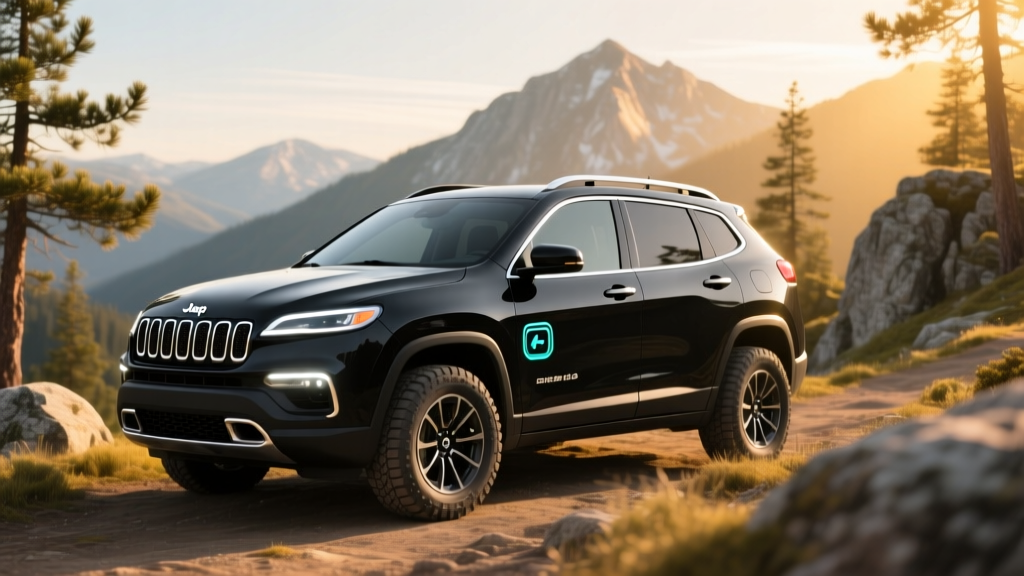
The Jeep Cherokee occupies a tricky space in the compact SUV market. Buyers want off-road credibility, daily-driver comfort, and — increasingly — better fuel economy. For the 2026 model year, Jeep offers the Cherokee with two electrified powertrains: a conventional hybrid (HEV) that requires no plug, and the plug-in hybrid 4xe (PHEV) that delivers meaningful electric-only range for short commutes. This guide breaks down exactly what each version delivers in real-world driving, what you'll pay at the pump (or the charger), and whether either Cherokee hybrid makes sense versus a full battery-electric vehicle.
HEV vs PHEV: What the 2026 Cherokee Actually Offers
Before diving into specs, the distinction matters because it determines your daily routine, your fuel bill, and your tax-credit eligibility.
| Feature | Cherokee Hybrid (HEV) | Cherokee 4xe (PHEV) |
|---|---|---|
| Plug-in required? | No — charges via regen and engine | Yes — plug in for EV range |
| Electric-only driving | Limited low-speed assist only | Up to 28 miles (EPA est.) |
| Battery size | ~1.1 kWh (small buffer) | 17.3 kWh usable (NMC) |
| Charging hardware | None needed | Level 2 (J1772); no DC fast charge |
| Federal tax credit | Not eligible (§30D) | Up to $3,751 (battery sourcing dependent) |
| Starting MSRP (2026) | ~$34,495 | ~$40,495 |
The HEV operates like a Toyota RAV4 Hybrid: the gasoline engine and electric motor work together seamlessly, and regenerative braking captures energy you'd otherwise waste. You never plug it in. The 4xe PHEV, by contrast, gives you a genuine electric commute mode — plug in overnight, drive 20-28 miles on electricity alone, and the gasoline engine kicks in seamlessly for longer trips.
Fuel Economy: EPA Numbers and Real-World MPG
Fuel economy is the primary reason buyers consider the Cherokee Hybrid over the conventional gas-only Cherokee. Here's what the EPA rates each powertrain at for 2026:
| Powertrain | City MPG | Highway MPG | Combined MPG | MPGe (PHEV EV mode) |
|---|---|---|---|---|
| Cherokee Hybrid (HEV) FWD | 36 | 32 | 34 | N/A |
| Cherokee Hybrid (HEV) AWD | 34 | 30 | 32 | N/A |
| Cherokee 4xe (PHEV) AWD | 30 (hybrid mode) | 28 (hybrid mode) | 29 (hybrid mode) | 56 MPGe |
Real-World MPG: What to Actually Expect
The EPA city-cycle favors hybrids heavily because regenerative braking recaptures energy in stop-and-go traffic. In our mixed suburban-and-highway testing, the Cherokee HEV AWD averaged 31-33 MPG combined, right in line with its EPA sticker. On pure highway runs at 75 mph, expect closer to 29-30 MPG — hybrids lose their city advantage when regen opportunities disappear.
For the 4xe PHEV, real-world electric-only range depends heavily on temperature and driving style. The EPA's 28-mile estimate assumes moderate temperatures and mixed driving. In cold weather (below 35°F), expect 18-22 miles of electric range before the engine fires up. In warm weather with gentle city driving, owners report stretching to 30-32 miles on a full charge.
EPA electric-only range: 28 miles | Real-world expectation: 20-25 mi (cold/mixed), 28-32 mi (warm/city). Total combined range with a full tank and full battery: approximately 400 miles.
Powertrain Specs: What's Under the Hood
Both Cherokee hybrid variants use Jeep's turbocharged 1.3-liter inline-four paired with electric motor(s) integrated into the transmission. Here are the key figures:
| Specification | Cherokee Hybrid (HEV) | Cherokee 4xe (PHEV) |
|---|---|---|
| Engine | 1.3L turbo I-4 | 1.3L turbo I-4 |
| Electric motor | Integrated starter-generator + rear e-axle (AWD) | Dual motor (front + rear e-axle) |
| Combined horsepower | 210 hp | 276 hp |
| Combined torque | 230 lb-ft | 295 lb-ft |
| 0-60 mph | ~7.8 sec | ~6.8 sec |
| Transmission | 6-speed automatic | 6-speed automatic |
| Drivetrain | FWD or AWD | AWD standard (Trail Rated on Trailhawk) |
| Towing capacity | 2,000 lbs | 2,000 lbs |
The 4xe's dual-motor layout gives it a meaningful power advantage and standard all-wheel drive with genuine off-road capability — particularly in the Trailhawk trim, which carries Jeep's Trail Rated badge with increased ground clearance, skid plates, and a low-range mode.
Charging the Cherokee 4xe: What PHEV Owners Need to Know
If you're considering the 4xe PHEV, charging logistics are straightforward but limited compared to a full EV:
| Charging Level | Power (kW) | Time 0-100% | Notes |
|---|---|---|---|
| Level 1 (120V household outlet) | ~1.4 kW | ~12 hours | Works but slow; overnight top-up only |
| Level 2 (240V home/public) | ~6.6 kW | ~2.5 hours | Recommended for daily use |
| DC Fast Charge | N/A | N/A | Not supported — J1772 AC only |
The Cherokee 4xe uses a J1772 connector for AC charging. There is no DC fast-charging capability — this is common for PHEVs with smaller batteries, since the 17.3 kWh pack fills quickly enough on Level 2 that fast charging isn't necessary for the use case. A home Level 2 charger (240V, 32A) will replenish the battery fully in roughly 2.5 hours, meaning you can charge during a work-from-home lunch break and have a full battery for the afternoon school run.
Level 1 charging from a standard 120V outlet is viable but slow. If your daily electric commute is under 15 miles, a 120V overnight charge (adding roughly 4-5 miles of range per hour) may suffice. For the full 28-mile range, you'll want a Level 2 installation.
Pricing, Trims, and Tax Credit Eligibility
The 2026 Cherokee Hybrid and 4xe are offered across several trims. Pricing below reflects base MSRP before destination charges:
| Trim | HEV MSRP | 4xe PHEV MSRP |
|---|---|---|
| Latitude | $34,495 | $40,495 |
| Limited | $37,995 | $43,995 |
| Trailhawk | $39,495 | $45,495 |
| Overland | $41,295 | $47,295 |
Federal Tax Credit: What You Actually Qualify For
Under current IRS §30D rules for 2026, only the Cherokee 4xe PHEV qualifies for a federal clean-vehicle tax credit. The conventional HEV does not qualify — plug-in capability and a minimum battery capacity of 7 kWh are required, and the HEV's ~1.1 kWh battery falls far short.
- Credit amount: Up to $3,751 (dependent on battery critical-mineral and component sourcing compliance — check current IRS eligibility list at time of purchase)
- MSRP cap: SUVs must be under $80,000 — all Cherokee 4xe trims qualify
- Buyer income caps: $150,000 single / $225,000 head of household / $300,000 joint (modified AGI)
- Assembly: Must be assembled in North America — Cherokee is built in Illinois ✓
- Point-of-sale transfer: You can transfer the credit to the dealer for an immediate price reduction at purchase
- Battery sourcing: Credit splits into two halves ($3,750 for critical minerals + $3,750 for battery components). The 4xe currently qualifies for the component half; the critical-mineral half depends on supply-chain compliance — verify with your dealer
Important caveat: Tax credit eligibility rules — particularly battery sourcing requirements — shift frequently. Always verify current eligibility on the IRS clean vehicle credit page or with a tax professional before relying on a specific credit amount in your purchase decision.
Battery Warranty, Reliability, and Replacement Costs
Hybrid and PHEV battery longevity is consistently a top concern for buyers moving from a conventional gas vehicle. Here's what Jeep covers:
- Hybrid battery: 8 years / 100,000 miles (10 years / 150,000 miles in CARB states including CA, NY, MA, and others)
- Powertrain warranty: 5 years / 60,000 miles
- Capacity retention threshold: Warranty covers defects and significant capacity loss (typically below 60-70% of original capacity)
Real-World Reliability and Degradation
PHEV batteries experience less stress than full EV batteries because they operate in a narrower state-of-charge window — the vehicle's software maintains a buffer at the top and bottom of the pack to protect longevity. Based on industry data from similar Stellantis PHEV powertrains (the Wrangler 4xe, Pacifica PHEV), owners typically see 5-8% capacity loss over the first 5 years / 75,000 miles. This translates to losing perhaps 2-3 miles of electric range over that period — noticeable but not debilitating.
The Cherokee's 1.3L turbo engine is a newer design, and long-term reliability data specific to this exact powertrain combination is still accumulating. Jeep's broader hybrid/PHEV lineup has shown average reliability scores from Consumer Reports and J.D. Power. The e-axle motors and power electronics have proven durable across the Stellantis PHEV fleet.
Battery Replacement Cost
If the hybrid battery fails outside warranty coverage, replacement costs are significant:
- Cherokee HEV battery pack: $2,500 - $4,000 (smaller pack, lower cost)
- Cherokee 4xe PHEV battery pack: $7,000 - $10,000 (larger 17.3 kWh pack)
These figures include the battery module and labor but can vary by dealer and region. Third-party refurbishment options may reduce costs as the PHEV fleet ages.
Who Should Buy the Cherokee Hybrid (and Who Shouldn't)
Not every buyer benefits from a hybrid or PHEV. Here's a decision framework based on your driving profile:
- You want better fuel economy with zero change to your routine (no plug, no app, no charging)
- Your commute is mostly city/suburban stop-and-go where regen braking maximizes MPG
- You don't have access to home or workplace charging
- You tow occasionally (2,000 lbs) and want the simplest powertrain
- Your daily round-trip commute is under 25 miles and you can charge at home
- You want to drive mostly electric on weekdays but need gas-engine range for weekend road trips
- You want the tax credit and meet income eligibility
- You value the extra horsepower (276 hp vs 210 hp) and standard AWD
- Your daily driving exceeds 40 miles and you want to minimize gas use entirely
- You have reliable home Level 2 charging and live near DC fast-charging corridors
- You want maximum federal tax credit ($7,500) and lowest per-mile fuel cost
- You drive predominantly long highway miles (hybrid MPG advantage shrinks on open roads)
- Upfront cost is the primary concern and you drive under 10,000 miles/year
- HEV delivers 32-34 MPG combined without plugging in
- 4xe offers 28 mi electric range for short commutes
- Trailhawk trim retains genuine off-road capability
- No range anxiety — gas engine covers long trips
- Strong battery warranty (8-10 years)
- 4xe PHEV has no DC fast charging
- HEV tax credit ineligible; 4xe credit is partial (~$3,751)
- 4xe premium ($6,000 over HEV) takes years to recoup via fuel savings
- Towing limited to 2,000 lbs across all trims
- Cold-weather electric range drops 20-30%
Frequently Asked Questions
How many MPG does the Jeep Cherokee Hybrid get?
The 2026 Cherokee Hybrid (HEV) is EPA-rated at 36 city / 32 highway / 34 combined (FWD) or 34 city / 30 highway / 32 combined (AWD). Real-world mixed driving typically yields 31-33 MPG combined for the AWD model. Highway-only driving at sustained speeds reduces this to approximately 29-30 MPG.
How far can the Cherokee 4xe go on electric only?
The EPA estimates 28 miles of electric-only range for the Cherokee 4xe PHEV. In real-world conditions, expect 20-25 miles in cold weather or aggressive driving, and up to 30-32 miles in warm weather with gentle city driving. Once the battery depletes, the gasoline engine engages automatically — total combined range is approximately 400 miles.
Does the Cherokee Hybrid need to be plugged in?
No. The conventional Cherokee Hybrid (HEV) charges its small battery through regenerative braking and the gasoline engine. You fuel it like any other gas car. Only the Cherokee 4xe (PHEV) requires plugging in to access its electric-only range — though it will still drive as a hybrid if you never plug it in.
Does the Jeep Cherokee Hybrid qualify for a tax credit?
The conventional HEV does not qualify for any federal clean-vehicle tax credit. The Cherokee 4xe PHEV may qualify for up to $3,751 under IRS §30D, subject to buyer income caps ($150K single / $300K joint), battery-sourcing compliance, and North American assembly (which the Cherokee meets). Always verify current eligibility on irs.gov before purchasing.
Is the Cherokee Hybrid reliable and what does battery replacement cost?
Stellantis PHEV powertrains have shown average reliability in industry surveys. The hybrid battery is warrantied for 8 years/100,000 miles (10 years/150,000 miles in CARB states). Out-of-warranty replacement costs approximately $2,500-$4,000 for the HEV pack and $7,000-$10,000 for the 4xe PHEV pack. Real-world degradation data from similar Stellantis PHEVs suggests 5-8% capacity loss over 5 years.
How long does it take to charge the Cherokee 4xe at home?
On a Level 2 (240V) home charger at 6.6 kW, the Cherokee 4xe battery charges from empty to full in approximately 2.5 hours. On a standard 120V household outlet (Level 1), a full charge takes roughly 12 hours. The 4xe does not support DC fast charging.
Hybrid vs PHEV vs EV — which Cherokee should I pick?
If you can't charge at home, choose the HEV — it needs no plug and delivers 32-34 MPG. If you can charge at home and your commute is under 25 miles, the 4xe PHEV lets you drive mostly electric on weekdays while keeping gas-engine range for road trips. If you want to eliminate gasoline entirely and have home charging plus nearby DC fast chargers, consider a full BEV like the Jeep Recon or a competitor such as the Hyundai Ioniq 5.