Why "Hybrid Tug" Searches Are Surging in 2026
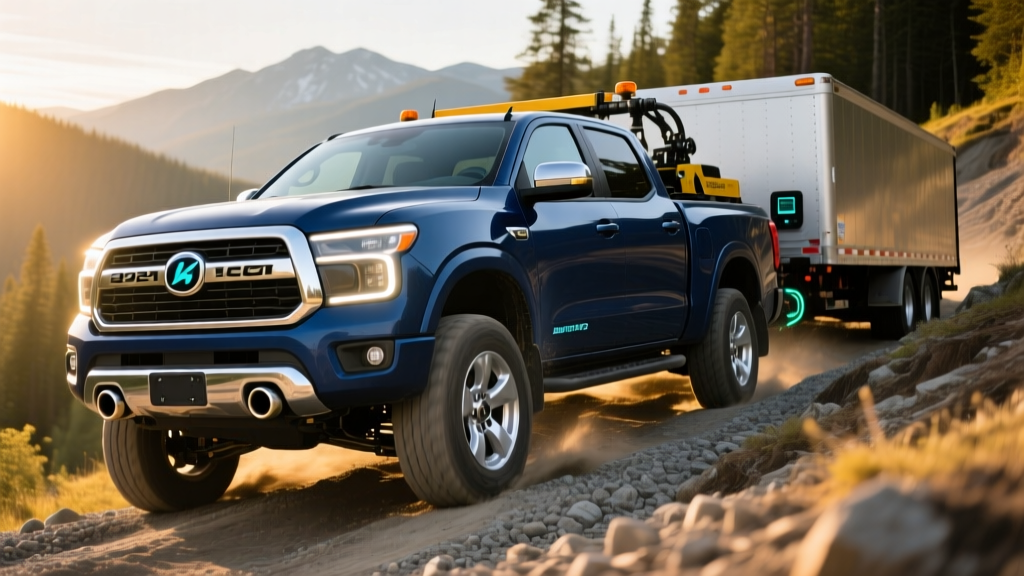
Search for "hybrid tug" and you'll find a mix of industrial electric tugs used in warehouses and a growing number of truck shoppers asking a more practical question: can a hybrid pickup truck actually tug a heavy trailer? The answer is yes — and in some cases, a hybrid powertrain gives you more low-end torque than a gas-only equivalent while slashing fuel consumption on the commute to the job site or boat ramp.
This guide covers the hybrid and plug-in hybrid (PHEV) pickups available for the 2026 model year that buyers are considering when they search for a "hybrid tug." We'll compare their towing capacity, fuel economy, electric-only range, battery warranties, and tax-credit eligibility so you can decide whether a hybrid truck, a full EV truck, or a conventional gas rig is the right tool for your hauling needs.
HEV vs PHEV — What's the Difference?
Conventional Hybrid (HEV): Uses a small battery (typically 1–2 kWh) recharged by regenerative braking and the gas engine. You never plug it in. The electric motor assists the engine for better fuel economy and added low-RPM torque. Example: Ford F-150 PowerBoost.
Plug-In Hybrid (PHEV): Carries a larger battery (typically 12–20 kWh) that you can charge from a wall outlet or Level 2 charger. It can drive on electric power alone for a set range before the gas engine kicks in. Example: the 2026 Ram 1500 Ramcharger (extended-range PHEV). You get EV-like daily commuting with a gas engine for long hauls and heavy towing.
The 2026 Hybrid Pickup Lineup: Tug-Worthy Contenders
Three electrified pickups dominate the "hybrid tug" conversation for 2026. Each takes a different approach to combining electric torque with gasoline range.
| Spec | Ford F-150 PowerBoost (HEV) | Ram 1500 Ramcharger (PHEV) | Toyota Tundra i-FORCE MAX (HEV) |
|---|---|---|---|
| Powertrain Type | Conventional Hybrid | Plug-In Hybrid (EREV) | Conventional Hybrid |
| Engine | 3.5L V6 + electric motor | 3.6L V6 range-extender + dual motors | 3.5L Twin-Turbo V6 + electric motor |
| Combined HP | 430 hp | ~663 hp | 437 hp |
| Combined Torque | 570 lb-ft | ~615 lb-ft | 583 lb-ft |
| Max Towing Capacity | 11,200 lbs | 14,000 lbs | 12,000 lbs |
| Battery (usable) | 1.5 kWh (NiMH-style) | ~92 kWh (NMC) | 1.87 kWh (NiMH) |
| Electric-Only Range | N/A (HEV) | ~69 miles (EPA est.) | N/A (HEV) |
| Total Range | ~700 miles | ~690 miles combined | ~650 miles |
| EPA Combined MPG / MPGe | 25 MPG combined | 56 MPGe (elec+gas) | 22 MPG combined |
| 0–60 mph | ~5.6 sec | ~4.4 sec | ~5.7 sec |
| Starting MSRP | ~$60,500 | ~$69,995 | ~$57,500 |
How Many MPG Does a Hybrid Truck Get?
Real-world hybrid truck fuel economy often surprises owners — and not always the way you'd expect.
| Model | City MPG | Highway MPG | Combined MPG |
|---|---|---|---|
| Ford F-150 PowerBoost 4WD | 23 | 24 | 25 |
| Toyota Tundra i-FORCE MAX 4WD | 20 | 24 | 22 |
| Ram 1500 Ramcharger 4WD (gas-only mode) | ~18* | ~22* | ~20* |
*Ramcharger gas-only MPG estimated based on range-extender operation after battery depletion. While battery charge remains, MPGe is rated at 56 MPGe combined. Source: fueleconomy.gov
Real-world vs. EPA: Hybrid trucks tend to exceed their EPA city rating in stop-and-go traffic because regenerative braking recovers energy that a gas truck wastes as heat. On the highway, however, the heavy vehicle weight and aerodynamic drag reduce the electric motor's advantage. Expect the F-150 PowerBoost to deliver 26–28 MPG in city driving but 21–23 MPG at sustained 75 mph highway speeds. Towing a 5,000 lb trailer? Drop all expectations to roughly 10–13 MPG for any of these trucks — hybrid or not, physics dominates when you're pushing a wall of air and rolling mass.
Electric-Only Range: The PHEV Advantage for Daily Driving
Only the Ram 1500 Ramcharger offers meaningful electric-only range. Its ~92 kWh battery pack delivers an EPA-estimated 69 miles of electric driving before the 3.6L V6 range-extender generator activates. That's enough to cover most daily commutes, school runs, and errands without burning a drop of gasoline.
Ramcharger Charging Details
Level 1 (120V, 1.4 kW): ~65 hours from empty — impractical for regular use.
Level 2 (240V, 7.2 kW): ~12.5 hours — viable for overnight top-ups.
DC Fast Charge: Not available. The Ramcharger's architecture does not support DC fast charging.
Total combined range (electric + gas): approximately 690 miles.
For the conventional hybrids (F-150 PowerBoost, Tundra i-FORCE MAX), the tiny 1.5–1.9 kWh batteries provide electric assist at low speeds and during acceleration, but they cannot propel the truck on electric power alone for any meaningful distance. Think of them as torque-fill systems that also happen to improve fuel economy.
Hybrid vs PHEV vs EV: Which Truck Fits Your Hauling Needs?
The "hybrid tug" question ultimately comes down to how you use your truck. Here's a practical decision framework:
Choose a conventional HEV (F-150 PowerBoost, Tundra i-FORCE MAX) if:
- You tow frequently but don't want to change your fueling habits
- You lack home charging access
- You want better city MPG without plug-in complexity
- You prioritize proven, simpler hybrid systems
Choose a PHEV (Ram 1500 Ramcharger) if:
- You have a garage or driveway with a 240V outlet for overnight Level 2 charging
- Your daily driving is under 65 miles and you want EV-like commuting
- You still need 14,000 lbs of towing for weekend or job-site use
- You want maximum combined horsepower (663 hp) for performance towing
Choose a full BEV (Ford F-150 Lightning, Rivian R1T, Chevy Silverado EV) if:
- You have reliable home charging and your towing trips stay within the EV's range (typically 100–200 miles while towing)
- You want zero tailpipe emissions and the lowest per-mile fuel cost
- You qualify for the full §30D federal tax credit (up to $7,500)
Does a Hybrid Truck Qualify for a Tax Credit?
Under current IRS §30D Clean Vehicle Credit rules, the tax-credit landscape for hybrid trucks is narrower than for full EVs:
- Conventional HEVs (F-150 PowerBoost, Tundra i-FORCE MAX): Do not qualify for the federal §30D credit. These are not plug-in vehicles and do not meet the battery-capacity threshold.
- PHEVs (Ram 1500 Ramcharger): May qualify for up to $7,500 if it meets critical-mineral and battery-component sourcing requirements, the MSRP does not exceed $80,000 (for trucks/vans), and the buyer's adjusted gross income is under $300,000 (joint filers), $225,000 (head of household), or $150,000 (single). The credit can be transferred to the dealer as a point-of-sale discount.
- State incentives: Vary widely. Check your state's energy office or AFDC state-law database for local rebates.
Tax rules change frequently. Consult a tax professional and verify current eligibility on irs.gov before purchasing.
Reliability and Battery Warranty: What Hybrid Truck Buyers Need to Know
Hybrid battery longevity is the top concern for truck buyers considering a "hybrid tug." Here's the data:
Battery Warranty Comparison
Ford F-150 PowerBoost: Hybrid battery covered for 8 years / 100,000 miles (whichever comes first). The 1.5 kWh pack is a proven NiMH-derived design with minimal degradation risk due to its small size and shallow cycling.
Toyota Tundra i-FORCE MAX: Hybrid battery covered for 10 years / 150,000 miles. Toyota's hybrid systems have an extensive real-world track record — the Prius platform has demonstrated battery longevity exceeding 200,000 miles in fleet service.
Ram 1500 Ramcharger: High-voltage battery covered for 8 years / 100,000 miles (federal emissions warranty minimum). The larger 92 kWh NMC pack is more complex and will experience gradual capacity loss over time, similar to a full EV battery.
Battery replacement cost: For conventional hybrids (PowerBoost, i-FORCE MAX), replacement battery packs typically cost $2,000–$4,000 installed — a manageable figure given the 8–10 year warranty window. For the Ramcharger's 92 kWh pack, replacement would likely cost $12,000–$18,000 out of warranty, comparable to full EV battery replacement pricing.
Reliability data: Toyota's hybrid powertrains consistently rank at the top of IIHS and J.D. Power dependability studies. Ford's PowerBoost system, introduced for the 2021 model year, has accumulated several years of fleet and consumer data with generally positive results, though some early models reported minor electrical gremlins. The Ramcharger is new for the 2025/2026 model year, so long-term reliability data is not yet available.
Real-World Towing: What Happens to MPG and Range When You Hitch Up?
No "hybrid tug" guide is complete without honest towing numbers. Aerodynamic drag and rolling resistance dominate fuel consumption once a trailer is attached, and the hybrid advantage shrinks considerably:
- F-150 PowerBoost towing 6,000 lbs: Expect 11–14 MPG combined, depending on trailer profile and terrain. The hybrid system's main benefit here is the 570 lb-ft of torque available at low RPM for smooth launches and hill climbs — not fuel savings.
- Tundra i-FORCE MAX towing 6,000 lbs: Similar 10–13 MPG. The 583 lb-ft of torque from the turbo-hybrid setup is excellent for merging onto highways with a load.
- Ramcharger towing 8,000+ lbs: Electric-only range drops to roughly 20–30 miles under heavy load. Once the range-extender activates, expect 9–12 MPG. However, the combined 663 hp and 615 lb-ft of torque make it the most powerful truck in this group for heavy trailer acceleration.
Cold-weather towing note: Battery efficiency drops 15–30% in sub-freezing temperatures. For the Ramcharger, this means electric-only range while towing in January could fall to 15–20 miles. The conventional hybrids are less affected since their small batteries play a supporting role.
Pros of a Hybrid Pickup for Towing
- High low-RPM torque from electric motors — excellent for trailer launches
- Better city and stop-and-go MPG than gas-only equivalents
- No range anxiety — fill up at any gas station
- Onboard generator capability (F-150 PowerBoost offers Pro Power Onboard up to 7.2 kW)
- Proven hybrid reliability (especially Toyota)
Cons to Consider
- Hybrid premium adds $3,000–$10,000 over gas-only trims
- Towing MPG advantage is modest — physics wins at highway speeds
- HEV models do not qualify for federal EV tax credits
- Ramcharger is heavy — the large battery adds ~1,200 lbs, reducing payload
- PHEV charging requires a 240V home outlet for daily EV-mode use
Frequently Asked Questions
How many MPG does a hybrid pickup truck get?
The 2026 Ford F-150 PowerBoost is EPA-rated at 25 MPG combined (23 city / 24 highway). The Toyota Tundra i-FORCE MAX is rated at 22 MPG combined (20 city / 24 highway). The Ram 1500 Ramcharger achieves 56 MPGe when operating on battery + gas, but drops to roughly 20 MPG combined once the battery is depleted and the range-extender is running. In real-world city driving, conventional hybrids often exceed their EPA city rating by 2–4 MPG thanks to regenerative braking.
How far can the Ramcharger go on electric only?
The Ram 1500 Ramcharger has an EPA-estimated 69 miles of electric-only range. In real-world conditions — especially highway driving, cold weather, or with a trailer attached — expect 45–60 miles. For daily commuting without a trailer, most owners will rarely use gasoline on weekdays.
Is a hybrid truck reliable, and what does battery replacement cost?
Conventional hybrid trucks (F-150 PowerBoost, Tundra i-FORCE MAX) use small, proven battery packs with 8–10 year / 100,000–150,000 mile warranties. Out-of-pocket replacement runs $2,000–$4,000. Toyota's hybrid systems have a 25+ year track record of longevity. The Ramcharger's larger 92 kWh pack carries an 8-year/100,000-mile warranty, with potential out-of-warranty replacement costs of $12,000–$18,000. Long-term data on the Ramcharger is not yet available since it's a new model.
Does a hybrid pickup qualify for the federal tax credit?
Conventional hybrids (HEVs) like the F-150 PowerBoost and Tundra i-FORCE MAX do not qualify for the §30D Clean Vehicle Credit — it is only available for plug-in vehicles. The Ram 1500 Ramcharger (PHEV) may qualify for up to $7,500, subject to MSRP caps ($80,000 for trucks), buyer income limits ($150,000–$300,000 depending on filing status), and battery-sourcing requirements. Verify current rules at irs.gov and consult a tax professional.
Can a hybrid truck tow as well as a gas or diesel truck?
Yes, within their rated capacities. The F-150 PowerBoost tows up to 11,200 lbs, the Tundra i-FORCE MAX up to 12,000 lbs, and the Ramcharger up to 14,000 lbs — all competitive with their gas-only counterparts. The electric motor's instant torque actually improves low-speed trailer control. However, fuel economy while towing drops to 9–14 MPG across all hybrid trucks, similar to conventional gas engines under the same load.
Hybrid vs PHEV vs EV — which is right for my truck needs?
If you tow heavy loads over long distances and lack charging access, a conventional HEV gives you torque and MPG gains without lifestyle changes. If you commute daily under 65 miles and can charge at home but still need serious towing on weekends, the Ramcharger PHEV is the most versatile option. If your towing trips are short (under 150 miles round-trip) and you have home charging, a full BEV like the F-150 Lightning offers the lowest operating cost and instant torque — but watch for 40–50% range loss while towing.