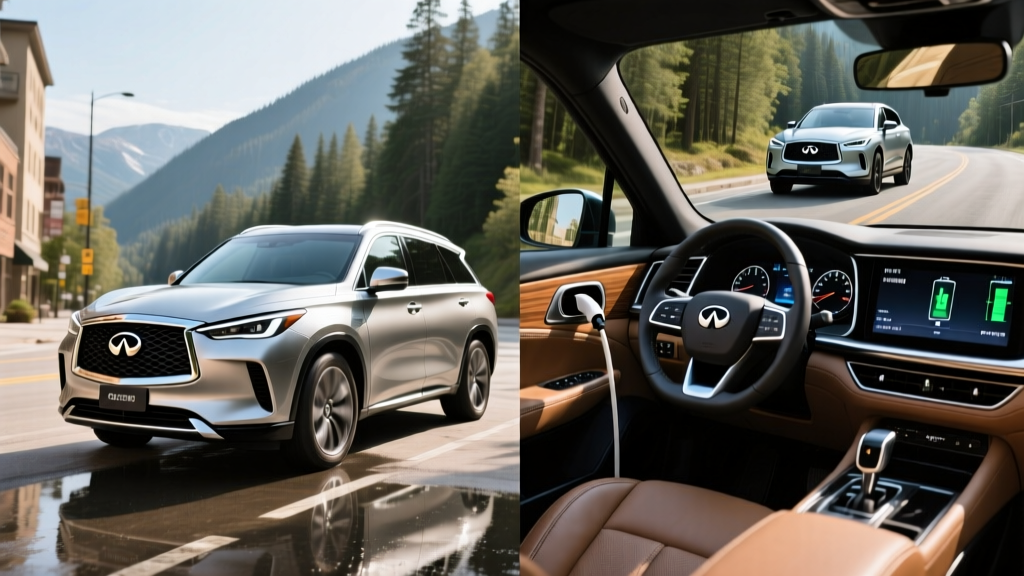
Infiniti's electrification strategy has evolved significantly, and for 2026, buyers researching Infiniti hybrid models have a clearer picture than ever. The brand currently offers electrified powertrains in its core crossover lineup — most notably the three-row QX60 with a conventional hybrid (HEV) option and the QX50 available as a plug-in hybrid (PHEV) in select markets. If you're weighing whether an Infiniti hybrid fits your garage, this guide breaks down every spec that matters: EPA MPG, electric-only range, battery warranties, tax credit eligibility, and who these vehicles actually serve best.
Infiniti's Hybrid Lineup for 2026: What's Available
Unlike Toyota or Hyundai, Infiniti has not pursued a broad hybrid rollout across every nameplate. The brand's electrified offerings remain concentrated in its highest-volume models. Here's what's in the showroom for the 2026 model year:
- Infiniti QX60 HEV — A conventional (self-charging) hybrid variant of the three-row luxury crossover. No plug required; the hybrid system recovers energy through regenerative braking and the gasoline engine.
- Infiniti QX50 PHEV — A plug-in hybrid version of the compact luxury crossover, offering a meaningful electric-only driving range before the turbocharged engine takes over. Requires plugging in to realize its efficiency benefits.
Infiniti has signaled future electrified models, but as of early 2026, these two represent the purchasable hybrid options. The discontinued Q50 sedan and Q70 are no longer in production, and the QX80 remains gasoline-only for now.
HEV vs. PHEV: Understanding the Infiniti Hybrid Difference
HEV vs. PHEV — Key Distinctions
| Feature | Conventional Hybrid (HEV) | Plug-In Hybrid (PHEV) |
|---|---|---|
| Plugs in to charge? | No — self-charging via engine & regen | Yes — Level 1 or Level 2 AC charging |
| Electric-only range | ~1 mile or less at very low speeds | 20–35 miles (model dependent) |
| Battery size | ~1–2 kWh (small buffer) | ~15–20 kWh usable |
| Federal tax credit (§30D) | Not eligible | May qualify — up to $7,500 (rules apply) |
| Best for | Drivers without home charging access | Drivers with home/workplace Level 2 charging |
The distinction matters enormously for your wallet and daily routine. A conventional HEV like the QX60 HEV requires zero behavioral change — you fuel it like any gas car and it simply uses less fuel. A PHEV like the QX50 PHEV rewards you with zero-emission local driving, but only if you plug in regularly. Drive a PHEV without ever charging it, and you're hauling dead battery weight with worse fuel economy than a comparable HEV.
Infiniti QX60 HEV: Fuel Economy and Powertrain Specs
| Spec | Value |
|---|---|
| Powertrain | 2.0L turbocharged 4-cyl + electric motor (VC-Turbo hybrid) |
| Combined Horsepower | ~268 hp (system net) |
| Transmission | CVT (continuously variable) |
| Drivetrain | FWD standard / AWD available |
| EPA MPG (city / hwy / combined) | 24 / 29 / 26 MPG (AWD est.) |
| Battery Type | Lithium-ion, ~1.5 kWh |
| Seating | 7 passengers (3 rows) |
| Starting MSRP | ~$52,500 (Pure HEV trim, est.) |
| Federal Tax Credit | Not eligible (HEV) |
The QX60 HEV pairs Infiniti's variable-compression turbo engine with an integrated electric motor. The result is modest but meaningful efficiency gains over the gasoline-only QX60, which returns roughly 22 MPG combined. In real-world driving, hybrid crossovers of this size tend to exceed their EPA city estimates in stop-and-go traffic, where regenerative braking recaptures the most energy. Highway driving at sustained 70+ mph speeds yields less hybrid benefit — expect closer to the EPA highway figure or slightly below on long, flat interstate runs.
Infiniti QX50 PHEV: Electric-Only Range and Charging
The QX50 PHEV is where Infiniti's electrified ambitions become more tangible. With a larger battery pack and the ability to plug in, it offers genuine zero-tailpipe-emission driving for daily commutes before seamlessly transitioning to hybrid operation.
| Spec | Value |
|---|---|
| Powertrain | 2.0L VC-Turbo 4-cyl + electric motor |
| Combined System Output | ~290 hp |
| EPA Electric-Only Range | ~30 miles (est.) |
| Total Combined Range | ~430 miles (gas + electric) |
| Usable Battery Capacity | ~17.5 kWh |
| EPA MPG (gas-only, combined) | ~28 MPG (after battery depleted) |
| MPGe (electric + gas combined) | ~65 MPGe |
| Level 1 Charge (120V, 1.4 kW) | ~12 hours (0–100%) |
| Level 2 Charge (240V, 7.2 kW) | ~2.5 hours (0–100%) |
| DC Fast Charging | Not supported |
| Drivetrain | AWD standard |
| 0–60 mph | ~6.5 seconds |
| Starting MSRP | ~$50,000 (est.) |
Around 30 miles of electric-only range is enough to cover the average American's daily commute — the Federal Highway Administration's NPTS data shows the median daily vehicle trip is under 30 miles. Charge overnight at home on a Level 2 unit, and most weekday driving happens on electricity alone. The gasoline engine only fires up for longer trips, heavy acceleration demands, or when the battery depletes.
Notably, the QX50 PHEV does not support DC fast charging. This is standard for most PHEVs — the battery is small enough that Level 2 AC charging replenishes it in a few hours, making DC infrastructure unnecessary for typical overnight routines. However, it means you cannot top up quickly at a highway fast-charging station the way a full BEV owner can.
Tax Credits, Pricing, and Incentives for Infiniti Hybrids
Federal tax credit eligibility is one of the sharpest dividing lines between HEV and PHEV ownership:
§30D Federal Tax Credit — PHEV Eligibility Checklist
- Vehicle type: Must be a plug-in hybrid or full EV with ≥7 kWh battery capacity — the QX50 PHEV qualifies on battery size.
- MSRP cap: SUVs/crossovers must have an MSRP ≤$80,000 — Infiniti QX50 PHEV trims fall well under this threshold.
- Buyer income cap: Modified AGI ≤$150,000 (single) or ≤$300,000 (joint filing) — per IRS §30D rules.
- Battery sourcing: Critical minerals and battery component requirements must be met — these thresholds tighten annually through 2030. Verify current-year compliance on the manufacturer's window sticker or fueleconomy.gov.
- Point-of-sale transfer: As of 2024+, eligible buyers can transfer the credit to the dealer at purchase, receiving an immediate price reduction rather than waiting for a tax refund.
- Credit amount: Up to $7,500, split between battery sourcing ($3,750) and critical minerals ($3,750). Partial credit ($3,750) is possible if only one requirement is met.
Note: The QX60 HEV does NOT qualify for §30D credits because it is a conventional hybrid without plug-in capability. Some state-level incentives may apply to HEVs — check your state energy office.
If the QX50 PHEV qualifies for the full $7,500 federal credit, a $50,000 MSRP effectively becomes ~$42,500 — narrowing the gap with gasoline competitors and making the PHEV a far more compelling financial proposition. Always confirm eligibility at purchase, as battery-sourcing rules change and manufacturer compliance can shift between model years.
Battery Warranty, Reliability, and Replacement Costs
Infiniti Hybrid Battery Warranty Coverage
| Component | Coverage |
|---|---|
| Hybrid battery (HEV & PHEV) | 8 years / 100,000 miles (10 yr/150,000 mi in CARB states) |
| Hybrid system components | 8 years / 100,000 miles |
| Powertrain (engine, transmission) | 6 years / 70,000 miles |
| Basic / bumper-to-bumper | 4 years / 60,000 miles |
Hybrid battery longevity is a top concern for buyers, and the data is reassuring. Toyota's hybrid systems — the industry benchmark — routinely exceed 200,000 miles on the original battery pack. Nissan/Infiniti's hybrid systems have a smaller sample size, but the 8-year/100,000-mile warranty (extended to 10 years/150,000 miles in states that follow California Air Resources Board emissions rules) provides substantial protection.
If a hybrid battery does require out-of-warranty replacement, costs for the QX60 HEV's smaller pack typically fall in the $2,000–$4,000 range (parts and labor). The QX50 PHEV's larger ~17.5 kWh pack would cost more — expect $5,000–$8,000 at current pricing, though costs continue to decline as battery manufacturing scales. Individual cell module replacement (rather than the full pack) may be possible and significantly cheaper, depending on the failure mode.
For reliability ratings, check NHTSA.gov for safety data and consumer complaints, and IIHS.org for crash-test performance. Infiniti's parent company Nissan has decades of hybrid and EV experience (the Leaf launched in 2010), which lends engineering credibility even if the brand's hybrid volumes remain lower than Toyota's.
Who Should Buy an Infiniti Hybrid — and Who Shouldn't
✓ Choose the QX60 HEV If...
- You need three rows and luxury branding but can't charge at home
- You want better fuel economy with zero routine change
- Your commute is highway-heavy (where HEV advantage is modest but consistent)
- You plan to keep the vehicle 5+ years within the warranty period
✓ Choose the QX50 PHEV If...
- You have home Level 2 charging (or reliable workplace charging)
- Your daily commute is under 30 miles round-trip
- You want electric daily driving but gas flexibility for road trips
- You qualify for the §30D tax credit (income + sourcing requirements)
✗ Consider a Full EV Instead If...
- You have home charging and drive under 250 miles/day
- You want the lowest per-mile fuel cost (~$0.04/mi on electricity vs. ~$0.15/mi on gas)
- You want zero engine maintenance (no oil changes, no spark plugs)
- Models like the Genesis Electrified GV70, BMW iX, or Tesla Model X serve the luxury EV space
Frequently Asked Questions
How many MPG does the Infiniti QX60 hybrid get?
The 2026 QX60 HEV returns an EPA-estimated 24 city / 29 highway / 26 combined MPG with AWD. Real-world city driving with frequent stops often yields 1–3 MPG above the EPA city figure thanks to regenerative braking, while sustained highway driving at 75+ mph may drop slightly below the EPA highway number. For a three-row luxury crossover, this represents a 15–20% improvement over the gasoline-only QX60.
How far can the Infiniti QX50 PHEV drive on electric only?
The QX50 PHEV offers approximately 30 miles of EPA-estimated electric-only range. Real-world range depends on temperature, terrain, and driving style. In mild weather at moderate speeds, expect 28–32 miles. In cold weather (below freezing), battery performance drops and electric range may shrink to 20–24 miles. Preconditioning the cabin while still plugged in helps preserve range.
Does the Infiniti QX50 PHEV qualify for a federal tax credit?
It may qualify for up to $7,500 under IRS §30D, provided the buyer meets income caps ($150K single / $300K joint), the vehicle MSRP is under $80,000, and battery sourcing requirements are satisfied for the current model year. The credit can be transferred to the dealer at point of sale for an immediate price reduction. The QX60 HEV does not qualify for §30D because it is not a plug-in vehicle. Always verify current eligibility at fueleconomy.gov before purchasing.
Are Infiniti hybrid batteries reliable, and what does replacement cost?
Infiniti backs its hybrid batteries with an 8-year/100,000-mile warranty (10 years/150,000 miles in CARB states). Industry data from Toyota and Honda hybrids shows battery packs regularly lasting 150,000–200,000+ miles. If out-of-warranty replacement is needed, expect $2,000–$4,000 for the QX60 HEV's smaller pack and $5,000–$8,000 for the QX50 PHEV's larger battery. Module-level repairs may reduce costs.
Should I get an Infiniti hybrid or just buy a full EV?
If you have reliable home Level 2 charging and your daily driving stays under 250 miles, a full EV (like the Tesla Model Y, BMW iX, or Genesis Electrified GV70) offers lower operating costs, zero engine maintenance, and a smoother driving experience. If you lack home charging, frequently drive 300+ miles in a day, or live in an area with sparse public charging infrastructure, the QX60 HEV or QX50 PHEV provides efficiency gains without range anxiety. The PHEV is the ideal middle ground for drivers who can charge at home but want gasoline backup for long road trips.
Do Infiniti hybrids require plugging in?
The QX60 HEV does not require plugging in — it charges its small battery through regenerative braking and the gasoline engine. The QX50 PHEV does need to be plugged in (Level 1 or Level 2) to access its electric-only range. Without plugging in, the PHEV operates as a conventional hybrid with reduced efficiency due to carrying extra battery weight.