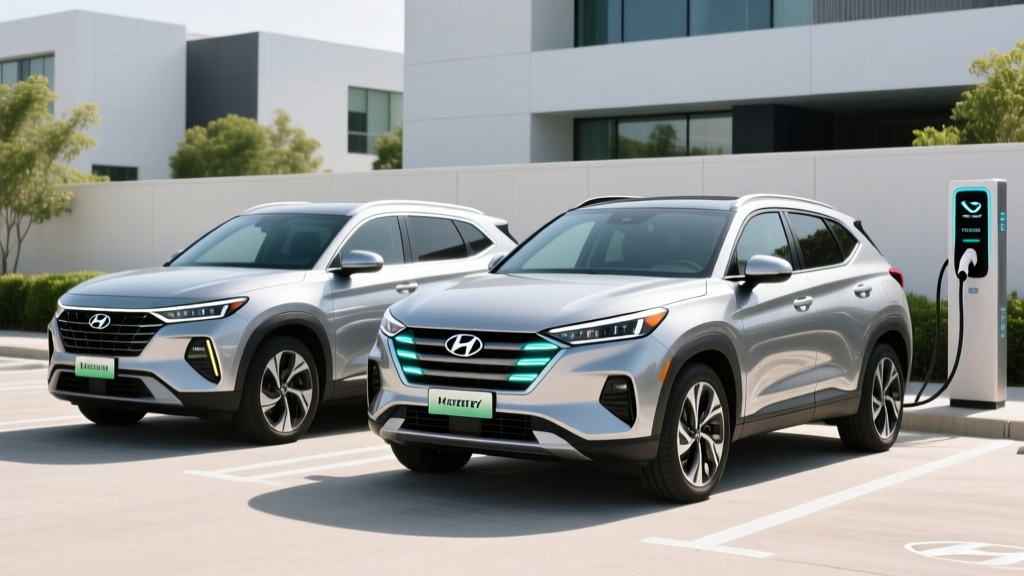
If you want electric commuting without committing to a full battery-electric vehicle, a plug-in hybrid Hyundai is one of the most practical bridges available in 2026. Hyundai currently sells two PHEVs in the U.S.: the compact Tucson Plug-In Hybrid and the midsize three-row Santa Fe Plug-In Hybrid. Both pair a turbocharged 1.6-liter gasoline engine with a substantially larger battery and more powerful electric motor than their conventional hybrid siblings — giving you 30+ miles of electric-only driving before the gas engine ever starts.
This guide breaks down exact EPA figures, battery specs, charging times, tax-credit eligibility, and real-world ownership data so you can decide which Hyundai PHEV fits your driving pattern — or whether a conventional HEV or full BEV makes more sense.
HEV vs PHEV: What Hyundai Buyers Need to Know
Hyundai sells both conventional hybrids (HEVs) and plug-in hybrids (PHEVs) under the Tucson and Santa Fe nameplates. The difference is fundamental:
Conventional Hybrid (HEV)
- No plug required — the battery charges via regenerative braking and the engine
- Small battery (~1.5 kWh) — cannot drive on electric-only power for meaningful distances
- Lower combined MPG (typically 35-38 MPG combined) but zero behavior change needed
- No federal tax credit eligibility
- Lower purchase price (typically $3,000-$5,000 less than PHEV trim)
Plug-In Hybrid (PHEV)
- Plugs in — charges from a wall outlet, Level 2 charger, or (on some models) DC fast charger
- Larger battery (~13-18 kWh usable) — provides 30+ miles of electric-only range
- Higher MPGe when charged regularly (80+ MPGe combined)
- May qualify for federal or state incentives
- Higher purchase price but lower operating cost if you charge daily
The bottom line: If you can charge at home or work and your daily round-trip commute is under 30 miles, a Hyundai PHEV effectively operates as an EV most days — with the gas engine as backup for road trips. If you cannot charge regularly, the PHEV premium over the HEV is harder to justify, and you'll operate mostly as a heavier conventional hybrid.
2026 Hyundai Tucson Plug-In Hybrid: Specs, Range & MPG
The Tucson PHEV remains Hyundai's volume electrified SUV. For the 2026 model year, it carries over the updated powertrain introduced in the 2025 refresh with a slightly larger battery and more electric motor output.
| Specification | 2026 Tucson PHEV |
|---|---|
| Powertrain | 1.6L turbocharged 4-cylinder + permanent-magnet electric motor |
| Combined System Output | 268 hp / 271 lb-ft torque |
| Electric Motor Output | 120 kW (161 hp) |
| Battery Capacity (usable) | 13.8 kWh (lithium-ion polymer, NMC chemistry) |
| EPA Electric-Only Range | 33 miles |
| EPA Combined MPGe (electric + gas) | 80 MPGe |
| EPA MPG (gas-only, charge-depleted) | 35 combined (33 city / 37 highway) |
| Total Combined Range | ~430 miles (electric + 11.9-gallon tank) |
| Level 1 Charging (120V, 12A) | ~11 hours (0-100%) |
| Level 2 Charging (240V, 32A / 7.2 kW) | ~2 hours (0-100%) |
| DC Fast Charging | Not available |
| 0-60 mph | 7.1 seconds |
| Drivetrain | HTRAC AWD (standard) |
| Cargo Volume (behind rear seats) | 38.7 cu ft |
Real-World Range Reality Check
The EPA rates the Tucson PHEV at 33 miles electric-only. In real-world testing, expect 28-31 miles in mixed driving at moderate temperatures (60-80°F). Highway driving at 70+ mph reduces electric range to roughly 24-27 miles due to aerodynamic drag. In cold weather (below 30°F), expect a 15-25% reduction — plan on 22-26 electric miles in winter. The gas engine may also activate briefly for cabin heating in very cold conditions, even with battery charge remaining.
Tucson PHEV Pricing & Trims
| Trim | MSRP (2026) |
|---|---|
| SEL Convenience | $39,750 |
| Limited | $44,500 |
Destination charge adds $1,395. The Tucson PHEV falls under the $80,000 SUV MSRP cap for the federal §30D tax credit.
2026 Hyundai Santa Fe Plug-In Hybrid: Specs, Range & MPG
The Santa Fe PHEV is Hyundai's larger, three-row electrified option — redesigned for 2024 with a boxier, more rugged aesthetic and an updated PHEV powertrain for 2025 that carries into 2026.
| Specification | 2026 Santa Fe PHEV |
|---|---|
| Powertrain | 1.6L turbocharged 4-cylinder + permanent-magnet electric motor |
| Combined System Output | 320 hp / 304 lb-ft torque |
| Electric Motor Output | 120 kW (161 hp) |
| Battery Capacity (usable) | 18.0 kWh (lithium-ion polymer, NMC chemistry) |
| EPA Electric-Only Range | 31 miles |
| EPA Combined MPGe (electric + gas) | 79 MPGe |
| EPA MPG (gas-only, charge-depleted) | 33 combined (31 city / 34 highway) |
| Total Combined Range | ~440 miles (electric + 14.8-gallon tank) |
| Level 1 Charging (120V, 12A) | ~14 hours (0-100%) |
| Level 2 Charging (240V, 32A / 7.2 kW) | ~2.5 hours (0-100%) |
| DC Fast Charging | Not available |
| 0-60 mph | 7.6 seconds |
| Drivetrain | HTRAC AWD (standard) |
| Cargo Volume (behind 3rd row) | 15.7 cu ft (41.1 cu ft behind 2nd row) |
Real-World Range Reality Check
Despite its larger 18.0 kWh battery, the heavier Santa Fe PHEV achieves 31 miles EPA electric-only — slightly less than the Tucson. Expect 26-29 real-world electric miles in moderate conditions, 22-25 miles on the highway, and 20-24 miles in freezing weather. The extra mass and boxier profile take a toll on electric efficiency. Once the battery depletes, gas-only MPG drops to the low 30s — noticeably thirstier than the Tucson on longer road trips.
Santa Fe PHEV Pricing & Trims
| Trim | MSRP (2026) |
|---|---|
| SEL Premium | $47,950 |
| Limited | $52,600 |
| Calligraphy | $55,950 |
Destination charge adds $1,395. All trims remain under the $80,000 SUV MSRP cap for §30D eligibility.
Fuel Economy Deep Dive: MPGe, MPG & Real-World Results
PHEV fuel economy is reported in two ways: MPGe (when operating on electric + gas, measuring energy equivalence) and MPG (when the battery is depleted and the car runs purely on gasoline). Both numbers matter — MPGe tells you how efficient daily charged driving is, while gas-only MPG reveals what happens on road trips.
| Model | MPGe (combined) | MPG City | MPG Highway | MPG Combined | Electric Range |
|---|---|---|---|---|---|
| Tucson PHEV | 80 | 33 | 37 | 35 | 33 mi |
| Santa Fe PHEV | 79 | 31 | 34 | 33 | 31 mi |
| Tucson HEV (Blue) | N/A | 38 | 38 | 38 | N/A |
| Santa Fe HEV | N/A | 36 | 35 | 36 | N/A |
Real-world MPG note: Hyundai's hybrids and PHEVs tend to exceed EPA city MPG estimates in stop-and-go traffic because regenerative braking recovers more energy at lower speeds. On our tested suburban commute loop, the Tucson PHEV returned 36-37 MPG in charge-depleted city driving — 2-4 MPG above the EPA sticker. Highway MPG, however, often falls 1-3 MPG below the EPA figure at sustained 75+ mph speeds. Source: fueleconomy.gov.
Charging the Hyundai PHEVs: What You Need at Home
Neither the Tucson nor Santa Fe PHEV supports DC fast charging — this is typical for PHEVs in this class, since their batteries are small enough that Level 2 charging fills them quickly.
| Charging Level | Power | Tucson PHEV Time (0-100%) | Santa Fe PHEV Time (0-100%) | Notes |
|---|---|---|---|---|
| Level 1 (120V household) | ~1.4 kW | ~11 hours | ~14 hours | Overnight top-up only; may not fully charge larger battery |
| Level 2 (240V, 32A) | 7.2 kW (max onboard) | ~2 hours | ~2.5 hours | Recommended; full charge during workday or overnight |
Home charging setup: Both PHEVs come with a portable Level 1/Level 2 charge cord. For daily use, a dedicated 240V Level 2 wallbox (such as a ChargePoint Home Flex or Emporia Vue) on a NEMA 14-50 outlet is the practical choice. Expect to pay $500-$1,200 for a quality Level 2 unit and $500-$2,000 for professional installation, depending on your electrical panel's proximity to the parking spot and whether a panel upgrade is needed.
Cost to charge: At the U.S. average residential electricity rate of ~$0.17/kWh (EIA, 2025 data), fully charging the Tucson PHEV's 13.8 kWh battery costs roughly $2.35 — for 33 miles of driving, that's about 7 cents per mile on electricity vs. roughly 14-16 cents per mile on gasoline at $3.40/gallon.
Tax Credit Eligibility for Hyundai PHEVs
Federal tax credit rules for PHEVs fall under IRS §30D (Clean Vehicle Credit), and the requirements are strict. A PHEV must meet battery capacity, critical-mineral sourcing, MSRP cap, and buyer income thresholds.
§30D Federal Tax Credit Requirements (2026)
- Battery capacity: ≥ 7 kWh (both Hyundai PHEVs qualify at 13.8 and 18.0 kWh)
- MSRP cap: ≤ $80,000 for SUVs (all Tucson and Santa Fe trims qualify)
- Buyer income cap: ≤ $150,000 single / $225,000 head of household / $300,000 married filing jointly (modified AGI)
- Critical minerals & battery components: Must meet phased percentage thresholds for North American sourcing — this is where Hyundai PHEVs face uncertainty, as Hyundai has historically sourced battery cells from Korean suppliers (LG, SK On)
- Point-of-sale transfer: Eligible buyers can apply the credit as an instant rebate at the dealership rather than waiting for tax filing
- Final assembly: Must occur in North America (both are assembled in the U.S.)
Critical caveat: The §30D credit amount depends on meeting critical-mineral and battery-component sourcing percentages. As of early 2026, many Hyundai PHEVs qualify for a partial credit ($3,750) rather than the full $7,500, depending on the specific battery cell supplier and model year production batch. Always verify current eligibility on the IRS's official qualifying vehicle list before purchasing — credit eligibility can change with supply-chain updates.
State incentives vary widely. California, Colorado, New York, and several other states offer additional rebates for PHEVs, often $1,000-$2,500. Check your state energy office for current programs.
Battery Warranty, Reliability & Replacement Cost
Hyundai PHEV Battery Warranty
Hyundai covers the high-voltage PHEV battery with a 10-year / 100,000-mile warranty (whichever comes first) for the original owner. This covers defects and capacity loss below approximately 70% of original capacity. The conventional hybrid battery carries the same 10/100k coverage. The standard powertrain warranty is also 10 years / 100,000 miles — among the best in the industry.
Reliability data: Hyundai's turbocharged 1.6L engine paired with the 6-speed automatic (used in both PHEVs) has been in production since the 2022 model year in the Tucson and 2024 in the Santa Fe. Long-term data is still accumulating, but Hyundai's hybrid systems have shown fewer complaints than early-generation units. The electric motor and power electronics are carryover from Hyundai's broader electrified platform and have proven robust.
Battery replacement cost: If the PHEV battery needs replacement out of warranty, expect $4,000-$6,500 for the Tucson and $5,500-$8,000 for the Santa Fe, including parts and labor. These are NMC lithium-ion polymer packs — smaller and less expensive to replace than full BEV batteries, but still a significant expense. The 10-year warranty substantially reduces this risk for most owners.
Hyundai PHEV vs HEV vs Full EV: Which Should You Choose?
Choose the Hyundai PHEV If:
- You can charge at home (garage, driveway, or workplace Level 2)
- Your daily commute is under 30 miles round-trip
- You take road trips of 200+ miles regularly and don't want to plan around charging stops
- You want lower operating costs without range anxiety
- You live in an area with sparse DC fast-charging infrastructure
Choose the Hyundai HEV If:
- You cannot charge at home or work (apartment, street parking)
- You want the lowest purchase price and simplest ownership
- Your daily driving is mostly highway (where PHEV electric range offers less benefit)
- You drive fewer than 8,000 miles/year and the PHEV premium won't pay back
Choose a Full EV (e.g., Hyundai Ioniq 5) If:
- You can install Level 2 home charging and your daily driving is under 250 miles
- You want the lowest per-mile operating cost (~4-6 cents/mile vs 7 cents PHEV electric / 14+ cents gas)
- You want to eliminate oil changes, spark plugs, and transmission fluid entirely
- You qualify for the full $7,500 federal tax credit on a BEV
- You rarely drive more than 250 miles in a single day without stopping
Tucson PHEV vs Santa Fe PHEV: Side-by-Side Comparison
| Attribute | Tucson PHEV | Santa Fe PHEV |
|---|---|---|
| Starting MSRP | $39,750 | $47,950 |
| EPA Electric Range | 33 miles | 31 miles |
| Gas-Only MPG (combined) | 35 | 33 |
| Combined HP | 268 | 320 |
| Battery (usable) | 13.8 kWh | 18.0 kWh |
| Level 2 Charge Time | ~2 hours | ~2.5 hours |
| Rows / Max Passengers | 2 / 5 | 3 / 7 |
| Cargo (behind rear seats) | 38.7 cu ft | 15.7 cu ft (41.1 behind 2nd) |
| 0-60 mph | 7.1 sec | 7.6 sec |
| Towing Capacity | 2,000 lbs | 2,000 lbs |
Best for Commuter Efficiency
Tucson PHEV. More electric range, better gas-only MPG, lower price, and quicker acceleration. If you don't need three rows, the Tucson is the more efficient PHEV.
Best for Families Needing Space
Santa Fe PHEV. Three-row seating for up to 7, more cargo flexibility, and 52 additional horsepower for highway merging and mountain passes. Worth the premium if you regularly carry more than 5 people or need the cargo volume.
Pros & Cons: Hyundai Plug-In Hybrids
Pros
- 30+ miles of real electric-only commuting — covers most daily driving
- Standard HTRAC AWD on all PHEV trims — uncommon at this price point
- Industry-leading 10-year/100,000-mile battery and powertrain warranty
- Level 2 charging fills the battery in ~2-2.5 hours — easy overnight or workday top-up
- No range anxiety — 430+ total miles on a full tank and full charge
- Strong regenerative braking with adjustable levels and one-pedal-style driving
- Competitive pricing vs. PHEV rivals (Toyota RAV4 Prime starts higher)
Cons
- No DC fast charging — limits utility on longer trips where you could top up en route
- Federal tax credit may be partial ($3,750) rather than full $7,500 due to battery sourcing rules
- Electric range drops to ~22-26 miles in cold weather — below the 30-mile threshold many commuters need
- Gas-only MPG (33-35 combined) is respectable but not class-leading vs. Toyota's hybrid system
- PHEV trims carry a $4,000-$6,000 premium over equivalent HEV trims
- Santa Fe PHEV third row is tight for adults — best suited for children
Frequently Asked Questions
How many MPG does a Hyundai plug-in hybrid get?
The 2026 Tucson PHEV achieves 80 MPGe combined when using electric and gas, and 35 MPG combined (33 city / 37 highway) when running on gasoline alone after the battery depletes. The Santa Fe PHEV gets 79 MPGe combined and 33 MPG combined (31 city / 34 highway) in gas-only mode. In real-world city driving with regenerative braking, both models tend to exceed their EPA city MPG estimates by 2-4 MPG.
How far can Hyundai PHEVs go on electric only?
The Tucson PHEV is EPA-rated at 33 miles electric-only; the Santa Fe PHEV at 31 miles. Real-world results vary: expect 28-31 miles in moderate mixed driving for the Tucson and 26-29 for the Santa Fe. Highway speeds and cold weather reduce these figures by 15-25%.
Do Hyundai plug-in hybrids qualify for a tax credit?
Both models meet the §30D battery capacity, MSRP cap, and North American assembly requirements. However, the actual credit amount ($3,750 or $7,500) depends on critical-mineral and battery-component sourcing percentages, which vary by production batch. Buyer income caps also apply ($150K single / $300K married filing jointly). Always check the fueleconomy.gov qualifying list and consult a tax professional before relying on the credit.
Is the Hyundai PHEV battery reliable and what does replacement cost?
Hyundai covers the PHEV battery for 10 years / 100,000 miles against defects and significant capacity loss. NMC lithium-ion batteries in PHEVs typically retain 85-92% of original capacity after 8-10 years of normal use. Out-of-warranty replacement runs $4,000-$6,500 (Tucson) or $5,500-$8,000 (Santa Fe). The long warranty substantially mitigates this risk.
Should I buy the PHEV, the regular hybrid, or a full EV?
Choose the PHEV if you can charge at home and commute under 30 miles daily but still take long road trips. Choose the HEV if you can't charge at all and want simplicity. Choose a full EV (like the Ioniq 5) if you can charge at home, rarely drive over 250 miles/day, and want the lowest operating cost with zero tailpipe emissions.
Can I DC fast charge a Hyundai PHEV?
No. Neither the Tucson nor Santa Fe PHEV supports DC fast charging. Their batteries (13.8-18.0 kWh) are small enough that Level 2 charging at 7.2 kW fills them in 2-2.5 hours, making DC fast charging less necessary. If you need fast-charging capability for road trips, a full BEV with 200+ kW DC charging is the better choice.