Quick Verdict: The Tucson Limited Hybrid Balances Efficiency and Practicality
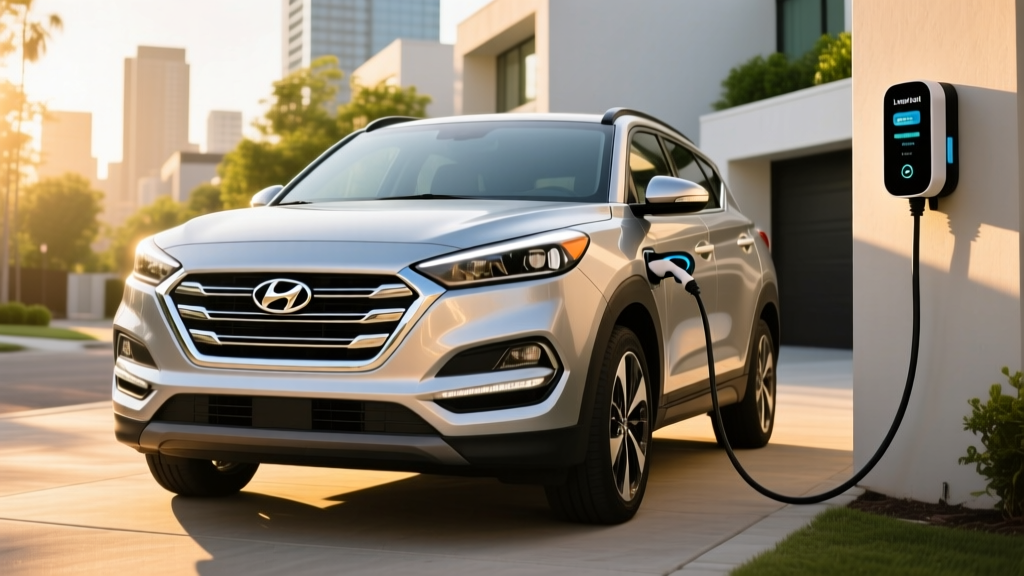
The 2026 Hyundai Tucson Limited Hybrid occupies a specific niche: buyers who want SUV practicality with meaningful fuel savings but aren't ready to plug in or go full electric. As the top-tier HEV trim, the Limited bundles premium features — ventilated seats, a panoramic sunroof, Highway Driving Assist 2, and a 12.3-inch dual-screen cockpit — on top of a proven 1.6-liter turbo hybrid powertrain that returns up to 38 MPG combined per the EPA. For shoppers cross-referencing the Hyundai Tucson Limited Hybrid against plug-in alternatives or full EVs, this guide breaks down exact specs, real-world efficiency, ownership costs, and whether the HEV, PHEV, or BEV variant fits your life.
The Tucson Hybrid (HEV) never plugs in. It recaptures energy through regenerative braking and uses a small battery to assist the gas engine, boosting MPG. The Tucson Plug-In Hybrid (PHEV) has a larger battery you charge via a wall outlet or public station, delivering ~33 miles of electric-only driving before the gas engine takes over. If you're searching for the Tucson Limited Hybrid, you're looking at the conventional HEV — no plug, no charging routine, just better fuel economy at every fill-up.
Fuel Economy: EPA MPG and Real-World Numbers
The 2026 Tucson Hybrid pairs a 1.6-liter turbocharged inline-4 with a 47.7 kW electric motor and a 6-speed automatic transmission. Combined output is 231 horsepower and 271 lb-ft of torque, routed through HTRAC all-wheel drive on every trim.
| Trim | City MPG | Highway MPG | Combined MPG |
|---|---|---|---|
| Blue | 38 | 38 | 38 |
| SEL Convenience / N Line / Limited | 37 | 36 | 37 |
Source: EPA fueleconomy.gov
Real-world expectations: Hyundai's hybrid system excels in city driving, where the electric motor handles low-speed propulsion and regenerative braking recaptures energy at every stop. Owners frequently report matching or slightly exceeding the EPA city figure in stop-and-go traffic. Highway fuel economy tends to settle around 34–35 MPG at 70–75 mph sustained — a characteristic of hybrids, which lose their electric-assist advantage at steady high speeds. In cold weather (below 30°F), expect a 3–5 MPG dip as the engine runs more often to generate cabin heat. Per fueleconomy.gov, the Tucson Hybrid Limited's annual fuel cost is approximately $1,550 based on 15,000 miles and current gas prices — roughly $600 less per year than the gas-only Tucson AWD.
Powertrain Deep Dive: Engine, Motor, and Drivetrain
The Tucson Hybrid's powertrain is a carryover of Hyundai's Smartstream G1.6 T-GDi hybrid system, refined for the current generation:
- Engine: 1.6L turbocharged inline-4, 178 HP / 195 lb-ft torque
- Electric motor: 47.7 kW (64 HP), integrated into the transmission housing
- Combined system output: 231 HP / 271 lb-ft
- Transmission: 6-speed automatic (not a CVT — a notable differentiator from Toyota's e-CVT approach in the RAV4 Hybrid)
- Drivetrain: HTRAC AWD standard on all trims
- Hybrid battery: ~1.49 kWh lithium-ion (located under the rear seat)
- 0–60 mph: Approximately 7.1 seconds
The 6-speed automatic delivers a more natural driving feel than the rubber-band effect some CVTs produce. Acceleration from stops is brisk thanks to the electric motor's instant torque fill, and highway passing confidence is solid. The small 1.49 kWh battery is never depleted to zero — the system maintains a buffer to protect longevity, which leads directly into warranty coverage.
Hyundai Tucson Hybrid vs Plug-In Hybrid vs Full EV
Hyundai offers three Tucson powertrains. Here's how they stack up for 2026:
| Spec | Hybrid (HEV) | Plug-In Hybrid (PHEV) | Gas (AWD) |
|---|---|---|---|
| Combined MPG / MPGe | 37–38 MPG | 80 MPGe / 35 MPG (gas-only) | 26 MPG |
| Electric-Only Range | N/A | ~33 miles | N/A |
| Combined HP | 231 | 268 | 187 |
| Battery Size | ~1.49 kWh | 13.8 kWh | N/A |
| Plugs In? | No | Yes (Level 2, ~2 hr) | No |
| DC Fast Charge? | No | No (Level 2 AC only) | N/A |
| Limited Trim MSRP (est.) | ~$43,350 | ~$48,200 | ~$41,000 |
| Federal Tax Credit | None | Up to $3,750* | None |
*PHEV credit subject to IRS §30D rules, battery sourcing, and income caps. See IRS.gov for current eligibility. Conventional HEVs do not qualify for the §30D new clean vehicle credit.
The conventional Tucson Hybrid (HEV) does not qualify for the federal §30D clean vehicle tax credit — that credit applies only to plug-in vehicles (PHEVs and BEVs). The Tucson PHEV may qualify for up to $3,750 depending on battery critical-mineral sourcing, your adjusted gross income, and MSRP caps. Some states offer additional hybrid rebates — check your state energy office or AFDC.energy.gov for local programs. Always verify with a tax professional before relying on incentive estimates.
Pricing and What You Get in the Limited Trim
The 2026 Tucson Limited Hybrid is the top-of-line HEV, with an estimated MSRP of $43,350 (including destination). Key equipment beyond lower trims includes:
- 12.3-inch digital cluster + 12.3-inch navigation touchscreen
- Leather-trimmed seats with ventilated front / heated front and rear
- Panoramic sunroof
- Highway Driving Assist 2 (Level 2 driver assistance with lane-centering and adaptive cruise)
- Blind View Monitor, Remote Smart Parking Assist
- 19-inch alloy wheels
- Bose premium audio, wireless Apple CarPlay/Android Auto
- Digital Key 2
At $43,350, the Limited Hybrid commands roughly $2,350 over the gas-only Tucson Limited and about $4,850 less than the PHEV Limited. The fuel savings versus the gas model — approximately $600/year — recoup the hybrid premium in about 4 years at 15,000 miles annually.
Battery Warranty, Reliability, and Replacement Cost
- Hybrid battery: 10 years / 100,000 miles (whichever comes first)
- Hybrid system components: 10 years / 100,000 miles
- Powertrain (engine, transmission): 10 years / 100,000 miles
- New vehicle limited: 5 years / 60,000 miles
Hyundai's hybrid battery warranty is among the best in the segment, matching Toyota and exceeding most competitors. The battery rarely requires full replacement under normal use — degradation in a ~1.49 kWh HEV battery is minimal because the system operates in a narrow state-of-charge window (roughly 40–80% SoC), which dramatically extends cycle life.
Is the Tucson Hybrid reliable? Hyundai's 1.6T hybrid powertrain has been in production since the 2022 model year refresh. The system avoids the complexity of a CVT and uses a conventional automatic, which reduces long-term service concerns. IIHS has rated the Tucson a Top Safety Pick+ in recent model years. J.D. Power and Consumer Reports have rated the Tucson Hybrid at or above average for compact SUV hybrids. Should the battery require replacement outside warranty, dealer quotes typically range from $2,500 to $4,000 including labor — though this is rare before 150,000+ miles given the shallow-cycle operating strategy.
Who Should Choose the Tucson Limited Hybrid?
✓ Choose the Tucson HEV If:
- You want 37+ MPG without changing your fueling routine
- You lack access to home or workplace charging
- You frequently drive in cold climates where EV range drops significantly
- You want AWD and a refined, feature-rich cabin under $45K
- You plan to keep the vehicle 8–10 years (warranty coverage)
✗ Look Elsewhere If:
- Your daily commute is under 30 miles and you can install a Level 2 charger (PHEV or EV saves more)
- You want zero tailpipe emissions for environmental reasons (choose a BEV)
- You want the lowest possible fuel cost — electricity at $0.13/kWh beats $3.40/gal gas by a wide margin
- You need a third row (consider the Kia Sorento Hybrid or a larger SUV)
Real-World Ownership Insights
Beyond the spec sheet, here's what matters in daily life with the Tucson Limited Hybrid:
- Cargo space: 38.7 cu ft behind the rear seats — essentially identical to the gas Tucson, since the hybrid battery sits compactly under the rear bench.
- Towing: 2,000 lbs (hybrid), adequate for a small trailer or bike rack but not heavy hauling.
- Regen feel: Hyundai offers adjustable regen via paddle shifters. The strongest setting provides noticeable deceleration but not true one-pedal driving — the Tucson Hybrid will still creep at stops like a conventional car.
- Insurance: Hybrid SUVs typically carry premiums 5–10% higher than gas equivalents due to higher replacement-cost estimates. Get a quote before committing.
- Highway Driving Assist 2: This is a Level 2 driver-assist system per SAE classification — it handles steering, acceleration, and braking on highways but requires your hands on the wheel and eyes on the road at all times. It is not autonomous driving.
Frequently Asked Questions
How many MPG does the Hyundai Tucson Limited Hybrid get?
The EPA rates the Tucson Hybrid Limited at 37 city / 36 highway / 37 combined MPG. In real-world city driving, many owners match or slightly exceed the 37 MPG city figure thanks to frequent regenerative braking. Highway cruising at 70+ mph typically yields 34–35 MPG.
Does the Tucson Hybrid need to be plugged in?
No. The conventional Tucson Hybrid (HEV) never plugs in. It charges its small battery entirely through regenerative braking and the gas engine. If you want plug-in capability with electric-only range, look at the Tucson Plug-In Hybrid instead.
How far can the Tucson PHEV go on electric only?
The Tucson Plug-In Hybrid delivers an EPA-estimated 33 miles of electric-only range on a full charge. Its 13.8 kWh battery recharges in roughly 2 hours on a 240V Level 2 home charger. The PHEV does not support DC fast charging — it is limited to Level 2 AC charging only.
Is the Tucson Hybrid battery expensive to replace?
Hyundai covers the hybrid battery for 10 years / 100,000 miles. If replacement is needed outside warranty, expect $2,500–$4,000 at a dealer. However, the HEV battery operates in a shallow charge window that minimizes wear — most hybrid batteries last well beyond 150,000 miles without issue.
Hybrid vs PHEV vs EV — which Tucson fits my life?
HEV (Hybrid): Best if you can't charge at home, drive long distances frequently, or live in extreme cold. No behavior change required — just fill up less often. PHEV (Plug-In Hybrid): Best if you have home charging and a commute under 33 miles — you'll drive most days on electricity and use gas only for longer trips. Full EV (like the Ioniq 5): Best if you want the lowest running cost, can charge at home, and your daily driving stays within ~250–300 miles.
Does the Tucson Hybrid qualify for any federal tax credit?
The conventional Tucson Hybrid (HEV) does not qualify for the federal §30D new clean vehicle credit. That credit is reserved for plug-in vehicles (PHEVs and BEVs) and is subject to income caps, MSRP limits, and battery-sourcing requirements. The Tucson PHEV may qualify for up to $3,750 depending on current IRS rules. Check IRS.gov and consult a tax professional for your specific situation.