Quick Verdict: The Top-Trim Hybrid That Doesn't Pretend to Be Electric
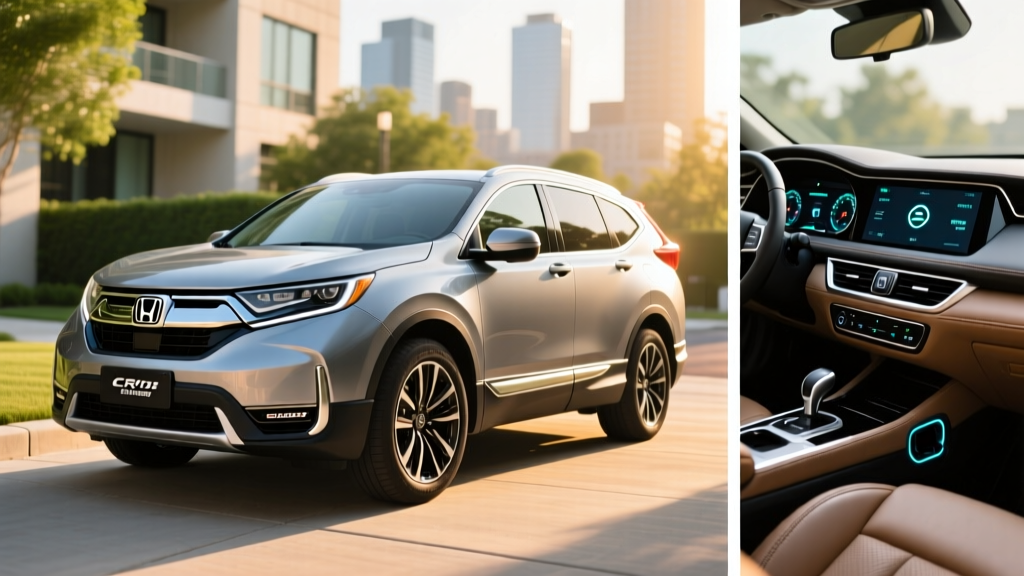
The Honda CR-V Hybrid Sport Touring occupies a specific lane: it's the fully loaded, all-wheel-drive hybrid variant of America's best-selling compact SUV, and it doesn't require you to plug it in. For buyers who want premium features and strong fuel economy without the lifestyle change of a plug-in hybrid or full EV, this trim delivers exactly what it promises — and nothing more.
With an EPA-estimated 40 MPG combined and a starting MSRP around $40,850 (including destination), the Sport Touring is the most expensive CR-V Hybrid you can buy. The question isn't whether it's efficient — it is — but whether the premium over the Sport-L Hybrid is worth it for your situation.
HEV vs PHEV: Why the CR-V Hybrid Is Not a Plug-In
Conventional Hybrid (HEV) — What the CR-V Hybrid Is:
- Self-charging via regenerative braking and the gasoline engine
- No plug, no charging cable, no electric-only driving beyond low-speed coasting
- Battery: ~1.1 kWh lithium-ion (small, used as a buffer)
- Refuels only at gas stations
- No federal tax credit eligibility
Plug-In Hybrid (PHEV) — What the CR-V Hybrid Is NOT:
- Requires plug-in charging to access electric-only range
- Larger battery (typically 15-20 kWh in competitors like the Toyota RAV4 Prime)
- Can drive 25-42 miles on electricity alone before the engine engages
- May qualify for federal §30D tax credit (up to $7,500) depending on sourcing and income
Honda does not currently offer a CR-V PHEV in the United States. If you need electric-only commuting capability, you'll need to look at competitors like the Toyota RAV4 Prime (42 miles EV range) or consider a full BEV like the Hyundai Ioniq 5.
Fuel Economy: EPA Ratings and Real-World MPG
| Driving Condition | EPA Estimate | Real-World Expectation |
|---|---|---|
| City | 43 MPG | 44-48 MPG (hybrids often beat EPA in stop-and-go) |
| Highway | 36 MPG | 33-36 MPG (aerodynamic drag limits hybrid advantage) |
| Combined | 40 MPG | 38-42 MPG depending on driving mix |
Source: EPA Fuel Economy Guide
The CR-V Hybrid's two-motor system excels in city driving, where regenerative braking recaptures energy at every stoplight. Expect to see the needle push past 45 MPG on urban commutes under 40 mph. Highway efficiency drops because the 1.5L turbocharged engine must do more of the work at sustained speeds, and the SUV's frontal area creates drag that no amount of regeneration can offset.
Cold-weather reality check: In sub-freezing temperatures, expect a 5-10% fuel economy reduction. The engine runs more frequently to provide cabin heat and warm up the catalytic converter. This is less severe than the 20-30% range loss a full EV experiences in cold weather, but it's measurable.
Powertrain Specs: What's Under the Hood
| Specification | Value |
|---|---|
| Engine | 2.0L Atkinson-cycle 4-cylinder + two electric motors |
| Combined System Horsepower | 204 hp |
| Combined Torque | 247 lb-ft (motor torque available from 0 RPM) |
| Drivetrain | Real Time AWD (standard on Sport Touring) |
| 0-60 mph | ~7.6 seconds (estimated) |
| Transmission | Electronic Continuously Variable (e-CVT) |
| Hybrid Battery | ~1.1 kWh lithium-ion (not plug-in capable) |
| Towing Capacity | 1,000 lbs |
The fourth-generation two-motor hybrid system uses the gasoline engine primarily as a generator at low speeds, with the electric motors driving the wheels. At highway speeds, a lockup clutch allows the engine to drive the wheels directly for efficiency. This is fundamentally different from Toyota's planetary-gear hybrid system, but the real-world result — seamless, efficient acceleration — is similar.
The 204 combined horsepower is respectable for the segment, though the RAV4 Hybrid offers 219 hp and the RAV4 Prime PHEV delivers 302 hp. If you prioritize acceleration over efficiency, the CR-V Hybrid won't win drag races, but it won't feel sluggish in daily driving either.
Pricing and Tax Credit Eligibility
2026 Honda CR-V Hybrid Sport Touring MSRP: Approximately $40,850 (including $1,350 destination charge)
This positions the Sport Touring about $5,000 above the CR-V Hybrid Sport-L and roughly $8,000 above the base Hybrid Sport. The premium buys you:
- Leather-trimmed seats with heated front and rear seats
- Wireless Apple CarPlay and Android Auto
- 12-speaker Bose premium audio system
- Hands-free power tailgate with walk-away close
- Wireless phone charger
- Rain-sensing windshield wipers
- Low-speed braking control and front/rear parking sensors
Federal Tax Credit Status: The Honda CR-V Hybrid does NOT qualify for the federal §30D Clean Vehicle Credit.
Reason: The §30D credit applies only to plug-in electric vehicles (BEVs and PHEVs) with at least 7 kWh of battery capacity. The CR-V Hybrid's ~1.1 kWh battery is far below this threshold. Conventional hybrids have not qualified for federal purchase incentives since the original Toyota Prius credit phased out in 2010.
State incentives: Some states offer modest rebates for high-efficiency hybrids, but these are typically $250-$1,000 and vary by jurisdiction. Check your state energy office or Alternative Fuels Data Center for local programs.
Reliability and Battery Longevity
Honda Hybrid Battery Warranty:
- Coverage: 8 years / 100,000 miles (10 years / 150,000 miles in CARB states including CA, NY, MA, and others)
- What's covered: Battery capacity loss below a specified threshold (typically 60-70% of original capacity) and defects
- Replacement cost (out of warranty): $2,000-$4,000 for the hybrid battery pack
Honda's hybrid system has proven reliable over multiple generations. The Accord Hybrid and CR-V Hybrid use similar architecture, and there are no widespread reports of premature battery failures in models from 2020 onward. The small battery capacity (~1.1 kWh) means the cells experience shallow charge-discharge cycles, which is far less stressful than the deep cycles a full EV battery endures.
Real-world lifespan expectation: Based on Toyota and Honda hybrid data from vehicles with 150,000+ miles, expect the hybrid battery to last 12-15 years or 150,000-200,000 miles before significant degradation. Many original Prius batteries from 2004-2009 are still in service. The CR-V Hybrid's battery should easily outlast the vehicle's typical ownership cycle.
For reliability ratings, the CR-V generally scores well with IIHS Top Safety Pick status and average-to-above-average marks from Consumer Reports and J.D. Power.
Sport Touring vs Sport-L Hybrid: Is the Premium Worth It?
Sport Touring Advantages
- Premium audio and full leather interior
- Heated rear seats (rare in this segment)
- Wireless connectivity and charging
- Enhanced safety features (parking sensors, low-speed braking)
- Stronger resale value due to top-trim status
Sport Touring Limitations
- ~$5,000 premium over equally efficient Sport-L Hybrid
- No federal or state tax credits to offset cost
- Still a 36 MPG highway vehicle (no electric-only mode)
- 1,000-lb towing limit (same as all CR-V Hybrids)
- Not a plug-in — no home charging, no EV commute
If you want the features and plan to keep the vehicle 8+ years, the Sport Touring's premium amortizes to roughly $50/month over a typical loan. If you're budget-conscious and don't care about Bose audio or leather, the Sport-L Hybrid delivers identical fuel economy and powertrain for significantly less money.
Who Should Choose the CR-V Hybrid Sport Touring?
Choose this vehicle if:
- You want strong fuel economy (40 MPG) without changing your refueling habits
- You live in an apartment or lack reliable home charging access (making a PHEV or EV impractical)
- You want AWD for snow/rain but don't need serious off-road capability
- You value premium features but don't want to pay luxury-brand prices
- You drive 12,000-15,000 miles per year and want to minimize fuel costs (~$1,400/year at $3.50/gallon)
Look elsewhere if:
- You have a short commute and home charging — a PHEV like the RAV4 Prime could eliminate gas use entirely on weekdays
- You want the lowest possible operating costs — a full EV like the Tesla Model Y costs ~$600/year to charge vs $1,400 in gas
- You need to tow more than 1,000 lbs (consider a hybrid truck or larger SUV)
- You want federal tax credits — only PHEVs and BEVs qualify
Frequently Asked Questions
How many MPG does the Honda CR-V Hybrid Sport Touring get?
The EPA rates it at 43 city / 36 highway / 40 combined MPG. Real-world testing shows it often exceeds the city estimate (44-48 MPG in stop-and-go traffic) but may fall slightly short on the highway (33-36 MPG at 70+ mph).
Does the CR-V Hybrid need to be plugged in?
No. The CR-V Hybrid is a conventional hybrid (HEV), not a plug-in hybrid (PHEV). It charges its small battery through regenerative braking and the gasoline engine. You refuel it only at gas stations, exactly like a conventional car.
Does the CR-V Hybrid qualify for any federal tax credit?
No. The federal §30D Clean Vehicle Credit applies only to plug-in vehicles (BEVs and PHEVs) with at least 7 kWh of battery capacity. The CR-V Hybrid's ~1.1 kWh battery does not meet this threshold. Some states offer small efficiency rebates, but these vary by location.
How long will the hybrid battery last, and what does replacement cost?
Honda warranties the hybrid battery for 8 years/100,000 miles (10 years/150,000 miles in CARB states). Based on historical data from Honda and Toyota hybrids, expect 12-15 years or 150,000-200,000 miles before significant degradation. Out-of-warranty replacement costs $2,000-$4,000 if needed.
Is the CR-V Hybrid Sport Touring better than the RAV4 Hybrid?
They're closely matched. The CR-V Hybrid offers slightly better fuel economy (40 vs 39 MPG combined) and a more refined interior. The RAV4 Hybrid has more horsepower (219 vs 204), slightly more cargo space, and the RAV4 Prime PHEV variant offers 42 miles of electric-only range — something Honda doesn't offer. Choose based on which brand's driving dynamics and dealer network you prefer.
Can I tow with the CR-V Hybrid Sport Touring?
Yes, but the limit is 1,000 lbs — sufficient for a small utility trailer or a couple of dirt bikes, but not a boat or camper. This is a powertrain limitation shared by all CR-V Hybrids due to the e-CVT design and cooling constraints.