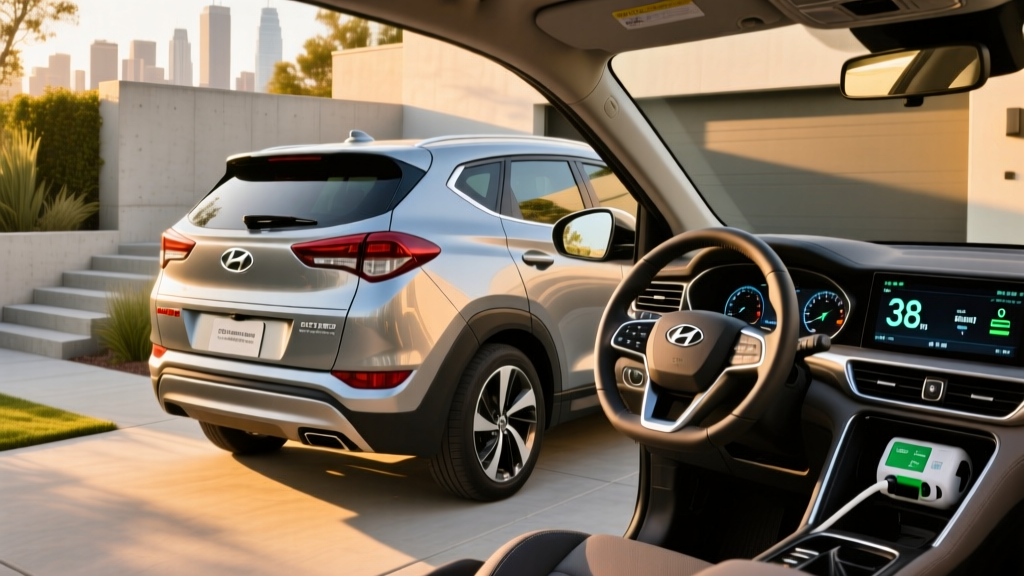
The 2025 Hyundai Tucson Hybrid Limited sits at the top of Hyundai's compact hybrid SUV lineup, packaging a turbocharged hybrid powertrain, standard all-wheel drive, and Hyundai's most advanced driver-assistance suite into a $40,235 MSRP. For buyers who want hybrid efficiency without plugging in, this is one of the most compelling options in the segment — but the Tucson PHEV exists just one trim ladder away, and the math between them isn't always obvious.
This guide breaks down the Tucson Hybrid Limited's real-world fuel economy, powertrain specs, battery longevity, and how it stacks up against its plug-in sibling and a full EV like the Ioniq 5. If you're cross-shopping electrified compact SUVs, the numbers below should settle the debate.
2025 Hyundai Tucson Hybrid Limited: Core Specifications
| Specification | 2025 Tucson Hybrid Limited |
|---|---|
| Powertrain | 1.6L turbocharged 4-cylinder + electric motor |
| Combined Output | 231 HP / 271 lb-ft torque |
| Transmission | 6-speed automatic |
| Drivetrain | Standard HTRAC AWD |
| EPA Fuel Economy (City/Hwy/Combined) | 38 / 38 / 38 MPG |
| Fuel Tank Capacity | 13.7 gallons |
| Total Driving Range (EPA) | ~520 miles |
| 0–60 MPH | ~7.4 seconds |
| Cargo Volume (behind 2nd row) | 38.7 cu ft |
| Towing Capacity | 2,000 lbs |
| Base MSRP (Limited AWD) | $40,235 |
| Federal Tax Credit | Not eligible (HEV) |
The 1.6-liter Smartstream turbo engine produces 178 HP on its own, supplemented by a 47.7 kW (64 HP) electric motor integrated into the transmission housing. Hyundai routes power through a conventional 6-speed automatic rather than a CVT, which gives the Tucson Hybrid a more natural acceleration feel than competitors like the Toyota RAV4 Hybrid.
Real-World MPG: Does the Tucson Hybrid Deliver?
The EPA rates the 2025 Tucson Hybrid at 38 MPG combined, with identical 38 city / 38 highway estimates. That symmetry is unusual — most hybrids favor city driving because regenerative braking and electric-motor assist work hardest at low speeds. Hyundai's turbocharged engine and AWD system narrow that gap, but real-world results still lean city-friendly.
| Driving Scenario | Expected MPG | Notes |
|---|---|---|
| EPA Combined | 38 MPG | Official sticker rating |
| City / Suburban (real-world) | 37–42 MPG | Hybrids often exceed EPA in stop-and-go |
| Highway (70–75 mph) | 33–36 MPG | Aero drag and AWD reduce efficiency |
| Cold Weather (below 30°F) | 30–34 MPG | Engine runs more for cabin heat, battery less efficient |
| Mixed Real-World Average | 35–38 MPG | Based on owner-reported data |
Owner forums and fueleconomy.gov user estimates cluster around 35–37 MPG for mixed driving, with some city-heavy drivers reporting 40+ MPG. Highway fuel economy is the Tucson Hybrid's relative weakness — at sustained 75 mph, expect closer to 33–35 MPG. If your commute is predominantly interstate, the advantage over a conventional gas Tucson (26 MPG combined) is meaningful but less dramatic than in city driving.
HEV vs. PHEV: Tucson Hybrid or Tucson Plug-In Hybrid?
Hyundai sells the Tucson in three flavors: a conventional gas model, the Tucson Hybrid (HEV), and the Tucson Plug-In Hybrid (PHEV). The Hybrid and PHEV share the same 1.6L turbo engine but diverge significantly in battery size, electric capability, and price.
| Feature | Tucson Hybrid (HEV) | Tucson Plug-In Hybrid (PHEV) |
|---|---|---|
| Battery Capacity | ~1.49 kWh (self-charging) | 13.8 kWh (NMC lithium-ion) |
| Electric-Only Range | None (motor assists only) | 33 miles (EPA) |
| Combined Horsepower | 231 HP | 268 HP |
| MPG / MPGe | 38 MPG combined | 80 MPGe (elec+gas) / 35 MPG (gas-only) |
| Charging Required? | No — charges via regen and engine | Yes — Level 2 in ~2 hours; no DC fast charge |
| Starting MSRP (top trim) | $40,235 (Limited) | $44,435 (Limited) |
| Federal Tax Credit | Not eligible | Not eligible for §30D (post-2022 sourcing rules) |
The key distinction: The HEV never needs to be plugged in. Its small 1.49 kWh battery recharges through regenerative braking and the engine. The PHEV's 13.8 kWh battery gives you 33 miles of pure electric driving — enough for most commutes — but requires a Level 2 home charger to realize its full value. If you can't charge at home or at work, the PHEV becomes a heavier, more expensive HEV that gets roughly 35 MPG once the battery depletes.
The PHEV also qualifies for no federal tax credit under current IRS §30D rules, which require North American battery assembly and critical-mineral sourcing thresholds that the Tucson PHEV does not meet as of 2025. This eliminates what was once a major PHEV incentive.
Pricing, Trims, and Tax Credit Eligibility
The 2025 Tucson Hybrid is offered in three trims:
- Blue: $34,235 MSRP — 38 MPG, cloth seats, 10.25-inch infotainment
- SEL Convenience: $36,735 MSRP — leatherette, panoramic sunroof, power liftgate
- Limited: $40,235 MSRP — leather, Bose audio, surround-view camera, Highway Driving Assist 2
The Limited adds Hyundai's most complete ADAS package, including Highway Driving Assist 2 (an IIHS-recognized Level 2 system with lane-centering and adaptive cruise). You also get a 10.25-inch digital cluster, ventilated front seats, a heated steering wheel, and a hands-free power liftgate.
Regarding incentives: the Tucson Hybrid (HEV) does not qualify for the federal §30D clean vehicle credit — that credit applies only to BEVs and PHEVs meeting battery-sourcing and assembly requirements. Some states offer their own hybrid rebates (Colorado, for instance, has offered hybrid incentives), but these vary by jurisdiction and change annually. Check your state energy office or a tax professional for current local programs.
Battery Longevity, Warranty, and Replacement Costs
Hyundai Hybrid Battery Warranty: 10 years / 100,000 miles (original owner). This covers defects and capacity loss below a defined threshold. Hyundai's hybrid battery warranty is among the longest in the industry, matching Toyota's 10-year/150,000-mile coverage in duration (though Toyota offers higher mileage).
The Tucson Hybrid's 1.49 kWh lithium-ion battery is small and operates in a narrow state-of-charge window — Hyundai's battery management system keeps it between roughly 40% and 80% SoC to minimize degradation. This is fundamentally different from a full EV battery that cycles through a wide range daily. As a result, hybrid battery degradation is typically minimal over the vehicle's life.
Real-world longevity data: Hyundai's hybrid systems, shared with the Kia Sorento Hybrid and Ioniq Hybrid, have shown strong reliability in owner surveys. The hybrid battery is not a wear item like a 12V battery — most will outlast the vehicle. If replacement is ever needed outside warranty, industry estimates for a compact hybrid battery module run $2,000–$3,500 including labor, though this is rare within the first 150,000 miles.
The conventional 12V auxiliary battery (which powers electronics, not the drivetrain) will need replacement every 3–5 years, like any vehicle — roughly $200–$350 at a shop.
Driving Impressions: Power, Refinement, and the 6-Speed Advantage
The Tucson Hybrid Limited's 231 HP and 271 lb-ft of torque make it genuinely quick for a hybrid SUV. The 0–60 time of approximately 7.4 seconds beats the Toyota RAV4 Hybrid (~7.8 sec) and Honda CR-V Hybrid (~8.0 sec). More importantly, the torque delivery is immediate — the electric motor fills the low-RPM gap that turbo lag typically creates, giving confident highway merge and passing performance.
Hyundai's decision to use a 6-speed automatic instead of a CVT pays dividends in driving feel. There are no rubber-band revs or drone under acceleration. The transmission shifts decisively, and the engine note stays composed. At highway cruise, the cabin is well-insulated — road noise is moderate, and the hybrid system transitions between electric and gas mode almost imperceptibly.
The HTRAC AWD system uses the electric motor to drive the rear axle, providing torque distribution without a mechanical driveshaft. In rain and light snow, this setup is effective and seamless. It's not a trail-rated system, but for the typical compact SUV buyer dealing with wet roads and occasional winter conditions, it's more than adequate.
Who Should Choose the Tucson Hybrid Limited — and Who Shouldn't
Pros
- 38 MPG combined — strong for a 231 HP AWD SUV
- No plug-in charging required — works with any lifestyle
- 6-speed automatic avoids CVT drone
- 10-year / 100,000-mile hybrid battery warranty
- Comprehensive ADAS standard on Limited (HDA2, blind-spot cameras)
- 38.7 cu ft cargo — competitive with gas-only Tucson
Cons
- Highway MPG drops to 33–35 at 75 mph
- No federal tax credit for HEV
- Limited trim at $40,235 pushes into luxury crossover pricing
- 2,000-lb towing capacity (below RAV4 Hybrid's 1,750 — both modest)
- Infotainment learning curve with touch-only climate controls
The Decision Framework
Choose the Tucson Hybrid if: You want 35–38 MPG without changing your fueling habits, you can't charge at home, or you take frequent road trips where DC fast-charging infrastructure is uncertain.
Choose the Tucson PHEV if: You have reliable Level 2 charging at home, your daily commute is under 30 miles, and you want electric-only driving for most trips with gas backup for longer hauls.
Choose a full EV (e.g., Ioniq 5) if: You have home charging, want $0 gas spend, drive under 300 miles daily, and qualify for the §30D credit on eligible models.
Stick with the gas Tucson if: Your annual mileage is under 8,000, the hybrid premium ($4,000+ over gas Blue trim) won't pay back in fuel savings within your ownership window.
Frequently Asked Questions
How many MPG does the 2025 Hyundai Tucson Hybrid actually get?
The EPA rates it at 38 MPG city / 38 highway / 38 combined. In real-world mixed driving, owners typically report 35–38 MPG. City-heavy driving can push above 40 MPG, while sustained 75 mph highway driving drops to 33–35 MPG. Cold weather (below 30°F) reduces economy to roughly 30–34 MPG due to increased engine runtime for cabin heating.
Does the Tucson Hybrid need to be plugged in?
No. The Tucson Hybrid (HEV) is a conventional self-charging hybrid. Its small battery recharges through regenerative braking and the gasoline engine. You fuel it like a normal car. Only the Tucson Plug-In Hybrid (PHEV) benefits from being plugged in.
How far can the Tucson PHEV go on electric only?
The Tucson Plug-In Hybrid has an EPA-rated 33 miles of electric-only range from its 13.8 kWh battery. Once that's depleted, it operates as a conventional hybrid at roughly 35 MPG combined. If you're considering the PHEV, your ability to charge at home determines whether those 33 electric miles are a daily benefit or a one-time bonus.
Is the Tucson Hybrid reliable, and what does a battery replacement cost?
Hyundai's hybrid system has shown strong reliability in industry surveys, and the hybrid battery carries a 10-year / 100,000-mile warranty. Because the battery operates in a narrow charge window and is relatively small, degradation is minimal. Full replacement outside warranty is estimated at $2,000–$3,500, but most hybrid batteries outlast 150,000+ miles without issue.
Does the 2025 Tucson Hybrid qualify for any federal tax credit?
No. The federal §30D Clean Vehicle Credit applies only to plug-in electric vehicles (BEVs and qualifying PHEVs) that meet battery sourcing and North American assembly requirements. The Tucson HEV is a conventional hybrid and is not eligible. The Tucson PHEV also does not currently qualify due to battery sourcing rules. Some states offer separate hybrid incentives — check your state energy office or consult a tax professional for current programs.
How does the Tucson Hybrid compare to the RAV4 Hybrid and CR-V Hybrid?
The Tucson Hybrid (231 HP, 38 MPG) is the most powerful in the trio and ties the RAV4 Hybrid on MPG (the RAV4 is rated 39–41 MPG depending on trim). The Honda CR-V Hybrid achieves 37–40 MPG with 204 HP. The Tucson's advantage is its 6-speed automatic (no CVT) and Hyundai's warranty. The RAV4 Hybrid's advantage is slightly better highway MPG and Toyota's long-term reliability reputation. The CR-V offers the most cargo volume at 39.3 cu ft.
The 2025 Hyundai Tucson Hybrid Limited is a well-rounded electrified SUV for buyers who want hybrid efficiency without lifestyle changes. At $40,235, it's priced at a premium, but the combination of powertrain refinement, standard AWD, comprehensive safety tech, and a 10-year battery warranty makes it one of the strongest hybrid SUVs in its class. If you can charge at home, the PHEV variant deserves a look — but for plug-and-play hybrid ownership, the HEV Limited delivers.