The Tucson's Two Hybrid Flavors: Standard HEV vs Plug-In PHEV
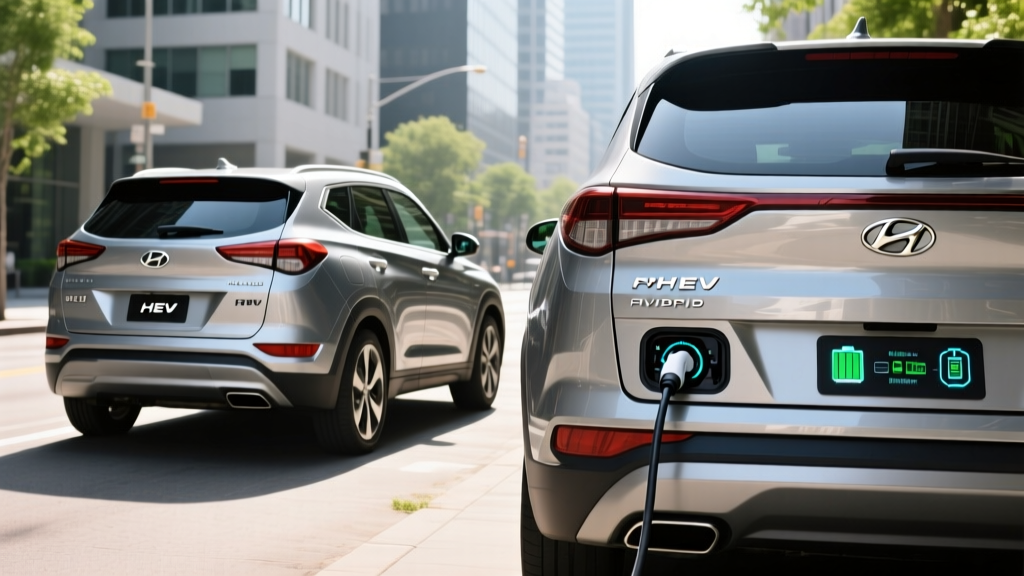
The Hyundai Tucson is one of the few compact SUVs that offers both a conventional hybrid (HEV) and a plug-in hybrid (PHEV) in the same body. Understanding how each works — and what separates them — is the first step to deciding which version fits your driving life.
HEV (Conventional Hybrid)
The Tucson Hybrid uses a 1.6-liter turbocharged gasoline engine paired with a 47.7 kW electric motor integrated into a 6-speed automatic transmission. A small 1.49 kWh lithium-ion battery stores energy recovered from braking and deceleration. You never plug it in. The system automatically switches between electric assist, engine power, and regenerative braking to maximize fuel economy. The combined output is 232 horsepower and 271 lb-ft of torque.
PHEV (Plug-In Hybrid)
The Tucson Plug-In Hybrid uses a larger 64.6 kW electric motor and a 13.8 kWh battery pack alongside the same 1.6L turbo engine. Combined output rises to 268 hp. You can plug it into a Level 1 (120V) or Level 2 (240V) charger to fill the battery, giving you an EPA-rated electric-only driving range before the gas engine kicks in. It cannot DC fast charge — all charging is AC-only via a standard J1772 connector.
Both powertrains use Hyundai's TMED-II (Transmission-Mounted Electric Device) architecture, which places the motor between the engine and transmission rather than on a separate axle. This means both the engine and motor can drive all four wheels through Hyundai's HTRAC all-wheel-drive system, providing genuine AWD traction rather than the rear-axle-only electric AWD some competitors use.
Fuel Economy: EPA MPG for the Tucson Hybrid and PHEV
Here's where the numbers matter most. The EPA's official fuel economy data breaks down as follows for the 2026 model year:
| Powertrain | City MPG | Highway MPG | Combined MPG | Combined Range |
|---|---|---|---|---|
| Tucson Hybrid (HEV) | 38 | 38 | 38 | ~525 miles |
| Tucson PHEV (gas mode) | 35 | 35 | 35 | ~420 miles (gas only) |
| Tucson PHEV (electric + gas) | 84 MPGe combined | ~430+ miles total | ||
Real-World MPG vs. the EPA Sticker
Hybrids often beat their EPA city estimates in real-world stop-and-go driving because regenerative braking recaptures energy that a gas car wastes as heat. Owners consistently report 39-42 MPG combined in mixed suburban driving with the Tucson HEV. Highway-only trips at 75+ mph tend to drop to 34-36 MPG because the electric motor provides less benefit at sustained high speeds and the turbo engine works harder.
For the PHEV, real-world electric-only range is the bigger variable. The EPA rates it at 33 miles on battery alone, but cold weather (below 40°F) can reduce that to 25-28 miles due to cabin heating demands and reduced battery efficiency. In mild weather with light throttle inputs, 35-37 electric miles is achievable.
Powertrain Deep Dive: What's Under the Hood
| Specification | Tucson Hybrid (HEV) | Tucson Plug-In Hybrid (PHEV) |
|---|---|---|
| Engine | 1.6L Turbo GDI 4-cyl | 1.6L Turbo GDI 4-cyl |
| Engine HP / Torque | 180 hp / 195 lb-ft | 180 hp / 195 lb-ft |
| Electric Motor | 47.7 kW (64 hp) | 64.6 kW (87 hp) |
| Combined System Output | 232 hp / 271 lb-ft | 268 hp / 271 lb-ft |
| Transmission | 6-speed automatic | 6-speed automatic |
| Battery Capacity | 1.49 kWh (Li-ion) | 13.8 kWh (Li-ion polymer) |
| Drivetrain | HTRAC AWD | HTRAC AWD |
| 0-60 mph | ~7.1 sec | ~6.3 sec |
| Towing Capacity | 2,000 lbs | 2,000 lbs |
| Plug-In Required? | No | Yes (for EV range) |
| DC Fast Charge | N/A | No (AC only) |
The key engineering insight: Hyundai chose a parallel hybrid architecture rather than a series hybrid (like the older Chevy Volt) or a power-split system (like Toyota's eCVT). The 6-speed automatic gives the Tucson Hybrid a more natural driving feel — shifts are perceptible, and there's no rubber-band effect. The trade-off is that it's slightly less seamless at low-speed electric-only transitions compared to Toyota's planetary gearset, but Hyundai's tuning has largely smoothed this out in recent model years.
PHEV Charging: Times, Connectors, and Costs
The Tucson PHEV charges exclusively via AC power using a J1772 connector. There is no DC fast-charging capability, which is standard for PHEVs in this class — the 13.8 kWh battery is small enough that Level 2 charging fills it quickly.
| Charging Method | Power | 0-100% Time | Notes |
|---|---|---|---|
| Level 1 (120V outlet) | ~1.4 kW | ~11 hours | Standard household outlet; overnight fill |
| Level 2 (240V) | ~7.2 kW | ~2 hours | Home wallbox or public Level 2 station |
If you can install a Level 2 charger at home (typically a 240V / 32A circuit), the PHEV battery fills in roughly two hours — easily done during a work-from-home day or overnight. A standard 120V outlet works too, but you'll need a full 11 hours, making it practical only if the car sits parked for long stretches.
Cost to fully charge the 13.8 kWh battery at the U.S. average residential electricity rate of ~$0.17/kWh is approximately $2.35. That gives you ~33 electric miles, or roughly 7 cents per mile — compared to about 12-14 cents per mile on gasoline at $3.40/gallon and 35 MPG.
Pricing, Trims, and Tax Credit Eligibility
For the 2026 model year, Hyundai prices the Tucson lineup as follows:
| Trim | HEV MSRP | PHEV MSRP |
|---|---|---|
| Blue (HEV only) | ~$34,460 | — |
| SEL Convenience | ~$37,260 | ~$41,260 |
| Limited | ~$40,510 | ~$45,510 |
All prices include destination. The PHEV commands roughly a $4,000-$5,000 premium over the equivalent HEV trim, which you'll want to weigh against the electric-only range and any applicable incentives.
Federal Tax Credit: §30D Rules for the Tucson PHEV
The Tucson PHEV may qualify for a partial or full federal tax credit under IRS §30D, but eligibility depends on several factors that shift with battery-sourcing regulations:
- MSRP cap: SUVs must be under $80,000 — all Tucson PHEV trims qualify.
- Buyer income cap: Modified AGI must not exceed $150,000 (single), $225,000 (head of household), or $300,000 (joint).
- Battery sourcing: The credit is split into two $3,750 halves — one for critical minerals, one for battery component assembly. As of 2026, the Tucson PHEV's battery sourcing determines whether you get $3,750 or the full $7,500. Hyundai has shifted significant battery assembly to U.S. and FTA-partner plants, but exact credit amounts vary by production batch.
- Point-of-sale transfer: You can transfer the credit to the dealer at purchase for an immediate price reduction rather than waiting to claim it on your tax return.
The standard Tucson HEV (non-plug-in) does not qualify for the §30D federal tax credit, as it does not meet the minimum 7 kWh battery capacity requirement. Some states offer separate hybrid incentives — check your state energy office for specifics.
Battery Warranty, Reliability, and Replacement Costs
Hyundai Hybrid Battery Warranty
HEV and PHEV: 10 years / 100,000 miles (whichever comes first) for the hybrid battery system.
Hybrid system components: 10 years / 100,000 miles covering the electric motor, inverter, and related electronics.
Bumper-to-bumper: 5 years / 60,000 miles.
Powertrain (engine/transmission): 10 years / 100,000 miles.
Note: Hyundai's 10-year warranty applies to the original owner. Second owners receive a reduced 5-year / 60,000-mile powertrain warranty unless the vehicle is a Hyundai Certified Pre-Owned model.
Hyundai's hybrid battery packs have proven durable. The 1.49 kWh pack in the HEV operates in a narrow state-of-charge window (roughly 40-60%), which dramatically reduces degradation because the battery is never fully charged or deeply discharged. The 13.8 kWh PHEV pack sees wider cycling but benefits from active thermal management.
If a replacement is needed out of warranty, industry estimates put the Tucson HEV battery at $2,000-$3,500 (parts and labor) and the PHEV battery at $5,000-$8,000. These are estimates — actual costs depend on dealer pricing and whether individual modules can be replaced rather than the full pack. The 10-year warranty makes this a low-probability concern for most original owners.
For reliability data, IIHS has rated recent Tucson models highly for crash safety, and Hyundai's hybrid powertrain has fewer moving parts than a conventional automatic (no torque converter, simpler clutch pack), which reduces long-term mechanical failure points.
Hybrid vs PHEV vs Full EV: Which Tucson Fits You?
Choose the Tucson Hybrid (HEV) if:
- You don't have access to home or workplace charging (apartment, street parking).
- You want maximum simplicity — no plugs, no charging apps, no range planning.
- Your budget is tighter and the $4,000-$5,000 PHEV premium doesn't pencil out.
- You drive a mix of city and highway and want a consistent 38 MPG without thinking about it.
Choose the Tucson PHEV if:
- You can charge at home (even a 120V outlet works for overnight fills).
- Your daily commute is under 30 miles round-trip — you could drive months without buying gas.
- You want EV-like quiet electric driving around town but need 400+ mile road-trip range without stopping.
- You qualify for the federal tax credit, which can close the price gap with the HEV.
Choose a Full EV (like the Ioniq 5) if:
- You have reliable Level 2 home charging and your daily driving is under 250 miles.
- You want to eliminate gasoline entirely and minimize maintenance (no oil changes, no spark plugs).
- You qualify for the full $7,500 federal credit and your state offers additional EV incentives.
- You're willing to plan around DC fast-charging on longer road trips.
The honest calculus: if you can't charge at home, the HEV is the clear winner — a PHEV you never plug in is just a heavier, more expensive hybrid that gets worse gas mileage (35 vs 38 combined) because it's hauling a 13.8 kWh battery it never uses. If you can charge at home and your daily driving fits within 33 electric miles, the PHEV operates as a daily EV with a gas-powered safety net, which is genuinely the best of both worlds for one-car households.
Tucson Hybrid (HEV) Pros
- 38 MPG combined without ever plugging in
- Lower starting price; no charging infrastructure needed
- 10-year / 100k-mile hybrid battery warranty
- AWD standard; solid 2,000-lb towing
- Natural 6-speed shifts, no CVT drone
Tucson Hybrid (HEV) Cons
- No federal tax credit eligibility
- No electric-only driving mode for zero-emission zones
- Highway MPG doesn't improve over city (unlike some competitors)
- Modest 1.49 kWh battery limits electric assist at higher speeds
Tucson PHEV Pros
- 33 miles electric-only covers most commutes
- 268 hp makes it the quickest Tucson variant
- May qualify for $3,750-$7,500 federal tax credit
- 430+ mile total range eliminates road-trip anxiety
- Charges fully in ~2 hours on Level 2
Tucson PHEV Cons
- $4,000-$5,000 premium over HEV trims
- Worse gas-only MPG (35) than the HEV (38)
- No DC fast charging
- Worthless if you can't plug in at home or work
- Cargo space slightly reduced by larger battery pack
Frequently Asked Questions
How many MPG does the Hyundai Tucson Hybrid get?
The 2026 Tucson Hybrid (HEV) is EPA-rated at 38 MPG city, 38 highway, and 38 combined. In real-world suburban driving with moderate traffic, owners frequently report 39-42 MPG thanks to regenerative braking. Highway-only driving at speeds above 75 mph typically drops to 34-36 MPG.
How far can the Tucson PHEV go on electric only?
The EPA rates the Tucson PHEV at 33 miles of electric-only range. In mild weather (50-80°F) with gentle driving, 35-37 miles is achievable. In cold weather below 40°F, expect 25-28 miles due to cabin heating demands and reduced battery efficiency. Once the battery depletes, the gas engine takes over and the car operates as a conventional hybrid at 35 MPG combined.
Does the Hyundai Tucson Hybrid need to be plugged in?
No. The standard Tucson Hybrid (HEV) never needs to be plugged in. It charges its small 1.49 kWh battery through regenerative braking and the gasoline engine. Only the Tucson Plug-In Hybrid (PHEV) benefits from being plugged in — if you don't charge it, it functions as a heavier, slightly less efficient conventional hybrid.
Is the Tucson Hybrid reliable and what does a battery replacement cost?
Hyundai's hybrid system has a strong reliability track record, backed by a 10-year / 100,000-mile hybrid battery warranty for the original owner. The HEV battery operates in a narrow charge window that minimizes degradation. Out-of-warranty replacement costs are estimated at $2,000-$3,500 for the HEV pack and $5,000-$8,000 for the PHEV pack, though these are rarely needed within the vehicle's typical lifespan.
Does the Tucson Hybrid qualify for a federal tax credit?
The standard Tucson Hybrid (HEV) does not qualify for the federal §30D clean vehicle credit because its battery is below the 7 kWh minimum. The Tucson PHEV (13.8 kWh) may qualify for up to $7,500, depending on battery-sourcing compliance, buyer income limits ($150K single / $300K joint), and the vehicle's MSRP (all trims fall under the $80K SUV cap). Credit amounts vary by production period — verify current eligibility at the IRS website or with your dealer at point of sale.
How does the Tucson Hybrid compare to the Toyota RAV4 Hybrid?
The RAV4 Hybrid uses Toyota's power-split eCVT system and is rated at 41 MPG combined vs the Tucson's 38. The RAV4's eCVT is smoother in stop-and-go traffic but can drone under hard acceleration. The Tucson offers a more conventional 6-speed automatic feel, a longer warranty (10yr/100k vs Toyota's 10yr/150k hybrid battery but 5yr/60k powertrain), and a notably more modern interior. The PHEV versions are closer competitors — the RAV4 Prime offers 42 electric miles to the Tucson PHEV's 33, but at a significantly higher starting price.