Quick Verdict: The Tucson Hybrid Blue at a Glance
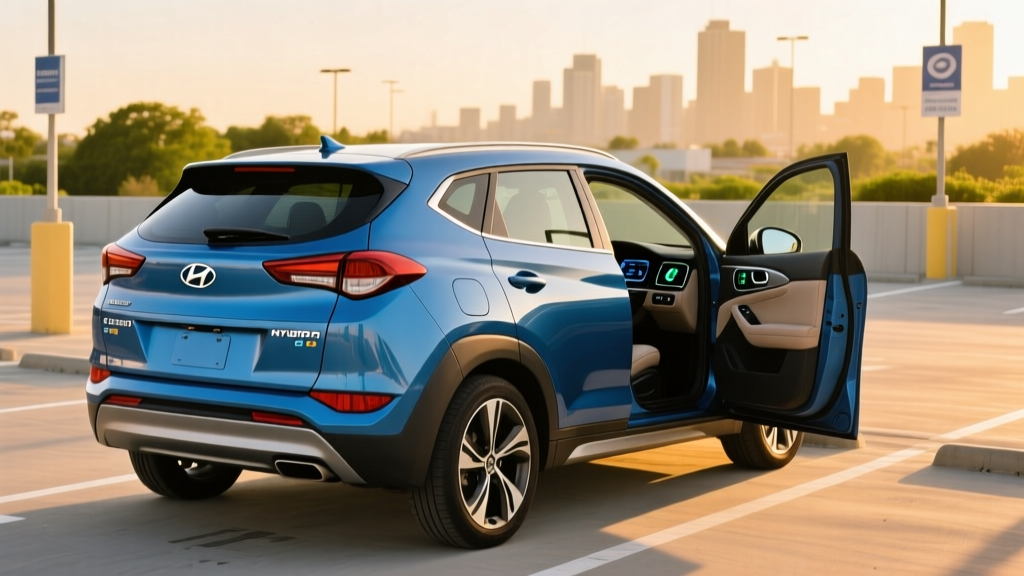
The Hyundai Tucson Hybrid Blue trim is the efficiency-focused variant of Hyundai's compact hybrid SUV lineup. For 2026, the Tucson Hybrid Blue targets buyers who want SUV practicality without the range anxiety or charging infrastructure demands of a full battery-electric vehicle. With an EPA-estimated 38 MPG combined, a 231-horsepower turbocharged hybrid powertrain, and a starting MSRP around $33,550, it occupies a compelling middle ground between the gas-only Tucson and the Tucson Plug-In Hybrid.
This guide covers everything you need to know about the Tucson Hybrid Blue — from real-world fuel economy and powertrain details to battery longevity, warranty coverage, and whether any federal tax credits apply. We'll also clarify the critical difference between this conventional hybrid (HEV) and its plug-in sibling, because confusing the two is one of the most common mistakes shoppers make.
HEV vs PHEV: Which Tucson Hybrid Are You Actually Looking At?
Hyundai sells two electrified Tucson variants, and the distinction matters enormously for your daily routine and wallet:
| Feature | Tucson Hybrid (HEV) — Blue Trim | Tucson Plug-In Hybrid (PHEV) |
|---|---|---|
| Drivetrain Type | Conventional hybrid — no plug needed | Plug-in hybrid — requires charging for EV mode |
| Electric-Only Range | None (EV assist only at low speeds) | ~33 miles EPA electric-only |
| Battery Capacity | ~1.49 kWh (small, self-charging) | 13.8 kWh usable |
| Charging Required? | No — regenerative braking + engine charges it | Yes — Level 1 or Level 2 plug-in |
| DC Fast Charging | Not applicable | Not available (AC only) |
| Federal Tax Credit (§30D) | Not eligible | Up to $7,500 (subject to sourcing/income rules) |
| Combined Power | 231 hp / 271 lb-ft torque | 268 hp / 271 lb-ft torque |
| Starting MSRP (2026) | ~$33,550 | ~$40,250 |
The bottom line: The Tucson Hybrid Blue is a conventional hybrid (HEV). You never plug it in. The gasoline engine and regenerative braking keep the small battery charged. If you want electric-only commuting capability and potential tax credit eligibility, you need the Tucson PHEV — a different vehicle at a different price point.
Fuel Economy: EPA Ratings and Real-World MPG
The headline number for the Tucson Hybrid Blue is its EPA-estimated fuel economy. Hyundai tunes the Blue trim specifically for maximum efficiency, using lighter wheels, lower-rolling-resistance tires, and aerodynamic tweaks compared to higher trims like the SEL Convenience or Limited.
| Driving Cycle | EPA Estimate | Real-World Expectation |
|---|---|---|
| City | 38 MPG | 39–42 MPG (hybrids excel in stop-and-go) |
| Highway | 38 MPG | 34–37 MPG (less regen benefit at sustained speed) |
| Combined | 38 MPG | 36–40 MPG depending on driving mix |
Why real-world city MPG often beats the EPA sticker: Conventional hybrids like the Tucson HEV recapture energy during braking and deceleration through regenerative braking. City driving with frequent stops gives the system more opportunities to recharge the battery and run the electric motor, reducing engine load. On the highway, the gasoline engine does most of the work at sustained speeds, which is why highway numbers don't get the same hybrid boost.
Cold weather impact: Expect a 5–10% fuel economy reduction in winter months (roughly 34–36 MPG combined). The engine runs more frequently to generate cabin heat, and battery chemistry is less efficient at low temperatures. This is normal for all hybrids and far less severe than the 20–30% range loss seen in full EVs during winter.
According to fueleconomy.gov, the Tucson Hybrid's combined rating places it among the most efficient compact SUVs in its class, trailing only the Toyota RAV4 Hybrid (39–41 MPG combined depending on trim) and competing closely with the Honda CR-V Hybrid (40 MPG combined AWD).
Powertrain Specs: What's Under the Hood
The Tucson Hybrid Blue uses Hyundai's Smartstream 1.6-liter turbocharged GDI four-cylinder engine paired with an electric motor integrated into the transmission housing. This is a parallel hybrid system — both the engine and motor can drive the wheels, and the system seamlessly blends power sources based on driving conditions.
| Specification | 2026 Tucson Hybrid Blue |
|---|---|
| Engine | 1.6L Turbo GDI 4-cylinder |
| Engine Power | 180 hp @ 5,500 rpm |
| Electric Motor | 47.7 kW (64 hp) |
| Combined System Output | 231 hp / 271 lb-ft torque |
| Transmission | 6-speed automatic (no CVT) |
| Drivetrain | AWD (HTRAC standard) |
| Hybrid Battery | ~1.49 kWh lithium-ion polymer |
| 0–60 mph | ~7.1 seconds (est.) |
| Towing Capacity | 2,000 lbs |
| Cargo Volume | 38.7 cu ft (rear seats up) / 80.3 cu ft (folded) |
The 6-speed automatic matters. Many competitors (Toyota RAV4 Hybrid, Honda CR-V Hybrid) use continuously variable transmissions (CVTs), which optimize efficiency but can create a droning sensation under hard acceleration. Hyundai's conventional 6-speed delivers more natural shift feel and better driving engagement — a deliberate trade-off that slightly reduces peak efficiency in exchange for drivability.
The 231 combined horsepower figure gives the Tucson Hybrid a meaningful advantage over the RAV4 Hybrid (219 hp) and makes highway merging and passing confident. HTRAC all-wheel drive is standard across all Tucson Hybrid trims, using the rear-mounted electric motor to send torque to the rear axle when needed.
Battery Longevity, Warranty, and Replacement Costs
Battery lifespan is consistently the top concern for hybrid buyers, and it's worth addressing directly with specifics rather than vague reassurance.
Hyundai Hybrid Battery Warranty Coverage
- Hybrid Battery: 10 years / 100,000 miles (whichever comes first)
- Hybrid System Components: 10 years / 100,000 miles (inverter, motor, controller)
- Original Owner: Warranty is transferable to second owners but may reduce to 5 years / 60,000 miles depending on state
- Capacity Threshold: Hyundai typically covers replacement if battery capacity drops below ~70% of original within the warranty period
Real-world degradation data: Hyundai's lithium-ion polymer hybrid batteries are small (~1.49 kWh) and operate within a narrow state-of-charge window — typically between 40% and 80%. This shallow cycling dramatically reduces degradation compared to full EVs that regularly cycle from 10% to 90%. Based on long-term fleet data from Hyundai and Kia hybrid platforms, most Tucson Hybrid batteries retain 85–90%+ of original capacity at 100,000 miles.
Out-of-warranty replacement cost: If a hybrid battery does fail outside the warranty window, a replacement battery pack for the Tucson Hybrid typically costs between $2,500 and $4,000 installed at a dealership. Independent hybrid specialists may offer refurbished packs for $1,500–$2,500. This is substantially less than full EV battery replacements ($10,000–$20,000+) because the hybrid pack is far smaller.
According to Hyundai's official warranty page, the 10-year/100,000-mile hybrid battery warranty is among the longest in the segment, matching Toyota and exceeding most competitors.
Pricing, Trims, and Tax Credit Eligibility
Understanding what you'll actually pay — and what incentives apply — requires separating the HEV from the PHEV, because the tax credit picture is completely different for each.
2026 Tucson Hybrid Blue Pricing
| Trim | MSRP | Federal Tax Credit |
|---|---|---|
| Blue (base hybrid) | ~$33,550 | Not eligible (§30D excludes HEVs) |
| SEL Convenience | ~$36,050 | Not eligible |
| Limited | ~$39,750 | Not eligible |
Federal tax credit reality for the Tucson Hybrid (HEV): The IRS §30D Clean Vehicle Credit applies only to plug-in electric vehicles — battery-electric vehicles (BEVs) and plug-in hybrids (PHEVs) with at least 7 kWh of battery capacity. Conventional hybrids like the Tucson Hybrid Blue do not qualify for the federal $7,500 credit. This is not a Hyundai-specific limitation; no conventional hybrid from any manufacturer qualifies.
What about the Tucson PHEV? The Tucson Plug-In Hybrid may qualify for up to $7,500 under §30D, but eligibility depends on several factors that change frequently:
- MSRP cap: SUVs must be under $80,000 MSRP (Tucson PHEV qualifies)
- Buyer income cap: AGI must not exceed $150,000 (single) / $300,000 (joint)
- Battery sourcing: Critical minerals and battery components must meet escalating domestic-content thresholds per IRS guidance
- Point-of-sale transfer: Eligible buyers can transfer the credit to the dealer for an immediate price reduction
Always verify current-year eligibility on the IRS website or with a tax professional before relying on the credit in your purchase decision, as sourcing requirements tighten annually.
Who Should Choose the Tucson Hybrid Blue — And Who Shouldn't
Pros
- 38 MPG combined with no plug-in requirement — zero lifestyle change from a gas car
- AWD standard, 231 hp, confident highway passing power
- 10-year/100,000-mile hybrid battery warranty
- Spacious cargo area (38.7 cu ft) with no battery-pack intrusion
- Natural 6-speed automatic — no CVT drone
- Lower starting price than PHEV or full EV competitors
Cons
- No electric-only driving mode — always uses gasoline
- No federal tax credit eligibility (HEV exclusion)
- Blue trim is sparsely equipped — key features require higher trims
- Towing limited to 2,000 lbs
- Doesn't match RAV4 Hybrid or CR-V Hybrid on EPA city MPG
Choose the Tucson Hybrid Blue if:
- You want SUV fuel economy without installing a home charger or relying on public charging
- Your daily commute is mixed city/highway and you want consistent MPG regardless of charging access
- You live in an apartment or lack dedicated parking with electrical access
- You want AWD capability for snow or rain without the cost of a PHEV or EV
- You plan to keep the vehicle 8–10 years and value Hyundai's long warranty
Look elsewhere if:
- You want electric-only commuting: The Tucson PHEV offers ~33 miles of EV range for daily driving under 30 miles, and may qualify for the $7,500 tax credit
- You want zero tailpipe emissions: A full EV like the Hyundai Ioniq 5 or Tesla Model Y eliminates gasoline entirely
- You prioritize maximum city MPG: The Toyota RAV4 Hybrid achieves 41 MPG city in LE trim, 3 MPG better in urban driving
- You need heavy towing: Neither the Tucson Hybrid nor PHEV exceeds 2,000 lbs; consider the gas Tucson (2,500 lbs) or a larger SUV
Tucson Hybrid vs PHEV vs Full EV: Which Fits Your Life?
| Factor | Tucson Hybrid (HEV) | Tucson PHEV | Hyundai Ioniq 5 (BEV) |
|---|---|---|---|
| Starting MSRP | ~$33,550 | ~$40,250 | ~$42,600 |
| Fuel/Energy Cost (annual, 15k mi) | ~$1,580 (gasoline) | ~$900–$1,400 (gas + electric) | ~$550–$800 (electric) |
| Home Charging Needed? | No | Recommended (Level 2 ideal) | Essential |
| Electric-Only Range | 0 miles | ~33 miles | ~303 miles (EPA) |
| Federal Tax Credit | $0 | Up to $7,500 | Up to $7,500 |
| Best For | No-charger households, budget-first buyers | Short commuters with home charging | Charging-access households wanting lowest operating cost |
The math favors the PHEV or BEV if you qualify for the tax credit and have home charging access — the $7,500 credit effectively brings the Tucson PHEV's net price close to the Hybrid SEL Convenience, and the Ioniq 5 undercuts both on annual energy cost. But if charging access is uncertain or you simply want the lowest upfront cost with zero infrastructure requirements, the Hybrid Blue is the pragmatic choice.
Frequently Asked Questions
How many MPG does the Hyundai Tucson Hybrid Blue get?
The EPA rates the Tucson Hybrid Blue at 38 MPG city, 38 MPG highway, and 38 MPG combined. In real-world city driving, many owners report 39–42 MPG thanks to regenerative braking. Highway driving typically yields 34–37 MPG. Cold weather reduces combined MPG by roughly 5–10%.
Does the Hyundai Tucson Hybrid need to be plugged in?
No. The Tucson Hybrid (HEV) is a conventional hybrid — it charges its own battery through the gasoline engine and regenerative braking. You never plug it in. Only the Tucson Plug-In Hybrid (PHEV) requires or accepts plug-in charging.
Does the Tucson Hybrid Blue qualify for any tax credit?
The Tucson Hybrid (HEV) does not qualify for the federal §30D Clean Vehicle Credit, which is limited to plug-in vehicles (BEVs and PHEVs). Some states offer their own hybrid incentives — check your state's energy or DMV website for current programs. The Tucson PHEV may qualify for up to $7,500 federally, subject to income, MSRP, and battery-sourcing rules.
How long will the Tucson Hybrid battery last and what does replacement cost?
Hyundai covers the hybrid battery for 10 years / 100,000 miles. Real-world data suggests most hybrid batteries retain 85–90%+ capacity at 100,000 miles due to shallow cycling. Out-of-warranty replacement costs approximately $2,500–$4,000 at a dealership, or $1,500–$2,500 from independent hybrid specialists using refurbished packs.
Is the Tucson Hybrid Blue reliable?
Hyundai's 1.6L turbo hybrid powertrain has been in service across multiple models (Tucson, Santa Fe, Sonata) since 2022 with generally positive reliability outcomes. The conventional hybrid system has fewer failure points than a PHEV (no onboard charger, smaller battery, no plug-in components). Hyundai's 10-year/100,000-mile powertrain warranty provides strong long-term coverage. Check NHTSA for the latest safety and reliability bulletins.
What's the difference between the Blue trim and other Tucson Hybrid trims?
The Blue trim is the efficiency-oriented base model. It uses lighter 18-inch wheels with low-rolling-resistance tires, has fewer standard luxury features (no leather, smaller infotainment screen vs. higher trims), and achieves the best MPG in the lineup. Higher trims (SEL Convenience, Limited) add features but may see a 1–2 MPG reduction due to heavier wheels and additional equipment.
Hybrid vs PHEV vs EV — which should I buy?
Choose the Hybrid (HEV) if you lack home charging access, want the lowest upfront cost, and don't want to change your fueling routine. Choose the PHEV if your daily commute is under 33 miles, you can install a Level 2 home charger, and you want electric-only daily driving with gasoline backup for road trips. Choose a full EV if you have reliable home charging, want the lowest operating cost, and are comfortable with 250+ miles of range and DC fast charging for longer trips.