Quick Verdict: The Midsize Hybrid Sedan Benchmark
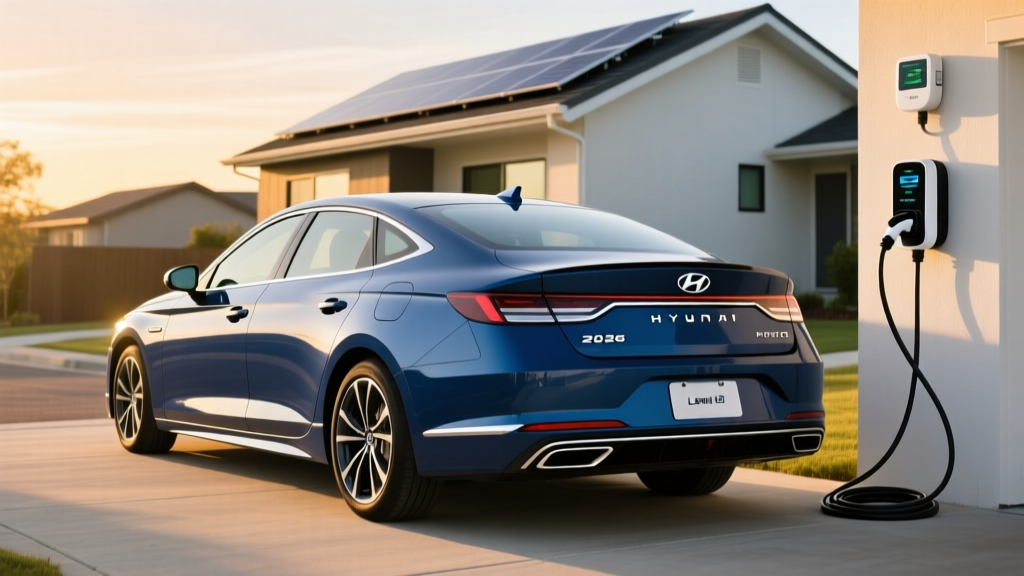
The 2026 Hyundai Sonata Hybrid remains one of the most fuel-efficient midsize sedans you can buy without plugging in. With an EPA-estimated 47 MPG combined, a proven 192-horsepower hybrid powertrain, and a starting MSRP around $30,250, it undercuts the Toyota Camry Hybrid on price while matching it on efficiency. For buyers who want dramatic fuel savings without changing their refueling habits, the Sonata Hybrid is a compelling, data-backed choice.
| Spec | Value |
|---|---|
| Powertrain | 2.0L GDI 4-cyl + electric motor (HEV) |
| Combined Horsepower | 192 hp |
| EPA MPG (City / Hwy / Combined) | 50 / 43 / 47 |
| Fuel Tank Capacity | 13.2 gallons |
| Total Driving Range | ~620 miles |
| 0–60 mph | ~7.5 seconds |
| Transmission | 6-speed automatic (no CVT) |
| Hybrid Battery | 1.76 kWh lithium-ion polymer |
| Hybrid Battery Warranty | 10 years / 100,000 miles |
| Base MSRP (Blue trim) | $30,250 |
| Federal Tax Credit (§30D) | Not eligible (HEV, not PHEV/BEV) |
HEV vs. PHEV: What the Sonata Hybrid Actually Is
A common source of confusion in the Hyundai lineup is the difference between the Sonata Hybrid (HEV) and a plug-in hybrid (PHEV). The 2026 Sonata Hybrid is a conventional hybrid. It does not have a charge port, cannot be plugged in, and has no meaningful electric-only driving range. Instead, its small 1.76 kWh battery is charged entirely through regenerative braking and the gasoline engine.
| Feature | Sonata Hybrid (HEV) | Typical PHEV | Full EV (BEV) |
|---|---|---|---|
| Plug-in Required? | No | Yes (for EV range) | Yes |
| Electric-Only Range | ~1 mile at low speed | 25–45 miles | 200–400 miles |
| Gasoline Engine | Yes (primary) | Yes (backup) | No |
| Fuel Economy | 47 MPG combined | 35–45 MPG (after EV range) | N/A (MPGe) |
| Federal Tax Credit | None | Up to $7,500 (§30D) | Up to $7,500 (§30D) |
| Home Charging Needed? | No | Recommended | Essential |
| Best For | No garage/outlet access | Short commutes + road trips | Home charging + daily driving |
Important note: Hyundai discontinued the Sonata Plug-in Hybrid after the 2020 model year in the U.S. market. If you want a Hyundai PHEV sedan in 2026, you would need to look at the used market or consider the Tucson PHEV crossover instead.
Fuel Economy: EPA Ratings and Real-World MPG
The Sonata Hybrid's headline number is its EPA rating, but real-world results depend heavily on your driving mix.
| Driving Cycle | EPA Rating |
|---|---|
| City | 50 MPG |
| Highway | 43 MPG |
| Combined | 47 MPG |
Real-World MPG: What Owners Actually See
Hybrids like the Sonata benefit enormously from city driving, where regenerative braking recovers energy and the electric motor handles low-speed propulsion. In mixed suburban and city driving, many owners report 48–52 MPG, slightly exceeding the EPA combined figure. This is typical for conventional hybrids — the EPA city test cycle actually underestimates how much regen braking helps in stop-and-go traffic.
However, on sustained highway trips at 75+ mph, expect the number to drop to 39–42 MPG. The gasoline engine is doing nearly all the work at those speeds, and aerodynamic drag dominates. In cold weather (below 32°F), the engine runs more frequently to maintain cabin heat, which can reduce city MPG to the low-to-mid 40s. According to fueleconomy.gov, the Sonata Hybrid's combined rating of 47 MPG places it among the top non-plug-in midsize sedans.
At a national average gas price of $3.15 per gallon and 12,000 miles driven annually, the Sonata Hybrid costs roughly $804 per year in fuel. Compare that to a similarly sized gasoline-only midsize sedan averaging 30 MPG combined, which would cost about $1,260 annually — a savings of approximately $456 per year.
Powertrain and Driving Dynamics
The Sonata Hybrid pairs a 2.0-liter gasoline direct-injection (GDI) four-cylinder engine with a 39 kW (52 hp) electric motor integrated into the transmission housing. Combined system output is 192 horsepower and 271 lb-ft of torque. Unlike most competitors that use continuously variable transmissions (CVTs), Hyundai uses a traditional 6-speed automatic, which gives the Sonata Hybrid a more natural, linear acceleration feel that many drivers prefer over the rubber-band sensation of a CVT.
The 0–60 mph sprint takes approximately 7.5 seconds — adequate for merging and passing, though not sporty. The electric motor provides instant torque fill at low RPMs, making the car feel peppier around town than the horsepower figure alone suggests. Hyundai's Active Shift Control technology synchronizes motor speed with transmission shifts, reducing shift shock and improving durability.
Three drive modes are available: Eco (maximizes electric assist and softens throttle response), Normal, and Sport (increases engine engagement and sharpens steering). In Eco mode, the car can creep on electric power alone at very low speeds (under ~15 mph in light-throttle situations), though this is not a usable "EV mode" in any practical sense.
Pricing, Trims, and Tax Credit Eligibility
The 2026 Sonata Hybrid is offered in three trims, all well-equipped:
| Trim | MSRP (incl. destination) | Key Features |
|---|---|---|
| Blue | $30,250 | 17" wheels, 12.3" digital cluster, wireless CarPlay/Android Auto, Hyundai SmartSense ADAS |
| SEL | $33,400 | Heated front seats, leatherette, sunroof, wireless charging pad, blind-spot cameras |
| Limited | $37,750 | Nappa leather, ventilated front seats, 12.3" nav touchscreen, Bose audio, highway driving assist |
Federal Tax Credit: Not Eligible
Because the Sonata Hybrid is a conventional HEV — not a plug-in hybrid or battery electric vehicle — it does not qualify for the IRS §30D Clean Vehicle Credit. That credit, which can provide up to $7,500, is reserved for vehicles with a charge port and a battery of at least 7 kWh that meet critical-mineral and battery-component sourcing requirements per current IRS guidelines.
Some states offer their own hybrid incentives. For example, certain states have offered rebate programs for hybrids in the past, but these vary by jurisdiction and change frequently. Check your state's energy office or department of environmental quality for current programs. The Sonata Hybrid's lower starting price compared to PHEV and BEV alternatives partly offsets the lack of a federal credit.
Battery Warranty, Reliability, and Replacement Cost
Hyundai Hybrid Battery Warranty: 10 years / 100,000 miles (whichever comes first). This covers defects and capacity loss below a functional threshold. Hyundai's hybrid battery warranty is among the longest in the industry, matching or exceeding Toyota's 10-year/150,000-mile coverage in most states.
How Long Will the Hybrid Battery Last?
The Sonata Hybrid's 1.76 kWh lithium-ion polymer battery is far smaller than an EV battery, and it operates within a narrow state-of-charge window (typically 40–80% SoC) managed by the vehicle's battery management system. This shallow cycling dramatically reduces degradation. Based on historical data from Hyundai's hybrid fleet (Sonata, Ioniq, Tucson), these batteries routinely last 150,000–200,000+ miles without significant capacity loss.
The hybrid battery is not the same chemistry or scale as an EV pack. Replacement cost, if needed out of warranty, typically ranges from $2,000 to $3,500 including labor at a dealership. Independent hybrid specialists may offer refurbished units for $1,200–$2,000. However, given the 10-year warranty and the battery's shallow-cycle design, most owners will never face this expense.
Overall Reliability
The Sonata Hybrid's powertrain has been in production since the 2011 model year with iterative improvements. The 2.0L GDI engine is a mature design, and the 6-speed automatic eliminates the complexity and failure modes associated with CVTs. The IIHS has historically rated the Sonata highly for crashworthiness, and Hyundai's standard SmartSense suite includes forward collision-avoidance assist, lane-keeping assist, blind-spot collision warning, and rear cross-traffic collision-avoidance assist across all trims.
Sonata Hybrid vs. the Competition
The midsize hybrid sedan segment is competitive. Here's how the Sonata Hybrid stacks up against its primary rivals on the metrics that matter:
| Spec | Hyundai Sonata Hybrid | Toyota Camry Hybrid | Honda Accord Hybrid |
|---|---|---|---|
| EPA Combined MPG | 47 | 51 (LE AWD: 44) | 48 |
| Combined HP | 192 | 225 (AWD) | 204 |
| 0–60 mph | ~7.5 sec | ~7.0 sec | ~7.4 sec |
| Transmission | 6-speed auto | eCVT | eCVT (2-motor) |
| Base MSRP | $30,250 | $29,495 | $33,655 |
| Battery Warranty | 10 yr / 100k mi | 10 yr / 150k mi | 8 yr / 100k mi |
| Cargo Volume | 16.0 cu ft | 15.1 cu ft | 16.7 cu ft |
The Camry Hybrid leads on combined MPG (51 in FWD LE trim) and offers all-wheel drive, which the Sonata Hybrid does not. The Accord Hybrid provides the most cargo space and a slightly more refined interior. The Sonata Hybrid's advantages are its conventional automatic transmission (no CVT), strong warranty, and competitive pricing that undercuts the Accord by over $3,000.
Who Should Buy the Sonata Hybrid?
Choose the Sonata Hybrid If:
- You want 45+ MPG without installing a home charger or changing your refueling routine
- You drive a mix of city and highway miles and want real-world MPG that often exceeds the EPA sticker
- You prefer a traditional automatic transmission over a CVT
- You want a long 10-year hybrid battery warranty for peace of mind
- You don't qualify for — or don't want to depend on — federal EV tax credits
- You need a comfortable, well-equipped midsize sedan under $38,000 fully loaded
Look Elsewhere If:
- You have home charging access and a short commute — a PHEV like the Toyota Prius Prime (44 mi EV range) could eliminate your gas usage entirely on weekdays
- You need all-wheel drive — the Camry Hybrid AWD or a PHEV SUV like the Tucson PHEV would be better
- You want to maximize federal tax incentives — a qualifying BEV or PHEV can net up to $7,500 under §30D
- You prioritize cargo space above all else — the Accord Hybrid offers 16.7 cu ft vs. the Sonata's 16.0 cu ft
- You want a sportier driving experience — consider the Honda Accord Hybrid Sport or a non-hybrid alternative
Frequently Asked Questions
How many MPG does the 2026 Hyundai Sonata Hybrid get?
The EPA rates the Sonata Hybrid at 50 MPG city, 43 MPG highway, and 47 MPG combined. In real-world mixed driving, many owners see 48–52 MPG, while sustained highway driving at higher speeds typically yields 39–42 MPG.
Does the Sonata Hybrid need to be plugged in?
No. The Sonata Hybrid is a conventional hybrid (HEV), not a plug-in hybrid. It charges its small battery entirely through regenerative braking and the gasoline engine. You fuel it like any other car at a gas station.
Is there a plug-in hybrid version of the Sonata?
Hyundai discontinued the Sonata Plug-in Hybrid in the U.S. after the 2020 model year. For 2026, the Sonata is offered only as a conventional hybrid. If you want a Hyundai PHEV, the Tucson PHEV crossover is the closest current alternative.
Does the Sonata Hybrid qualify for a federal tax credit?
No. The IRS §30D Clean Vehicle Credit applies only to plug-in electric vehicles (PHEVs and BEVs) with a battery capacity of at least 7 kWh and a charge port. The Sonata Hybrid's 1.76 kWh battery does not meet these requirements. Check with a tax professional or your state's energy office for any local incentives.
How long will the hybrid battery last, and what does replacement cost?
Hyundai covers the hybrid battery for 10 years or 100,000 miles. Based on historical fleet data, these batteries commonly last 150,000–200,000+ miles due to shallow charge cycling. Out-of-warranty replacement typically costs $2,000–$3,500 at a dealership, or $1,200–$2,000 for a refurbished unit from an independent specialist.
Hybrid vs. PHEV vs. EV — which should I choose?
If you lack home charging access or frequently take long road trips, a conventional hybrid like the Sonata Hybrid is the lowest-friction choice. If you have a garage with a 120V or 240V outlet and a commute under 40 miles, a PHEV can eliminate most weekday gas use while retaining a gas engine for longer trips. If you have reliable home charging and mostly drive under 250 miles per day, a full BEV offers the lowest per-mile energy cost and zero tailpipe emissions.
Does the Sonata Hybrid have all-wheel drive?
No. The 2026 Sonata Hybrid is front-wheel drive only. If AWD is a priority, the Toyota Camry Hybrid offers an available electronic AWD system, or you could consider a hybrid or PHEV crossover like the Hyundai Tucson Hybrid.