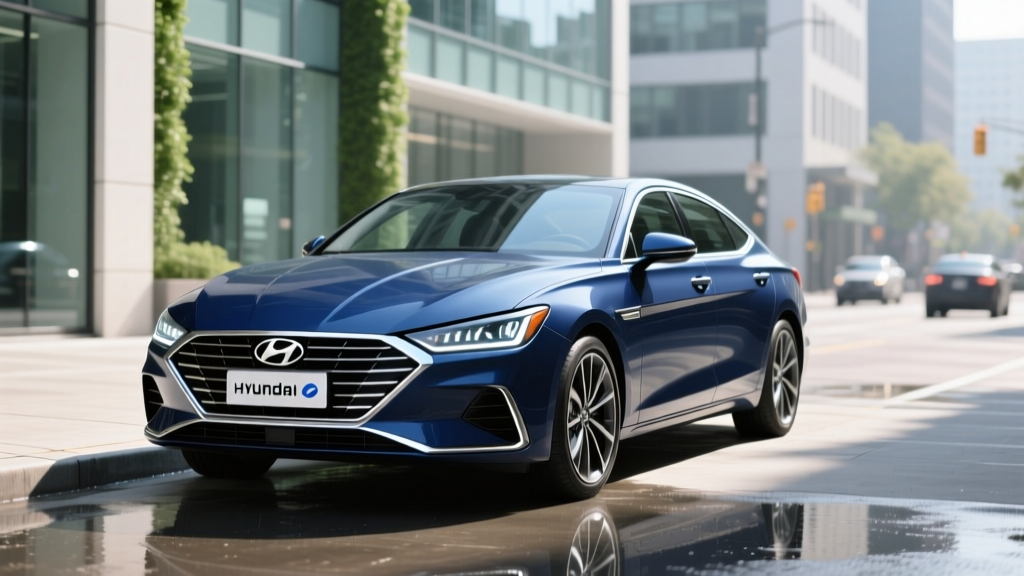
If you are researching a midsize sedan that sips fuel without requiring a charger in your garage, the Hyundai Sonata Hybrid lands in a narrow sweet spot: genuine 50+ MPG efficiency, a conventional hybrid powertrain that needs no plug, and a starting price that undercuts many gasoline rivals once you factor in fuel savings. But the sticker price is only half the story. This guide breaks down the real numbers behind a Hyundai Sonata Hybrid finance plan — monthly payments, fuel savings, battery longevity, and whether this HEV makes more sense than a PHEV or full EV for your commute.
2026 Hyundai Sonata Hybrid: Powertrain and Efficiency Specs
The current-generation Sonata Hybrid pairs a 2.0-liter four-cylinder engine with a front-mounted electric motor and a compact lithium-ion battery pack. Unlike a plug-in hybrid, the battery recharges through regenerative braking and the engine — you never plug it in. Hyundai routes power through a 6-speed automatic transmission rather than a CVT, which gives it a more natural driving feel under hard acceleration.
| Specification | Value |
|---|---|
| Engine | 2.0L GDI 4-cylinder |
| Electric Motor | 39 kW (52 hp) permanent-magnet synchronous |
| Combined System Output | 192 hp |
| Transmission | 6-speed automatic |
| Drivetrain | FWD |
| Hybrid Battery | ~1.6 kWh lithium-ion (self-charging) |
| EPA MPG (Blue trim) | 50 city / 54 highway / 52 combined |
| EPA MPG (SEL/Limited) | 44 city / 51 highway / 47 combined |
| Fuel Tank | 13.2 gallons |
| Total Range (Blue) | ~686 miles |
| 0–60 mph | ~7.5 seconds |
| Starting MSRP (Blue) | $30,250 |
The Blue trim is the efficiency champion. Its lighter weight and lower-resistance tires squeeze out an extra 5 combined MPG over the SEL and Limited trims, which add features like leather seats, a panoramic sunroof, and larger wheels. If you prioritize luxury over maximum fuel savings, the 47 MPG combined from the upper trims is still exceptional.
Real-World MPG: What Owners Actually See
Hyundai's EPA estimates for the Sonata Hybrid are conservative in the best way. In real-world mixed driving, owners and independent testers consistently report matching or slightly exceeding the EPA city figure. This is typical of conventional hybrids: stop-and-go traffic lets the electric motor do more work, and regenerative braking recaptures energy that a gas car wastes as heat.
- City commuting (stop-and-go): 52–56 MPG — often exceeds EPA
- Highway cruising (70–75 mph): 47–50 MPG — slight drop vs. EPA due to aero drag
- Cold weather (below 30°F): 42–46 MPG — engine runs more for cabin heat
- Mountainous terrain: 40–45 MPG — sustained grades reduce regen advantage
Source: Owner-reported data on fueleconomy.gov and independent testing.
On a 300-mile highway road trip at 75 mph, expect roughly 48 MPG in moderate temperatures — a negligible drop from the 54 highway sticker. In winter, the engine cycles on more frequently to heat the cabin, which can shave 5–8 MPG off city figures. This is a minor penalty compared to the 20–30% range loss a full EV experiences in cold weather.
Hyundai Sonata Hybrid Finance: Monthly Cost Breakdown
Let's model a realistic finance scenario. Assume you are purchasing a 2026 Sonata Hybrid Blue at its $30,250 MSRP, with a $2,500 down payment, 60-month loan term, and a 5.9% APR (a representative rate for good credit in the current lending environment).
| Item | Amount |
|---|---|
| MSRP | $30,250 |
| Down Payment | -$2,500 |
| Financed Amount | $27,750 |
| Loan Term | 60 months |
| APR | 5.9% |
| Estimated Monthly Payment | ~$536 |
| Total Interest Paid | ~$4,410 |
| Total Cost of Loan | ~$32,160 |
Hyundai Motor Finance frequently offers promotional APRs — sometimes as low as 1.9% or 2.9% for well-qualified buyers — which can drop that monthly payment by $40–$60. Always compare the dealer's finance offer against pre-approval from a credit union or bank. Hyundai also runs loyalty and conquest cash incentives periodically that can reduce the capitalized cost by $500–$1,500.
Fuel Savings vs. a Gas-Only Midsize Sedan
The finance picture is incomplete without factoring in fuel cost. Compare the Sonata Hybrid Blue (52 combined MPG) against a typical gas-only midsize sedan averaging 30 combined MPG, driving 15,000 miles per year at $3.40 per gallon:
| Vehicle | Combined MPG | Gallons/Year | Annual Fuel Cost |
|---|---|---|---|
| Sonata Hybrid Blue | 52 | 288 | $979 |
| Gas Midsize Sedan | 30 | 500 | $1,700 |
| Annual Savings with Sonata Hybrid | ~$721 | ||
Over a 5-year loan term, that's roughly $3,600 in fuel savings — enough to offset most of the interest paid on the loan. Over 10 years of ownership, the savings approach $7,200, making the hybrid premium pay for itself several times over.
HEV vs. PHEV vs. EV: Which Sonata Fits Your Life?
Hyundai has offered the Sonata in hybrid form for years, but it's critical to distinguish the conventional hybrid (HEV) discussed here from a plug-in hybrid (PHEV) or a full battery-electric vehicle (BEV). Each has different infrastructure requirements and cost profiles.
| Factor | HEV (Sonata Hybrid) | PHEV (e.g., Toyota Prius Prime) | BEV (e.g., Hyundai Ioniq 6) |
|---|---|---|---|
| Plug-in Required? | No — self-charging | Yes — Level 1 or 2 | Yes — Level 2 recommended |
| Electric-Only Range | None (EV assist only) | 25–44 miles typical | 250–360+ miles |
| Home Charging Setup | Not needed | 120V outlet minimum | 240V Level 2 ideal |
| EPA Efficiency | 47–52 MPG | 48–52 MPG + 100+ MPGe | 100–140 MPGe |
| Federal Tax Credit (§30D) | Not eligible | Up to $7,500 (if sourcing rules met) | Up to $7,500 (if sourcing rules met) |
| Starting Price Range | $30,250 | $33,000–$40,000 | $38,000–$55,000 |
| Best For | No home charging access, long highway commutes | Short daily commute + home charging | Home charging + daily commute under 300 mi |
If you live in an apartment without charging access, or regularly drive 400+ mile road trips, the Sonata Hybrid (HEV) is the pragmatic pick. You get massive fuel savings with zero lifestyle change. If you have a garage and a short commute, a PHEV lets you drive on electricity most weekdays while keeping a gas engine for road trips. A full EV eliminates gas entirely but requires reliable home or workplace charging.
Battery Warranty, Reliability, and Replacement Cost
Hybrid battery anxiety is the single most common concern among first-time hybrid buyers. Here's the reassurance: modern hybrid batteries are engineered for longevity, and Hyundai backs its hybrid components with one of the best warranties in the industry.
- Hybrid Battery: 10 years / 100,000 miles (whichever comes first)
- Hybrid System Components (motor, inverter): 10 years / 100,000 miles
- Powertrain (engine, transmission): 10 years / 100,000 miles
- New Vehicle Limited: 5 years / 60,000 miles
For the original owner, Hyundai's hybrid battery warranty is among the longest available. Some states with California emissions standards (CARB states) may extend hybrid battery coverage further. Check your state-specific terms on Hyundai's owner site or with your dealer.
Real-World Battery Lifespan
The Sonata Hybrid's ~1.6 kWh battery pack is small and never fully charged or fully depleted — the hybrid system keeps it in a narrow state-of-charge window (roughly 40–80%) to minimize stress. This partial-cycling strategy is why hybrid batteries routinely outlast their warranty periods. Data from earlier-generation Sonata Hybrids and Toyota Prius fleets shows hybrid batteries commonly reaching 150,000–200,000 miles before capacity loss becomes noticeable.
Battery Replacement Cost
If the hybrid battery does fail outside warranty, replacement costs for the Sonata Hybrid typically range from $2,000 to $4,000 for the battery pack, plus $500–$800 in labor. Refurbished or reconditioned packs from third-party suppliers can reduce this to $1,500–$2,500. This is far less expensive than a full EV battery replacement ($8,000–$20,000+), because the hybrid pack is much smaller.
According to reliability data tracked by IIHS and owner surveys, the Sonata Hybrid has demonstrated solid build quality. The conventional automatic transmission (rather than a CVT) also removes a common failure point found in some competing hybrids.
Tax Credits and Incentives: What the Sonata Hybrid Qualifies For
Here's where the finance picture gets nuanced. The conventional Sonata Hybrid (HEV) does not qualify for the federal §30D Clean Vehicle Credit — that credit is reserved for plug-in hybrids (PHEVs) and battery-electric vehicles (BEVs) that meet battery-sourcing and critical-mineral requirements outlined by the IRS.
- Federal §30D Credit ($7,500 max): Not eligible — HEV, not a plug-in vehicle.
- Used Clean Vehicle Credit (§25E, up to $4,000): Not eligible — applies only to plug-in vehicles.
- State/Local Incentives: Varies by jurisdiction. Some states offer rebates for any high-efficiency vehicle. Check your state energy office or fueleconomy.gov's incentive finder.
- Employer Commuter Benefits: Some employers offer pre-tax commuter benefits that can be applied to hybrid vehicle expenses or transit alternatives.
- Insurance Discounts: Several insurers (Geico, Liberty Mutual, others) offer 5–10% discounts for hybrid/electric vehicles — ask your agent.
While the lack of a federal tax credit stings, the Sonata Hybrid's lower MSRP compared to PHEV and EV alternatives often results in a lower total cost of ownership anyway — especially when you factor in no home charger installation ($500–$2,000) and no electricity cost for charging.
Pros, Cons, and the Verdict
- 52 combined MPG (Blue trim) — among the best in the midsize segment
- No plug-in charging required — zero infrastructure investment
- 10-year / 100,000-mile hybrid battery and powertrain warranty
- 6-speed automatic feels more natural than competitor CVTs
- 686+ mile total range — fewer fill-ups on road trips
- Competitive starting price at $30,250
- Strong standard safety tech (forward collision avoidance, lane keeping, blind spot monitoring)
- No federal tax credit eligibility (HEV limitation)
- 192 hp is adequate, not sporty — highway passing requires planning
- Higher trims (SEL/Limited) drop to 47 combined MPG
- No AWD option (available on Toyota Camry Hybrid)
- Rear-seat headroom slightly tighter than some competitors due to roofline
- Hybrid battery replacement ($2,000–$4,000) if it fails outside warranty
Who Should Buy the Sonata Hybrid — and Who Shouldn't
- You want 50+ MPG without installing a home charger or changing your fueling habits
- Your commute is a mix of city and highway driving (where hybrids shine)
- You take regular road trips exceeding 300 miles and don't want to plan charging stops
- You want a long warranty safety net on the hybrid system
- Your budget is $30,000–$36,000 and you want maximum fuel savings per dollar
- You have home charging and a short daily commute (under 30 miles) — a PHEV lets you drive mostly on electricity
- You want to qualify for the $7,500 federal tax credit (requires a PHEV or BEV that meets sourcing rules)
- You want zero tailpipe emissions during daily driving (PHEV in EV mode, or BEV)
- You prioritize acceleration — full EVs typically deliver 0–60 in 5 seconds or less
Frequently Asked Questions
How many MPG does the Hyundai Sonata Hybrid get?
The Blue trim achieves an EPA-estimated 50 city / 54 highway / 52 combined MPG. The SEL and Limited trims rate at 44 city / 51 highway / 47 combined. Real-world city driving often matches or slightly exceeds EPA figures thanks to regenerative braking. Highway driving at sustained 75 mph typically yields 47–50 MPG for the Blue trim.
Does the Sonata Hybrid need to be plugged in?
No. The Sonata Hybrid is a conventional hybrid (HEV). Its small battery recharges through regenerative braking and the gasoline engine. You fuel it like any other car at a gas station. This is fundamentally different from a plug-in hybrid (PHEV), which has a larger battery and an electric-only driving mode that requires plug-in charging to access.
Is the Hyundai Sonata Hybrid reliable, and what does battery replacement cost?
Hyundai's hybrid system has demonstrated strong reliability across multiple model years. The hybrid battery is covered by a 10-year / 100,000-mile warranty for the original owner. If replacement is needed outside warranty, expect to pay $2,000–$4,000 for the battery pack plus labor. Refurbished packs are available for $1,500–$2,500. The small battery pack is cycled in a narrow charge window, which significantly extends its lifespan — many hybrid batteries reach 150,000+ miles without issue.
Does the Sonata Hybrid qualify for any tax credit?
The conventional Sonata Hybrid (HEV) does not qualify for the federal §30D Clean Vehicle Credit, which is limited to plug-in hybrids and battery-electric vehicles. Some states may offer incentives for high-efficiency vehicles, and some insurance companies offer hybrid discounts. Check fueleconomy.gov for state-specific programs.
How does the Sonata Hybrid compare to the Toyota Camry Hybrid?
The Camry Hybrid offers slightly higher combined MPG (up to 53 on the LE trim) and an available AWD powertrain, which the Sonata Hybrid lacks. The Sonata counters with a longer hybrid warranty (10/100k vs. Toyota's 10/150k on hybrid battery but 5/60k on powertrain for newer models), a more traditional automatic transmission feel, and competitive pricing. Both are excellent choices — the decision often comes down to AWD needs, styling preference, and dealer proximity.
What is the best way to finance a Hyundai Sonata Hybrid?
Start by checking Hyundai Motor Finance for promotional APR rates, which can be as low as 1.9–2.9% for qualified buyers. Then compare against pre-approval from a credit union or online lender. A 60-month term balances monthly affordability with total interest paid. If you can put $3,000–$5,000 down, you'll reduce interest costs significantly. Factor in the ~$721 annual fuel savings vs. a gas sedan — that savings effectively reduces your true monthly transportation cost by about $60.