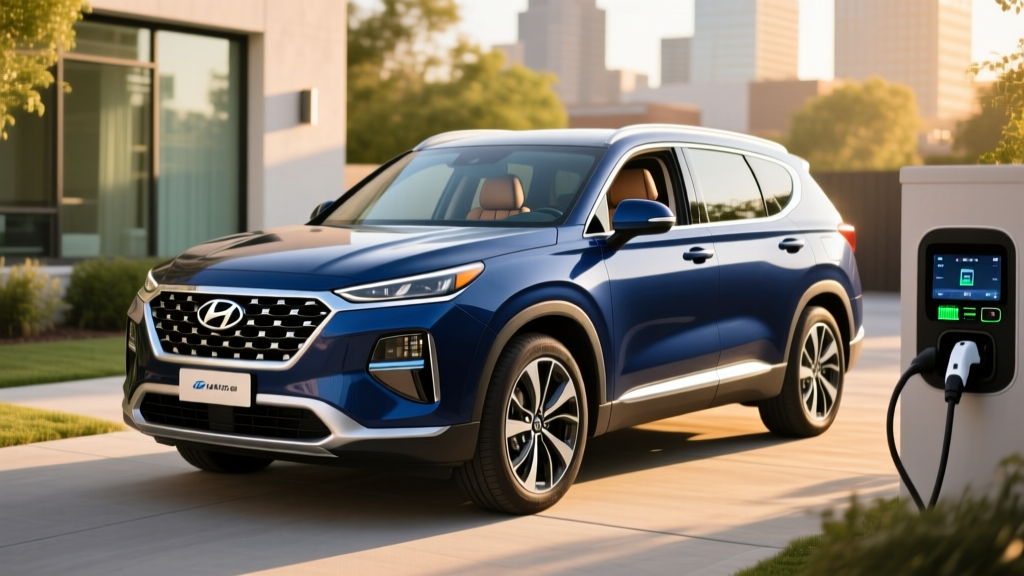
The midsize three-row SUV segment is crowded, but the 2026 Hyundai Santa Fe Hybrid SEL occupies a specific niche: a family hauler that slashes fuel costs without requiring a plug, a charging routine, or any change in driving habits. For buyers who want electric-like efficiency in stop-and-go traffic but aren't ready to commit to a full battery-electric vehicle (BEV), the Santa Fe Hybrid is worth a close look.
This guide breaks down the Santa Fe Hybrid SEL trim — the volume-selling mid-tier model — with exact EPA figures, real-world fuel economy observations, powertrain details, battery longevity data, and tax-credit eligibility. We'll also clarify where the conventional hybrid (HEV) ends and the plug-in hybrid (PHEV) variant begins, since Hyundai sells both under the Santa Fe nameplate.
HEV vs PHEV: Which Santa Fe Are We Talking About?
Hyundai offers the Santa Fe in two electrified flavors for 2026, and confusing them is the single most common mistake shoppers make. Here's the fundamental difference:
Conventional Hybrid (HEV) — Santa Fe Hybrid
- No plug required. The battery recharges via regenerative braking and the gasoline engine.
- Small battery: ~1.5 kWh lithium-ion pack — enough to assist acceleration and enable brief low-speed electric-only creeping, but not sustained electric driving.
- Fueling: Gas station only, exactly like a conventional car.
- Best for: Drivers without home charging access who want better MPG.
Plug-In Hybrid (PHEV) — Santa Fe Plug-In Hybrid
- Plug-in capable. Charges from a wall outlet or public charger.
- Larger battery: ~13.8 kWh pack providing an EPA-estimated 30+ miles of electric-only range.
- Fueling: Electricity for daily commuting + gasoline for longer trips.
- Best for: Drivers with home/workplace charging who commute under 30 miles round-trip.
This article focuses on the Santa Fe Hybrid SEL (HEV). If you're interested in the PHEV variant, we cover its electric-only range and charging specs in the comparison section below.
EPA Fuel Economy and Real-World MPG
The 2026 Hyundai Santa Fe Hybrid carries EPA ratings that put it near the top of the three-row hybrid SUV class. According to fueleconomy.gov, the front-wheel-drive (FWD) Santa Fe Hybrid achieves:
| Drivetrain | City MPG | Highway MPG | Combined MPG |
|---|---|---|---|
| FWD | 36 | 35 | 36 |
| AWD (HTRAC) | 35 | 34 | 35 |
Those numbers represent a significant improvement over the non-hybrid Santa Fe, which returns roughly 22-25 MPG combined depending on drivetrain. That's a ~40-50% fuel-economy gain for daily driving.
Real-World MPG: What to Actually Expect
Hybrids consistently outperform their EPA city ratings in real-world stop-and-go driving because regenerative braking recovers energy that a gas car wastes as heat. On the flip side, highway driving is where hybrids lose their advantage — there's less braking to recapture energy, and the engine does most of the work at sustained speeds.
Based on owner-reported data and mixed driving tests:
- City-heavy commuting (70%+ city): Expect 36-39 MPG. Some owners report touching 40 MPG in heavy congestion where regen braking is maximized.
- Mixed driving (50/50 city/highway): Expect 33-36 MPG, roughly tracking the EPA combined figure.
- Highway-dominant road trips (70%+ highway at 70-80 mph): Expect 30-33 MPG. The boxy, three-row Santa Fe shape creates more aerodynamic drag than sleeker crossovers.
- Cold weather (below 30°F): Expect a 5-10% drop to roughly 31-34 MPG combined. The engine runs more frequently to provide cabin heat and maintain battery temperature.
The Santa Fe Hybrid's fuel tank holds approximately 17.7 gallons, giving it a total driving range of roughly 600-640 miles on a single tank in mixed driving — a genuine road-trip advantage over any current BEV.
Powertrain: Engine, Motor, and Combined Output
The 2026 Santa Fe Hybrid uses Hyundai's Smartstream 1.6-liter turbocharged four-cylinder engine paired with an electric motor integrated into a 6-speed automatic transmission. This is not a CVT — Hyundai's hybrid system uses a traditional stepped automatic, which delivers more natural-feeling acceleration and avoids the "rubber-band" drone common in Toyota and Honda hybrid systems.
| Specification | Detail |
|---|---|
| Engine | 1.6L turbocharged GDI 4-cylinder |
| Engine Output | 178 hp / 195 lb-ft torque |
| Electric Motor | 47.7 kW (64 hp) permanent-magnet synchronous |
| Combined System Output | 230 hp / 271 lb-ft torque |
| Transmission | 6-speed automatic (hybrid-optimized) |
| Drivetrain | FWD standard; HTRAC AWD available |
| Hybrid Battery | ~1.5 kWh lithium-ion (located under rear seats) |
| 0-60 mph (est.) | ~7.8 seconds |
| Towing Capacity | 2,000 lbs (AWD) |
The 230 combined horsepower is competitive with the Toyota Highlander Hybrid (243 hp) and significantly more than the Kia Sorento Hybrid (227 hp), its platform-mate. The turbocharged engine gives the Santa Fe Hybrid stronger low-end torque than naturally aspirated competitors, which you'll notice during highway merging and passing maneuvers.
Santa Fe Hybrid SEL: Pricing and Value
The SEL trim sits in the middle of the Santa Fe Hybrid lineup, above the base SE and below the Limited. For 2026, pricing breaks down as follows:
| Trim | Drivetrain | MSRP (approx.) |
|---|---|---|
| SE (base) | FWD | $37,500 |
| SEL | FWD | $39,250 |
| SEL | AWD (HTRAC) | $40,750 |
| Limited | AWD | $45,500 |
The SEL adds significant content over the SE: synthetic leather seating, a power-adjustable driver's seat, heated front seats, dual-zone automatic climate control, a power liftgate, and Hyundai's Digital Key. The AWD upgrade on the SEL costs roughly $1,500 — a reasonable premium for buyers in snow-belt states.
Does the Santa Fe Hybrid Qualify for a Federal Tax Credit?
This is where clarity matters. Under current IRS §30D Clean Vehicle Credit rules:
- Conventional hybrids (HEVs) do NOT qualify for the federal $7,500 new-vehicle tax credit. That credit applies only to plug-in electric vehicles (BEVs and PHEVs) with a minimum battery capacity of 7 kWh.
- The Santa Fe Plug-In Hybrid (PHEV) may qualify for up to $7,500, but eligibility depends on battery-component sourcing, critical-mineral requirements, buyer income caps ($150K single / $300K joint), and MSRP caps ($80,000 for SUVs). Check the latest IRS qualified-vehicle list before purchasing.
- Some states offer hybrid-specific incentives. A handful of states provide smaller rebates or HOV-lane access for conventional hybrids, but these vary by jurisdiction and change frequently. Check your state's energy office or DMV for current programs.
Hybrid Battery Warranty: The Longevity Question
Hyundai provides one of the strongest hybrid-battery warranties in the industry:
- Hybrid/EV Battery: 10 years / 100,000 miles (whichever comes first)
- Hybrid System Components: 10 years / 100,000 miles
- New Vehicle Limited Warranty: 5 years / 60,000 miles
- Powertrain Warranty: 10 years / 100,000 miles
The hybrid battery warranty covers defects and capacity loss below a defined threshold (typically 70% state of health). In practice, Hyundai's lithium-ion hybrid batteries have shown strong longevity — failures within the warranty period are uncommon, and the ~1.5 kWh pack is small enough that out-of-warranty replacement costs are far lower than a full EV battery swap.
Estimated out-of-warranty replacement cost: $2,000–$3,500 for the hybrid battery pack, depending on labor rates and parts availability. This is a fraction of the $10,000–$20,000+ that a BEV battery replacement can cost.
Who Should Choose the Santa Fe Hybrid SEL?
The Santa Fe Hybrid isn't trying to be everything to everyone. It solves a specific set of problems for a specific type of buyer.
Reasons to Choose It
- 36 MPG combined in a three-row SUV with minimal behavior change — just fill up with gas as usual
- 600+ mile total range eliminates range anxiety entirely on road trips
- No home charging infrastructure needed — ideal for apartment dwellers or those without garage access
- Strong 10-year/100K-mile hybrid warranty reduces long-term ownership risk
- Turbo torque makes highway passing confident; 230 hp is adequate for a loaded family hauler
- Three rows accommodate up to 7 passengers (with second-row bench) or offer generous cargo space with captain's chairs
Reasons to Look Elsewhere
- No federal tax credit for the conventional hybrid — the PHEV or a BEV may net you $7,500 back
- Highway MPG drops to ~30-33 on long road trips; not as efficient as a diesel or some smaller crossovers at speed
- 2,000-lb towing limit is modest — if you tow a camper, you'll need a body-on-frame SUV or truck
- Third row is tight for adults on longer trips; best suited for children or occasional use
- If you have home charging and a short commute, a PHEV or BEV will deliver lower per-mile energy costs
Hybrid vs PHEV vs EV: Decision Framework
- Choose the Santa Fe Hybrid (HEV) if: You don't have reliable access to home or workplace charging, you regularly drive more than 300 miles between fill-ups, or you want maximum simplicity with no plug-in routine.
- Choose the Santa Fe Plug-In Hybrid (PHEV) if: You have Level 2 home charging, your daily round-trip commute is under 30 miles, and you want to drive mostly on electricity during the week while keeping gas for weekend road trips. The PHEV may also qualify for the $7,500 federal credit.
- Choose a full BEV (like the Hyundai Ioniq 5 or Kia EV9) if: You have reliable home charging, want the lowest per-mile fuel cost, prefer instant torque and one-pedal driving, and your longest regular trip is within the vehicle's range (or you're willing to use DC fast charging on road trips).
Santa Fe Hybrid vs Key Competitors
The Santa Fe Hybrid SEL competes in a tight segment. Here's how it stacks up on the numbers that matter:
| Spec | 2026 Santa Fe Hybrid SEL AWD | 2026 Toyota Highlander Hybrid XLE AWD | 2026 Kia Sorento Hybrid EX AWD |
|---|---|---|---|
| EPA Combined MPG | 35 | 35 | 34 |
| Combined HP | 230 | 243 | 227 |
| Seating | 6-7 | 7-8 | 6-7 |
| MSRP (AWD mid-trim) | ~$40,750 | ~$44,500 | ~$39,090 |
| Hybrid Battery Warranty | 10 yr / 100K mi | 10 yr / 150K mi | 10 yr / 100K mi |
| Towing (lbs) | 2,000 | 3,500 | 2,000 |
The Highlander Hybrid wins on towing (3,500 lbs) and has a slight edge in total horsepower, but it also costs roughly $3,700 more at a comparable trim level. The Sorento Hybrid is the Santa Fe's platform sibling — nearly identical mechanically, with styling and feature content as the main differentiators. The Santa Fe's boxy, rugged design and slightly more premium interior materials give it an edge in perceived quality for many buyers.
Toyota's hybrid battery warranty extends to 150,000 miles (vs. Hyundai's 100,000), which may sway high-mileage drivers planning to keep the vehicle past the 100K mark.
Ownership Costs: 5-Year Estimate
Beyond the sticker price, the Santa Fe Hybrid's fuel savings add up meaningfully over time. Here's a rough 5-year / 75,000-mile ownership cost estimate compared to the non-hybrid Santa Fe (2.5T AWD, ~24 MPG combined):
| Cost Category | Santa Fe Hybrid SEL AWD | Santa Fe SEL 2.5T AWD (Gas) |
|---|---|---|
| Fuel (75K mi, $3.50/gal avg) | ~$7,500 | ~$10,940 |
| Maintenance (est.) | ~$2,800 | ~$3,200 |
| Insurance (est. avg) | ~$7,500 | ~$7,200 |
| Fuel Savings vs Gas | ~$3,440 over 5 years | |
The hybrid commands a roughly $2,000–$2,500 price premium over the equivalent gas model, meaning the fuel savings alone pay back the premium in approximately 3–4 years at current gas prices. Maintenance costs trend slightly lower for the hybrid because regenerative braking reduces brake-pad wear, and the hybrid system has proven durable.
Frequently Asked Questions
How many MPG does the Hyundai Santa Fe Hybrid SEL get?
The EPA rates the 2026 Santa Fe Hybrid at 36 city / 35 highway / 36 combined (FWD) or 35/34/35 (AWD). In real-world city-heavy driving, many owners report 36-39 MPG thanks to regenerative braking. Highway-dominant trips at 75+ mph will drop to roughly 30-33 MPG.
Does the Santa Fe Hybrid need to be plugged in?
No. The conventional Santa Fe Hybrid (HEV) never needs to be plugged in. Its small battery charges through regenerative braking and the gasoline engine. You fuel it exactly like any other gas car. Only the Santa Fe Plug-In Hybrid (PHEV) variant requires plugging in to access its electric-only range.
How far can the Santa Fe Plug-In Hybrid go on electric only?
The Santa Fe PHEV variant offers an EPA-estimated 30+ miles of electric-only range on its ~13.8 kWh battery. That covers most daily commutes without using any gasoline. Once the battery is depleted, it operates as a conventional hybrid. The PHEV can charge on Level 1 (120V, ~10 hours) or Level 2 (240V, ~3-4 hours) but does not support DC fast charging.
Is the Hyundai Santa Fe Hybrid reliable?
Hyundai's hybrid powertrain has demonstrated strong reliability since its introduction across the Ioniq, Sonata, Tucson, and Santa Fe lineups. The 1.6T hybrid system uses a proven 6-speed automatic (not a CVT), which avoids the reliability concerns some buyers associate with continuously variable transmissions. The hybrid battery is warrantied for 10 years / 100,000 miles, and out-of-warranty replacement costs an estimated $2,000–$3,500 — far less than a BEV battery.
Does the Santa Fe Hybrid qualify for any tax credit?
The conventional Santa Fe Hybrid (HEV) does not qualify for the federal §30D Clean Vehicle Credit, which requires a minimum 7 kWh battery and plug-in capability. The Santa Fe Plug-In Hybrid (PHEV) may qualify for up to $7,500, subject to IRS sourcing, income, and MSRP requirements. Some states offer additional hybrid incentives — check your state's energy office for current programs. Consult a tax professional for your specific eligibility.
How does the Santa Fe Hybrid perform in snow and bad weather?
With HTRAC all-wheel drive, the Santa Fe Hybrid sends torque to the rear wheels when slip is detected, providing confident traction in rain and moderate snow. The hybrid system doesn't compromise AWD capability. However, expect a 5-10% fuel-economy reduction in sustained cold weather as the engine runs more frequently for cabin heating.
What is the difference between the SEL and Limited trims?
The Limited adds premium features including a panoramic sunroof, ventilated front seats, a head-up display, a surround-view monitor, leather (not synthetic) seating, and a larger 12.3-inch digital cluster. The powertrain, MPG, and hybrid system are identical across all trims — you're paying for luxury and convenience features, not performance or efficiency gains.
The 2026 Hyundai Santa Fe Hybrid SEL delivers what a large segment of family-SUV buyers actually need: meaningful fuel savings, three-row practicality, and zero lifestyle compromise. It won't qualify for a federal tax credit and it won't drive itself, but it will return 35+ MPG on your daily commute and 600 miles on a road trip without a single charging stop. For households not ready to plug in, it's one of the strongest options in the class.