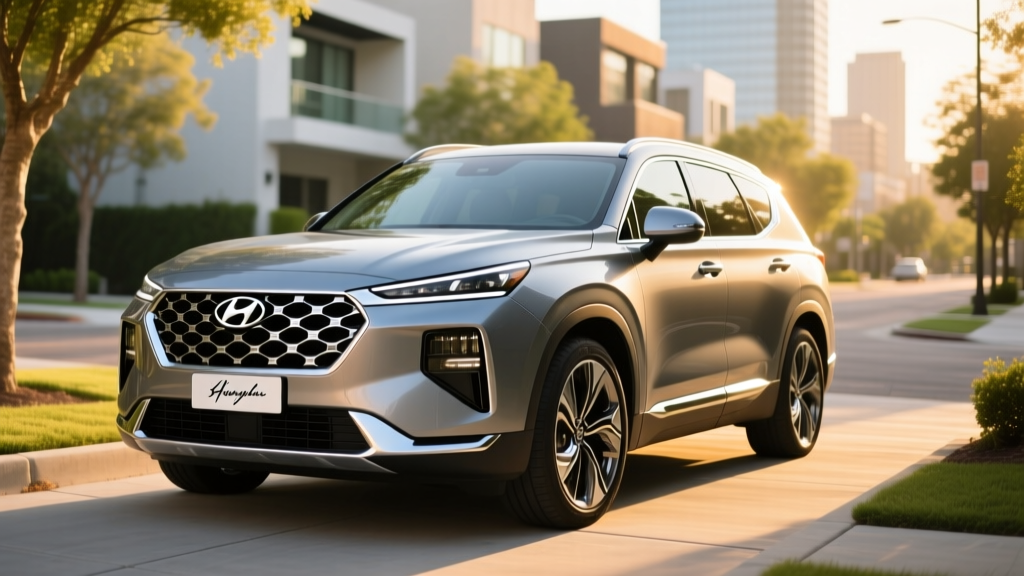
The Hyundai Santa Fe has long occupied a specific niche: a midsize three-row crossover that punches slightly above its price class in interior quality and tech. For 2026, the Hyundai Santa Fe Hybrid Calligraphy sits at the top of the hybrid lineup, wrapping the same turbocharged hybrid powertrain in Hyundai's most premium trim. But does the luxury equipment justify the sticker, and how does its real-world fuel economy stack up against the EPA estimates? We break down every number that matters — from MPG and horsepower to battery warranty and tax-credit eligibility — so you can decide if this is the right electrified SUV for your garage.
Quick Verdict: Who the Santa Fe Hybrid Calligraphy Is For
Buy it if: You need three rows, want premium interior materials, prioritize low running costs without plugging in, and your daily driving is a mix of city errands and highway commuting.
Pass if: You want electric-only driving (look at the Santa Fe PHEV or a full BEV like the Ioniq 5), need max towing capacity (the non-hybrid 2.5T tows 3,500 lbs vs. the hybrid's 2,000 lbs), or prioritize sporty driving dynamics over comfort.
Hyundai Santa Fe Hybrid Calligraphy: Core Specifications
| Spec | Value |
|---|---|
| Powertrain | 1.6L turbocharged 4-cylinder + electric motor (HEV) |
| Combined Horsepower | 232 hp |
| Combined Torque | 271 lb-ft |
| Transmission | 6-speed automatic |
| Drivetrain | HTRAC AWD (standard on Calligraphy) |
| EPA MPG (City / Hwy / Combined) | 35 / 34 / 35 MPG |
| Fuel Tank | 17.7 gallons |
| Estimated Total Range | ~620 miles |
| Towing Capacity | 2,000 lbs |
| Cargo (behind 3rd / 2nd / 1st row) | 14.5 / 40.5 / 79.6 cu ft |
| 0-60 mph (est.) | ~7.8 seconds |
| MSRP (Calligraphy AWD) | ~$47,450 (incl. destination) |
Source: fueleconomy.gov and Hyundai Motor America. Specs reflect the 2025/2026 model year; always confirm with your dealer for the exact build.
Fuel Economy: EPA Numbers vs. Real-World MPG
How Many MPG Does the Santa Fe Hybrid Get?
The EPA rates the 2026 Hyundai Santa Fe Hybrid AWD at 35 city / 34 highway / 35 combined MPG. These numbers apply across all hybrid trims including the Calligraphy, since the powertrain and weight differences between trims are minimal.
| Cycle | MPG | Notes |
|---|---|---|
| City | 35 | Hybrid advantage: regen braking + electric assist at low speeds |
| Highway | 34 | Slight drop vs. city — aero drag dominates at 70+ mph |
| Combined | 35 | 55% city / 45% highway weighting |
Real-World MPG: What Owners Actually Report
Hyundai's hybrid system, like Toyota's, tends to meet or slightly exceed EPA city estimates in stop-and-go driving because regenerative braking recovers energy that a conventional car wastes as heat. In real-world testing and owner reports:
- City / suburban driving: 34–38 MPG is typical. Short trips in warm weather with moderate traffic yield the best results.
- Highway (70-75 mph): Expect 30–33 MPG. The boxy, SUV shape creates more aerodynamic drag than a sedan, and the hybrid system's advantage diminishes at sustained high speeds.
- Cold weather (below 35°F): Plan for a 10–15% drop — roughly 30–32 MPG combined. The engine runs more often to provide cabin heat and maintain battery temperature.
- Mountain / hilly terrain: Highly variable. Uphill segments will show low teens, but downhill regen can partially recover that energy.
Bottom line: if your commute is mostly city and suburban, the Santa Fe Hybrid Calligraphy will likely deliver 35–37 MPG year-round. Highway-heavy drivers should budget for 31–33 MPG.
HEV vs. PHEV: Which Santa Fe Hybrid Is Right for You?
Hyundai offers the Santa Fe in two electrified flavors. Understanding the difference is critical before you visit the dealer.
Conventional Hybrid (HEV) — Santa Fe Hybrid
- Does NOT plug in. The battery recharges through regenerative braking and the gasoline engine.
- Battery: ~1.5 kWh lithium-ion (small, used for assist and regen buffer)
- No electric-only range to speak of — the motor assists the engine but cannot propel the car alone for meaningful distances.
- Advantage: Zero behavior change from a gas car. Just fill up and drive.
Plug-In Hybrid (PHEV) — Santa Fe Plug-In Hybrid
- Plugs in to a wall outlet, Level 2 charger, or (in some models) DC fast charger.
- Battery: ~13.8 kWh lithium-ion
- Electric-only range: ~30 miles EPA (enough for most daily commutes without burning gas)
- Total range: ~400+ miles (electric + gas combined)
- Level 2 charging time: ~3–4 hours on a 240V outlet
- Advantage: Gas-free daily driving with road-trip flexibility. Eligible for potential tax benefits.
| Attribute | HEV (This Review) | PHEV |
|---|---|---|
| Plugs in? | No | Yes |
| Battery size | ~1.5 kWh | ~13.8 kWh |
| Electric-only range | N/A | ~30 mi |
| Combined MPG / MPGe | 35 MPG | 79 MPGe (elec) / 33 MPG (gas) |
| Combined HP | 232 hp | 261 hp |
| Starting MSRP (top trim) | ~$47,450 | ~$52,000+ |
| Federal tax credit (§30D) | Not eligible | May qualify (see below) |
Powertrain Deep Dive: What Moves the Calligraphy
The Santa Fe Hybrid pairs a 1.6-liter turbocharged gasoline direct-injection (GDi) 4-cylinder engine with an electric motor integrated into the transmission housing. Combined output is 232 horsepower and 271 lb-ft of torque. That torque figure is the headline: it's available low in the rev range thanks to electric motor assist, which gives the Santa Fe Hybrid confident acceleration from stops and during passing maneuvers.
The 6-speed automatic transmission is a conventional torque-converter unit — not a CVT. This matters for driving feel: shifts are perceptible and linear, avoiding the "rubber-band" sensation some drivers dislike in Toyota's e-CVT hybrid systems. The trade-off is marginally less seamless power delivery, but most buyers will prefer the more traditional feel.
HTRAC all-wheel drive is standard on the Calligraphy trim. This system can send up to 50% of torque to the rear wheels when slip is detected, and includes terrain modes (Snow, Sand, Mud). It's a competent light-duty AWD system for rain and moderate snow, though it's not designed for serious off-road use.
Calligraphy Trim: What the Premium Price Gets You
The Calligraphy sits above SEL Premium and Limited in the Santa Fe Hybrid hierarchy. At approximately $47,450 (including destination), it commands a meaningful premium. Here's what justifies it:
- Nappa leather seats with quilted stitching and ventilated front / heated front and rear outboard seats
- Head-up display (HUD) with speed, navigation, and ADAS info projected on the windshield
- Dual 12.3-inch displays (digital instrument cluster + infotainment) with wireless Apple CarPlay and Android Auto
- Premium audio: Bose 12-speaker system
- Hyundai Digital Key 2 — use your smartphone as the key fob
- Highway Driving Assist 2 (HDA2): adaptive cruise with stop-and-go, lane centering, and lane-change assist (SAE Level 2 — requires driver supervision at all times)
- Remote Smart Parking Assist: the car can pull itself in and out of tight spaces while you stand outside
- Unique 20-inch alloy wheels, dark chrome exterior accents, and Calligraphy-specific front grille
The interior genuinely impresses for the price. Soft-touch materials cover most surfaces, the quilted leather feels a tier above competitors like the Toyota Highlander Hybrid Limited, and the boxy exterior design translates to excellent headroom and usable third-row space for a midsize SUV.
Battery Warranty, Reliability, and Replacement Costs
Hyundai Hybrid Battery Warranty
Standard coverage: 10 years / 100,000 miles (whichever comes first) on the hybrid battery and all hybrid-system components, including the electric motor and inverter.
In CARB-adopting states (CA, NY, MA, WA, CO, and others that follow California emissions rules): hybrid battery coverage extends to 10 years / 150,000 miles under PZEV/AT-PZEV provisions.
Is the Santa Fe Hybrid Reliable?
Hyundai's 1.6T hybrid powertrain is now in its second generation, having debuted in the 2024-model-year Santa Fe redesign. The first-generation system (in the Sonata Hybrid and Tucson Hybrid) proved durable, with few widespread failure modes reported. The hybrid battery itself is a lithium-ion polymer pack, and Hyundai has not had the large-scale battery-degradation issues that affected some early Korean hybrids a decade ago.
The conventional-hybrid battery (~1.5 kWh) is small and lightly stressed — it cycles within a narrow state-of-charge window, which dramatically extends its life. Most hybrid batteries from major manufacturers last well beyond 150,000 miles under normal use.
Battery Replacement Cost
If the hybrid battery does fail outside of warranty, replacement costs for the Santa Fe HEV's small battery pack are estimated at $2,000–$4,000 (parts and labor). This is far less than a full EV battery replacement ($8,000–$20,000+) because the pack is small and accessible. The PHEV's larger 13.8 kWh pack would cost more — likely $5,000–$8,000 — but is similarly well-warranted.
Tax Credits and Incentives: Does the Santa Fe Hybrid Qualify?
This is where HEV and PHEV buyers have very different experiences:
- Santa Fe Hybrid (HEV): Does NOT qualify for the federal §30D Clean Vehicle Credit. Conventional hybrids are excluded — the credit requires a minimum battery capacity of 7 kWh and plug-in capability. No federal purchase incentive applies.
- Santa Fe Plug-In Hybrid (PHEV): May qualify for up to $7,500 under §30D, but eligibility depends on multiple factors that change frequently:
§30D Federal Tax Credit Checklist (PHEV)
- ✅ Vehicle must have ≥ 7 kWh battery capacity (Santa Fe PHEV qualifies)
- ✅ MSRP must not exceed $80,000 for SUVs (Santa Fe PHEV qualifies)
- ⚠️ Buyer income caps: $300k joint / $225k head-of-household / $150k single (modified AGI)
- ⚠️ Battery components must be manufactured or assembled in North America (phase-in percentages increase annually)
- ⚠️ Critical minerals must be sourced from the US or FTA partners (thresholds tighten yearly)
- ✅ Credit can be transferred to the dealer at point of sale for an instant price reduction
Rules are subject to change. Always verify current eligibility on IRS.gov and consult a tax professional before purchasing.
Some states offer additional rebates for hybrids or PHEVs. California's CVRP, for instance, has historically offered rebates for PHEVs (not conventional hybrids), but funding and eligibility vary. Check your state energy office or AFDC state incentive database for current programs.
Santa Fe Hybrid Calligraphy vs. the Competition
The three-row hybrid SUV segment is competitive. Here's how the Santa Fe Hybrid stacks up against the most common cross-shops:
| Model | Combined MPG | HP | Top Trim MSRP |
|---|---|---|---|
| Hyundai Santa Fe Hybrid Calligraphy | 35 | 232 | ~$47,450 |
| Toyota Highlander Hybrid Platinum | 35 | 243 | ~$53,000 |
| Kia Sorento Hybrid SX Prestige | 34 | 232 | ~$47,000 |
| Toyota Grand Highlander Hybrid MAX | 27 | 362 | ~$58,000 |
The Santa Fe Hybrid's 35 MPG combined ties the Highlander Hybrid while undercutting it on price by several thousand dollars at the top trim. The Kia Sorento Hybrid shares the same powertrain (Hyundai and Kia are corporate siblings) but has slightly less cargo room and a smaller third row. The Grand Highlander Hybrid MAX trades fuel economy for performance.
Pros
- 35 MPG combined in a 3-row SUV is excellent
- Calligraphy interior quality rivals luxury brands at this price
- 10-year / 100k-mile hybrid battery warranty
- Strong low-end torque from electric motor assist
- Comprehensive ADAS suite standard (HDA2)
- AWD standard on Calligraphy
Cons
- No federal tax credit for the HEV version
- 2,000-lb towing capacity lags non-hybrid and some rivals
- Third row is usable but tight for adults on long trips
- 20-inch wheels on Calligraphy may slightly reduce ride comfort
- Highway MPG drops to low 30s at 75+ mph
- No DC fast charging (HEV doesn't need it; PHEV limited to Level 2)
Hybrid vs. PHEV vs. Full EV: Which Should You Choose?
Choose the Santa Fe Hybrid (HEV) if:
- You don't have access to home or workplace charging
- You want the simplest ownership experience — no plugs, no apps, no charging planning
- Your budget caps around $47k and you want the most features per dollar
- You take frequent long road trips and don't want to plan around charging stops
Choose the Santa Fe Plug-In Hybrid (PHEV) if:
- You can install a Level 2 charger at home (240V) or have reliable workplace charging
- Your daily commute is under 30 miles round-trip (you'd rarely burn gas)
- You want to reduce fuel consumption dramatically while keeping road-trip flexibility
- You may qualify for the §30D federal tax credit (check IRS rules)
Choose a Full EV (like the Hyundai Ioniq 5) if:
- You have reliable home Level 2 charging
- You want zero tailpipe emissions and the lowest per-mile "fuel" cost
- You qualify for the full $7,500 federal credit (most BEVs have broader eligibility)
- You don't need three rows or can accept a larger EV like the Kia EV9
Frequently Asked Questions
How many MPG does the Hyundai Santa Fe Hybrid Calligraphy get in real driving?
The EPA rates it at 35 city / 34 highway / 35 combined. In real-world mixed driving, most owners report 33–37 MPG depending on conditions. City driving with regenerative braking tends to match or exceed the EPA number, while sustained highway driving above 70 mph drops to the low 30s.
Does the Santa Fe Hybrid need to be plugged in?
No. The Santa Fe Hybrid is a conventional hybrid (HEV). It charges its small battery through regenerative braking and the gasoline engine. You simply fill it with gas like any other car. Only the Santa Fe Plug-In Hybrid (PHEV) version requires or benefits from plugging in.
Is the Hyundai hybrid battery reliable, and what does replacement cost?
Hyundai covers the hybrid battery for 10 years / 100,000 miles (150,000 miles in CARB states). The small ~1.5 kWh HEV battery is lightly stressed and typically lasts well beyond the warranty period. Out-of-warranty replacement is estimated at $2,000–$4,000 — far less than a full EV battery.
Does the 2026 Santa Fe Hybrid qualify for any tax credit?
The conventional hybrid (HEV) does not qualify for the federal §30D Clean Vehicle Credit — that credit requires plug-in capability and a minimum 7 kWh battery. The Santa Fe PHEV may qualify for up to $7,500 depending on your income, the vehicle's battery sourcing, and current IRS rules. Some states offer separate incentives for hybrids; check AFDC for details.
How does the Calligraphy trim compare to the Limited?
The Calligraphy adds Nappa leather, head-up display, Remote Smart Parking Assist, Digital Key 2, a Bose premium audio system, and unique exterior styling over the Limited trim. If you value luxury touches and don't mind the ~$3,000 premium, the Calligraphy is the most feature-rich Santa Fe Hybrid available.
Can the Santa Fe Hybrid tow a trailer?
Yes, but modestly. The hybrid's towing capacity is rated at 2,000 pounds — enough for a small utility trailer, bike rack, or lightweight pop-up camper. If you need to tow a larger boat or travel trailer, the non-hybrid 2.5T Santa Fe (3,500 lbs) or a body-on-frame SUV would be more appropriate.
How far can the Santa Fe PHEV go on electric only?
The Santa Fe Plug-In Hybrid offers approximately 30 miles of EPA-rated electric-only range. That's sufficient for most daily commutes and errands without using any gasoline. Once the battery is depleted, it operates as a conventional hybrid with ~33 MPG combined.