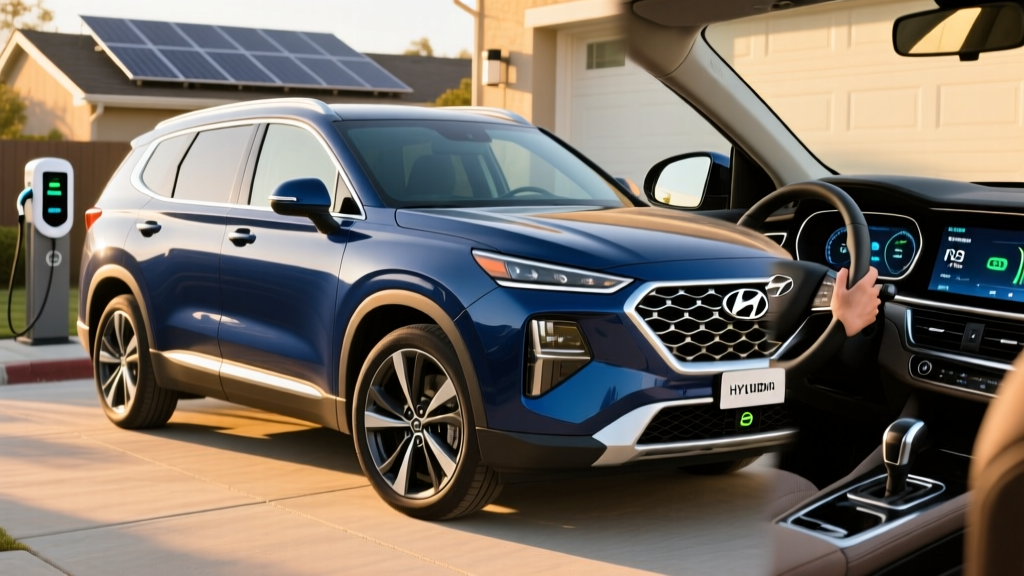
The 2023 Hyundai Santa Fe Hybrid sits in a practical middle ground for families who want electric-style efficiency without the charging logistics of a full EV. With 33 MPG combined and standard all-wheel drive, it delivers SUV space with sedan-like fuel bills. But Hyundai also offered a plug-in hybrid variant that year — and the two are very different animals. This guide breaks down exactly what the 2023 Santa Fe Hybrid (HEV) offers, how it compares to the PHEV version, and whether either makes sense over a pure battery-electric vehicle.
HEV vs PHEV: Which 2023 Santa Fe Are We Talking About?
Hyundai sold two electrified Santa Fe models for 2023, and confusing them is one of the most common buyer mistakes. Here's the hard line:
Conventional Hybrid (HEV)
The 2023 Santa Fe Hybrid uses a 1.6L turbocharged engine paired with an electric motor and a small battery that recharges through regenerative braking and the engine. You never plug it in. It operates like a traditional hybrid — the electric motor assists the engine, enables short EV-mode bursts at low speed, and recaptures energy you'd otherwise waste braking. The result is higher MPG with zero behavioral change from a gas car.
Plug-In Hybrid (PHEV)
The 2023 Santa Fe Plug-In Hybrid adds a larger battery pack and a more powerful electric motor. You plug it in to unlock its full value. On a full charge, it can drive approximately 31 miles on electricity alone before the gas engine kicks in. If you can charge at home daily, most local driving happens without burning a drop of fuel.
Both use Hyundai's Smartstream powertrain architecture, but the PHEV's larger battery and stronger motor give it a fundamentally different driving character — and a different price tag.
Fuel Economy: EPA MPG and Real-World Numbers
The headline number is what most buyers search for, and the 2023 Santa Fe Hybrid delivers solidly. According to EPA data on fueleconomy.gov, the conventional hybrid is rated as follows:
| Model | City MPG | Highway MPG | Combined MPG |
|---|---|---|---|
| Santa Fe Hybrid (HEV) AWD | 33 | 30 | 33 |
| Santa Fe Plug-In Hybrid (PHEV) AWD | 33 (gas mode) | 30 (gas mode) | 33 (gas mode) |
| Santa Fe PHEV — Electric Mode | 79 MPGe combined | ||
Real-world MPG vs. the EPA sticker: Hybrids typically exceed their EPA city rating in stop-and-go driving because regenerative braking recaptures more energy at lower speeds. In mixed suburban and city driving, owners frequently report 34–36 MPG from the HEV. Highway driving is where hybrids lose their advantage — expect 28–30 MPG at sustained 70+ mph speeds, where the engine does most of the work alone.
For the PHEV, the 33 MPG combined rating only applies once the battery is depleted. If you charge nightly and drive under 31 miles daily, your actual fuel consumption could be near zero for weeks at a time. The PHEV's value is entirely dependent on your charging access and daily mileage pattern.
Powertrain Specs: What Moves the 2023 Santa Fe Hybrid
| Specification | Santa Fe HEV | Santa Fe PHEV |
|---|---|---|
| Engine | 1.6L Turbo I-4 | 1.6L Turbo I-4 |
| Engine HP / Torque | 178 hp / 195 lb-ft | 178 hp / 195 lb-ft |
| Electric Motor | 44.2 kW (59 hp) | 66.9 kW (90 hp) |
| Combined System Output | 226 hp / 258 lb-ft | 261 hp / 258 lb-ft |
| Transmission | 6-speed automatic | 6-speed automatic |
| Drivetrain | AWD (standard) | AWD (standard) |
| Battery Capacity | 1.49 kWh (nominal) | 13.8 kWh (usable) |
| 0–60 mph (est.) | ~7.6 sec | ~7.1 sec |
| Towing Capacity | 2,000 lbs | 2,000 lbs |
The PHEV's stronger electric motor (90 hp vs. 59 hp) gives it noticeably more responsive acceleration from a stop and smoother electric-only driving at speeds up to about 75 mph. The HEV's smaller motor assists the engine but can't sustain highway speeds on electricity alone.
PHEV Electric-Only Range and Charging
If you're considering the plug-in variant, the electric range is the number that matters most:
EPA Electric-Only Range: 31 miles (PHEV only)
Real-World Expectation: 26–30 miles in mild weather; 22–25 miles in cold weather or at highway speeds
Total Combined Range: Approximately 430 miles (electric + full gas tank)
The PHEV's 13.8 kWh battery charges via a standard J1772 connector. There is no DC fast charging capability — this is typical for PHEVs, whose smaller batteries aren't designed for high-power charging.
| Charging Method | Power | 0–100% Time |
|---|---|---|
| Level 1 (120V household) | ~1.4 kW | ~10 hours |
| Level 2 (240V home/public) | ~3.3 kW (onboard max) | ~3 hours 15 min |
For most PHEV owners, Level 1 charging from a standard outlet overnight is sufficient — 10 hours easily covers a night's rest. A Level 2 home charger is a luxury for the PHEV, not a necessity, given the small battery. This is a stark contrast to full EVs, where Level 2 is practically mandatory.
Pricing, Trims, and Tax Credit Eligibility
As a 2023 model year vehicle, the Santa Fe Hybrid and PHEV were available through dealers at the following MSRPs:
| Trim | 2023 HEV MSRP | 2023 PHEV MSRP |
|---|---|---|
| Blue (HEV only) | $36,210 | — |
| SEL Premium | $38,810 | $42,410 |
| Limited | $42,960 | $46,710 |
Federal tax credit (§30D): The 2023 Santa Fe PHEV was not eligible for the full $7,500 federal tax credit under the Inflation Reduction Act's battery sourcing and critical mineral requirements that took effect in 2023. The conventional HEV has never qualified for the new-vehicle §30D credit, as it is not a plug-in vehicle.
If you're shopping for a 2023 model on the used market in 2026, the used clean vehicle credit (up to $4,000 or 30% of sale price, whichever is less) may apply to the PHEV if the sale price is $25,000 or less and you meet income requirements (AGI under $75,000 single / $150,000 joint). Verify current eligibility on irs.gov, as rules evolve.
Battery Warranty, Lifespan, and Replacement Cost
Hyundai Hybrid/PHEV Battery Warranty: 10 years / 100,000 miles (whichever comes first) for the original owner. This covers defects and capacity loss below a specified threshold.
Powertrain Warranty: 10 years / 100,000 miles.
Realistic Battery Lifespan: Hyundai's hybrid batteries are designed to last the life of the vehicle under normal use. Nickel-metal-hydride (HEV) and lithium-ion polymer (PHEV) chemistries in Hyundai's hybrid systems have shown strong longevity in fleet data, with most units retaining over 90% capacity at 100,000 miles.
Is the 2023 Santa Fe Hybrid reliable? Hyundai's hybrid system has a solid track record. The Santa Fe Hybrid uses a proven powertrain shared with the Tucson Hybrid and Kia Sorento Hybrid. Common concerns are minimal — early-build 2021–2022 models had some transmission software complaints, but these were addressed in updates. The 2023 model year benefits from those refinements.
Battery replacement cost: If the hybrid battery fails outside warranty, expect $2,500–$4,000 for the HEV battery pack and $5,000–$8,000 for the PHEV's larger battery. These are out-of-warranty estimates; the 10-year coverage means most original owners will never face this expense. For a 2023 model purchased in 2026, significant warranty coverage remains.
Hybrid vs. PHEV vs. Full EV: Which Fits You?
The right choice depends entirely on your driving pattern, charging access, and budget. Here's a practical decision framework:
Choose the Santa Fe HEV if:
- You cannot charge at home (no garage, apartment living, no outlet access)
- Your daily driving is highly variable — some days 10 miles, some days 300
- You want lower fuel costs with zero lifestyle change
- Budget is a priority (lowest MSRP of the electrified options)
Choose the Santa Fe PHEV if:
- You can charge at home every night (even a standard 120V outlet works)
- Your daily round-trip commute is under 30 miles
- You want EV-style driving for local trips but gas flexibility for road trips
- You're willing to pay a ~$3,600 premium over the equivalent HEV trim
Choose a full EV (e.g., Hyundai Ioniq 5, Tesla Model Y) if:
- You have reliable Level 2 home charging
- You want to eliminate gas entirely and access the full $7,500 federal credit (model-dependent)
- Your longest regular trip is under 250 miles, or you're comfortable with DC fast charging on road trips
- You want the lowest per-mile fuel cost and minimal maintenance
The PHEV's value proposition collapses if you can't charge at home. Without plugging in, it's simply a heavier, more expensive hybrid — and the HEV actually achieves comparable MPG in that scenario. Charging access is the single biggest variable in whether a PHEV saves you money.
Pros, Cons, and the Bottom Line
Pros
- Standard AWD across all trims — rare in this class
- 33 MPG combined is competitive with smaller crossovers
- 10-year/100,000-mile hybrid battery warranty is among the best
- PHEV variant offers 31 miles of electric range for daily commuting
- Spacious interior with 36.4 cu ft cargo volume (behind second row)
- Smooth 6-speed automatic — no CVT drone
Cons
- HEV highway MPG drops to ~30 — less impressive on long trips
- PHEV has no DC fast charging — limits public charging utility
- Neither variant qualifies for the full $7,500 new-vehicle federal tax credit
- 2,000-lb towing capacity trails V-6 competitors
- PHEV premium (~$3,600) takes years to recoup at current fuel prices
- Infotainment system is functional but dated vs. newer Hyundai designs
The 2023 Santa Fe Hybrid is a rational, low-risk choice for buyers who want SUV practicality with meaningful fuel savings. It doesn't require any infrastructure investment, doesn't demand you change how you drive, and carries one of the longest warranty packages in the industry. The PHEV variant is compelling for the right buyer — someone with home charging and a short commute — but the math only works if you actually plug it in.
Frequently Asked Questions
How many MPG does the 2023 Hyundai Santa Fe Hybrid get?
The EPA rates the 2023 Santa Fe Hybrid at 33 city / 30 highway / 33 combined MPG. In real-world city and suburban driving, many owners report 34–36 MPG thanks to regenerative braking. Highway-only driving at 70+ mph typically yields 28–30 MPG.
How far can the 2023 Santa Fe PHEV go on electric only?
The EPA rates the Santa Fe Plug-In Hybrid at 31 miles of electric-only range. Real-world results vary: expect 26–30 miles in mild conditions and 22–25 miles in cold weather or sustained highway driving. Once the battery depletes, the vehicle operates as a conventional hybrid at 33 MPG combined.
Does the 2023 Santa Fe Hybrid need to be plugged in?
No. The conventional Santa Fe Hybrid (HEV) never needs to be plugged in. It recharges its small battery through regenerative braking and the gasoline engine. Only the Santa Fe Plug-In Hybrid (PHEV) benefits from being plugged in — and if you don't plug in the PHEV, you're paying a premium for electric range you never use.
Is the 2023 Santa Fe Hybrid reliable?
Hyundai's hybrid system has demonstrated strong reliability, sharing components with the Tucson and Kia Sorento hybrid lineages. The 10-year/100,000-mile hybrid battery warranty provides substantial protection. IIHS testing gave the 2023 Santa Fe strong crashworthiness scores, adding to the ownership confidence picture.
What does it cost to replace the hybrid battery?
Out-of-warranty replacement costs range from approximately $2,500–$4,000 for the HEV battery and $5,000–$8,000 for the PHEV battery. However, Hyundai's 10-year/100,000-mile hybrid battery warranty means most owners will never face this expense. Hybrid battery failures before 150,000 miles are statistically uncommon.
Does the 2023 Santa Fe Hybrid qualify for any tax credit?
The conventional HEV does not qualify for the federal §30D clean vehicle credit — that credit applies only to plug-in vehicles. The PHEV did not qualify for the full $7,500 credit under 2023 IRA battery-sourcing rules. If purchasing used in 2026, the used clean vehicle credit (up to $4,000) may apply to the PHEV if the sale price is ≤$25,000 and income limits are met. Always check current IRS guidance before relying on credit eligibility.
How long does it take to charge the Santa Fe PHEV?
Using a standard 120V household outlet (Level 1), the PHEV charges from empty to full in approximately 10 hours. On a 240V Level 2 charger, it takes about 3 hours and 15 minutes. The PHEV does not support DC fast charging — this is standard for plug-in hybrids, whose smaller batteries don't require it.