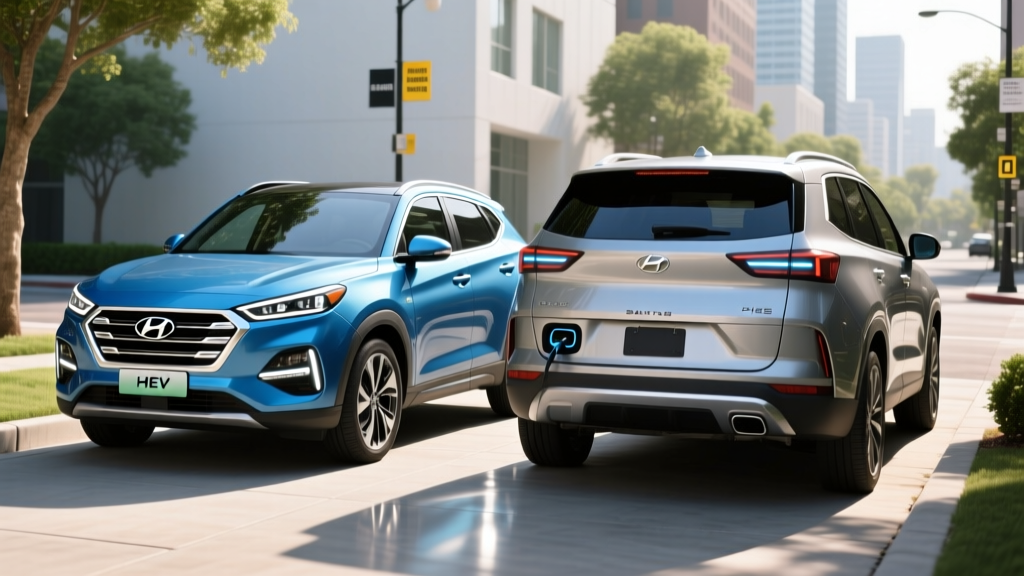
Hyundai offers two plug-in hybrid (PHEV) SUVs for the 2026 model year: the compact Tucson PHEV and the midsize three-row Santa Fe PHEV. Both pair a turbocharged gasoline engine with an electric motor and a battery large enough to handle daily commutes on electricity alone—then switch to hybrid operation for longer trips. This guide breaks down the exact specs, real-world efficiency, charging logistics, tax credit eligibility, and long-term ownership costs so you can decide whether a Hyundai plug-in hybrid fits your driving life.
HEV vs PHEV: What Hyundai Actually Sells
Before diving into specs, it's worth clarifying Hyundai's electrified lineup, because the terminology trips up many shoppers.
| Feature | Hyundai HEV (Conventional Hybrid) | Hyundai PHEV (Plug-In Hybrid) |
|---|---|---|
| Plugs in? | No — charges via regenerative braking and engine | Yes — plugs into a wall outlet or charger |
| Electric-only range | Less than 1 mile at low speed | 30–33 miles (EPA est.) |
| Battery size | ~1.5 kWh | 13.8 kWh (usable) |
| Fuel economy (gas mode) | 36–38 MPG combined | 33–35 MPG combined (after battery depleted) |
| Electric motor output | ~44 kW / 59 HP | ~72 kW / 97 HP |
| Federal tax credit | Not eligible | Up to $3,750 (subject to §30D rules) |
The conventional Tucson and Santa Fe HEVs are excellent fuel-sippers that never need a plug. But if you have access to home or workplace charging, the PHEV versions let you drive most weekday commutes without burning a drop of gas—while keeping a gas engine for weekend road trips. That dual capability is the entire PHEV value proposition.
2026 Hyundai Tucson PHEV: Specs, Range, and MPG
The Tucson PHEV is Hyundai's volume plug-in hybrid. It slots between the Tucson HEV and the all-electric Ioniq 5 in Hyundai's showroom, targeting buyers who want electric commuting without range anxiety.
| Specification | 2026 Hyundai Tucson PHEV (SEL / Limited) |
|---|---|
| Powertrain | 1.6L turbocharged 4-cylinder + permanent-magnet electric motor |
| Combined system output | 261 HP / 258 lb-ft torque |
| Transmission | 6-speed automatic |
| Drivetrain | HTRAC AWD (standard) |
| Battery capacity | 13.8 kWh usable (NMC chemistry) |
| EPA electric-only range | 33 miles |
| EPA total range (EV + gas) | ~400 miles |
| EPA MPGe (electric mode) | 80 MPGe combined |
| EPA MPG (hybrid/gas mode) | 35 combined / 33 city / 37 highway |
| Level 2 charging (240V) | ~2 hours (7.2 kW onboard charger) |
| DC fast charging | Not available |
| 0–60 mph | ~7.1 seconds |
| Cargo volume | 38.5 cu ft (rear seats up) |
| Starting MSRP | $39,900 (SEL) / $45,200 (Limited) |
2026 Hyundai Santa Fe PHEV: The Three-Row Option
The Santa Fe PHEV is the larger, more expensive sibling. Redesigned with a boxy, upright design for the 2024 model year, it carries into 2026 with the same 1.6L turbo PHEV powertrain but tuned for the heavier chassis. It's one of the few plug-in hybrids offering three rows of seating.
| Specification | 2026 Hyundai Santa Fe PHEV (SEL Premium / Limited) |
|---|---|
| Powertrain | 1.6L turbocharged 4-cylinder + permanent-magnet electric motor |
| Combined system output | 258 HP / 271 lb-ft torque |
| Transmission | 6-speed automatic |
| Drivetrain | HTRAC AWD (standard) |
| Battery capacity | 13.8 kWh usable (NMC chemistry) |
| EPA electric-only range | 30 miles |
| EPA total range (EV + gas) | ~380 miles |
| EPA MPGe (electric mode) | 76 MPGe combined |
| EPA MPG (hybrid/gas mode) | 33 combined / 31 city / 35 highway |
| Level 2 charging (240V) | ~2 hours (7.2 kW onboard charger) |
| DC fast charging | Not available |
| 0–60 mph | ~7.8 seconds |
| Cargo volume | 40.5 cu ft (behind 2nd row) |
| Starting MSRP | $47,500 (Sel Premium) / $51,200 (Limited) |
The Santa Fe's extra weight and less aerodynamic profile cost it roughly 3 electric miles and 2 MPG in gas mode versus the Tucson. For families needing a third row, that trade-off is usually worth it. For two-row shoppers, the Tucson PHEV is the more efficient and more affordable pick.
Charging: What You Need at Home
Neither Hyundai PHEV supports DC fast charging—a common limitation in the plug-in hybrid segment. The 13.8 kWh battery is small enough that Level 2 charging handles it quickly, and DC fast-charging hardware would add cost and weight for marginal benefit.
| Charging Level | Power | Time (0–100%) | Where |
|---|---|---|---|
| Level 1 (120V household outlet) | ~1.4 kW | ~10 hours | Any standard outlet; overnight top-up |
| Level 2 (240V home charger) | 7.2 kW (vehicle-limited) | ~2 hours | Home garage, workplace chargers |
| DC Fast Charge | N/A | N/A | Not supported |
Practical setup: Most PHEV owners charge overnight on a standard 120V outlet. A full charge in ~10 hours means you plug in when you get home and wake up to a full battery. If you want faster top-ups (say, replenishing during a midday break at home), a Level 2 charger like the ChargePoint Home Flex or Hyundai's own home charging unit will refill the battery in about 2 hours. Installation typically runs $500–$1,500 depending on your electrical panel's proximity to the garage—no panel upgrade is usually needed for a PHEV's modest 7.2 kW draw.
Key distinction (kW vs kWh): The battery stores 13.8 kWh of energy (like a gas tank measured in gallons). The charger delivers up to 7.2 kW of power (like the flow rate of a gas pump). Dividing kWh by kW gives you the approximate charge time: 13.8 ÷ 7.2 ≈ 1.9 hours.
Fuel Economy in the Real World: EPA vs Actual
Hyundai's PHEVs tend to deliver close to their EPA ratings in gas mode, and real-world electric range often matches the sticker in moderate weather with city driving. Here's what to expect based on owner reports and testing patterns:
| Scenario | Tucson PHEV | Santa Fe PHEV |
|---|---|---|
| EPA combined MPG (gas mode) | 35 MPG | 33 MPG |
| Real-world city (gas mode) | 36–38 MPG | 34–36 MPG |
| Real-world highway (gas mode) | 33–35 MPG | 31–33 MPG |
| Real-world electric range (moderate weather) | 28–33 miles | 26–30 miles |
| Real-world electric range (cold, <32°F) | 22–26 miles | 20–24 miles |
Hybrids generally exceed their EPA city ratings because regenerative braking recovers energy in stop-and-go traffic. Highway driving is where efficiency drops—the engine works harder at sustained speeds with no regen benefit. Cold weather reduces electric range by 15–25% because the battery is less efficient and cabin heating draws from the pack.
For a commuter driving 25 miles round-trip, the Tucson PHEV could cover most weekday trips on electricity alone, using gas only on longer weekend drives. According to fueleconomy.gov, the Tucson PHEV's combined operating cost is roughly $0.08–$0.12 per mile on electricity versus $0.15–$0.18 per mile on gasoline (varies by local rates and fuel prices).
Federal Tax Credit and Incentives
Under IRS §30D, qualifying plug-in hybrids may receive a federal tax credit—but the rules are strict and have changed significantly since 2023. Here's the current framework for 2026:
- Credit amount: Up to $3,750 for PHEVs meeting battery-component sourcing requirements; up to $7,500 if both critical-mineral and battery-component tests are met. Hyundai PHEVs have historically qualified for a partial credit ($3,750) due to battery sourcing constraints—confirm current status at irs.gov before purchasing.
- MSRP cap: SUVs (including Tucson and Santa Fe) must have an MSRP at or below $80,000. Both models qualify.
- Income cap: Modified adjusted gross income must not exceed $150,000 (single), $225,000 (head of household), or $300,000 (joint filing).
- Point-of-sale transfer: As of 2024, you can transfer the credit to the dealer at purchase, reducing the sale price directly rather than waiting for a tax refund.
- Battery sourcing: The credit phases in requirements for North American battery-component manufacturing and critical-mineral sourcing. These thresholds tighten annually—check the latest IRS guidance for the specific model year.
Battery Longevity, Warranty, and Replacement Cost
Battery degradation is the top concern for any electrified-vehicle buyer. Hyundai addresses this with one of the strongest warranty packages in the industry:
| Coverage | Term |
|---|---|
| Hybrid/PHEV battery | 10 years / 100,000 miles (whichever comes first) |
| Hybrid/PHEV system components | 10 years / 100,000 miles |
| Capacity retention threshold | Warranty covers replacement if battery falls below ~70% of original capacity |
| Powertrain warranty | 10 years / 100,000 miles |
| New-vehicle limited warranty | 5 years / 60,000 miles |
In practice, Hyundai's PHEV batteries use NMC (nickel-manganese-cobalt) chemistry, which has proven durable in real-world use. Most PHEV owners report less than 5–8% degradation over the first 5 years—well within the warranty threshold. The 13.8 kWh pack is also smaller and less stressed than a full EV battery, since it operates in a narrower state-of-charge window (the car's software prevents full 0% or 100% usage to extend cell life).
If the battery does need replacement out of warranty (typically after 10+ years), expect a cost in the range of $4,000–$7,000 including labor for the PHEV pack. This is significantly less than a full EV battery replacement ($10,000–$20,000+) because the pack is much smaller. However, the vast majority of Hyundai PHEV batteries will outlast the vehicle's useful life without needing replacement.
Hyundai Plug-In Hybrid vs Full EV vs Gas: Which Is Right for You?
Choose a Hyundai PHEV if:
- You have access to Level 1 or Level 2 charging at home or work
- Your daily commute is under 30 miles round-trip
- You take road trips longer than 200 miles at least a few times per year
- You want to reduce gas consumption without committing to full electric
- You live in an area with limited public DC fast-charging infrastructure
Choose a full EV (e.g., Hyundai Ioniq 5) if:
- You can install a Level 2 home charger and rarely drive more than 250 miles in a day
- You want the lowest per-mile operating cost and minimal maintenance
- You're eligible for the full $7,500 federal tax credit on a qualifying EV
- You have access to reliable public fast-charging networks for road trips
Choose a conventional hybrid (HEV) if:
- You cannot charge at home or work (apartment, street parking, no outlet access)
- You want improved MPG over a gas car with zero behavior change
- Your budget is tighter—HEVs typically cost $3,000–$5,000 less than PHEV versions
Choose a gas-only vehicle if:
- Your annual mileage is very low (<6,000 miles) and fuel cost savings won't offset a higher purchase price
- You need maximum towing capacity (gas models sometimes tow more than hybrid variants)
Pricing and Trim Breakdown
Both Hyundai PHEVs are offered in two trims. Here's what you'll pay before incentives:
| Model | Trim | MSRP | Est. After $3,750 Credit |
|---|---|---|---|
| Tucson PHEV | SEL | $39,900 | ~$36,150 |
| Tucson PHEV | Limited | $45,200 | ~$41,450 |
| Santa Fe PHEV | Sel Premium | $47,500 | ~$43,750 |
| Santa Fe PHEV | Limited | $51,200 | ~$47,450 |
Destination charges ($1,395–$1,495) are additional. Dealer markups vary by market—check inventory at multiple dealerships, as PHEV supply has improved since the 2022–2023 shortage.
Pros
- 30–33 miles of electric-only range covers most commutes
- Standard AWD on all trims (rare in the PHEV segment)
- 10-year/100,000-mile hybrid battery and powertrain warranty
- No range anxiety—gas engine covers any trip length
- Competitive pricing vs Toyota RAV4 Prime and Chrysler Pacifica PHEV
- Strong safety ratings (IIHS Top Safety Pick for Tucson)
Cons
- No DC fast charging (limits public charging utility)
- Electric range drops noticeably in cold weather
- PHEV premium over HEV trim (~$4,000–$5,000 more)
- Federal tax credit may be partial ($3,750 vs $7,500) depending on sourcing rules
- 6-speed automatic feels less refined than competitors' e-CVT setups
- Third row in Santa Fe is tight for adults (best for children)
Frequently Asked Questions
How many MPG does the Hyundai Tucson PHEV get?
The EPA rates the 2026 Tucson PHEV at 35 MPG combined (33 city / 37 highway) in hybrid/gas mode after the battery is depleted. In real-world driving, owners commonly report 36–38 MPG in city traffic (thanks to regenerative braking) and 33–35 MPG on the highway. The Santa Fe PHEV rates at 33 MPG combined.
How far can the Hyundai plug-in hybrid go on electric only?
The Tucson PHEV is EPA-rated at 33 electric-only miles; the Santa Fe PHEV at 30 miles. In moderate weather with city driving, you'll see close to these numbers. Highway driving reduces electric range to roughly 27–30 miles (Tucson) or 25–28 miles (Santa Fe). In freezing temperatures, expect 22–26 miles from the Tucson and 20–24 miles from the Santa Fe.
Do I need to plug in a Hyundai PHEV?
To get the benefit of electric-only driving, yes—you should plug in regularly. However, if you forget or don't have access to a charger on a given day, the car operates as a conventional hybrid using the gas engine and regenerative braking. It will never strand you for not plugging in. That said, a PHEV you never plug in is just a heavier, more expensive hybrid—you're paying for electric range you're not using.
Is the Hyundai PHEV reliable, and what does battery replacement cost?
Hyundai's hybrid and PHEV powertrains have proven reliable, with the company backing them with a 10-year/100,000-mile warranty on the battery and hybrid system components. Out-of-warranty battery replacement is estimated at $4,000–$7,000, but real-world data suggests most PHEV batteries retain 90%+ capacity after 5 years and will outlast the vehicle. According to IIHS, Hyundai's PHEV models also earn strong crash-test ratings.
Does the Hyundai plug-in hybrid qualify for a tax credit?
Under current IRS §30D rules, Hyundai PHEVs may qualify for a partial federal tax credit of $3,750, depending on battery-component sourcing requirements that tighten each year. Full $7,500 eligibility depends on meeting both critical-mineral and battery-component tests. Income caps ($150K single / $300K joint) and the $80,000 SUV MSRP cap also apply. The credit can be transferred to the dealer at point of sale. Always verify current eligibility at fueleconomy.gov before purchasing, as sourcing rules change annually.
How long does it take to charge a Hyundai PHEV at home?
On a standard 120V household outlet (Level 1), a full charge takes approximately 10 hours—fine for overnight charging. On a 240V Level 2 charger, the Tucson and Santa Fe PHEV both charge in about 2 hours using the 7.2 kW onboard charger. Neither model supports DC fast charging.
Hyundai Tucson PHEV vs Toyota RAV4 Prime: which is better?
The RAV4 Prime offers more electric range (42 miles EPA) and a higher combined output (302 HP), but it's frequently marked up above MSRP and harder to find in inventory. The Tucson PHEV offers competitive pricing, more readily available stock, a longer warranty (10 years vs Toyota's 8 years/100,000 miles on hybrid battery), and a more modern interior. If you can find a RAV4 Prime at MSRP and need the extra electric range, it's the stronger PHEV. If availability and value matter more, the Tucson PHEV is the practical choice.