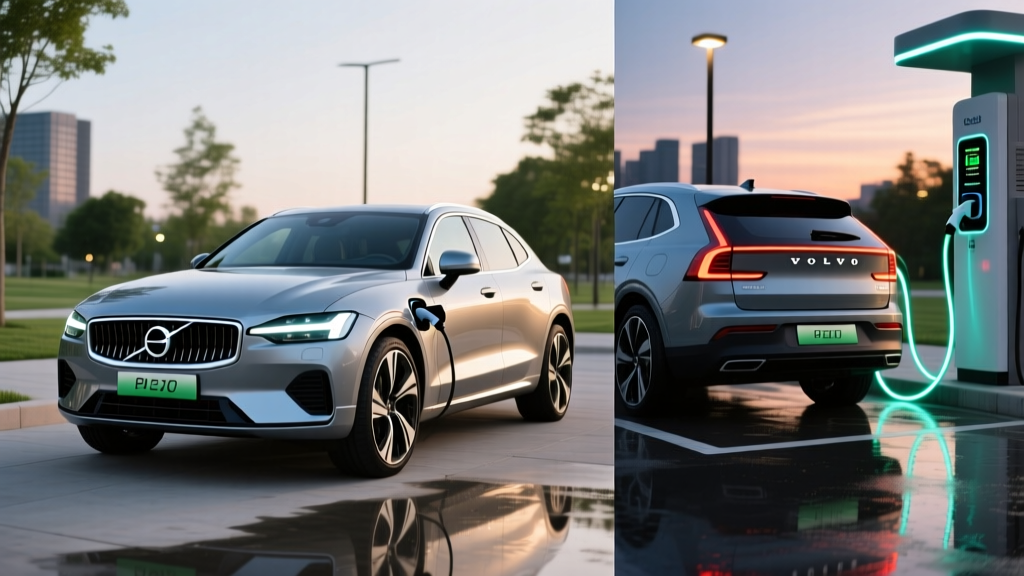
If you want to drive on electricity for your daily commute but keep a gas engine for weekend road trips, Volvo's plug-in hybrid (PHEV) lineup is one of the most compelling options in the luxury segment. For the 2026 model year, Volvo has fully committed to its "Recharge" PHEV architecture across the XC90, XC60, and S60/V60 lines, pairing a turbocharged and supercharged 2.0-liter four-cylinder engine with a rear-axle electric motor and an 18.8 kWh (usable) battery pack.
This guide breaks down every current Volvo hybrid vehicle by the numbers that matter: real-world electric range, EPA MPG, charging times, powertrain output, pricing, and federal tax credit eligibility. We'll also address the question every luxury hybrid shopper eventually asks — should you go PHEV, full EV, or stick with a conventional hybrid?
Volvo's PHEV Strategy: What "Recharge" Actually Means
Volvo no longer sells conventional hybrids (HEVs) in the U.S. market. Every electrified Volvo you can buy today is either a plug-in hybrid (labeled Recharge) or a fully electric vehicle (labeled Recharge Pure Electric). This is a critical distinction for buyers cross-shopping brands:
HEV vs. PHEV — Know the Difference
| Feature | Conventional Hybrid (HEV) | Plug-In Hybrid (PHEV) |
|---|---|---|
| Plug in to charge? | No — charges via regenerative braking and engine | Yes — plug in to maximize electric range |
| Electric-only driving | Very limited (under 1 mile at low speed) | 30–40+ miles on battery alone |
| Battery size | 1–2 kWh | 15–20+ kWh |
| Federal tax credit | No | Potentially, if §30D requirements met |
| Example | Toyota Prius, Honda CR-V Hybrid | Volvo XC60 Recharge, Toyota RAV4 Prime |
Every Volvo Recharge model is a PHEV. You can drive them without ever plugging in — the gas engine and regenerative braking will keep the battery minimally charged — but you'll forfeit the electric-only range that makes the PHEV premium worthwhile. If you can't charge at home or at work, a conventional hybrid from another brand may be a better fit.
The 2026 Volvo Recharge Lineup: Specs at a Glance
Volvo's PHEV powertrain is shared across models with minor tuning differences. All use the same T8 architecture: a 2.0L turbocharged and supercharged inline-four driving the front wheels, paired with a 143-hp electric motor on the rear axle for standard all-wheel drive.
| Spec | XC90 Recharge | XC60 Recharge | S60 Recharge | V60 Recharge |
|---|---|---|---|---|
| Combined HP | 455 hp | 455 hp | 455 hp | 455 hp |
| Combined Torque | 523 lb-ft | 523 lb-ft | 523 lb-ft | 523 lb-ft |
| 0–60 mph | 5.0 sec | 4.5 sec | 4.3 sec | 4.4 sec |
| Battery (usable) | 18.8 kWh | 18.8 kWh | 18.8 kWh | 18.8 kWh |
| EPA Electric Range | 32 mi | 35 mi | 41 mi | 38 mi |
| EPA Combined MPG (gas) | 27 MPG | 28 MPG | 30 MPG | 29 MPG |
| MPGe (electric + gas) | 55 MPGe | 58 MPGe | 63 MPGe | 60 MPGe |
| Total Range (est.) | ~500 mi | ~520 mi | ~560 mi | ~540 mi |
| DC Fast Charge | No | No | No | No |
| Level 2 Charge (0–100%) | ~5 hours (3.7 kW) | ~5 hours (3.7 kW) | ~5 hours (3.7 kW) | ~5 hours (3.7 kW) |
| Starting MSRP | $73,350 | $58,950 | $52,550 | $54,950 |
Source: EPA estimates via fueleconomy.gov and Volvo Cars USA. MSRP reflects base Plus trim before destination charges. Specs are for 2026 model year.
Electric-Only Range: What You'll Actually Get
The EPA-rated electric-only range varies by model because of weight and aerodynamics. The S60 Recharge sedan leads the pack at 41 miles, while the three-row XC90 Recharge trails at 32 miles.
Real-World Electric Range vs. EPA Sticker
EPA ratings: XC90: 32 mi | XC60: 35 mi | S60: 41 mi | V60: 38 mi
Expect in practice: In mild weather (60–80°F) with mixed city/suburban driving, most owners report achieving 90–100% of EPA electric range. In cold weather (below 30°F), expect a 20–30% reduction — meaning the XC60's 35-mile rating may drop to 25–28 miles. Highway driving at 70+ mph also reduces electric range by roughly 15–20% due to aerodynamic drag.
Practical takeaway: If your one-way commute is under 25 miles, any Volvo Recharge model will cover it on electricity alone in most conditions. If your commute exceeds 35 miles, you'll burn gas on the tail end.
One advantage of Volvo's PHEV system: when the battery depletes, the transition to hybrid mode is seamless. The 2.0L engine fires up without drama, and the car operates as a conventional AWD hybrid with the MPG figures listed in the spec table above.
Charging: Level 2 Only, No DC Fast Charging
This is where prospective buyers need to set expectations correctly. No current Volvo Recharge PHEV supports DC fast charging. The maximum onboard charger rate is approximately 3.7 kW on Level 2 (240V). Here's what that means for your daily routine:
| Charging Method | Power | 0–100% Time | Practical Notes |
|---|---|---|---|
| Level 1 (120V household) | ~1.4 kW | ~13 hours | Works overnight; may not fully charge if battery is deeply depleted |
| Level 2 (240V home/public) | 3.7 kW | ~5 hours | Ideal — plug in at night, full by morning |
| DC Fast Charging | N/A | N/A | Not supported on any Volvo PHEV |
The lack of DC fast charging is standard for PHEVs in this class — the BMW X5 xDrive50e and Mercedes GLE 350e also lack it. The reasoning is simple: the battery is small enough (18.8 kWh usable) that Level 2 overnight charging fully replenishes it before your next drive. You'd never realistically need a DC fast charger for a 35-mile battery.
Home charging setup: A standard NEMA 14-50 outlet (the same as a dryer outlet) on a dedicated 40A circuit will deliver the full 3.7 kW rate. Installation typically costs $500–$1,500 depending on panel proximity, per industry estimates. Volvo includes a Level 1/Level 2 portable charging cord with the vehicle.
Fuel Economy: EPA Numbers and Real-World MPG
Once the battery is depleted, Volvo Recharge models operate as conventional hybrids. Here's the EPA city/highway/combined breakdown for gas-only operation:
| Model | City MPG | Highway MPG | Combined MPG | Combined MPGe* |
|---|---|---|---|---|
| XC90 Recharge | 26 | 28 | 27 | 55 |
| XC60 Recharge | 27 | 29 | 28 | 58 |
| S60 Recharge | 29 | 32 | 30 | 63 |
| V60 Recharge | 28 | 31 | 29 | 60 |
*MPGe accounts for both electric and gasoline operation. Source: fueleconomy.gov
Real-world MPG reality check: Hybrid MPG figures are often higher in real-world city driving than the EPA sticker suggests, because regenerative braking recaptures more energy in stop-and-go traffic. Conversely, sustained highway driving at 75+ mph will yield lower MPG than rated — expect 24–26 MPG combined in the XC60 on a long road trip with a depleted battery. If you charge daily and commute within electric range, your effective "MPG" is essentially infinite for those miles — you're burning zero gasoline.
Pricing, Trims, and Federal Tax Credit Eligibility
Volvo Recharge PHEVs carry a price premium over their mild-hybrid (B5/B6) counterparts — typically $7,000–$10,000 more depending on the model. Here's the 2026 pricing landscape:
| Model | Base MSRP (Plus trim) | Ultimate Trim MSRP | Premium over mild-hybrid |
|---|---|---|---|
| S60 Recharge | $52,550 | $61,050 | ~$7,500 |
| V60 Recharge | $54,950 | $64,450 | ~$8,000 |
| XC60 Recharge | $58,950 | $69,950 | ~$8,500 |
| XC90 Recharge | $73,350 | $83,350 | ~$10,000 |
Does a Volvo Recharge PHEV Qualify for the Federal Tax Credit?
Under IRS §30D rules, plug-in hybrids with batteries of at least 7 kWh are technically eligible for the federal clean vehicle credit — but the credit amount and availability depend on several requirements that change frequently:
- Battery sourcing: A percentage of critical minerals and battery components must be sourced from the U.S. or free-trade-agreement countries. This requirement tightens annually.
- MSRP caps: Vans/SUVs/pickups must be under $80,000 MSRP; sedans under $55,000. The S60 Recharge (sedan) at $52,550 base clears the cap; higher trims do not. The XC60 and XC90 Recharge (SUVs) at base trims are under $80,000.
- Buyer income limits: AGI must not exceed $150,000 (single), $225,000 (head of household), or $300,000 (joint).
- Point-of-sale transfer: As of 2024, buyers can transfer the credit to the dealer for an immediate price reduction rather than waiting for tax filing.
- Credit amount: The maximum is $7,500, but partial credits ($3,750) apply if only one of the two sourcing requirements (minerals or components) is met.
Bottom line: Some Volvo Recharge models at base trims may qualify for a partial or full credit, but battery-component sourcing rules are the biggest variable. Always verify current eligibility on IRS.gov or with a tax professional before purchasing. Do not assume the full $7,500 applies.
Battery Longevity, Warranty, and Replacement Costs
Volvo PHEV Battery Warranty
High-voltage battery warranty: 8 years / 100,000 miles (whichever comes first), with a guaranteed minimum capacity retention of 70% of original capacity.
Powertrain warranty: 4 years / 50,000 miles for the engine, transmission, and electric motor.
Battery chemistry: NMC (nickel manganese cobalt) lithium-ion — standard for PHEVs prioritizing energy density in a compact package.
PHEV batteries experience less stress than full EV batteries because they operate in a narrower state-of-charge window (the system reserves a buffer at the top and bottom). Most Volvo PHEV owners report minimal degradation over 5+ years — typically 5–10% capacity loss, well within the warranty threshold.
What Does a Replacement Cost?
If the battery fails outside of warranty, replacement is expensive. Based on current industry data for 18–19 kWh NMC PHEV packs:
- Battery pack cost: $6,000–$9,000 (parts)
- Labor: $1,500–$3,000
- Total out-of-pocket: $7,500–$12,000 at a dealership
However, catastrophic battery failure in a modern PHEV is rare. More commonly, individual modules can sometimes be replaced rather than the entire pack, reducing costs. Volvo's 8-year/100,000-mile warranty covers the vast majority of ownership periods for original purchasers.
Reliability: What Owners and Data Show
Volvo's T8 PHEV powertrain has been in production since 2015, giving it a long track record relative to competitors. The system is generally regarded as reliable, though a few recurring issues are worth noting:
- Engine: The 2.0L turbo/supercharged four-cylinder is a complex engine (both forced-induction systems plus the electric motor). Some owners report higher maintenance costs compared to simpler hybrid powertrains like Toyota's.
- Electronics: Volvo's Google-based infotainment system (Android Automotive OS) has drawn complaints for occasional glitches, though over-the-air updates have improved stability in 2025–2026 models.
- Brakes: Regenerative braking reduces wear on the friction brakes. Many PHEV owners report original brake pads lasting 80,000+ miles.
For reliability ratings, check IIHS crash-test scores (Volvo consistently earns Top Safety Pick+ designations) and owner-survey data from Consumer Reports or J.D. Power for model-specific reliability trends.
Volvo Hybrid vs. Full EV vs. Gas: Which Should You Choose?
Choose a Volvo Recharge PHEV if:
- Your daily commute is under 35 miles round-trip and you can charge at home overnight
- You regularly take road trips exceeding 300 miles and don't want to plan around charging stops
- You want electric daily driving but live in an area with limited public DC fast-charging infrastructure
- You value Volvo's safety reputation and Scandinavian interior design
Choose a full EV (like the Volvo EX90 or EX40) if:
- You can charge at home and your daily driving is under 250 miles
- You want to eliminate gasoline entirely and minimize maintenance (no oil changes, fewer moving parts)
- You have access to reliable DC fast charging for road trips
- You want maximum federal tax credit eligibility (full EVs often qualify more easily than PHEVs)
Choose a conventional hybrid (from another brand) if:
- You cannot charge at home or at work — a PHEV's electric range is wasted without plugging in
- You want maximum fuel efficiency at a lower purchase price
- You prefer the proven simplicity of a Toyota or Honda hybrid system
Volvo Recharge PHEV — Pros
- 35–41 miles of electric range covers most commutes
- 455 hp provides genuinely quick acceleration (4.3–5.0 sec 0–60)
- Premium interior materials and Google-based infotainment
- Standard AWD with electric rear axle — no mechanical driveshaft
- Top Safety Pick+ ratings across the lineup
- Seamless transition between electric and hybrid modes
Volvo Recharge PHEV — Cons
- No DC fast charging — Level 2 only (3.7 kW)
- Complex powertrain (turbo + supercharger + electric motor) may mean higher long-term maintenance
- Premium pricing: $52K–$83K depending on model and trim
- Federal tax credit eligibility is uncertain due to sourcing rules
- Smaller battery means electric range drops significantly in cold weather
- Infotainment can lag behind competitors in responsiveness
Frequently Asked Questions
How many MPG does a Volvo hybrid get?
In hybrid mode (battery depleted), the 2026 Volvo Recharge lineup achieves 27–30 MPG combined depending on the model. The S60 Recharge sedan leads at 30 MPG combined (29 city / 32 highway). If you charge daily and drive within the electric range, you'll use little to no gasoline on typical commutes.
How far can a Volvo PHEV go on electric only?
EPA-rated electric-only range is 32 miles (XC90), 35 miles (XC60), 38 miles (V60), and 41 miles (S60). In cold weather, expect a 20–30% reduction. In mild conditions with moderate driving, most owners achieve close to the EPA rating.
Do Volvo hybrid vehicles need to be plugged in?
Volvo Recharge models are plug-in hybrids. You don't have to plug them in — the gas engine and regenerative braking will keep the battery charged — but without plugging in, you lose the 32–41 mile electric-only range that justifies the PHEV premium. If you never plug in, you're essentially driving a heavy, expensive conventional hybrid.
Is the Volvo PHEV powertrain reliable?
The T8 powertrain has been in production since 2015 and is generally reliable. The high-voltage battery carries an 8-year/100,000-mile warranty with 70% capacity retention guaranteed. The complexity of the dual-forced-induction engine means maintenance costs may be higher than simpler hybrid systems from Toyota or Honda over the long term.
What does a Volvo hybrid battery replacement cost?
Out-of-warranty replacement of the 18.8 kWh NMC battery pack typically costs $7,500–$12,000 including parts and labor at a dealership. However, full battery failure is uncommon; individual module replacement may be possible at lower cost.
Does a Volvo Recharge PHEV qualify for a federal tax credit?
Possibly. Under IRS §30D, PHEVs with 7+ kWh batteries can qualify, but the actual credit depends on battery sourcing requirements, MSRP caps ($55K for sedans, $80K for SUVs), and buyer income limits. The credit may be $3,750 or $7,500 depending on which sourcing requirements are met. Always check IRS.gov for current eligibility before purchasing.
How long does it take to charge a Volvo PHEV at home?
On a Level 2 (240V) connection at 3.7 kW, a full 0–100% charge takes approximately 5 hours. On a standard 120V household outlet (Level 1), expect roughly 13 hours. Most owners plug in overnight and wake up to a full battery every morning.
Specs and pricing reflect 2026 model year data available at time of publication. Federal tax credit rules are subject to change. Verify all figures with your local Volvo dealer and IRS.gov before purchasing.