Quick Verdict: The Palisade Hybrid SEL Premium Is a Smart Three-Row Upgrade
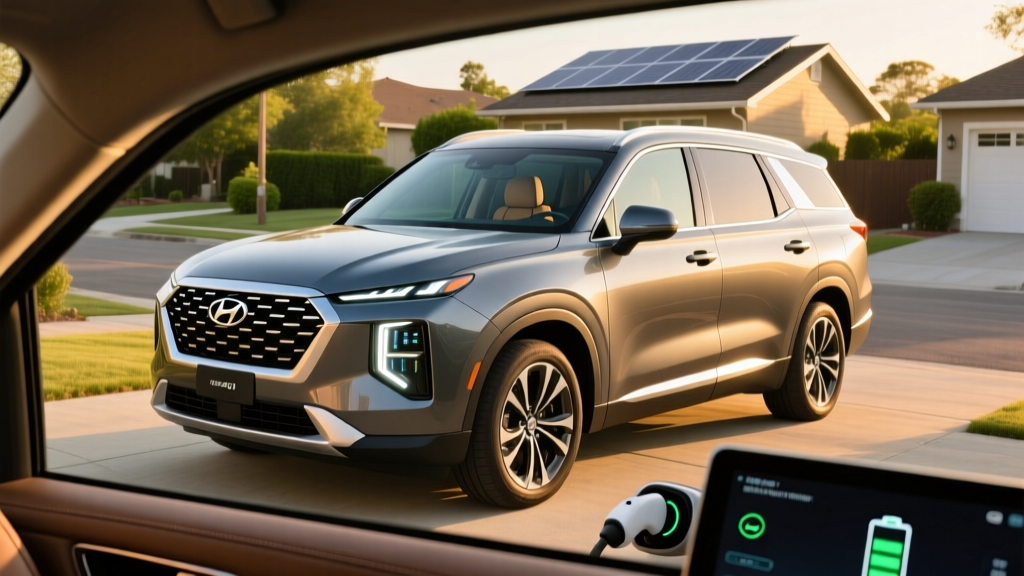
The 2026 Hyundai Palisade Hybrid SEL Premium occupies a compelling middle ground for three-row SUV buyers who want meaningful fuel savings without committing to a plug-in lifestyle or a full battery-electric vehicle. Built on Hyundai's turbocharged 1.6-liter hybrid powertrain, the Palisade Hybrid delivers an EPA-estimated 34 MPG combined — a dramatic improvement over the gas-only Palisade's 22 MPG combined — while retaining the same 5,000-pound towing capacity and seating for up to eight. The SEL Premium trim adds luxury-adjacent features like ventilated front seats, a hands-free liftgate, and Hyundai's Highway Driving Assist 2 without pushing into the six-figure pricing territory that luxury competitors demand. If you want a family hauler that sips fuel in school-drop-off traffic and still handles cross-country road trips without route planning, this is the configuration to target.
| Specification | Detail |
|---|---|
| Powertrain | 1.6L turbocharged 4-cylinder + electric motor (HEV) |
| Combined Horsepower | 258 hp |
| Combined Torque | 271 lb-ft |
| Transmission | 6-speed automatic |
| EPA MPG (City / Highway / Combined) | 36 / 31 / 34 |
| Fuel Tank Capacity | 18.8 gallons |
| Total Range | ~639 miles |
| 0-60 mph (est.) | ~7.8 seconds |
| Towing Capacity | 5,000 lbs |
| Seating Capacity | 7 or 8 passengers |
| Cargo (behind 3rd / 2nd / 1st row) | 20.4 / 45.8 / 86.4 cu ft |
| SEL Premium MSRP | $52,400 (est.) |
| Hybrid Battery Warranty | 10 years / 100,000 miles |
| Federal Tax Credit (§30D) | Not eligible (HEV, not PHEV/BEV) |
HEV vs PHEV: Understanding the Palisade Hybrid's Powertrain
Before we dig into real-world fuel economy, it's essential to clarify exactly what the Palisade Hybrid is — and what it isn't. The Palisade Hybrid is a conventional hybrid electric vehicle (HEV). It pairs a turbocharged 1.6-liter four-cylinder engine with an electric motor integrated into the transmission housing, and a small lithium-ion battery pack (approximately 1.49 kWh) that recharges through regenerative braking and engine power. You never plug it in. You fuel it at any gas station and drive.
HEV vs PHEV vs BEV at a Glance
| Feature | HEV (Palisade Hybrid) | PHEV (e.g., Sorento PHEV) | BEV (e.g., Ioniq 9) |
|---|---|---|---|
| Plug-in Required? | No | Yes (Level 2 recommended) | Yes (Level 2 or DC fast) |
| Electric-Only Range | ~1 mile at low speed | 30-40 miles typical | 250-350+ miles |
| Total Range | ~639 miles | ~430 miles combined | 250-350 miles (then recharge) |
| Fuel Economy | 34 MPG combined | ~80 MPGe (elec), ~30 MPG (gas) | ~3.0-3.5 kWh/mile |
| Federal Tax Credit | None | Up to $7,500 (if eligible) | Up to $7,500 (if eligible) |
| Home Charging Needed? | No | Highly recommended | Essential |
| Best For | No garage/outlet access; road trips | Short commute + home charging | Home charging + daily driving |
Hyundai does not currently offer a Palisade PHEV in the US market. If plug-in hybrid capability is a priority — meaning 30+ miles of electric-only commuting before the gas engine engages — you'd need to look at the mechanically related Kia Sorento PHEV or wait for any future Palisade PHEV announcement. For most three-row SUV buyers without home charging infrastructure, the HEV configuration is the more practical choice.
EPA Fuel Economy and Real-World MPG
The EPA rates the 2026 Palisade Hybrid at 36 MPG city / 31 MPG highway / 34 MPG combined, according to data from fueleconomy.gov. That city number is the star: hybrid powertrains shine in stop-and-go driving because the electric motor handles low-speed propulsion while regenerative braking recaptures energy that a gas-only vehicle wastes as heat.
| Vehicle | City MPG | Highway MPG | Combined MPG |
|---|---|---|---|
| 2026 Palisade Hybrid (AWD) | 36 | 31 | 34 |
| 2026 Palisade Gas (V6 AWD) | 19 | 24 | 22 |
| Toyota Grand Highlander Hybrid (AWD-i) | 35 | 34 | 35 |
| Kia Telluride (V6 AWD) | 18 | 24 | 21 |
| Honda Pilot (V6 AWD) | 19 | 25 | 22 |
Real-World MPG: What to Actually Expect
In mixed suburban and highway driving, expect the Palisade Hybrid to deliver 31-35 MPG combined in real-world conditions. City-heavy commutes with frequent stops can push readings toward 37-38 MPG, where the electric motor does the heavy lifting. Sustained highway driving at 75+ MPH with a full load of passengers and cargo will pull figures down to approximately 28-30 MPG. Cold weather (below 30°F) typically reduces hybrid efficiency by 5-10% due to increased engine idling for cabin heat and reduced battery efficiency — figure 30-32 MPG combined in winter conditions.
Compared to the gas-only Palisade's 22 MPG combined, that's roughly a 55% improvement. Over 15,000 annual miles at $3.50/gallon, the hybrid saves approximately $1,100 per year in fuel costs. Over a typical 7-year ownership period, that's $7,700 in fuel savings — which nearly offsets the hybrid powertrain's premium over the gas model.
Powertrain Deep Dive: Engine, Motor, and Drivetrain
The Palisade Hybrid's powertrain pairs a turbocharged 1.6-liter GDI four-cylinder engine (producing approximately 178 hp on its own) with a 47.7 kW electric motor embedded in the 6-speed automatic transmission. Combined system output is 258 horsepower and 271 lb-ft of torque. AWD is standard on all Palisade Hybrid trims, using a traditional mechanical driveshaft to the rear axle rather than a separate rear electric motor.
The turbocharged engine is important context: unlike naturally aspirated hybrid setups (like Toyota's), Hyundai's turbo provides strong mid-range torque for highway merging and passing, even when the battery state of charge is low. The trade-off is slightly more complexity in the powertrain, though Hyundai's hybrid system has proven durable across the Tucson Hybrid and Santa Fe Hybrid lineups since their 2022 debuts.
The 1.49 kWh lithium-ion battery pack is small by PHEV or BEV standards, but it's sized appropriately for an HEV: it buffers regenerative energy and provides electric assist during acceleration. It is not designed for extended electric-only driving — expect roughly 1 mile of EV creep in parking lots or heavy traffic before the engine fires up.
Pricing, SEL Premium Trim Value, and Tax Credit Eligibility
The 2026 Palisade Hybrid SEL Premium is expected to carry an MSRP of approximately $52,400 (including destination), positioning it between the SEL ($48,900) and the Limited ($57,000). The SEL Premium adds meaningful upgrades over the base SEL:
- Ventilated front seats and heated second-row seats
- Hands-free smart liftgate
- Highway Driving Assist 2 (HDA2) with lane-change assist
- Leather-appointed seating surfaces
- Bose premium audio system
- Dual-pane sunroof
Federal Tax Credit: The Honest Answer
Because the Palisade Hybrid is a conventional HEV (not a PHEV or BEV), it does not qualify for the IRS §30D Clean Vehicle Credit. The federal tax credit of up to $7,500 is reserved for plug-in vehicles meeting battery sourcing, MSRP, and buyer income requirements, as outlined on IRS.gov. There is no federal purchase incentive for conventional hybrids.
Some states offer modest rebates or HOV-lane access for hybrids, but these vary by jurisdiction and change frequently. Check your state's energy or DMV website for current programs. The fuel savings alone — roughly $1,100/year — remain the primary financial argument for the Palisade Hybrid over its gas counterpart.
Battery Warranty, Reliability, and Replacement Cost
Hyundai Hybrid Battery Warranty
Hyundai covers the Palisade Hybrid's lithium-ion battery pack with a 10-year / 100,000-mile warranty (whichever comes first). This warranty covers battery defects and capacity loss below a defined threshold — typically 70% of original capacity, though Hyundai's specific retention threshold is outlined in the owner's warranty booklet. The hybrid system components (electric motor, inverter, control electronics) are covered under the same 10-year/100,000-mile powertrain warranty.
Long-Term Reliability Outlook
Hyundai's turbocharged 1.6L hybrid powertrain has been in service since 2022 across the Tucson Hybrid, Santa Fe Hybrid, and Kia Sorento Hybrid. Early failure rates have been low, and the hybrid components (motor, inverter) are simpler and less stressed than a conventional transmission. The 6-speed automatic is a proven unit shared across Hyundai-Kia's lineup.
Should the hybrid battery require replacement outside of warranty — unlikely before 150,000+ miles based on industry data for similar-capacity HEV packs — expect a replacement cost in the range of $2,500 to $4,000 including labor. This is significantly less than PHEV or BEV battery replacements, which can exceed $10,000, because the HEV battery pack is small (1.49 kWh) and less complex.
Hyundai's overall vehicle warranty remains one of the strongest in the industry: 5-year/60,000-mile bumper-to-bumper and 10-year/100,000-mile powertrain. The IIHS and NHTSA have rated previous Palisade model years highly for crash safety; check both sites for 2026 test results once published.
Who Should Buy the Palisade Hybrid SEL Premium — and Who Shouldn't
Choose the Palisade Hybrid SEL Premium If:
- You drive 12,000-20,000 miles/year and want fuel savings without plugging in
- Your commute is city-heavy (stop-and-go maximizes hybrid efficiency)
- You need three rows and 5,000-lb towing but want better MPG than a V6
- You lack home charging access (apartment, street parking, no 240V outlet)
- You frequently take long road trips and don't want to plan around chargers
- You value Hyundai's 10-year/100,000-mile warranty coverage
Look Elsewhere If:
- You have a short commute with home charging — a PHEV gives you electric-only daily driving
- You want zero tailpipe emissions — consider a BEV like the Ioniq 9 or Rivian R1S
- You need the absolute lowest operating cost — BEVs cost ~$0.04/mile to fuel vs ~$0.10/mile for this hybrid
- You want federal tax credit eligibility — only PHEVs and BEVs qualify under §30D
- You prioritize third-row space above all — the Grand Highlander Hybrid offers a slightly roomier third row at similar MPG
Decision Framework: Hybrid vs PHEV vs EV for Your Situation
Choose the Palisade Hybrid (HEV) if you lack reliable home or workplace charging, regularly drive 300+ miles between stops, or want a simple ownership experience identical to a gas car minus the fuel bill.
Choose a PHEV (like the Sorento PHEV) if your daily commute is under 35 miles, you can install a Level 2 charger at home, and you want electric-only weekday driving with gas flexibility for weekend trips.
Choose a full BEV (like the Ioniq 9) if you have home charging, your daily driving is under 250 miles, you want the lowest per-mile fuel cost, and you're eligible for the $7,500 federal credit.
Frequently Asked Questions
How many MPG does the Hyundai Palisade Hybrid get?
The EPA rates the 2026 Palisade Hybrid AWD at 36 MPG city, 31 MPG highway, and 34 MPG combined. In real-world mixed driving, expect 31-35 MPG. City-heavy routes can push above 37 MPG, while sustained 75+ MPH highway driving with a full load may drop to 28-30 MPG.
Does the Palisade Hybrid need to be plugged in?
No. The Palisade Hybrid is a conventional HEV. Its small battery recharges through regenerative braking and the gasoline engine. You fuel it at any gas station and never need a charging cable or outlet.
Is there a Palisade PHEV with electric-only range?
As of the 2026 model year, Hyundai does not offer a Palisade plug-in hybrid in the US. The mechanically related Kia Sorento PHEV offers approximately 32 miles of electric-only range and qualifies for the federal tax credit. Hyundai has not announced a Palisade PHEV for the US market.
Does the Palisade Hybrid qualify for any tax credit?
No. The IRS §30D Clean Vehicle Credit applies only to plug-in electric vehicles (PHEVs and BEVs) that meet battery sourcing, MSRP caps, and buyer income requirements. Conventional hybrids like the Palisade Hybrid do not qualify for any federal purchase incentive. Some states may offer minor incentives — check your local energy office.
How reliable is the Palisade Hybrid and what does a battery replacement cost?
Hyundai's 1.6L turbo hybrid powertrain has been in service since 2022 with low reported failure rates. The hybrid battery is covered by a 10-year/100,000-mile warranty. Out-of-warranty replacement, while unlikely before 150,000+ miles, is estimated at $2,500-$4,000 — far less than a PHEV or BEV battery due to the small 1.49 kWh pack size.
How does the Palisade Hybrid compare to the Toyota Grand Highlander Hybrid?
The Grand Highlander Hybrid edges out the Palisade by 1 MPG combined (35 vs 34) and offers a slightly roomier third row. The Palisade Hybrid counters with a more premium interior at the SEL Premium trim level, Hyundai's longer 10-year warranty, and a more intuitive infotainment interface. Both are strong choices; test-drive both and compare seating comfort for your family.
What is the towing capacity of the Palisade Hybrid?
The Palisade Hybrid maintains a 5,000-pound maximum towing capacity when properly equipped, identical to the gas-only V6 model. The hybrid's electric motor torque actually provides strong low-speed pulling power for trailer launches.