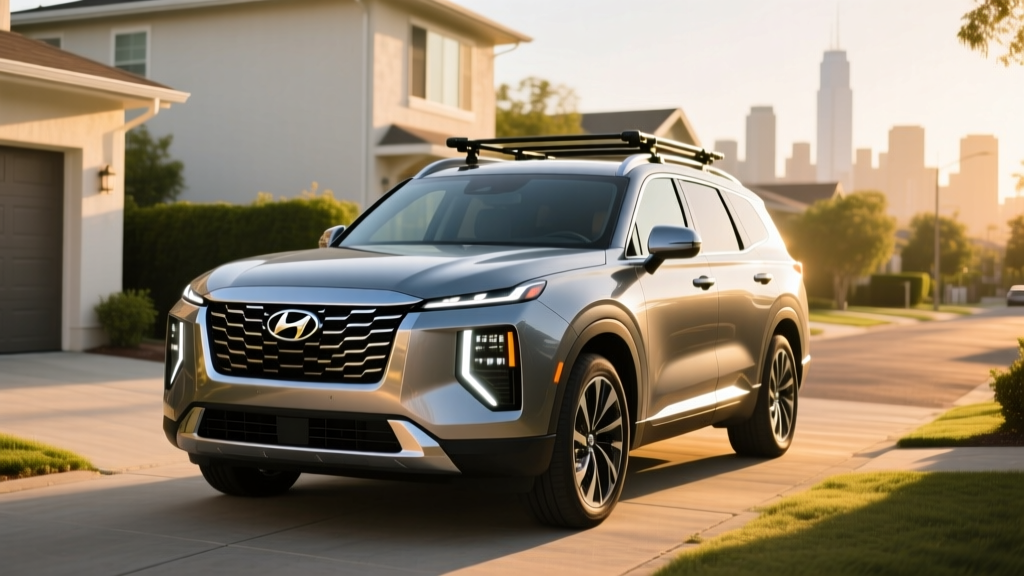
The Hyundai Palisade has been one of the most popular three-row SUVs in America since its debut, but for years it was only available with a conventional V6 engine. That changed with the introduction of a hybrid powertrain, giving families a way to haul seven or eight passengers while trimming fuel costs significantly. If you've been searching for Hyundai Palisade Hybrid miles per gallon data, you've likely noticed conflicting numbers online. This guide cuts through the noise with exact EPA figures, real-world efficiency observations, and a clear breakdown of whether the Palisade Hybrid — or its plug-in sibling — is the right fit for your driveway.
Hyundai Palisade Hybrid MPG: The Official EPA Numbers
The 2026 Hyundai Palisade Hybrid (HEV) pairs a 1.6-liter turbocharged four-cylinder engine with an electric motor integrated into the transmission. This is a conventional hybrid — meaning it charges its own small battery through regenerative braking and engine power. You never plug it in.
According to fueleconomy.gov, the EPA rates the 2026 Palisade Hybrid as follows:
| Driving Cycle | EPA Rating |
|---|---|
| City | 30 MPG |
| Highway | 28 MPG |
| Combined | 29 MPG |
For a three-row SUV with a curb weight pushing 4,500 pounds, those numbers represent a meaningful improvement over the conventional 3.8L V6 Palisade, which is rated at 19 city / 24 highway / 21 combined. That's roughly a 38% improvement in combined fuel economy.
Palisade Hybrid vs. Palisade Plug-In Hybrid: What's the Difference?
Hyundai also offers the Palisade as a plug-in hybrid (PHEV) in select trims. The distinction matters enormously for your fuel costs, daily routine, and tax-credit eligibility.
Palisade Hybrid (HEV)
- No plug-in required — charges itself
- Battery: ~1.5 kWh (small, self-charging)
- Electric-only driving: Brief low-speed assist only
- EPA Combined: 29 MPG
- Range: ~520+ miles on a full tank
- Federal tax credit: Not eligible
Palisade Plug-In Hybrid (PHEV)
- Plug-in capable — Level 2 charging
- Battery: ~22.8 kWh usable (NMC lithium-ion)
- Electric-only range: EPA-estimated 33 miles
- Combined (after battery depleted): ~27 MPG
- Total range: ~460+ miles (electric + gas)
- Federal tax credit: Potentially up to $7,500 (§30D)
The PHEV is the stronger choice if you have home charging access and a commute under 35 miles round-trip. You could go weeks without visiting a gas station. The conventional HEV makes more sense for apartment dwellers, high-mileage drivers, or those who simply don't want to think about plugging in.
Powertrain Specs: What's Under the Hood
| Specification | HEV | PHEV |
|---|---|---|
| Engine | 1.6L Turbo I-4 | 1.6L Turbo I-4 |
| Electric Motor | 47.7 kW (64 hp) | 72 kW (97 hp) |
| Combined System Output | 232 hp / 271 lb-ft | 268 hp / 271 lb-ft |
| Transmission | 6-speed automatic | 6-speed automatic |
| Drivetrain | FWD or HTRAC AWD | HTRAC AWD (standard) |
| Battery Capacity | ~1.5 kWh | ~22.8 kWh usable |
| Battery Chemistry | Lithium-ion polymer | NMC lithium-ion |
| 0–60 mph (est.) | ~7.8 sec | ~7.2 sec |
| Towing Capacity | 4,000 lbs | 4,000 lbs |
Both powertrains use Hyundai's TMED-II (Transmission-Mounted Electric Device) architecture, which places the motor between the engine and transmission. This design delivers smooth torque fill at low RPMs — the electric motor provides instant torque while the turbo spools up, eliminating the lag you'd feel in a conventional turbocharged SUV.
PHEV Charging: How Long Does It Take?
If you opt for the Palisade PHEV, charging logistics become part of your ownership experience. Here's what to expect:
| Charging Level | Power | Time (0–100%) | Notes |
|---|---|---|---|
| Level 1 (120V outlet) | ~1.4 kW | ~16 hours | Emergency/trickle only |
| Level 2 (240V home charger) | 7.2 kW | ~3.5 hours | Recommended for daily use |
| DC Fast Charge | Not supported | N/A | CCS port is AC-only on PHEV |
A critical detail: the Palisade PHEV does not support DC fast charging. This is standard for most PHEVs — the battery is small enough that Level 2 charging refills it overnight or during a workday. If you need fast-charge capability for road trips, you're looking at a full BEV, not a PHEV.
For Level 2 home charging, expect to budget $500–$1,200 for a quality 32-amp or 48-amp wall connector and $800–$2,500 for professional electrical installation (depending on whether your panel needs a 240V circuit run). Total home charging setup typically lands between $1,300 and $3,700.
Pricing, Trims, and Tax Credit Eligibility
The 2026 Palisade Hybrid lineup starts in the mid-$40,000 range and climbs toward $55,000 for fully loaded trims. The PHEV commands a premium of roughly $4,000–$5,000 over equivalent HEV trims.
| Trim | HEV MSRP | PHEV MSRP |
|---|---|---|
| SEL Premium | $44,500 | — |
| Limited | $48,900 | $53,400 |
| Calligraphy | $52,500 | $57,000 |
Prices include destination charge. Verify current MSRP on Hyundai's official site as pricing adjusts throughout the model year.
- MSRP cap: SUVs must be under $80,000 (Palisade qualifies)
- Buyer income cap: $150,000 single / $300,000 married filing jointly
- Battery sourcing: Critical minerals and battery components must meet phased-in domestic/free-trade-agreement thresholds — these tighten annually
- Point-of-sale transfer: You can apply the credit as a down-payment reduction at the dealer rather than waiting for tax filing
Battery Warranty, Reliability, and Replacement Costs
Hybrid battery longevity is consistently the top concern for first-time hybrid buyers. Hyundai addresses this with one of the strongest warranty packages in the industry.
Battery & Powertrain Warranty Coverage
- Hybrid/EV Battery: 10 years / 100,000 miles (original owner)
- Hybrid System Components: 10 years / 100,000 miles
- Powertrain: 10 years / 100,000 miles
- New Vehicle Limited: 5 years / 60,000 miles
- Capacity Retention Threshold: Battery covered if it falls below ~70% of original capacity during warranty period
Source: Hyundai USA Warranty
In real-world terms, Hyundai's hybrid systems have proven reliable. The 1.6L turbo hybrid powertrain is shared across multiple Hyundai/Kia models (Tucson, Santa Fe, Sorento), giving it a large installed base and well-documented service history. Nickel-metal hydride and small lithium-ion hybrid batteries typically last 150,000–200,000+ miles before significant degradation — and the HEV's tiny 1.5 kWh battery undergoes far fewer deep cycles than a full EV pack.
If out-of-warranty replacement is ever needed, expect $2,500–$4,500 for the HEV battery pack and $6,000–$9,000 for the PHEV's larger 22.8 kWh unit, including labor. These are rough estimates — actual costs depend on dealer pricing and whether refurbished packs are available.
Palisade Hybrid vs. PHEV vs. Full EV: Which Should You Choose?
Choose the Palisade HEV if:
- You lack access to home or workplace charging
- You want zero behavior change — just drive and fuel up
- Your annual mileage is high (15,000+ miles) and mostly highway
- You want the lowest upfront cost in the Palisade lineup
- You frequently tow or take long road trips through charging-desert regions
Choose the Palisade PHEV if:
- You have a garage or driveway where you can install a Level 2 charger
- Your daily commute is under 35 miles round-trip
- You want EV-like daily driving with gas-engine flexibility for road trips
- You qualify for the §30D tax credit, narrowing the price gap with the HEV
- You want to reduce fuel stops to 2–3 per month for daily driving
Consider a full EV (e.g., Kia EV9, Tesla Model X) if:
- You have reliable home Level 2 charging
- Your typical trips are under 250 miles or you're willing to plan DC fast-charge stops
- You want the lowest per-mile fuel cost (electricity is ~$0.04–$0.06/mile vs. ~$0.12–$0.16/mile for the HEV)
- You want to eliminate oil changes and reduce brake wear via regenerative braking
- You're ready for the full EV ownership experience
Real-World Ownership Costs: Hybrid vs. Gas Palisade
The fuel savings are where the Palisade Hybrid justifies its existence. Here's a 5-year cost comparison assuming 15,000 miles/year, $3.50/gallon regular unleaded, and EPA-rated efficiency:
| Powertrain | Combined MPG/MPGe | Annual Fuel Cost | 5-Year Fuel Cost |
|---|---|---|---|
| Gas V6 (3.8L) | 21 MPG | $2,500 | $12,500 |
| HEV (1.6T Hybrid) | 29 MPG | $1,810 | $9,050 |
| PHEV (50% electric / 50% gas) | ~27 MPG + electric | ~$1,200 | ~$6,000 |
The HEV saves roughly $3,450 over five years compared to the gas model. The PHEV saves even more if you maximize electric-only driving — potentially $6,500 in fuel savings versus the gas V6. Factor in a $7,500 tax credit on the PHEV, and the financial case becomes compelling despite the higher MSRP.
Pros and Cons at a Glance
✓ Pros
- 29 MPG combined in a 3-row SUV — class-leading efficiency
- 10-year/100,000-mile hybrid battery warranty
- No plug-in required (HEV) — zero lifestyle change
- Smooth electric torque fill eliminates turbo lag
- Available HTRAC AWD for snow/rain traction
- 4,000-lb towing capacity maintained
- PHEV variant eligible for up to $7,500 federal credit
✗ Cons
- 4-cylinder engine note is less refined than the old V6 under hard acceleration
- HEV not eligible for any federal tax credit
- PHEV does not support DC fast charging
- Hybrid trims start at higher price points (no base SE hybrid)
- AWD hybrid loses ~1 MPG vs. FWD
- Third row remains tight for adults on long trips
- PHEV cargo space slightly reduced due to larger battery pack
Frequently Asked Questions
How many MPG does the Hyundai Palisade Hybrid get?
The EPA rates the 2026 Palisade Hybrid at 30 city / 28 highway / 29 combined MPG. In real-world mixed driving, most owners report between 27 and 31 MPG, with city driving often exceeding the EPA estimate thanks to regenerative braking.
How far can the Palisade PHEV go on electric only?
The Palisade PHEV delivers an EPA-estimated 33 miles of electric-only range. In practice, expect 28–35 miles depending on temperature, terrain, and driving style. Once the battery is depleted, it operates as a conventional hybrid at roughly 27 MPG combined.
Does the Palisade Hybrid qualify for a tax credit?
The conventional Palisade Hybrid (HEV) does not qualify for the federal §30D Clean Vehicle Credit — it is not a plug-in vehicle. The Palisade PHEV may qualify for up to $7,500, subject to income caps ($150K single / $300K joint), MSRP caps ($80K for SUVs), and battery-sourcing requirements that tighten annually. Check IRS.gov for current eligibility.
Is the Palisade Hybrid reliable? What about battery replacement?
Hyundai's hybrid powertrain has demonstrated strong reliability across its model range. The hybrid battery is covered for 10 years/100,000 miles, and real-world data from similar Hyundai/Kia hybrid systems shows batteries lasting 150,000+ miles without significant issues. Out-of-warranty HEV battery replacement would cost approximately $2,500–$4,500 if ever needed.
Do I need to plug in the Palisade Hybrid?
No. The conventional Palisade Hybrid (HEV) charges its own battery through regenerative braking and the gasoline engine. You never plug it in. Only the PHEV variant requires plugging in to access its electric-only range.
How does the Palisade Hybrid compare to the Kia Telluride Hybrid?
The Palisade and Telluride share a platform, and their hybrid powertrains deliver similar efficiency — both land in the 28–30 MPG combined range. The Telluride Hybrid may have slightly different trim availability and pricing, but the driving experience and fuel economy are closely matched. Choose based on styling preference, dealer proximity, and specific trim features.