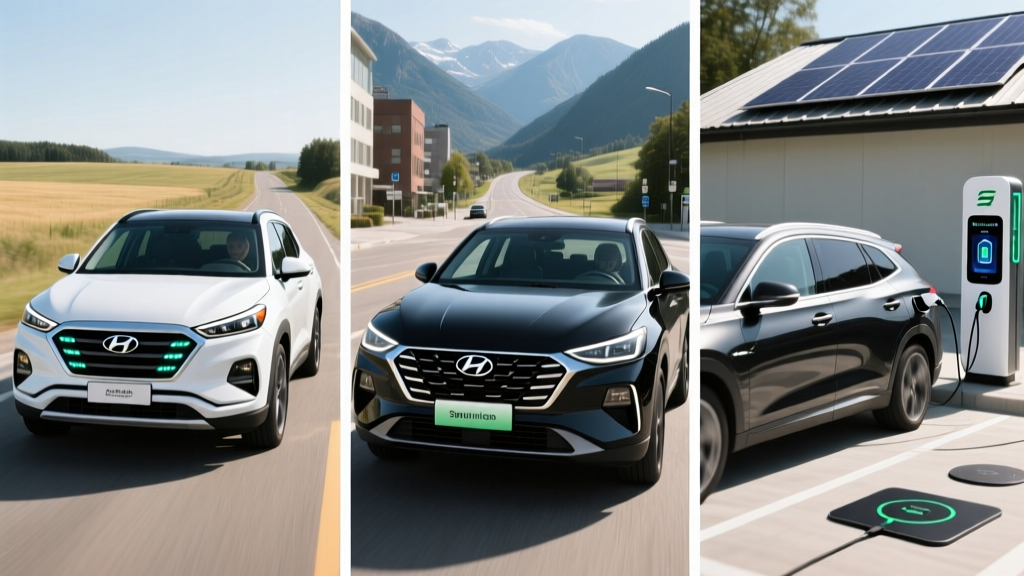
Hyundai's 2025 hybrid lineup spans three distinct vehicles — the Tucson Hybrid and PHEV, the Santa Fe Hybrid, and the Sonata Hybrid sedan — each targeting a different buyer. This guide breaks down every model with exact EPA figures, real-world expectations, powertrain details, and current tax-credit eligibility so you can decide which one actually fits your driving life.
HEV vs PHEV: What Hyundai Offers in 2025
Before comparing models, the critical distinction: Hyundai sells both conventional hybrids (HEVs) and plug-in hybrids (PHEVs). They are fundamentally different ownership experiences.
| Feature | Hybrid (HEV) | Plug-In Hybrid (PHEV) |
|---|---|---|
| Plug in to charge? | No — regenerative braking charges the small battery | Yes — larger battery charges via outlet or charger |
| Electric-only driving | Brief EV assist at low speeds only | Full EV mode for 20–40+ miles |
| Battery size | ~1.5–2.0 kWh | ~13–18 kWh usable |
| Federal tax credit | No | Yes — up to $3,750 (see details below) |
| Best for | Drivers without home charging access | Drivers with home Level 1/2 charging + short commutes |
In 2025, Hyundai's only PHEV offering is the Tucson Plug-In Hybrid. The Tucson Hybrid, Santa Fe Hybrid, and Sonata Hybrid are all conventional HEVs — you never plug them in.
2025 Hyundai Tucson Hybrid
| Spec | Detail |
|---|---|
| Powertrain | 1.6L turbo-4 + electric motor |
| Combined HP | 231 hp / 258 lb-ft torque |
| Transmission | 6-speed automatic |
| Drivetrain | AWD (standard) |
| EPA City / Hwy / Combined | 38 / 38 / 38 MPG |
| Battery | ~1.5 kWh lithium-ion (self-charging) |
| 0–60 mph | ~7.1 seconds |
| Cargo (behind 2nd row) | 38.7 cu ft |
| Base MSRP (Blue trim) | $33,465 |
| Federal tax credit | None (HEV) |
Real-World MPG vs EPA
The Tucson Hybrid's 38 MPG combined EPA rating is remarkably balanced between city and highway — unusual for a hybrid. In real-world driving, expect 36–40 MPG in mixed city/suburban use. Hybrids excel in stop-and-go traffic where regenerative braking recovers energy. On sustained highway trips at 75+ mph, aerodynamic drag pushes consumption higher; expect 34–36 MPG on flat interstate runs, dropping to 30–32 MPG in cold weather or mountainous terrain.
Who Should Choose the Tucson Hybrid?
This is the right pick if you want a compact SUV with strong fuel economy but cannot charge at home — apartment dwellers, street parkers, or anyone without garage/outlet access. The AWD standard drivetrain and 231 hp make it genuinely capable in snow and on hills, unlike some hybrid competitors that feel sluggish.
2025 Hyundai Tucson Plug-In Hybrid (PHEV)
| Spec | Detail |
|---|---|
| Powertrain | 1.6L turbo-4 + electric motor |
| Combined HP | 268 hp / 258 lb-ft torque |
| Transmission | 6-speed automatic |
| Drivetrain | AWD (standard) |
| EPA Electric-Only Range | 33 miles |
| EPA Combined (gas mode) | 35 MPG (charge-sustaining) |
| EPA MPGe (EV mode) | 80 MPGe |
| Battery (usable) | ~13.8 kWh lithium-ion |
| Level 2 Charging (240V) | ~2 hours (0–100%) |
| DC Fast Charging | Not available (Level 2 max) |
| Total Combined Range | ~430 miles (EV + gas) |
| 0–60 mph | ~6.5 seconds |
| Base MSRP (SEL trim) | $40,225 |
| Federal tax credit (§30D) | Up to $3,750 (see eligibility below) |
Electric-Only Range: 33 Miles in the Real World
The EPA rates the Tucson PHEV at 33 miles of pure electric driving. In practice, expect 28–33 miles in mild weather (60–75°F) on suburban roads. Cold weather (below 32°F) reduces this to roughly 22–26 miles due to cabin heating demands and reduced battery efficiency. Highway-speed EV driving (65+ mph) also shortens range — aerodynamic drag consumes more energy than the 80 kW electric motor can efficiently deliver.
The 33-mile EV range covers most daily commutes. The U.S. average one-way commute is approximately 16 miles (U.S. Census Bureau), meaning a round trip is feasible entirely on electricity — effectively making this a daily EV with a gas backup for longer trips.
Charging the Tucson PHEV
The Tucson PHEV charges exclusively via AC (Level 1 or Level 2). There is no DC fast-charging port.
| Charging Method | Power | 0–100% Time | Cost (approx.) |
|---|---|---|---|
| Level 1 (120V household outlet) | ~1.4 kW | ~10 hours | $0.50–$1.50 per full charge |
| Level 2 (240V home charger) | ~7.2 kW | ~2 hours | $1.50–$3.00 per full charge |
A standard 120V outlet overnight is sufficient for most owners — plug in at 9 PM, fully charged by 7 AM. A Level 2 home charger is faster but not strictly necessary given the small battery. Installation for a 240V/50A circuit typically runs $500–$1,500 depending on panel proximity and local permit costs (consult a licensed electrician for your specific situation).
Tucson PHEV Tax Credit Eligibility (§30D)
Under current IRS rules (IRS §30D), the Tucson PHEV may qualify for a federal tax credit of up to $3,750. Eligibility depends on:
- Vehicle MSRP cap: SUVs must be below $80,000 — the Tucson PHEV qualifies
- Buyer income cap: AGI below $150,000 (single) / $300,000 (married filing jointly)
- Battery sourcing: Critical mineral and battery component requirements phase in annually; the Tucson PHEV currently meets partial sourcing thresholds, yielding $3,750 rather than the full $7,500
- Point-of-sale transfer: You can apply the credit at purchase to reduce your out-of-pocket cost immediately
Tax rules change frequently. Confirm your specific eligibility with a tax professional and check the latest fueleconomy.gov tax credit listings before purchasing.
2025 Hyundai Santa Fe Hybrid
| Spec | Detail |
|---|---|
| Powertrain | 1.6L turbo-4 + electric motor |
| Combined HP | 231 hp / 271 lb-ft torque |
| Transmission | 6-speed automatic |
| Drivetrain | AWD (standard) |
| EPA City / Hwy / Combined | 36 / 32 / 34 MPG |
| Battery | ~1.5 kWh lithium-ion (self-charging) |
| Seating | 3 rows / 7 passengers |
| Cargo (behind 3rd row) | 14.5 cu ft |
| 0–60 mph | ~7.8 seconds |
| Base MSRP (SE trim) | $40,200 |
| Federal tax credit | None (HEV) |
Real-World MPG Expectations
The Santa Fe Hybrid's boxy design and 7-passenger size work against highway efficiency. The EPA's 34 MPG combined is realistic for suburban and city driving, where you'll see 35–37 MPG thanks to frequent regenerative braking. Highway-only trips at 70+ mph yield 29–32 MPG, and towing (max 2,000 lbs with the hybrid) pushes consumption significantly higher.
The city-biased EPA split (36 city vs 32 highway) is typical for hybrids: the electric motor handles low-speed loads efficiently, while the turbo gas engine works harder at sustained high speeds.
Who Should Choose the Santa Fe Hybrid?
This is the family hauler for households that need 3 rows but refuse to pay minivan prices or burn minivan fuel. The Kia Sorento Hybrid is the closest competitor; the Santa Fe edges ahead on interior materials and standard AWD. If you need genuine 7-passenger space and can't charge at home, this is the strongest option in its class.
2025 Hyundai Sonata Hybrid
| Spec | Detail |
|---|---|
| Powertrain | 2.0L naturally aspirated 4-cyl + electric motor |
| Combined HP | 192 hp / 139 lb-ft torque (engine) + 39 kW motor |
| Transmission | 6-speed automatic |
| Drivetrain | FWD |
| EPA City / Hwy / Combined | 44 / 51 / 47 MPG |
| Battery | ~1.6 kWh lithium-ion (self-charging) |
| Solar Roof Panel | Standard on Limited trim (adds ~700 mi/yr of range) |
| 0–60 mph | ~8.2 seconds |
| Base MSRP (SEL trim) | $31,250 |
| Federal tax credit | None (HEV) |
Why the Sonata Hybrid's 51 MPG Highway Is Exceptional
Most hybrids are city-biased — the Sonata Hybrid flips this with 51 MPG highway, one of the highest highway ratings of any non-plug-in vehicle sold in the U.S. (fueleconomy.gov). This is achieved through a combination of the 2.0L engine's efficiency at steady-state cruising, low aerodynamic drag (the sedan shape is sleeker than any SUV), and the solar roof panel on the Limited trim, which trickle-charges the 12V system and reduces alternator-equivalent load.
In real-world driving, expect 45–50 MPG on highway trips and 40–45 MPG in city traffic. Cold weather drops both figures by approximately 5–8 MPG due to reduced battery efficiency and increased engine warm-up time.
Side-by-Side: Hyundai's 2025 Hybrid Lineup
| Model | Type | EPA Combined | EV Range | HP | Base MSRP | Tax Credit |
|---|---|---|---|---|---|---|
| Tucson Hybrid | HEV | 38 MPG | N/A | 231 | $33,465 | None |
| Tucson PHEV | PHEV | 35 MPG / 80 MPGe | 33 mi | 268 | $40,225 | Up to $3,750 |
| Santa Fe Hybrid | HEV | 34 MPG | N/A | 231 | $40,200 | None |
| Sonata Hybrid | HEV | 47 MPG | N/A | 192 | $31,250 | None |
Hybrid vs PHEV vs EV: Which Hyundai Fits You?
Choose a Hyundai HEV (Tucson Hybrid, Santa Fe Hybrid, Sonata Hybrid) if:
- You cannot install a home charger (apartment, condo, street parking)
- You want zero behavior change — drive it exactly like a gas car
- You regularly drive 400+ miles between fill-ups
- You want the lowest purchase price in Hyundai's electrified lineup
Choose the Tucson PHEV if:
- You have home charging (even a 120V outlet is sufficient)
- Your daily round-trip commute is under 33 miles
- You want EV-mode daily driving with gas-engine flexibility for road trips
- You qualify for the $3,750 federal tax credit, bringing effective price closer to the Tucson Hybrid SEL
Choose a full EV (e.g., Ioniq 5) instead if:
- Your daily driving exceeds 33 miles but you can charge at home nightly
- You want the lowest per-mile fuel cost (~$0.04/mile vs ~$0.12/mile for the Tucson PHEV on gas)
- You qualify for the full $7,500 §30D credit on a battery-electric vehicle
- You want zero engine maintenance (no oil changes, no spark plugs, no timing chain)
Reliability and Battery Replacement Costs
Hyundai's hybrid systems use proven parallel-hybrid architectures shared with Kia — the 1.6L turbo hybrid powertrain has been in production since 2021 across multiple models. There are no widespread reliability red flags specific to these systems.
Battery replacement cost (out of warranty): Hybrid batteries are significantly cheaper than full EV batteries. Expect $2,000–$4,000 for a Tucson or Sonata Hybrid battery replacement, and $4,000–$7,000 for the Tucson PHEV's larger pack. For context, most hybrid batteries last 150,000–200,000 miles before significant degradation, and many outlast the vehicle itself.
The hybrid batteries in HEVs are small (~1.5 kWh) and experience shallow charge cycles — they never fully deplete or fully charge, which dramatically extends lifespan compared to EV batteries that cycle 0–100% regularly.
Pros and Cons: Hyundai's 2025 Hybrid Strategy
Pros
- Strongest hybrid battery warranty in the segment (10yr/100k mi)
- Tucson PHEV offers 33 mi EV range + AWD — rare combination
- Sonata Hybrid achieves 51 MPG highway — class-leading sedan efficiency
- Standard AWD on both Tucson variants and Santa Fe Hybrid
- No charging infrastructure required for HEV models
- Tucson PHEV eligible for $3,750 federal credit, reducing effective price gap with HEV
Cons
- No Santa Fe PHEV option — only the Tucson offers plug-in capability
- Tucson PHEV lacks DC fast charging — Level 2 only
- Santa Fe Hybrid highway MPG (32) lags behind Toyota Highlander Hybrid (35)
- Sonata Hybrid is FWD only — no AWD option for snow-belt buyers
- HEV models ineligible for any federal tax credit
- PHEV battery reduces cargo space slightly vs HEV Tucson
Frequently Asked Questions
How many MPG does the 2025 Hyundai Tucson Hybrid get?
The EPA rates it at 38 MPG combined (38 city / 38 highway). Real-world testing shows 36–40 MPG in mixed driving, with highway-only trips yielding 34–36 MPG.
How far can the Tucson PHEV go on electric only?
The EPA rates it at 33 miles of electric-only range. In mild weather on suburban roads, expect 28–33 miles. Cold weather reduces this to approximately 22–26 miles.
Does the 2025 Hyundai Tucson PHEV qualify for a tax credit?
Yes — it qualifies for up to $3,750 under §30D, subject to buyer income limits ($150K single / $300K joint) and battery-sourcing requirements. The credit can be transferred at point of sale to reduce your purchase price immediately. Confirm current eligibility at irs.gov.
Do Hyundai hybrids need to be plugged in?
No — the Tucson Hybrid, Santa Fe Hybrid, and Sonata Hybrid are conventional HEVs that charge their batteries through regenerative braking and the gas engine. Only the Tucson Plug-In Hybrid requires (and benefits from) plugging in.
Is the Hyundai hybrid battery reliable and what does replacement cost?
Hyundai covers hybrid batteries for 10 years / 100,000 miles. Out of warranty, HEV battery replacement runs $2,000–$4,000; the Tucson PHEV's larger pack costs $4,000–$7,000. Most hybrid batteries last 150,000–200,000+ miles with shallow-cycle use.
Which 2025 Hyundai hybrid gets the best gas mileage?
The Sonata Hybrid leads at 47 MPG combined (44 city / 51 highway). Among SUVs, the Tucson Hybrid ties at 38 MPG combined.
Should I buy the Tucson Hybrid or the Tucson PHEV?
If you can charge at home (even a standard 120V outlet overnight) and your daily driving is under 33 miles round-trip, the PHEV's $3,750 tax credit and daily EV mode make it the better value. If you can't charge at home or regularly drive long distances, the HEV is simpler and cheaper upfront.