The 2026 Hyundai Hybrid Lineup at a Glance
Hyundai offers one of the broadest electrified portfolios in the mainstream market, spanning conventional hybrids (HEVs) that never need plugging in and plug-in hybrids (PHEVs) that deliver 30+ miles of electric-only driving before the gas engine takes over. For 2026, the Hyundai hybrid lineup covers four nameplates: the Tucson Hybrid and Tucson Plug-in Hybrid, the Santa Fe Hybrid and Santa Fe Plug-in Hybrid, the Sonata Hybrid, and the Ioniq Plug-in Hybrid (a liftback PHEV separate from the all-electric Ioniq 5/6 family).
This guide breaks down every current Hyundai hybrid model with exact EPA fuel economy figures, electric-only range for PHEVs, powertrain specs, pricing, battery warranty coverage, and federal tax credit eligibility under current IRS §30D rules. Whether you're trying to dodge high gas prices without committing to a full battery-electric vehicle or you want electric commuting with gas-engine road-trip flexibility, this is the spec-driven comparison you need.
HEV vs. PHEV — What's the Difference?
Conventional Hybrid (HEV): A small battery (typically 1–2 kWh) is recharged by the engine and regenerative braking. You never plug it in. The electric motor assists the gas engine to improve MPG, especially in city driving. Think of it as a more efficient gas car.
Plug-in Hybrid (PHEV): A larger battery (typically 13–22 kWh) can be charged from a wall outlet or public charger. It delivers 30–40+ miles of pure electric driving before the gas engine kicks in, functioning as a regular hybrid afterward. Ideal for short commutes on electricity with gas-engine backup for longer trips.
2026 Hyundai Tucson Hybrid and Plug-in Hybrid
The Tucson remains Hyundai's best-selling SUV, and its hybrid variants account for a significant share of that volume. The Tucson Hybrid uses a 1.6-liter turbocharged four-cylinder paired with an electric motor for a combined system output of 232 horsepower and 271 lb-ft of torque, routed through a 6-speed automatic to either front-wheel or all-wheel drive (AWD is standard on most trims).
Tucson Hybrid (HEV) Fuel Economy
| Trim / Drivetrain | City MPG | Highway MPG | Combined MPG |
|---|---|---|---|
| Blue FWD | 38 | 38 | 38 |
| AWD (SEL Convenience, Limited) | 37 | 36 | 37 |
Real-world note: Hyundai's hybrid system excels in stop-and-go traffic, where regenerative braking and electric-motor assist do the heavy lifting. Owners routinely report 39–42 MPG in city-heavy commutes with the FWD Blue trim. Highway-only driving at 75+ mph tends to drop to 33–35 MPG, since the engine carries more of the load at sustained speed. According to fueleconomy.gov, the Tucson Hybrid AWD carries a combined EPA rating of 37 MPG.
Tucson Plug-in Hybrid (PHEV)
The Tucson PHEV pairs the same 1.6-liter turbo engine with a more powerful electric motor and a larger 13.8 kWh battery pack. Combined system output rises to 268 horsepower. EPA-rated electric-only range is 33 miles, after which the vehicle operates as a conventional hybrid with an EPA rating of 80 MPGe (combined) and approximately 35 MPG on gasoline alone.
| Spec | Tucson PHEV |
|---|---|
| Battery Capacity | 13.8 kWh (NMC lithium-ion) |
| Electric-Only Range (EPA) | 33 miles |
| Total Combined Range | ~420 miles (electric + gas) |
| Combined Horsepower | 268 hp / 271 lb-ft |
| Level 2 Charging (240V) | ~1 hr 45 min (0–100%, 7.2 kW onboard charger) |
| DC Fast Charging | Not available |
| 0–60 mph | ~7.1 seconds |
Charging reality: The Tucson PHEV does not support DC fast charging. On a Level 2 home charger at 7.2 kW, a full charge takes under two hours. On a standard 120V household outlet (Level 1), expect roughly 5–6 hours from empty — sufficient for overnight replenishment if your commute is under 30 miles.
Real-world electric range: Expect 28–33 miles in mild weather with moderate acceleration. Cold weather (below 35°F) with cabin heating can reduce electric-only range to 22–26 miles. Highway-speed electric driving at 70+ mph will also deplete the battery faster than the EPA cycle suggests.
2026 Hyundai Santa Fe Hybrid and Plug-in Hybrid
The three-row Santa Fe is Hyundai's midsize SUV offering, redesigned for the 2024 model year with a boxier, more rugged design. Both hybrid and PHEV variants are available for 2026, and both come standard with HTRAC all-wheel drive.
Santa Fe Hybrid (HEV)
Using the same 1.6-liter turbo hybrid powertrain as the Tucson but tuned for the larger vehicle, the Santa Fe Hybrid produces 232 combined horsepower. The EPA rates it at 35 MPG combined (36 city / 34 highway) for the most efficient trims. Real-world city driving often yields 36–38 MPG thanks to frequent regenerative braking opportunities in urban traffic, while highway cruising at 70+ mph tends to settle around 31–33 MPG given the vehicle's size and weight.
Santa Fe Plug-in Hybrid (PHEV)
The Santa Fe PHEV uses a larger 22.8 kWh battery pack — significantly bigger than the Tucson PHEV's — and produces 304 combined horsepower. EPA-rated electric-only range is 37 miles, with 79 MPGe combined when accounting for both electric and gasoline operation. On gasoline alone after battery depletion, expect approximately 33 MPG combined.
| Model | City | Highway | Combined | EV Range |
|---|---|---|---|---|
| Santa Fe Hybrid AWD | 36 | 34 | 35 | N/A (HEV) |
| Santa Fe PHEV AWD | — | — | 79 MPGe / 33 MPG | 37 miles |
Charging: The Santa Fe PHEV features a 7.2 kW onboard charger for Level 2 replenishment, completing a full charge in approximately 2 hours 45 minutes. Like the Tucson PHEV, there is no DC fast-charging capability — this is typical for PHEVs in this class, as the battery is small enough that Level 2 charging is adequate for overnight use.
2026 Hyundai Sonata Hybrid
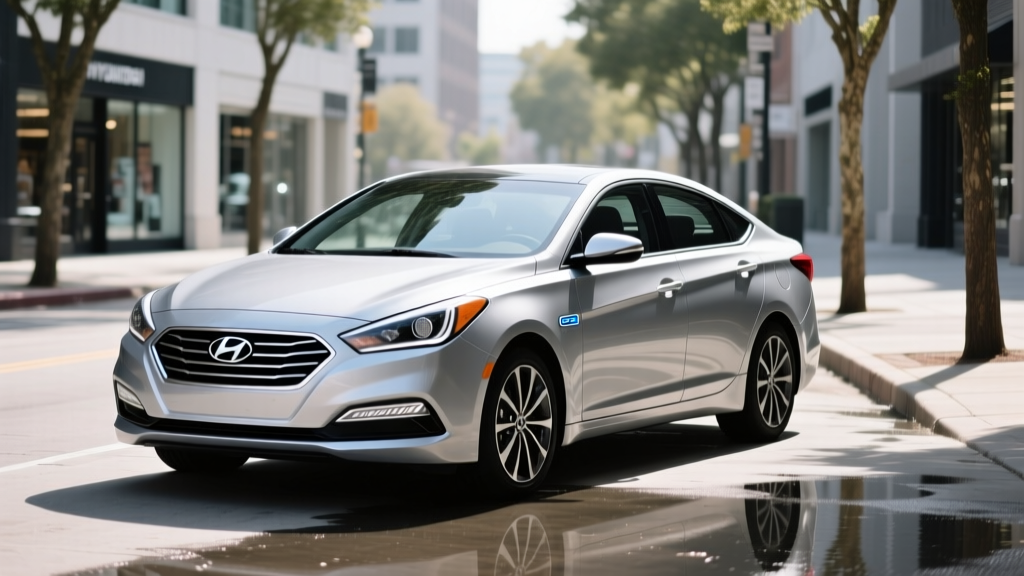
The Sonata Hybrid is the sedan option in Hyundai's hybrid lineup, competing directly with the Toyota Camry Hybrid and Honda Accord Hybrid. For 2026, it uses a 2.0-liter naturally aspirated four-cylinder engine paired with an electric motor integrated into the 6-speed automatic transmission, producing a combined 192 horsepower.
| Sonata Hybrid Trim | City MPG | Highway MPG | Combined MPG |
|---|---|---|---|
| SEL / Limited | 44 | 51 | 47 |
The Sonata Hybrid's EPA numbers are impressive, and real-world results often match or exceed them. Owners with city-heavy commutes regularly report 48–52 MPG, while steady highway driving at 65–70 mph yields 45–48 MPG. The solar-panel roof on the Limited trim provides a small trickle charge to the 12V accessory battery, marginally reducing parasitic load on the hybrid system.
The Sonata is offered only as a conventional HEV — there is no PHEV variant for the 2026 model year in the U.S. market. Hyundai previously sold a Sonata PHEV, but it was discontinued and replaced in the lineup by the Ioniq Plug-in Hybrid.
2026 Hyundai Ioniq Plug-in Hybrid
The Ioniq Plug-in Hybrid returns for 2026 as a dedicated electrified liftback, offering one of the longest electric-only ranges among compact PHEVs. It pairs a 1.6-liter four-cylinder engine with a 62 kW electric motor and an 11.3 kWh battery pack, producing a combined 158 horsepower.
Ioniq PHEV Key Specs
- EPA Electric-Only Range: 29 miles (some earlier model-year variants rated up to 29–30 mi)
- EPA MPGe (combined): 119 MPGe
- Gasoline-Only MPG: 52 MPG combined after battery depletion
- Total Combined Range: ~600+ miles
- Level 2 Charging Time: ~2 hours 15 minutes (3.3 kW onboard charger)
- DC Fast Charging: Not available
- Starting MSRP: ~$33,600
The Ioniq PHEV's standout feature is its gasoline-mode efficiency: even after the battery is depleted, it operates as an exceptionally efficient hybrid at 52 MPG combined. This makes it a strong choice for buyers who want electric commuting capability but also take frequent long road trips where MPG still matters.
Pricing, Tax Credits, and Total Cost
| Model | Starting MSRP | Federal §30D Credit | Effective Price (est.) |
|---|---|---|---|
| Tucson Hybrid (Blue FWD) | $34,250 | Not eligible | $34,250 |
| Tucson PHEV (SEL) | $39,900 | Up to $3,750* | ~$36,150 |
| Santa Fe Hybrid (SEL) | $40,600 | Not eligible | $40,600 |
| Santa Fe PHEV (SEL) | $46,550 | Up to $3,750* | ~$42,800 |
| Sonata Hybrid (SEL) | $31,450 | Not eligible | $31,450 |
| Ioniq Plug-in Hybrid (SE) | $33,600 | Up to $3,750* | ~$29,850 |
*Federal tax credit amounts shown are estimates based on current IRS §30D rules for 2026. PHEVs with battery packs under 16 kWh typically qualify for a partial credit (often $3,750 rather than the full $7,500), and eligibility depends on critical-mineral sourcing requirements, buyer income caps ($150K single / $300K joint AGI), and MSRP caps ($55K for sedans, $80K for SUVs/vans/pickups). Conventional HEVs do not qualify for §30D. Always verify current eligibility at irs.gov or consult a tax professional before purchasing.
Several states offer additional incentives for PHEVs. California's Clean Vehicle Rebate, Colorado's innovative motor vehicle credit, and various utility-company rebates can stack with the federal credit. Check your state and local utility for current programs.
Battery Warranty, Reliability, and Replacement Costs
Hyundai Hybrid & PHEV Battery Warranty
Hybrid/PHEV Battery: 10 years / 100,000 miles (whichever comes first) in all 50 states. This covers the high-voltage traction battery against defects and excessive capacity loss.
Hybrid System Components: 10 years / 100,000 miles, including the electric motor, inverter, and related powertrain electronics.
Basic Vehicle Warranty: 5 years / 60,000 miles bumper-to-bumper.
Powertrain Warranty: 10 years / 100,000 miles.
Hyundai's 10-year/100,000-mile hybrid battery warranty is among the longest in the industry, matching or exceeding Toyota and Honda. In practice, modern lithium-ion hybrid and PHEV battery packs are engineered to last the life of the vehicle under normal use. Degradation in HEVs is minimal because the battery operates within a narrow state-of-charge window (typically 40–60%), avoiding the deep cycles that stress batteries in full EVs.
For PHEVs, the larger battery experiences wider charge cycles, but the 10-year coverage window provides substantial peace of mind. Industry data suggests that hybrid battery replacement outside of warranty is uncommon before 150,000+ miles. If replacement is needed out of warranty, expect approximately $2,500–$4,000 for an HEV battery pack and $5,000–$8,000 for a PHEV battery pack, depending on the model and whether you source a new, refurbished, or salvage unit.
Hyundai's hybrid reliability track record has improved significantly since the early Ioniq generations. The Tucson Hybrid and Santa Fe Hybrid use a proven powertrain shared across multiple models, which tends to improve long-term parts availability and service familiarity at dealerships.
Hyundai Hybrid vs. PHEV vs. Full EV: Which Fits You?
Decision Framework
Choose a Hyundai HEV (Tucson Hybrid, Santa Fe Hybrid, Sonata Hybrid) if:
- You cannot charge at home (no garage, no outlet access, apartment living)
- You want better MPG without changing any habits — just fill up with gas
- Your budget is tighter and you want the lowest upfront cost
- You primarily drive in the city where hybrids shine (40+ MPG real-world)
Choose a Hyundai PHEV (Tucson PHEV, Santa Fe PHEV, Ioniq PHEV) if:
- Your daily commute is under 30–37 miles round-trip (covers most daily driving on electricity)
- You have access to Level 2 charging at home or work
- You want to reduce gas consumption by 60–80% for daily driving but keep gas-engine flexibility for road trips
- You want to access HOV lanes in states that grant PHEV access (varies by state)
Choose a full EV (Ioniq 5, Ioniq 6, Kona Electric) if:
- You have reliable home Level 2 charging and your daily driving is under 250 miles
- You want the lowest per-mile energy cost and minimal maintenance
- You qualify for the full $7,500 federal tax credit on eligible BEV models
- You're willing to plan around DC fast-charging stops on road trips longer than ~280 miles
Pros and Cons Across the Hyundai Hybrid Lineup
Pros
- Class-leading 10-year/100,000-mile hybrid battery warranty
- Sonata Hybrid achieves up to 51 MPG highway — among the best midsize sedans
- PHEV models offer 29–37 miles of electric-only range, covering most commutes
- HTRAC AWD standard on most SUV hybrid trims — confident in rain and snow
- Hyundai's infotainment and driver-assistance tech (Highway Driving Assist 2) is competitive with luxury brands
- No plug-in required for HEVs — zero lifestyle change from a gas car
Cons
- No DC fast charging on any Hyundai PHEV — limits public charging utility
- Conventional hybrids (HEVs) are not eligible for the federal §30D tax credit
- PHEV battery packs reduce cargo space slightly vs. gas-only models
- Santa Fe Hybrid fuel economy trails Toyota Highlander Hybrid by 1–2 MPG combined
- PHEV trims carry a $5,000–$6,000 price premium over equivalent HEV trims
- Real-world electric range drops 15–25% in cold weather with cabin heating
Frequently Asked Questions
How many MPG does the Hyundai Tucson Hybrid get in real-world driving?
The EPA rates the 2026 Tucson Hybrid FWD Blue trim at 38 MPG combined (38 city / 38 highway). In real-world city-heavy commuting, many owners report 39–42 MPG. Highway-only driving at speeds above 70 mph typically yields 33–35 MPG. The AWD trims are rated at 37 MPG combined by the EPA.
How far can the Hyundai Tucson PHEV go on electric only?
The EPA rates the Tucson PHEV at 33 miles of electric-only range. In mild weather with moderate driving, expect 28–33 miles. In cold weather below 35°F with cabin heating active, plan for 22–26 miles of electric range. This is sufficient for most daily commutes under 30 miles round-trip.
Do Hyundai hybrids need to be plugged in?
No. Conventional Hyundai hybrids (Tucson Hybrid, Santa Fe Hybrid, Sonata Hybrid) never need plugging in — they recharge their small battery through the gas engine and regenerative braking. Only the plug-in hybrid (PHEV) models — Tucson PHEV, Santa Fe PHEV, and Ioniq PHEV — benefit from being plugged in to charge their larger batteries for electric-only driving.
Does any Hyundai hybrid qualify for the federal tax credit?
Under current IRS §30D rules, only the plug-in hybrid (PHEV) models may qualify for a partial federal tax credit (typically $3,750, depending on battery capacity and critical-mineral sourcing). Conventional HEVs do not qualify. Eligibility also depends on buyer income limits ($150,000 single / $300,000 joint modified AGI) and MSRP caps ($55,000 for sedans, $80,000 for SUVs). Always verify at irs.gov before purchasing.
How long will a Hyundai hybrid battery last, and what does replacement cost?
Hyundai covers its hybrid and PHEV batteries with a 10-year/100,000-mile warranty. Under normal driving conditions, modern lithium-ion hybrid batteries are designed to last 150,000+ miles without significant degradation. Out-of-warranty replacement costs range from approximately $2,500–$4,000 for HEV battery packs and $5,000–$8,000 for PHEV packs, depending on the model and sourcing (new vs. refurbished).
Is the Hyundai Sonata Hybrid better than the Toyota Camry Hybrid?
It depends on your priorities. The 2026 Sonata Hybrid achieves 47 MPG combined (44 city / 51 highway), while the Camry Hybrid AWD achieves approximately 50 MPG combined. The Sonata offers a more tech-forward interior with Hyundai's latest infotainment system and Highway Driving Assist 2, while the Camry Hybrid has a longer track record of proven reliability. Both are strong choices; test-drive both and compare the specific trim pricing in your area.
Can I charge a Hyundai PHEV on a regular household outlet?
Yes. All Hyundai PHEVs include a Level 1 (120V) charging cable. A full charge from empty on a standard household outlet takes approximately 5–6 hours for the Tucson PHEV and 6–7 hours for the Santa Fe PHEV, depending on battery size. For faster replenishment, a Level 2 (240V) home charger reduces charge time to under 3 hours.