The Quick Answer: Hybrid vs Plug-In Hybrid
If you're not ready for a full battery-electric vehicle but want to cut fuel costs, you're choosing between two distinct powertrains: a conventional hybrid (HEV) and a plug-in hybrid (PHEV). The difference isn't just a charging port — it's a fundamentally different ownership experience with different economics, range profiles, and daily routines.
A conventional hybrid (like the Toyota Camry Hybrid or Honda Accord Hybrid) never plugs in. It uses a small battery recharged by regenerative braking and the gas engine to assist acceleration and enable brief low-speed electric operation. You simply fuel it like a normal car and enjoy 40–55 MPG.
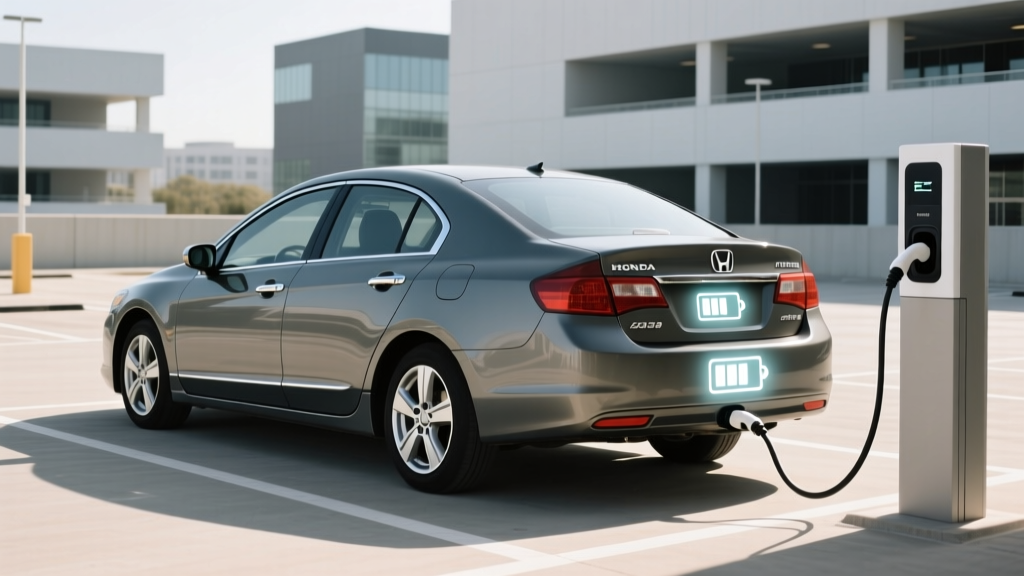
A plug-in hybrid (like the Toyota RAV4 Prime or Jeep Wrangler 4xe) carries a much larger battery — typically 13–22 kWh — that you charge from a wall outlet or Level 2 charger. It delivers 25–50 miles of pure electric driving before the gas engine kicks in, functioning as a conventional hybrid afterward. For short commutes, a PHEV can run weeks without burning a drop of gas.
HEV vs PHEV at a Glance
| Attribute | Conventional Hybrid (HEV) | Plug-In Hybrid (PHEV) |
|---|---|---|
| Plugs in? | No | Yes (120V or 240V) |
| Battery size | 0.6–1.6 kWh | 13–22 kWh |
| Electric-only range | ~1 mile at low speed | 25–50 miles |
| EPA combined MPG (gas) | 40–55 MPG | 35–50 MPG (after battery depletes) |
| MPGe (electric mode) | N/A | 80–105 MPGe |
| Upfront cost premium | +$1,000–$2,500 over gas | +$4,000–$8,000 over gas |
| Federal tax credit | None | Up to $7,500 (eligibility varies) |
| Best for | No home charging, long highway miles | Home charging, short daily commute |
Real-World MPG: What the EPA Sticker Doesn't Tell You
The EPA rates every hybrid and PHEV sold in the US, and you can verify any model at fueleconomy.gov. But the sticker number only tells part of the story, especially for hybrids.
| Model | City | Highway | Combined | EV Range | MPGe |
|---|---|---|---|---|---|
| Toyota Camry Hybrid (HEV) | 51 | 49 | 50 | — | — |
| Honda Accord Hybrid (HEV) | 51 | 44 | 48 | — | — |
| Toyota RAV4 Prime (PHEV) | 40 | 36 | 38 | 42 mi | 94 |
| Chrysler Pacifica PHEV | 29 | 30 | 30 | 32 mi | 82 |
| Hyundai Tucson PHEV | 37 | 35 | 36 | 33 mi | 80 |
Real-world caveat: Conventional hybrids often exceed their EPA city rating in stop-and-go traffic because regenerative braking recaptures more energy at low speeds. Highway MPG, however, can drop 5–10 MPG below the sticker at sustained 75+ MPH. PHEVs are more variable: if your commute is within the electric range and you charge nightly, you might burn zero gas for months. If you never plug in, a PHEV operates as a heavier, slightly less efficient HEV — so a PHEV you don't charge is a waste of money and weight.
PHEV Electric-Only Range, Charging, and Battery Specs
The electric-only range of a PHEV is its most important spec if you're trying to eliminate daily fuel use. Here's how the hardware breaks down for current popular models:
| PHEV Model | Battery (kWh) | EV Range | Level 2 Charge Time | DC Fast Charge? | Combined HP |
|---|---|---|---|---|---|
| Toyota RAV4 Prime | 18.1 | 42 mi | ~2.5 hrs (3.3 kW) | No | 302 |
| Toyota Prius Prime | 13.6 | 44 mi | ~4 hrs (3.3 kW) | No | 220 |
| Hyundai Tucson PHEV | 13.8 | 33 mi | ~2 hrs (7.2 kW) | No | 261 |
| Jeep Wrangler 4xe | 17.3 | 21 mi | ~2 hrs (7.2 kW) | No | 375 |
| BMW X5 xDrive50e | 25.7 | 38 mi | ~3.5 hrs (7.4 kW) | No | 483 |
A critical detail most buyers miss: nearly all PHEVs lack DC fast charging. You're limited to Level 1 (120V household outlet, adding ~4–5 miles of range per hour) or Level 2 (240V, fully recharging overnight in 2–4 hours). This isn't a defect — PHEV batteries are small enough that overnight Level 2 charging is sufficient, and adding DC fast-charge hardware would increase cost, weight, and packaging complexity. If you need road-trip fast charging, a full BEV is the right tool.
MPGe explained: MPGe (miles per gallon equivalent) measures how far a PHEV travels on the electricity equivalent of one gallon of gasoline (33.7 kWh). A 94 MPGe rating means the vehicle uses energy at the same rate as a 94 MPG gas car while in electric mode. Once the battery depletes, the standard MPG rating takes over.
Pricing, Tax Credits, and Total Cost of Ownership
PHEVs carry a significant price premium over their gas-only counterparts, but federal incentives can narrow the gap substantially.
§30D Federal Tax Credit for PHEVs — 2026 Rules
Under IRS §30D, qualifying new PHEVs may receive up to $7,500 in federal tax credits, but eligibility is far from automatic. Key requirements include:
- Battery capacity: At least 7 kWh (most current PHEVs qualify)
- MSRP caps: Vans/SUVs/pickups ≤ $80,000; sedans ≤ $55,000
- Buyer income caps: AGI ≤ $150,000 (single) / $300,000 (joint)
- Battery sourcing: Critical minerals and battery components must meet phased-in domestic/content thresholds that tighten annually through 2030
- Point-of-sale transfer: As of 2024+, you can transfer the credit to the dealer for an immediate price reduction rather than waiting for tax filing
Conventional hybrids (HEVs) do not qualify for the §30D credit. Always verify current eligibility at irs.gov before purchasing — battery sourcing rules change frequently, and models can lose eligibility mid-year.
| Model | MSRP | Est. Credit | Net Price |
|---|---|---|---|
| Toyota Prius Prime SE | $33,445 | $3,751 | ~$29,694 |
| Toyota RAV4 Prime SE | $44,230 | $7,500* | ~$36,730 |
| Hyundai Tucson PHEV SEL | $39,750 | $3,751–$7,500* | ~$32,250–$35,999 |
| Chrysler Pacifica PHEV | $51,095 | $7,500* | ~$43,595 |
*Credit amounts depend on battery sourcing compliance and buyer income. Verify at irs.gov before purchase. Some PHEVs may qualify for partial credit ($3,751) if critical-mineral thresholds are met but component thresholds are not.
Battery Reliability, Warranty, and Replacement Costs
Hybrid and PHEV battery longevity remains a top buyer concern, but the data is reassuring. Modern hybrid batteries — whether the small 1.1 kWh pack in a Camry Hybrid or the 18.1 kWh pack in a RAV4 Prime — use mature lithium-ion chemistry with conservative thermal management. Toyota's hybrid synergy drive system has accumulated over two decades of real-world data, with many first-generation Prius packs lasting 150,000–200,000+ miles before significant degradation.
Hybrid & PHEV Battery Warranty Standards
| Manufacturer | Hybrid Battery Warranty | Capacity Retention Guarantee |
|---|---|---|
| Toyota / Lexus | 10 years / 150,000 miles | Below 70% triggers replacement |
| Honda | 8 years / 100,000 miles (10/150k in CARB states) | Below 70% capacity |
| Hyundai / Kia | 10 years / 100,000 miles | Below 70% capacity |
| Ford | 8 years / 100,000 miles | Below 70% capacity |
| BMW | 8 years / 80,000 miles | Below 70% capacity |
Out-of-warranty replacement cost: $2,000–$4,000 for most HEV battery packs (parts + labor); $5,000–$9,000 for PHEV packs due to larger capacity. Refurbished and aftermarket options are increasingly available for $1,200–$2,500 for common models. In practice, most hybrid batteries outlast the vehicle's economic life, and failure before 150,000 miles is statistically uncommon.
Hybrid vs PHEV vs Full EV: Which Powertrain Fits You?
The decision between a hybrid, plug-in hybrid, and full battery-electric vehicle comes down to three factors: your daily mileage, your charging access, and your road-trip tolerance.
Choose a Conventional Hybrid (HEV) If:
- You have no access to home or workplace charging
- Your commute is long (40+ miles daily) with mostly highway driving
- You want zero change to your fueling routine — just fill up at gas stations
- Budget is a priority: HEVs cost only $1,000–$2,500 more than gas equivalents
- You want maximum simplicity with no charging cables or apps
Best models: Toyota Camry Hybrid (50 MPG), Honda Accord Hybrid (48 MPG), Toyota Highlander Hybrid (35 MPG)
Choose a Plug-In Hybrid (PHEV) If:
- You have home charging (even a standard 120V outlet works overnight)
- Your daily commute is under 35–45 miles round trip
- You want EV-like daily driving but gas-engine freedom for road trips
- You qualify for the §30D tax credit (income and sourcing requirements)
- You're not ready to depend on public charging infrastructure for long trips
Best models: Toyota RAV4 Prime (42 mi EV), Toyota Prius Prime (44 mi EV), Hyundai Tucson PHEV (33 mi EV)
Choose a Full EV (BEV) If:
- You have reliable Level 2 home charging (240V installed)
- You want the lowest per-mile fuel cost ($0.03–$0.05/mi on home electricity)
- You want minimal maintenance (no oil changes, fewer moving parts)
- Your household has a second gas car for rare long trips, or you're comfortable planning DC fast-charge stops
- You want maximum federal/state incentives ($7,500 credit + many state rebates)
Best models: Tesla Model 3 (363 mi), Hyundai Ioniq 5 (318 mi), Chevrolet Equinox EV (319 mi)
5-Year Cost Comparison: HEV vs PHEV vs Gas
Let's run real numbers for a 15,000-mile/year driver over five years, comparing a Toyota Camry gas, Camry Hybrid, and Prius Prime PHEV. PHEV calculation assumes 80% of miles driven on electricity (30-mile daily commute, nightly charging).
| 5-Year Cost Factor | Camry LE (Gas) | Camry Hybrid LE | Prius Prime SE (PHEV) |
|---|---|---|---|
| Purchase price (MSRP) | $28,700 | $29,995 | $33,445 |
| Federal tax credit | $0 | $0 | −$3,751 |
| Fuel / electricity (75k mi) | $9,375 (32 MPG, $4/gal) | $6,000 (50 MPG, $4/gal) | $2,250 (mix) |
| Maintenance (5 yr) | $3,500 | $3,200 | $2,800 |
| Total 5-Year Cost | $41,575 | $39,195 | $34,744 |
| Savings vs Gas | — | $2,380 | $6,831 |
The PHEV wins on total cost if you charge regularly and qualify for the tax credit. If you never plug in a PHEV, you're carrying 300+ lbs of dead battery weight and paying a premium for nothing — the conventional hybrid becomes the smarter buy.
Frequently Asked Questions
How many MPG does a hybrid get compared to a gas car?
Current conventional hybrids deliver 40–55 MPG combined, compared to 25–35 MPG for their gas-only equivalents. The Toyota Camry Hybrid achieves 50 MPG combined (51 city / 49 highway) versus the gas Camry's 32 MPG combined — a 56% improvement. Hybrids gain the most in city driving, where regenerative braking and engine-off coasting maximize efficiency.
How far can a plug-in hybrid go on electric only?
Current PHEVs offer 21–50 miles of EPA-rated electric-only range. The Toyota Prius Prime leads at 44 miles, the RAV4 Prime delivers 42 miles, and most compact SUV PHEVs fall in the 28–38 mile range. Real-world EV range drops 15–25% in cold weather (below 35°F) due to cabin heating demands and reduced battery efficiency. For commutes within the EV range, a PHEV effectively operates as a full EV on weekdays and a gas car on weekends.
Do conventional hybrids need to be plugged in?
No. Conventional hybrids (HEVs) charge their small battery entirely through regenerative braking and the gas engine. There is no charging port, no cable, and no change to your fueling routine. Only plug-in hybrids (PHEVs) require or benefit from external charging — though a PHEV will still drive normally on gas alone if you forget to plug it in (you just lose the electric-range benefit).
Is a hybrid reliable, and what does battery replacement cost?
Hybrid powertrains are among the most reliable in the industry. Toyota's hybrid system has been in continuous production since 1997 with well-documented longevity. The hybrid battery is warranted for 8–10 years / 100,000–150,000 miles depending on the manufacturer. Out-of-warranty replacement runs $2,000–$4,000 for HEV packs and $5,000–$9,000 for PHEV packs. Refurbished packs and independent hybrid shops offer lower-cost alternatives. Most hybrid batteries last the life of the vehicle.
Does a hybrid or PHEV qualify for a tax credit?
Conventional hybrids do not qualify for any federal tax credit. PHEVs may qualify for up to $7,500 under the IRS §30D Clean Vehicle Credit, subject to MSRP caps ($55,000 for sedans, $80,000 for SUVs/vans/pickups), buyer income limits ($150K single / $300K joint AGI), and battery sourcing requirements that tighten annually. The credit can now be transferred to the dealer at point of sale for an immediate price reduction. Check current eligibility at irs.gov before purchasing.
Should I get a hybrid, PHEV, or full EV?
Get a conventional hybrid if you lack home charging or drive mostly highway miles. Get a PHEV if you have home charging, a commute under 40 miles, and want gas-engine backup for road trips. Get a full EV if you have reliable Level 2 home charging, want the lowest running costs, and are comfortable planning DC fast-charge stops on long trips — or have a second gas vehicle for those occasions.