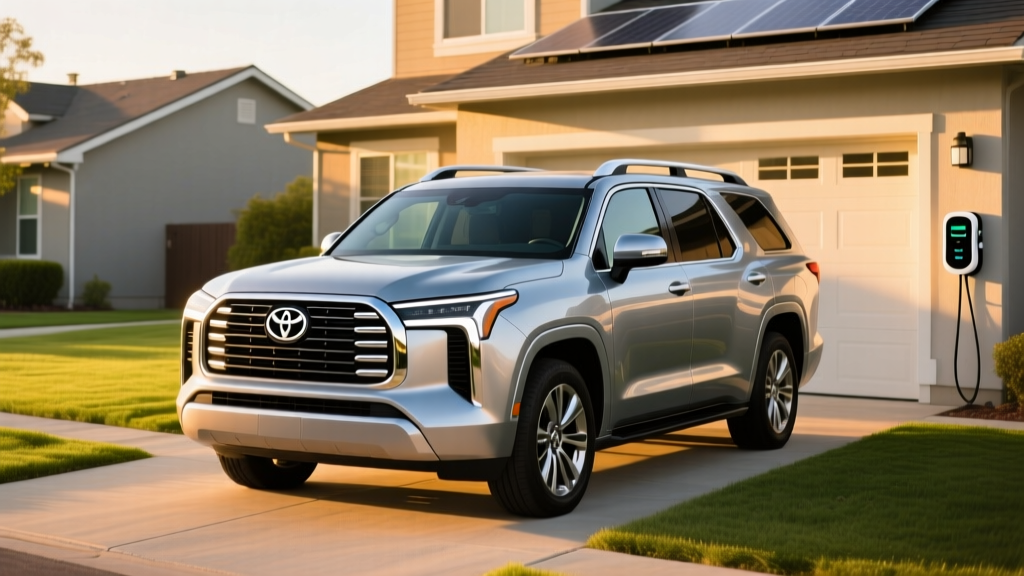
The Toyota Sequoia has been a full-hybrid-only SUV since its current generation launched, and the 2026 model continues that strategy with the i-FORCE MAX powertrain standard across every trim. For large-family shoppers and tow-heavy buyers who aren't ready for a battery-electric vehicle, the hybrid Toyota Sequoia occupies a specific niche: three-row body-on-frame capability with meaningful fuel savings over its gas-only rivals. This guide covers exactly what you get — EPA and real-world MPG, powertrain specs, pricing, tax credit status, and long-term battery reliability — so you can decide if it's the right fit.
Hybrid vs. Plug-In Hybrid: Where the Sequoia Fits
Before diving into specs, it's essential to understand what kind of hybrid the Sequoia is, because this is a common point of confusion among shoppers cross-shopping electrified SUVs.
Conventional Hybrid (HEV) — Toyota Sequoia
- No plug required. The battery recharges through regenerative braking and the gasoline engine.
- No electric-only driving range to speak of — the electric motor assists the gas engine but cannot propel the vehicle alone for meaningful distances.
- No home charging setup needed. You fuel it exactly like a conventional vehicle.
- Lower upfront cost than a comparable PHEV, with no charging infrastructure requirements.
Plug-In Hybrid (PHEV) — e.g., Toyota RAV4 Prime
- Must be plugged in to access its full electric-only range (typically 25–42 miles on current PHEVs).
- Larger battery pack (typically 13–18 kWh) with Level 2 AC charging capability.
- Qualifies for federal tax credits under IRS §30D when battery-sourcing and MSRP caps are met.
- Higher upfront cost but potential fuel savings for short-commute drivers who charge daily.
The Sequoia is a conventional HEV. It does not plug in, has no meaningful electric-only range, and does not qualify for the federal EV tax credit. If you're looking for a three-row Toyota with plug-in capability, you'd need to look outside the Sequoia lineup — Toyota currently does not offer a PHEV variant of this model.
EPA Fuel Economy and Real-World MPG
The 2026 Toyota Sequoia's fuel economy varies slightly by drivetrain. Here are the official EPA estimates as published on fueleconomy.gov:
| Drivetrain | City MPG | Highway MPG | Combined MPG |
|---|---|---|---|
| RWD (SR5, Limited) | 21 | 24 | 22 |
| 4WD (SR5, Limited, Platinum, TRD Pro, Capstone) | 19 | 22 | 20 |
For a 7,000-pound body-on-frame SUV, those numbers are genuinely impressive. The comparable 2026 Chevrolet Tahoe with the 5.3L V8 returns roughly 16 city / 20 highway / 17 combined, and the Ford Expedition with the EcoBoost V6 sits around 17/23/19. The Sequoia's hybrid system delivers a clear advantage, especially in city and stop-and-go driving where regenerative braking and electric-motor assist do the most work.
Real-World MPG: What Owners Actually See
Toyota hybrids tend to meet or slightly exceed their EPA city estimates in real-world driving — a pattern we've observed across the Toyota hybrid lineup. The Sequoia is no exception. Owner-reported data on fuel-tracking platforms consistently shows 4WD Sequoia owners averaging 19–21 MPG combined in mixed driving, with some reaching 22–23 MPG in predominantly suburban and city conditions.
However, highway-heavy road trips at sustained 75–80 mph speeds will pull the number down to 18–19 MPG for 4WD models. Towing is the biggest fuel economy penalty: expect 10–13 MPG when pulling a 6,000–8,000 lb trailer, depending on terrain and wind. That's still better than gas-only competitors under load, but it's a meaningful drop from unloaded driving.
Powertrain: i-FORCE MAX Hybrid Specs
Every 2026 Sequoia uses the same i-FORCE MAX hybrid powertrain — there is no base gas-only engine option. Here's the complete breakdown:
| Specification | Detail |
|---|---|
| Engine | 3.4L twin-turbo V6 (V35A-FTS) |
| Electric Motor | Integrated between engine and transmission |
| Combined Horsepower | 437 hp |
| Combined Torque | 583 lb-ft |
| Transmission | 10-speed automatic |
| Drivetrain Options | RWD or part-time 4WD |
| 0-60 mph (est.) | ~5.6 seconds (4WD) |
| Max Towing Capacity | 9,520 lbs (RWD, properly equipped) |
| Hybrid Battery Type | Lithium-ion, sealed |
| Seating Capacity | 8 (bench 2nd row) or 7 (captain's chairs) |
The i-FORCE MAX system pairs the twin-turbo V6 with an electric motor-generator sandwiched between the engine and the 10-speed automatic transmission. This motor provides low-end torque fill (eliminating turbo lag) and handles regenerative braking. The result is 583 lb-ft of torque available very low in the rev range, which makes the Sequoia feel far quicker than its size suggests and gives it serious towing grunt.
Unlike some hybrid systems that use a continuously variable transmission (CVT), the Sequoia's 10-speed automatic delivers familiar, stepped gear changes. There's no "rubber-band" drone under hard acceleration — a common complaint with CVT-based hybrids that Toyota has largely eliminated here.
2026 Sequoia Pricing by Trim
Here's the manufacturer's suggested retail pricing for the 2026 Toyota Sequoia, before destination charges and dealer adjustments. Prices reflect the latest available MSRPs from Toyota's official specifications:
| Trim | Drivetrain | MSRP (approx.) |
|---|---|---|
| SR5 | RWD | $62,175 |
| SR5 | 4WD | $65,175 |
| Limited | 4WD | $70,875 |
| Platinum | 4WD | $77,460 |
| TRD Pro | 4WD | $80,455 |
| Capstone | 4WD | $82,960 |
Destination and handling charges add approximately $1,995. Actual transaction prices vary by dealer and region; some trims (particularly TRD Pro and Capstone) have seen dealer markups in high-demand markets.
Federal and State Tax Credit Eligibility
Because the Sequoia is a conventional hybrid (HEV) and not a plug-in hybrid or battery-electric vehicle, it does not qualify for the IRS §30D federal clean vehicle tax credit. That credit — up to $7,500 for qualifying new EVs and PHEVs — requires a minimum battery capacity of 7 kWh and plug-in charging capability, neither of which the Sequoia has.
There is also no federal "hybrid-only" tax credit currently in effect. The previous Hybrid Vehicle Tax Credit expired for new purchases years ago. Some states may offer small incentives or HOV lane access for hybrids, but these vary significantly by jurisdiction. Check your state's energy or DMV website for current programs.
Bottom line on incentives: Budget for the full MSRP. The Sequoia's value proposition rests on fuel savings over time, not upfront tax credits.
Battery Warranty, Reliability, and Replacement Cost
Hybrid battery longevity is the number-one concern we hear from prospective hybrid buyers, especially when spending $60,000+. Here's what you need to know about the Sequoia's hybrid battery.
Toyota Hybrid Battery Warranty
Coverage: 10 years / 150,000 miles (whichever comes first)
What's covered: Hybrid battery pack, hybrid control module, and related hybrid-system components against defects and abnormal capacity loss.
Applies to: All 50 states (California-emissions states receive identical coverage terms for the hybrid battery on current Toyota models).
Toyota's track record with hybrid battery reliability is among the strongest in the industry. The Prius, which has used hybrid battery packs since 2001, has demonstrated that well-designed nickel-metal hydride and lithium-ion hybrid batteries routinely last 150,000–200,000+ miles with minimal degradation. The Sequoia's lithium-ion hybrid battery is relatively small (roughly 1.5–2 kWh of total capacity — far smaller than an EV battery) and is never deeply discharged, which significantly extends its cycle life.
Hybrid Battery Replacement Cost
If the hybrid battery does fail outside of warranty, replacement costs for Toyota's full-hybrid systems typically range from $3,000 to $5,000 for the battery pack itself, plus labor. This is substantially less than a full EV battery replacement ($10,000–$20,000+) because the hybrid battery is far smaller. Additionally, refurbished and aftermarket hybrid battery options are increasingly available for $1,500–$3,000 for older Toyota hybrid models, and this aftermarket ecosystem will likely mature for the Sequoia over the coming decade.
The hybrid system's other major components — the electric motor-generator and the power control inverter — are also covered under the hybrid warranty and have proven extremely durable in Toyota's Tundra and other i-FORCE MAX applications.
Sequoia Hybrid vs. Full EV vs. Gas SUV: Which Fits You?
The three-row SUV market now offers genuine choices across all three powertrain types. Here's a practical decision framework:
Choose the Hybrid Sequoia If:
- You need 9,000+ lbs of towing capacity and three rows of seating
- You drive in areas with limited or unreliable public charging infrastructure
- You want 20–22 MPG without changing your fueling habits at all
- You take frequent long road trips where charging stops would add significant time
- You live in an apartment or lack home charging access
- You prioritize proven long-term reliability with a 10-year battery warranty
Choose a Full EV (e.g., Rivian R1S, Tesla Model X) If:
- You have reliable Level 2 home charging and want near-zero daily fuel cost
- Your daily driving is under 250 miles and you road-trip infrequently
- You want the lowest possible maintenance costs (no oil changes, fewer moving parts)
- You qualify for the $7,500 federal tax credit, narrowing the price gap
- You value instant torque and silent operation over maximum towing capacity
For buyers who need serious towing and off-road capability but want to reduce fuel consumption without any lifestyle changes, the hybrid Sequoia is currently the strongest option in its class. If your daily commute is short, you have home charging, and towing is rare, a full-electric three-row SUV may save you more money over five years — but at a higher upfront cost and with range limitations on long hauls.
What the Sequoia Hybrid Does NOT Do
Honesty matters in a purchase this size. Here's what the Sequoia's hybrid system does not provide:
- No electric-only driving. Unlike a PHEV, you cannot run errands on battery power alone. The engine starts in cold conditions and under moderate-to-heavy acceleration.
- No plug-in capability. You cannot charge at home or at public stations. This is a fuel-and-go vehicle.
- No federal tax credit. The purchase price is what you pay, minus any state-specific hybrid incentives.
- Not a fuel-economy leader in absolute terms. At 20–22 MPG combined, it's excellent for a 7,000-lb body-on-frame SUV, but a three-row crossover like the Toyota Grand Highlander Hybrid achieves 34–36 MPG combined. If you don't need body-on-frame capability or 9,500-lb towing, the Grand Highlander Hybrid is far more efficient.
Ownership Costs: 5-Year Fuel Savings vs. Gas Competitors
The Sequoia's hybrid premium pays for itself through fuel savings. Here's a simplified comparison assuming 15,000 miles per year, $3.50/gallon regular unleaded, and EPA combined MPG figures:
| Vehicle | Combined MPG | Annual Fuel Cost | 5-Year Fuel Cost |
|---|---|---|---|
| 2026 Toyota Sequoia 4WD (Hybrid) | 20 | $2,625 | $13,125 |
| 2026 Chevrolet Tahoe 5.3L V8 | 17 | $3,088 | $15,441 |
| 2026 Ford Expedition 3.5L EcoBoost | 19 | $2,763 | $13,816 |
Over five years, the Sequoia saves roughly $2,300 vs. the Tahoe and about $700 vs. the Expedition in fuel alone. Those savings grow if gas prices rise or if your driving skews toward city conditions where the hybrid system excels. Factor in Toyota's strong resale value — historically among the highest in the full-size SUV segment — and the Sequoia's total cost of ownership becomes very competitive despite its higher starting MSRP.
Frequently Asked Questions
How many MPG does the hybrid Toyota Sequoia get?
The EPA rates the 2026 Sequoia at 21 city / 24 highway / 22 combined (RWD) and 19 city / 22 highway / 20 combined (4WD). In real-world mixed driving, 4WD owners commonly report 19–21 MPG combined. Highway-only driving at high speeds drops this to 18–19 MPG, and towing drops it to 10–13 MPG.
Does the Toyota Sequoia plug in or have electric-only range?
No. The Sequoia is a conventional hybrid (HEV), not a plug-in hybrid (PHEV). It has no electric-only driving range and does not plug in. The hybrid system recharges its small battery through regenerative braking and the gasoline engine. You fuel it exclusively at gas stations.
Is the hybrid Toyota Sequoia reliable, and what does a battery replacement cost?
Toyota's hybrid systems have a two-decade track record of exceptional reliability. The Sequoia's hybrid battery is covered by a 10-year/150,000-mile warranty. Out-of-warranty replacement costs typically range from $3,000 to $5,000 for the battery pack — far less than an EV battery. The hybrid system's motor-generator and inverter are also highly durable with minimal failure rates in Toyota's i-FORCE MAX applications.
Does the Sequoia qualify for any federal tax credit?
No. The IRS §30D Clean Vehicle Credit applies only to plug-in electric vehicles and plug-in hybrids meeting battery-capacity and sourcing requirements. Since the Sequoia is a conventional hybrid with no plug-in capability, it does not qualify for any current federal tax credit. Check your state's energy office for any local hybrid incentives.
Should I buy the Sequoia hybrid or the Grand Highlander Hybrid?
It depends on what you need from a vehicle. The Grand Highlander Hybrid delivers 34–36 MPG combined in a three-row crossover package starting around $45,000, but it's unibody with a maximum towing capacity of roughly 5,000 lbs. The Sequoia is body-on-frame, tows up to 9,520 lbs, has more off-road capability, and offers a truck-like ride — but gets 20–22 MPG and starts above $62,000. If you need serious towing and ruggedness, the Sequoia is the right call. If you just need three rows and efficiency, the Grand Highlander Hybrid is the smarter buy.
How does cold weather affect the Sequoia's hybrid fuel economy?
Like all hybrids, the Sequoia's fuel economy drops in cold weather — typically 2–4 MPG below EPA estimates in sub-freezing temperatures. The engine runs more frequently to maintain cabin heat and bring the hybrid system to operating temperature. This is less severe than the range loss experienced by full EVs in cold weather (often 20–30%), but it's noticeable on short winter trips.
The 2026 hybrid Toyota Sequoia isn't trying to be an EV or a fuel-sipping crossover. It's a heavy-duty, three-row, body-on-frame SUV that happens to use a hybrid powertrain to deliver class-leading fuel economy and impressive torque. For buyers who need its specific combination of towing, seating, and off-road capability, it's currently the most efficient option on the market — and the 10-year hybrid battery warranty provides genuine peace of mind for long-term ownership.