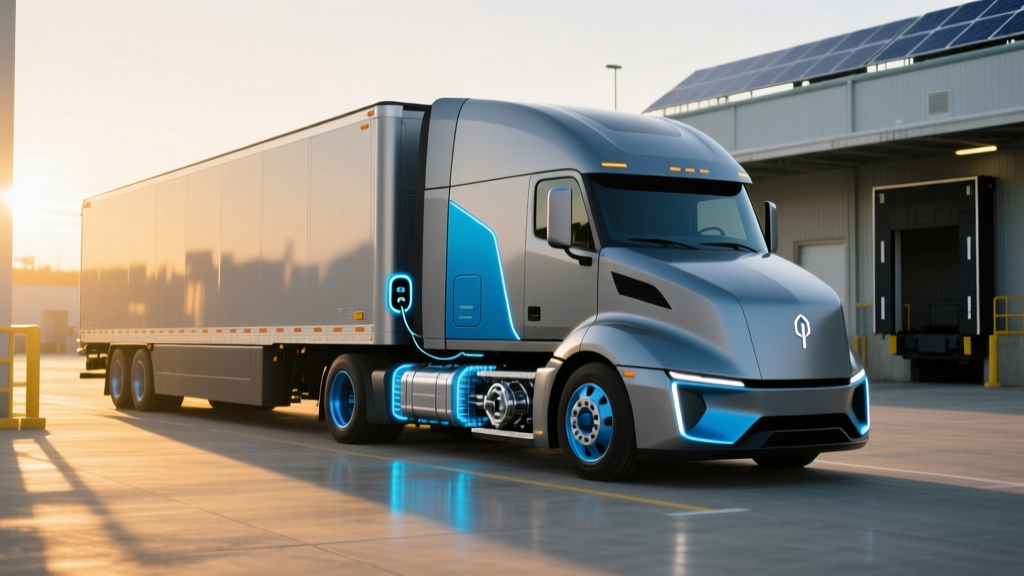
Class 8 trucking is entering a transitional era. While battery-electric and hydrogen fuel-cell semis grab headlines, hybrid semi trucks — both conventional hybrids (HEV) and plug-in hybrids (PHEV) — are carving out a pragmatic middle ground for fleets that need diesel range but want meaningful fuel savings in stop-start drayage, urban delivery, and regional haul cycles. This guide breaks down the hybrid semi truck landscape as it stands in the 2026 model year, covering powertrain architectures, real-world MPG expectations, battery durability, and total cost of ownership.
HEV vs. PHEV: The Critical Distinction for Semi Trucks
Conventional Hybrid (HEV): Uses a smaller battery (typically 2–10 kWh) charged exclusively through regenerative braking and the diesel engine. No plug required. Fuel savings come from engine load-leveling, idle reduction, and recaptured braking energy. Think of it as a more efficient diesel — same fueling workflow, 10–25% better MPG in stop-start duty.
Plug-In Hybrid (PHEV): Pairs a larger battery (typically 30–100+ kWh) with an electric motor and a diesel engine. Can be plugged into Level 2 or DC fast chargers. Offers 20–50+ miles of electric-only range for zero-emission drayage or depot-to-depot runs, then switches to hybrid or diesel mode for highway stretches. Requires charging infrastructure investment.
Current Hybrid Semi Truck Platforms (2026)
The heavy-duty hybrid market is narrower than the passenger-car segment. Major OEMs have pursued different strategies: some offer integrated hybrid powertrains, while others support third-party hybrid-electric upfits on existing chassis. Here are the primary platforms available or in fleet delivery as of 2026.
Kenworth T680 Hybrid (HEV — PACCAR Powertrain)
Kenworth's hybrid variant of the T680 pairs the PACCAR MX-13 diesel engine (455 hp, 1,650 lb-ft) with an integrated electric motor/generator and a lithium-ion battery pack (~5 kWh). The system provides engine-assist torque fill, regenerative braking capture, and engine-off idle reduction. No plug-in charging is needed — the battery charges via regen and the engine.
EPA-estimated fuel economy: ~7.2 MPG combined (vs. ~6.5 MPG for the conventional T680 diesel). In urban/drayage cycles, real-world testing by fleet operators has shown 8.0–9.5 MPG, a 15–25% improvement over baseline, because hybrids recapture the enormous kinetic energy lost during frequent braking of an 80,000-lb combination.
Volvo VNR Electric/Hybrid Regional Platform (PHEV Variant)
Volvo Trucks has offered a plug-in hybrid variant of the VNR for regional-haul fleets that need electric-only operation in urban zones (for compliance with clean-air regulations like California's Advanced Clean Trucks rule) but diesel range for highway segments. The PHEV VNR uses a ~60 kWh lithium-ion battery pack paired with Volvo's D13 turbo-diesel (455 hp) and an integrated electric driveline.
Electric-only range: Approximately 35–45 miles (loaded, flat terrain), sufficient for port drayage or metro delivery loops. Total combined range: 500+ miles using the diesel tank. Charging: Level 2 (19.2 kW AC) in ~3.5 hours from empty; DC fast charging at up to 150 kW, reaching 80% in approximately 30 minutes.
Third-Party Hybrid Upfit Systems
Companies like Hyliion have developed hybrid-electric axle systems (e.g., the Hypertruck ERX) that can be integrated onto existing Class 8 chassis from Freightliner, Peterbilt, or Volvo. These systems add electric-powered axles with regenerative braking and, in the ERX's case, an onboard generator for extended range. Hyliion's claimed fuel savings range from 20–30% in mixed duty cycles, though real-world results depend heavily on route topography and stop frequency.
Hybrid Semi Truck Specs at a Glance
| Specification | Kenworth T680 HEV | Volvo VNR PHEV | Hyliion Hypertruck ERX |
|---|---|---|---|
| Type | HEV (conventional hybrid) | PHEV (plug-in hybrid) | Series-hybrid upfit (EREV) |
| Engine | PACCAR MX-13 diesel, 455 hp | Volvo D13 diesel, 455 hp | Cummins L9N natural gas / diesel generator |
| Battery (kWh) | ~5 kWh (Li-ion) | ~60 kWh (Li-ion NMC) | ~50 kWh (Li-ion) |
| Combined System HP | ~480 hp (peak assist) | ~500 hp (combined) | ~500 hp (electric axle drive) |
| Electric-Only Range | N/A (HEV) | 35–45 miles | ~30 miles (battery only) |
| EPA MPG (Combined) | ~7.2 MPG | ~8.5 MPG (hybrid mode); MPGe in EV mode varies | ~8.0–9.0 MPG (diesel-equiv.) |
| DC Fast Charge | No (no plug) | Yes, up to 150 kW | Limited / varies by config |
| Base MSRP (est.) | ~$185,000 | ~$250,000+ | ~$230,000 (upfit incl.) |
| Battery Warranty | 5 yr / 500,000 mi | 5 yr / 600,000 mi | 5 yr / 750,000 mi |
How Many MPG Do Hybrid Semi Trucks Actually Get?
Class 8 fuel economy is measured differently than passenger vehicles. The EPA's heavy-duty fuel economy standards focus on brake-specific fuel consumption and greenhouse gas compliance rather than window-sticker MPG. However, fleet operators track MPG closely, and here's what the data shows:
| Duty Cycle | Conventional Diesel | HEV Semi | PHEV Semi (Hybrid Mode) |
|---|---|---|---|
| Highway (steady 65 mph) | 7.0–7.5 MPG | 6.8–7.3 MPG (minimal hybrid benefit) | 7.0–7.5 MPG |
| Regional (mixed) | 6.0–6.8 MPG | 7.0–8.0 MPG | 7.5–9.0 MPG |
| Urban drayage (stop-start) | 4.5–5.5 MPG | 6.0–7.5 MPG | Electric-only / N/A |
Key takeaway: Hybrid semi trucks shine in stop-start and urban duty cycles, where regenerative braking recovers energy that conventional diesels waste as brake heat. On steady-state highway runs, the hybrid advantage narrows to just 2–5% because there's little braking energy to recapture. If your fleet runs 90% highway, a hybrid may not justify its premium. If 40%+ of miles are urban or regional with frequent stops, the ROI becomes compelling.
PHEV Electric-Only Range and Charging Realities
For plug-in hybrid semis, electric-only range is the headline spec — but real-world range depends on payload, terrain, and temperature.
Real-World Electric Range vs. Sticker
Volvo VNR PHEV: Rated at ~40 miles electric-only (loaded, flat). Expect 30–35 miles in hilly urban terrain, and as low as 22–28 miles in cold weather (below 35°F) due to cabin heating demand and reduced battery discharge efficiency. The NMC chemistry in the ~60 kWh pack loses approximately 15–20% usable capacity in freezing conditions.
Charging time reality: At a 150 kW DC fast charger, the 10–80% charge takes ~30 minutes. However, the charge curve tapers significantly above 80% — a full 0–100% session may take 50–60 minutes. For depot operations, overnight Level 2 charging (19.2 kW) is the practical default: a full charge takes roughly 3.5 hours, which fits within a typical 8–10 hour dwell.
kW vs. kWh reminder: kW (kilowatts) measures the rate of charge — how fast energy flows. kWh (kilowatt-hours) measures the total energy stored in the battery. A 60 kWh battery charged at 150 kW won't fill in 60÷150 = 0.4 hours because the charge rate tapers as the battery fills. Always look at the 10–80% time, not peak kW, for practical planning.
Battery Warranty, Lifespan, and Replacement Cost
Hybrid Semi Truck Battery Warranty Summary
- HEV systems (Kenworth/PACCAR): 5 years / 500,000 miles — the smaller battery (~5 kWh) undergoes shallow charge/discharge cycles and is designed to last the life of the truck with minimal degradation.
- PHEV systems (Volvo): 5 years / 600,000 miles, with a guaranteed minimum of 70% capacity retention at warranty end.
- Upfit systems (Hyliion): 5 years / 750,000 miles on the electric axle battery pack.
Replacement cost: For HEV packs (~5 kWh), replacement runs $4,000–$8,000. For PHEV packs (~60 kWh), expect $18,000–$30,000 depending on chemistry and supplier. These costs are trending downward as heavy-duty battery production scales, but remain a significant mid-life expense for fleet budgeting.
Real-world lifespan: HEV batteries in Class 8 service commonly exceed 700,000 miles before capacity loss affects performance. PHEV batteries, subjected to deeper cycles, typically reach 500,000–600,000 miles before dropping below the 70% capacity threshold — still well within a typical first-owner lifecycle.
Does a Hybrid Semi Truck Qualify for Tax Credits?
This is where the commercial-vehicle incentive landscape differs sharply from passenger cars. The federal §45W Commercial Clean Vehicle Credit (not §30D, which applies to personal-use vehicles) offers up to $40,000 for qualified commercial plug-in vehicles with a GVWR over 14,000 lbs. Here's the breakdown:
- HEV (conventional hybrid) semis: Do NOT qualify for §45W. This credit requires plug-in capability and minimum battery capacity thresholds. Conventional hybrids cannot be plugged in, so they are ineligible.
- PHEV semis: Generally qualify for the full $40,000 credit, provided the vehicle meets incremental-cost and battery-sourcing requirements. The credit equals the lesser of 15% of the vehicle's basis (or 30% if not subject to depreciation limits) or the incremental cost over a comparable diesel model.
- State incentives: California's HVIP (Hybrid and Zero-Emission Truck and Bus Voucher Incentive Project) offers point-of-sale vouchers of $30,000–$120,000 for qualifying hybrid and electric Class 8 trucks, depending on technology and fleet size. Other states including New York, New Jersey, and Oregon have similar programs, though amounts and eligibility vary by jurisdiction.
Important: Incentive programs change annually and have specific fleet-size, domicile, and technology requirements. Consult a tax professional and check irs.gov and your state air-resources board for current-year eligibility before committing to a purchase.
Hybrid vs. PHEV vs. Full Electric Semi — Which Fits Your Fleet?
Choose a Conventional Hybrid (HEV) Semi If:
- Your fleet runs mixed regional/urban routes and you want 10–25% fuel savings with zero infrastructure changes
- You have no depot charging capability and no plans to install it
- You need full diesel range (1,000+ miles) without compromise
- You want lower maintenance (regenerative braking reduces brake wear by 30–50%)
Choose a Plug-In Hybrid (PHEV) Semi If:
- You operate in clean-air zones requiring zero-emission operation (ports, urban cores)
- Your daily routes include a 30–40 mile electric-suitable segment plus longer highway stretches
- You can install depot Level 2 or DC fast charging
- You want to claim the $40,000 §45W commercial credit
Choose a Full Battery-Electric (BEV) Semi If:
- Your routes are under 200 miles round-trip with predictable depot charging
- You operate in California or other states with BEV-purchase mandates for fleets
- You want maximum per-mile energy savings (electricity at $0.12–$0.18/kWh vs. diesel at $3.80–$4.50/gal)
- You can absorb the $350,000–$500,000 upfront cost and depot charging buildout
Pros and Cons of Hybrid Semi Trucks
Pros
- 10–25% fuel savings in stop-start and urban duty cycles
- 30–50% reduction in brake wear from regenerative braking
- No range anxiety — diesel engine provides unlimited range
- HEV requires no charging infrastructure investment
- PHEV qualifies for up to $40,000 federal commercial credit
- Lower idle emissions — hybrid systems shut off the engine at stops
- Proven diesel reliability with electric-assist simplicity
Cons
- $25,000–$65,000 premium over a conventional diesel semi
- Minimal fuel savings on steady-state highway routes
- PHEV requires depot charging infrastructure ($15,000–$50,000+ per stall)
- Battery replacement at mid-life adds $4,000–$30,000 cost
- Heavier curb weight reduces payload by 200–800 lbs depending on system
- Fewer OEM options than conventional diesel — longer lead times
- Resale value uncertainty as the market is still maturing
Frequently Asked Questions
How many MPG does a hybrid semi truck get?
In real-world fleet testing, conventional hybrid (HEV) semi trucks achieve approximately 7.0–8.0 MPG combined in mixed regional duty, compared to 6.0–6.8 MPG for a conventional diesel. In urban drayage with frequent stops, the gap widens: HEV semis can reach 6.0–7.5 MPG versus 4.5–5.5 MPG for a standard diesel. PHEV semis running in hybrid mode (battery depleted) perform similarly to HEVs, while their electric-only segments use zero diesel.
How far can a plug-in hybrid semi truck go on electric only?
Current PHEV Class 8 trucks like the Volvo VNR PHEV offer approximately 35–45 miles of electric-only range when fully charged and carrying a typical load. Real-world range drops to 22–35 miles in cold weather or hilly terrain. This is sufficient for port drayage, depot-to-customer urban delivery, or zero-emission zone compliance — but not for long-haul segments.
Are hybrid semi trucks reliable, and what does battery replacement cost?
Yes. Hybrid semi trucks use well-proven diesel engines paired with electric motor/generators that have fewer moving parts than additional mechanical components. The HEV battery packs (~5 kWh) undergo shallow cycles and commonly last 700,000+ miles. PHEV packs (~60 kWh) typically last 500,000–600,000 miles before significant degradation. Replacement costs range from $4,000–$8,000 for HEV packs to $18,000–$30,000 for PHEV packs. All major OEMs provide 5-year / 500,000+ mile battery warranties.
Does a hybrid semi truck qualify for any tax credit?
Conventional hybrids (HEVs) do not qualify for the federal §45W Commercial Clean Vehicle Credit because they lack plug-in capability. Plug-in hybrid (PHEV) semis generally qualify for up to $40,000 under §45W, subject to incremental-cost calculations and battery-sourcing requirements. Additionally, state programs like California's HVIP can provide $30,000–$120,000 in point-of-sale vouchers. Always verify current-year eligibility with a tax professional and irs.gov.
Hybrid vs. PHEV vs. full electric semi — which should my fleet buy?
It depends on your duty cycle and infrastructure. HEV semis suit fleets wanting fuel savings without infrastructure changes or range compromise. PHEV semis suit fleets with depot charging that need electric-only capability for urban zones but diesel range for highway segments. Full BEV semis suit fleets with sub-200-mile routes, depot charging, and regulatory mandates pushing toward zero-emission operation. For most regional-haul fleets in 2026, the PHEV represents the best balance of emissions reduction and operational flexibility.
Do conventional hybrid semi trucks need to be plugged in?
No. Conventional hybrid (HEV) semi trucks charge their small battery packs entirely through regenerative braking and the diesel engine. There is no plug, no charging cable, and no charging infrastructure required. The driver fuels the truck with diesel exactly as with a conventional semi.
Sources: EPA Heavy-Duty Emissions & Fuel Economy, IRS §45W Commercial Clean Vehicle Credit, California Air Resources Board — Advanced Clean Trucks.