If you've been searching for a hybrid RV camper, you've likely noticed the options are thinner than the marketing suggests. The RV industry has been slower to electrify than the passenger-car world, and the term "hybrid camper" gets tossed around to describe everything from a plug-in hybrid SUV towing a travel trailer to a Class C motorhome with a mild-hybrid diesel chassis. This guide cuts through the noise with exact specs, real-world MPG data, and a clear framework for deciding which hybrid camping setup actually makes sense for you.
What "Hybrid RV Camper" Actually Means in 2026
There is no single vehicle category called "hybrid RV camper." Instead, buyers are typically looking at one of three configurations:
- Hybrid or PHEV tow vehicle + travel trailer: The most common and practical setup. You use a hybrid SUV or truck to tow a conventional travel trailer or pop-up camper.
- Hybrid motorhome (Class C or Class B): A motorized RV built on a hybrid chassis. Options here are extremely limited in 2026, with only a handful of concept-stage or low-volume products.
- Lightweight "electric camper" trailers: Towable campers with onboard battery packs (like the Lightship L1 or Colorado Teardrops e-drop) that provide off-grid power or even assist with towing via an integrated axle motor. These are not hybrids themselves but pair well with hybrid tow vehicles.
Understanding which configuration you're after determines every downstream decision — from tow rating to charging logistics to whether you need a plug-in hybrid (PHEV) or a conventional hybrid (HEV).
HEV vs PHEV: Which Hybrid Tow Vehicle Makes Sense for Camping?
| Feature | Conventional Hybrid (HEV) | Plug-in Hybrid (PHEV) |
|---|---|---|
| Needs to plug in? | No — charges via regenerative braking and engine | Yes — plug in for electric-only range |
| Electric-only range | None (EV mode limited to ~1 mi at low speed) | Typically 28–42 miles (varies by model) |
| Battery size | 1.0–2.0 kWh | 13–25 kWh |
| Best for camping if... | You want max towing and no charging logistics | You can charge at home/campsite and want quiet electric campsite power |
| Towing capacity | Generally higher (no battery weight penalty) | Often 500–1,500 lbs less than HEV equivalent |
| Federal tax credit (§30D) | Not eligible | Eligible if sourcing/income/MSRP rules met |
For most RV camping scenarios, a conventional hybrid (HEV) tow vehicle is the pragmatic choice. You get better fuel economy than a gas equivalent without sacrificing towing capacity, and you never need to hunt for a charger at a remote campsite. PHEVs shine if you have home charging and want to run campsite appliances off the larger battery — but their added weight reduces tow ratings.
Top Hybrid & PHEV Tow Vehicles for RV Campers (2026 Specs)
Here are the most capable hybrid vehicles for towing a travel trailer, pop-up camper, or teardrop in 2026. All figures are from fueleconomy.gov and manufacturer spec sheets.
| Vehicle | Type | Combined HP | Max Tow (lbs) | EPA City/Hwy/Combined MPG | PHEV EV Range | Starting MSRP |
|---|---|---|---|---|---|---|
| Ford F-150 PowerBoost | HEV | 430 hp | 11,200 | 23 / 23 / 23 | N/A | $62,710 |
| Toyota Tacoma i-FORCE MAX | HEV | 326 hp | 6,000 | 23 / 24 / 23 | N/A | $46,300 |
| Toyota Grand Highlander Hybrid MAX | HEV | 362 hp | 5,000 | 26 / 27 / 27 | N/A | $55,170 |
| Jeep Wrangler 4xe | PHEV | 375 hp | 3,500 | 49 MPGe / 20 MPG gas | 22 miles | $54,595 |
| Toyota RAV4 Prime | PHEV | 302 hp | 1,750 | 94 MPGe / 38 MPG gas | 42 miles | $44,900 |
| Ford F-150 Lightning (BEV baseline) | BEV | 580 hp | 10,000 | 70 MPGe combined | 230–320 mi | $54,995 |
Real-World MPG: What Hybrids Actually Get While Towing
EPA numbers tell only part of the story. Towing a travel trailer dramatically changes fuel economy for any powertrain, and hybrids are no exception. Based on owner reports and independent testing:
- Ford F-150 PowerBoost towing a 5,500-lb travel trailer: expect 10–13 MPG combined (vs. 23 MPG unloaded). The hybrid system helps most in stop-and-go campground traffic, not sustained highway pulling.
- Toyota Tacoma i-FORCE MAX towing a 3,500-lb trailer: expect 13–16 MPG combined (vs. 23 unloaded).
- Jeep Wrangler 4xe towing a 2,500-lb pop-up: the first 22 miles can be electric (near-zero fuel burn), then 14–17 MPG on gas — a real advantage for short trips to nearby campgrounds.
- Toyota RAV4 Prime towing a 1,200-lb teardrop: 42 miles electric-only, then ~30 MPG on gas — outstanding for lightweight weekend trips.
The hybrid advantage while towing is modest on the highway (5–15% better than a gas equivalent) but significant in city and campground driving, where regenerative braking recaptures energy during frequent stops. PHEVs have a unique edge: if your campground is within the electric-only range, you burn zero fuel getting there.
Hybrid Motorhomes: The Limited Class B and Class C Landscape
If you're looking for a motorized hybrid RV — not a tow vehicle but an actual motorhome with a hybrid powertrain — the 2026 market is sparse. Here's what exists or is announced:
- Winnebago Roam (concept/limited production): Built on the Ram ProMaster chassis with a mild-hybrid diesel system. Not a plug-in; the hybrid system assists the diesel engine for marginal fuel savings. Expect ~16–18 MPG (vs. ~14 for the non-hybrid ProMaster). Availability is limited.
- Thor Motor Coach e-RV concepts: Thor has shown all-electric and PHEV motorhome concepts, but as of early 2026, no production PHEV Class C is available for retail purchase.
- Mercedes-Benz Sprinter mild-hybrid (OM654 diesel): The latest Sprinter chassis (used by Winnebago Revel, Airstream Interstate, and others) features a 48-volt mild-hybrid system that improves fuel economy by roughly 5–8%. This is not a plug-in hybrid — it cannot drive on electric power alone.
The honest takeaway: if you want a hybrid motorhome in 2026, you're mostly looking at mild-hybrid diesel Class B and Class C rigs that offer incremental MPG gains, not electric-only driving capability. True PHEV motorhomes remain in the concept stage.
Electric Camper Trailers: The Emerging Category
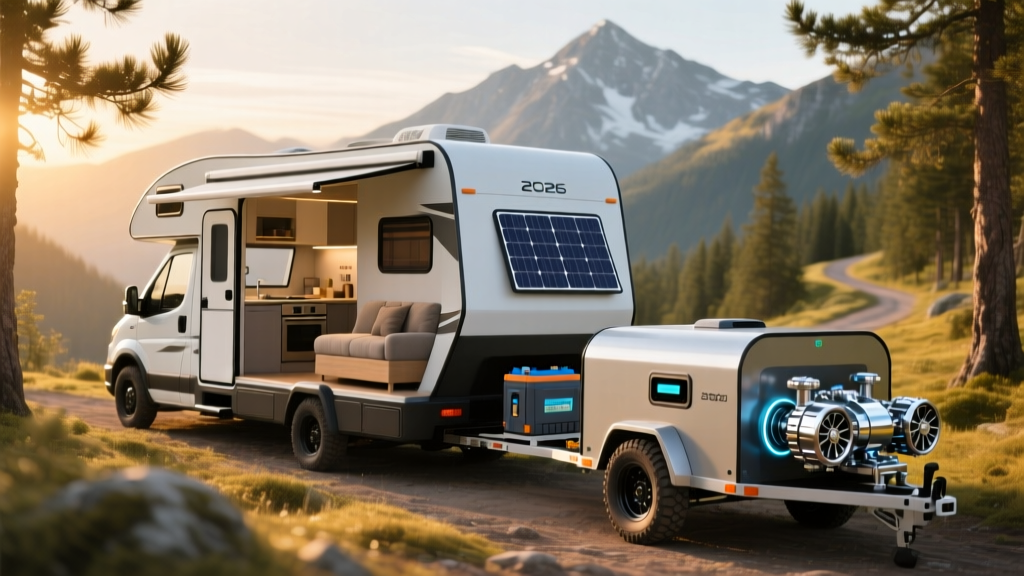
A new category of "e-trailers" is emerging that pairs well with hybrid tow vehicles. These campers have onboard battery packs (typically 40–80 kWh) and integrated axle motors that assist with towing, reducing the energy burden on the tow vehicle:
- Lightship L1: Aerodynamic travel trailer with an ~80 kWh battery and dual-motor electric axle. Claimed to reduce tow-vehicle energy consumption by up to 50%. Starting MSRP around $107,000 (announced/preliminary — deliveries expected late 2026).
- Colorado Teardrops e-drop: Compact teardrop with a 20 kWh battery providing off-grid power and mild tow assist. More accessible pricing around $30,000–$35,000.
These trailers don't replace a hybrid tow vehicle — they complement one. A RAV4 Prime towing an e-drop, for example, could theoretically complete a 40-mile campground trip almost entirely on electricity.
Tax Credits, Battery Warranty, and Ownership Costs
- Toyota hybrid batteries: 10 years / 150,000 miles warranty. Replacement cost: $2,500–$4,500 depending on model.
- Ford PowerBoost hybrid battery: 8 years / 100,000 miles. Replacement cost: estimated $4,000–$6,000.
- Jeep Wrangler 4xe (PHEV) battery: 8 years / 100,000 miles. Replacement cost: estimated $8,000–$12,000 (larger PHEV pack).
Source: Toyota Warranty, manufacturer spec sheets. Real-world data shows most hybrid batteries last 150,000+ miles with minimal degradation.
Federal Tax Credit Eligibility for PHEV Tow Vehicles
Only plug-in hybrids (PHEVs) are potentially eligible for the federal §30D clean vehicle credit. Conventional hybrids (HEVs) do not qualify. For 2026, key rules include:
- Credit amount: Up to $7,500, split between critical minerals ($3,750) and battery components ($3,750). Many PHEVs qualify for only $3,750 due to sourcing requirements.
- MSRP caps: Vans/SUVs/pickups must be under $80,000 MSRP; sedans under $55,000.
- Buyer income limits: AGI must not exceed $150,000 (single), $225,000 (head of household), or $300,000 (joint).
- Point-of-sale transfer: You can transfer the credit to the dealer for an immediate price reduction at purchase.
- Battery sourcing: Critical minerals and battery components must meet phased-in domestic/free-trade-area sourcing thresholds that tighten annually.
As of 2026, the Jeep Wrangler 4xe qualifies for a partial credit (typically $3,750), while the Toyota RAV4 Prime has had inconsistent eligibility due to battery sourcing rules — always verify on the IRS qualified vehicles list before purchasing.
Hybrid vs PHEV vs Full EV: Which Camping Setup Fits You?
Choose a conventional hybrid (HEV) tow vehicle if:
- You tow 3,500+ lbs regularly (travel trailers, boat trailers)
- You camp off-grid or in remote areas with no charging infrastructure
- You want the simplicity of gas-station refueling with better MPG than a pure gas truck
- Examples: Ford F-150 PowerBoost, Toyota Tacoma i-FORCE MAX
Choose a PHEV tow vehicle if:
- Your campground is within 25–40 miles of home (electric-only trip possible)
- You tow lighter loads (teardrops, pop-ups under 3,500 lbs)
- You have home Level 2 charging and want to use the PHEV battery for campsite power
- You want potential federal tax credit eligibility
- Examples: Jeep Wrangler 4xe, Toyota RAV4 Prime
Choose a full EV (BEV) tow vehicle if:
- You have reliable home charging and access to DC fast chargers on your route
- You accept 50–60% range reduction while towing (e.g., 300-mile EPA becomes ~130–150 miles towing)
- You want zero tailpipe emissions and the lowest per-mile energy cost
- Example: Ford F-150 Lightning (10,000-lb tow rating, but plan charging stops carefully)
Frequently Asked Questions
How many MPG does a hybrid truck get while towing an RV?
Expect roughly 10–16 MPG depending on trailer weight and terrain. The Ford F-150 PowerBoost drops from 23 MPG unloaded to about 10–13 MPG towing a 5,500-lb trailer. The Toyota Tacoma i-FORCE MAX gets about 13–16 MPG towing a 3,500-lb load. Hybrid benefits are greatest in stop-and-go driving; highway towing at 65+ MPH is dominated by aerodynamic drag.
Can a plug-in hybrid tow a camper on electric power alone?
Yes, for short distances. The Toyota RAV4 Prime can tow ~1,200 lbs for up to 42 miles on electric power. The Jeep Wrangler 4xe can tow ~2,500 lbs for about 22 miles electric-only. Beyond that range, the gas engine engages. This works well for nearby campgrounds but not for long-distance RV travel.
Are hybrid RV motorhomes available to buy in 2026?
Options are very limited. The Sprinter-based Class B/C motorhomes (Winnebago Revel, Airstream Interstate) use a mild-hybrid diesel system with ~5–8% fuel savings — not plug-in capability. True PHEV motorhomes remain in the concept stage. For most buyers, a hybrid tow vehicle plus a conventional travel trailer is the most practical hybrid camping setup.
Is a hybrid battery reliable, and what does replacement cost?
Hybrid batteries are among the most reliable components in modern vehicles. Toyota's hybrid battery warranty covers 10 years / 150,000 miles, and real-world data shows many lasting 200,000+ miles. Replacement costs range from $2,500–$4,500 for Toyota HEVs and $8,000–$12,000 for PHEVs like the Wrangler 4xe. Ford's PowerBoost battery is warranted for 8 years / 100,000 miles.
Do hybrid tow vehicles qualify for a federal tax credit?
Only plug-in hybrids (PHEVs) can qualify for the §30D federal clean vehicle credit — up to $7,500, subject to income caps, MSRP limits, and battery-sourcing requirements. Conventional hybrids (HEVs) like the F-150 PowerBoost and Tacoma i-FORCE MAX do not qualify. Check the IRS qualified vehicle list before purchasing, as eligibility changes throughout the year.
What's the best hybrid for towing a lightweight teardrop camper?
The Toyota RAV4 Prime (PHEV, 302 hp, 1,750-lb tow rating, 42-mile EV range) is the standout for teardrop campers under 1,500 lbs. You can reach most nearby campgrounds on electric power, then use the hybrid system for return trips. For heavier teardrops (1,500–3,500 lbs), the Jeep Wrangler 4xe or Toyota Grand Highlander Hybrid MAX are strong options.
The Bottom Line on Hybrid RV Campers
The hybrid RV camper market in 2026 is less about a single revolutionary product and more about smart powertrain pairing. A hybrid or PHEV tow vehicle matched to an appropriately sized trailer delivers real fuel savings — typically 15–30% better than a gas-only equivalent — without the range and charging anxieties of a full-electric setup. For most campers, the Ford F-150 PowerBoost (heavy towing) or Toyota RAV4 Prime (light towing with electric-only capability) represents the best balance of capability, efficiency, and real-world practicality. As e-trailer technology matures and PHEV motorhomes move from concept to production, the hybrid camping landscape will broaden — but for now, the tow-vehicle-plus-trailer approach is where the concrete specs and proven reliability live.