The Physics of Energy Recovery
When you press the brake pedal in a traditional internal combustion engine (ICE) vehicle, you are initiating a fundamentally wasteful process. The brake calipers clamp down on the rotors, creating immense friction that converts your vehicle's kinetic energy into useless heat, which then dissipates into the atmosphere. In hybrid electric vehicles (HEVs) and plug-in hybrid electric vehicles (PHEVs), this paradigm is entirely flipped through a process called regenerative braking, or 'regen.'
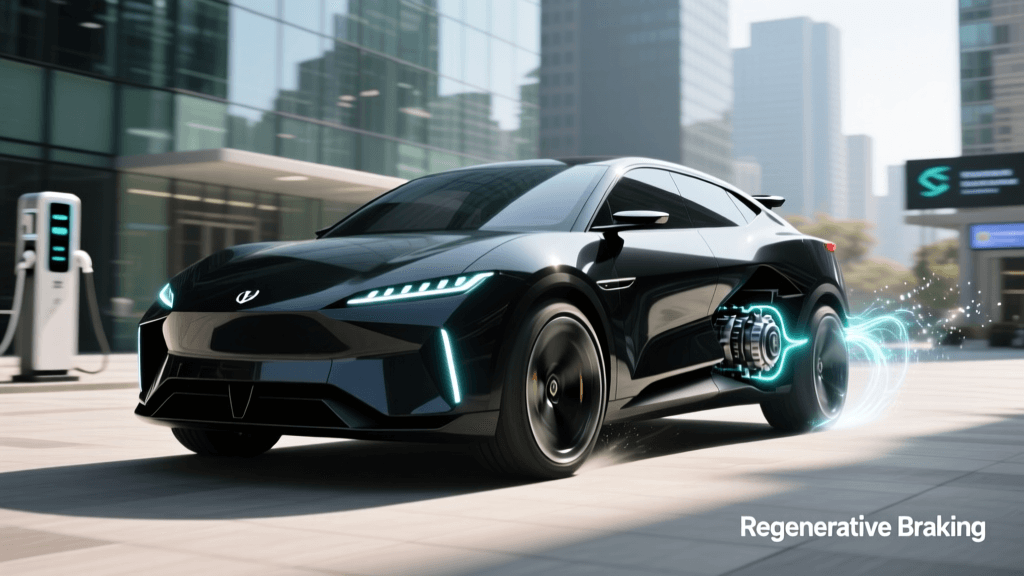
At its core, regenerative braking relies on the principles of electromagnetism and Faraday's Law of Induction. The electric motor that propels your hybrid forward is inherently reversible. When you lift off the accelerator or press the brake pedal, the vehicle's power electronics reverse the motor's function, turning it into a generator. As the wheels turn the motor's rotor through a magnetic field, electrical current is induced. This electromagnetic resistance creates a drag force that slows the vehicle down, while simultaneously sending electricity back into the high-voltage battery pack.
According to the Alternative Fuels Data Center, regenerative braking is the primary mechanism that allows hybrids to achieve up to 30% better fuel economy in stop-and-go city traffic compared to highway driving.
Under the Hood: Motor-Generators and Inverters
To truly understand regen, we must look at the hardware. Most modern hybrids utilize a setup featuring one or more Motor-Generators (MGs). For example, Toyota’s ubiquitous Hybrid Synergy Drive utilizes a planetary gearset connected to two distinct motor-generators: MG1 and MG2.
- MG1 (Motor-Generator 1): Primarily acts as a starter for the gas engine and controls the continuously variable transmission (eCVT) ratio. It can also generate electricity, but it is not the primary regen motor.
- MG2 (Motor-Generator 2): This is the heavy lifter. It is directly linked to the final drive and the wheels. MG2 is the primary traction motor for EV-mode driving and the primary generator during regenerative braking.
When MG2 captures kinetic energy, it generates Alternating Current (AC). However, the high-voltage battery pack stores and discharges Direct Current (DC). This is where the inverter comes into play. The inverter acts as the translator, rapidly switching the AC power from the motor into DC power to charge the battery. Newer PHEVs, like the latest generation Toyota Prius Prime, utilize Silicon Carbide (SiC) semiconductors in their inverters. SiC technology drastically reduces switching losses and heat generation, meaning a higher percentage of the captured kinetic energy actually makes it into the battery rather than being lost as thermal waste in the inverter itself.
The Brake Blending Algorithm
One of the most misunderstood aspects of hybrid technology is the brake pedal itself. In a modern HEV or PHEV, the brake pedal is often a 'brake-by-wire' simulator. When you press the pedal, you are not directly opening a hydraulic valve; you are sending an electronic signal to a computer.
The vehicle's braking control module uses a complex algorithm to determine the optimal blend of regenerative and friction braking. In most hybrids, the first 70% to 80% of brake pedal travel engages only the regenerative system via MG2. The hydraulic friction brakes remain completely disengaged. It is only when you require emergency stopping power, or when the vehicle drops below roughly 5 to 7 mph (where the electric motor stops generating sufficient resistance), that the hydraulic brake pads physically clamp onto the rotors. This seamless transition is known as 'brake blending,' and it is the secret to the smooth stopping feel in well-engineered PHEVs.
Battery Chemistry and Thermal Constraints
Regenerative braking is not a guaranteed constant; it is heavily dictated by battery chemistry and thermal dynamics. Lithium-ion batteries have strict 'charge acceptance' limits. If you attempt to force high-current DC into a battery that cannot accept it, you risk severe degradation or catastrophic failure.
There are two primary scenarios where your hybrid will temporarily disable or severely limit regenerative braking:
- High State of Charge (SOC): If you start a long downhill descent with your PHEV battery at 100%, the Battery Management System (BMS) will taper off regen to prevent overcharging. The friction brakes will engage much earlier in the pedal travel to compensate.
- Cold Temperatures: Lithium-ion cells are highly sensitive to cold. If the battery temperature drops near or below freezing (32°F / 0°C), charging the battery at high amperages can cause 'lithium plating'—a phenomenon where metallic lithium builds up on the anode, permanently reducing battery capacity. To protect the pack, the BMS will block regen until the battery warms up through internal resistance or active thermal management.
The Environmental Protection Agency (EPA) notes that extreme temperatures can significantly impact the efficiency and range of electrified vehicles, largely due to these thermal constraints on energy recovery and cabin heating demands.
Regen System Comparison Chart
Different manufacturers approach regenerative braking tuning and driver adjustability in unique ways. Below is a comparison of how popular hybrids and PHEVs handle energy recovery.
| Vehicle Model | Drivetrain | Regen Adjustment Method | Friction Brake Blend Point |
|---|---|---|---|
| Toyota Prius (HEV) | Series-Parallel | B-Mode (Shift Lever) | ~7 mph or heavy pedal press |
| RAV4 Prime (PHEV) | Series-Parallel | B-Mode & Sequential Shift | ~5 mph or heavy pedal press |
| Hyundai Tucson PHEV | Parallel (6-Speed Auto) | Steering Wheel Paddle Shifters | ~3 mph (Aggressive blend) |
| Ford Escape PHEV | Power-Split eCVT | L-Mode (Shift Lever) | ~8 mph or heavy pedal press |
Actionable Advice: Maximizing Your Hybrid's Regen
Understanding the technology is only half the battle; applying it to your daily driving habits is where you realize the financial and efficiency benefits. Here is how to extract the maximum amount of energy from your hybrid's regenerative system:
- Prioritize Coasting Over Braking: The most efficient way to slow down is to lift off the accelerator early. Coasting allows the vehicle to overcome aerodynamic drag and rolling resistance naturally. Heavy regen braking, while better than friction braking, still incurs electrical and thermal losses in the inverter and battery.
- Use 'B-Mode' or Paddles Wisely: Many drivers mistakenly leave their vehicle in 'B' (Engine Braking) mode or the highest regen paddle setting on the highway. This creates unnecessary drag. Reserve maximum regen settings for stop-and-go city traffic or steep mountain descents where you would otherwise overheat your friction brakes.
- Precondition Your PHEV: If you own a PHEV and live in a cold climate, use the vehicle's app to precondition (warm up) the cabin and battery while still plugged into your Level 2 charger. This brings the battery chemistry up to an optimal temperature, ensuring that maximum regenerative braking is available the moment you start your winter commute.
Maintenance: The Rusty Rotor Dilemma
Because regenerative braking handles the vast majority of your daily deceleration, the physical brake pads and rotors on a hybrid or PHEV are rarely used. It is incredibly common for hybrid owners to see their original factory brake pads last well past 100,000 miles. However, this lack of use introduces a unique maintenance issue: corrosion.
Brake rotors are typically made of cast iron. Without the regular scraping action of the brake pads to clean them, the rotors can develop heavy surface rust, which can eventually lead to pitting, warped braking surfaces, and seized caliper slide pins. Furthermore, brake fluid is hygroscopic (it absorbs moisture from the air over time), which can lead to internal corrosion in the ABS module and brake lines, regardless of mileage.
The Solution: Once a week, or whenever road conditions are dry and safe, perform a 'friction brake conditioning' stop. Find a clear road, accelerate to 45 mph, and apply firm, steady pressure to the brake pedal to slow down to 10 mph. This deliberate action forces the brake blending computer to bypass regen and engage the physical pads, scraping off surface rust and ensuring the calipers remain free and functional. Additionally, adhere strictly to the manufacturer's time-based brake fluid flush intervals (usually every 2 to 3 years), rather than waiting for a mileage threshold.
Conclusion
Regenerative braking is the unsung hero of hybrid and PHEV efficiency. By turning the electric traction motor into a dynamic generator, these vehicles recapture energy that would otherwise be lost to the atmosphere, drastically reducing fuel consumption and brake wear. By understanding the thermal limitations of lithium-ion batteries and mastering the art of anticipatory coasting and brake blending, drivers can optimize their vehicle's total cost of ownership and extend the lifespan of both the high-voltage battery and the friction braking components. For a deeper look into how these systems integrate with broader alternative fuel strategies, the U.S. Department of Energy's PHEV resources offer excellent ongoing data and research.