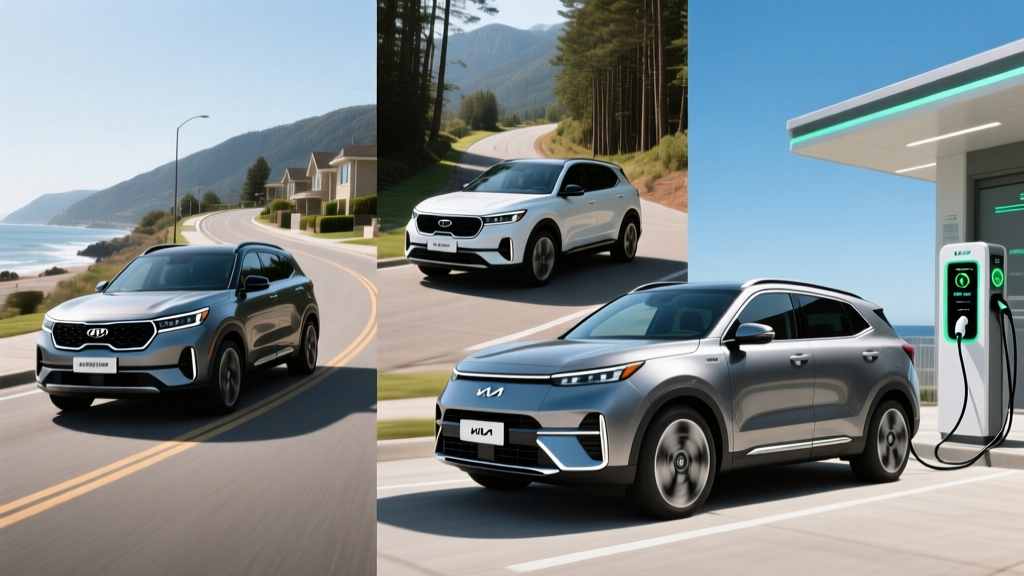
Kia's electrified lineup has matured well beyond the original Niro. For 2026, the automaker offers hybrid (HEV) and plug-in hybrid (PHEV) variants across three core nameplates — the compact Niro, the midsize Sportage SUV, and the three-row Sorento. Each fills a different use case, and the gap between their EPA fuel economy figures and real-world results is worth understanding before you buy.
This guide breaks down every current hybrid Kia vehicle by the numbers: EPA MPG, PHEV electric-only range, powertrain output, battery warranty, pricing, and federal tax credit eligibility under IRS §30D. If you're cross-shopping a Toyota RAV4 Hybrid, Honda CR-V Hybrid, or Hyundai Tucson PHEV, the data below will help you decide whether Kia's offerings deserve a spot on your shortlist.
HEV vs PHEV: What Kia Actually Sells
Before diving into individual models, the distinction matters because it changes everything from your daily routine to your tax return.
Conventional Hybrid (HEV)
How it works: A small battery (typically 1.5–2.0 kWh) and electric motor assist the gas engine. The battery recharges through regenerative braking and the engine — you never plug it in.
Best for: Drivers without reliable home or workplace charging access who want better fuel economy without changing habits.
Kia HEV models: Niro Hybrid, Sportage Hybrid, Sorento Hybrid.
Plug-In Hybrid (PHEV)
How it works: A larger battery (13–18 kWh usable) powers an electric motor for a meaningful distance (30–40+ miles) before the gas engine engages. You plug in to recharge, typically via a Level 2 home charger or 120V outlet.
Best for: Drivers with home charging and a commute under 40 miles who want EV-like daily driving plus gas-engine flexibility for road trips.
Kia PHEV models: Niro PHEV, Sportage PHEV, Sorento PHEV.
2026 Kia Niro Hybrid and Niro PHEV
The Niro is Kia's dedicated hybrid platform — not a gas car adapted for electrification. That purpose-built approach gives it a packaging advantage: the battery sits under the rear seat, preserving cargo space that rivals like the Toyota Prius sacrifice.
| Spec | Niro HEV | Niro PHEV |
|---|---|---|
| EPA Combined MPG / MPGe | 53 MPG combined | 105 MPGe (electric) / 48 MPG (gas) |
| EPA City / Highway | 53 city / 54 highway | N/A (MPGe: 105 combined) |
| Electric-Only Range (PHEV) | — | 33 miles (EPA) |
| Total Range | ~590 miles | ~560 miles (combined EV + gas) |
| Combined Horsepower | 139 hp | 180 hp |
| Powertrain | 1.6L 4-cyl + 32 kW motor | 1.6L 4-cyl + 62 kW motor |
| Battery (usable) | 1.56 kWh (lithium-ion) | 11.1 kWh (lithium-ion polymer) |
| PHEV Charge Time (Level 2, 240V) | — | ~2 hr 45 min (7.2 kW onboard charger) |
| DC Fast Charge Capable | No | No |
| 0–60 mph | ~9.3 sec | ~7.5 sec |
| Starting MSRP (2026) | $28,390 (LX) | $35,890 (EX) |
The Niro HEV's 53 MPG combined is among the highest of any non-plugin crossover on the market. In real-world city driving, owners frequently report exceeding the EPA sticker — hybrids thrive in stop-and-go traffic where regenerative braking is constant. Highway driving at 75+ mph will drop efficiency to roughly 46–49 MPG, which is still exceptional for a crossover.
The Niro PHEV's 33-mile electric range covers most commutes. On a 120V household outlet (Level 1), expect a full charge in about 10–11 hours, making overnight replenishment feasible but tight. A Level 2 home charger cuts that to under three hours.
2026 Kia Sportage Hybrid and Sportage PHEV
The Sportage is Kia's volume SUV, and its hybrid variants address buyers who need more space and all-wheel drive than the Niro provides. The HEV uses a conventional torque-converter automatic, while the PHEV pairs with a 6-speed automatic tuned for smoother electric-to-gas transitions.
| Spec | Sportage HEV (AWD) | Sportage PHEV (AWD) |
|---|---|---|
| EPA Combined MPG / MPGe | 38 MPG combined | 84 MPGe (electric) / 35 MPG (gas) |
| EPA City / Highway | 38 city / 38 highway | N/A (MPGe mode) |
| Electric-Only Range (PHEV) | — | 34 miles (EPA) |
| Total Range | ~430 miles | ~400 miles |
| Combined Horsepower | 226 hp | 261 hp |
| Powertrain | 1.6L turbo 4-cyl + 44 kW motor | 1.6L turbo 4-cyl + 72 kW motor |
| Battery (usable) | 1.49 kWh | 13.8 kWh |
| PHEV Charge Time (Level 2) | — | ~2 hr 15 min (7.2 kW charger) |
| DC Fast Charge Capable | No | No |
| 0–60 mph | ~7.4 sec | ~6.8 sec |
| Starting MSRP (2026) | $32,590 (LX) | $40,490 (X-Line) |
The Sportage HEV's 38 MPG combined is competitive with the Toyota RAV4 Hybrid (39 MPG) and Honda CR-V Hybrid (40 MPG). Where the Sportage distinguishes itself is the turbocharged powertrain — 226 hp gives it noticeably more passing power than the RAV4 Hybrid's 219 hp, particularly at highway speeds. Real-world highway economy tends to settle around 33–35 MPG, which is typical for a turbo hybrid under sustained load.
The Sportage PHEV's 34-mile electric range is practical for suburban commutes, and the 261 hp combined output makes it the most powerful compact PHEV crossover in its class. Standard AWD across all PHEV trims is a significant advantage for snow-belt buyers.
2026 Kia Sorento Hybrid and Sorento PHEV
The Sorento is the only three-row vehicle in Kia's hybrid lineup and one of very few PHEV crossovers offering a third row (the Mitsubishi Outlander PHEV is the other). If you need occasional kid-hauling capacity without committing to a minivan, this is the niche it fills.
| Spec | Sorento HEV (AWD) | Sorento PHEV (AWD) |
|---|---|---|
| EPA Combined MPG / MPGe | 34 MPG combined | 79 MPGe (electric) / 33 MPG (gas) |
| EPA City / Highway | 34 city / 34 highway | N/A (MPGe mode) |
| Electric-Only Range (PHEV) | — | 32 miles (EPA) |
| Total Range | ~480 miles | ~440 miles |
| Combined Horsepower | 227 hp | 261 hp |
| Powertrain | 1.6L turbo 4-cyl + 44 kW motor | 1.6L turbo 4-cyl + 72 kW motor |
| Battery (usable) | 1.49 kWh | 13.8 kWh |
| PHEV Charge Time (Level 2) | — | ~2 hr 15 min (7.2 kW charger) |
| DC Fast Charge Capable | No | No |
| 0–60 mph | ~7.8 sec | ~7.0 sec |
| Starting MSRP (2026) | $39,590 (S) | $51,990 (SX Prestige) |
The Sorento PHEV's third row is best suited for children — adults will find it cramped on longer drives. But for families who need that extra row a few times a month, the PHEV's 32-mile electric range means most school runs and errands happen on electricity alone. When the battery depletes, 33 MPG combined from a three-row AWD SUV is genuinely efficient.
Kia Hybrid Battery Warranty
All Kia hybrid and PHEV models come with a 10-year/100,000-mile hybrid battery warranty (whichever comes first). This covers battery capacity loss below a defined threshold and is transferable to subsequent owners in most states. Kia's hybrid battery warranty is among the longest in the industry, matching Hyundai and exceeding Toyota's 10-year/150,000-mile coverage only on mileage (Toyota's is longer by 50,000 miles). For the original owner, both effectively cover the vehicle's expected first-decade lifespan.
Real-World MPG: What to Actually Expect
EPA figures are tested under controlled conditions. Here's how Kia's hybrid vehicles perform in the real world based on aggregated owner data and independent testing:
| Model | EPA Combined | Real-World City | Real-World Highway (75 mph) | Cold-Weather Impact |
|---|---|---|---|---|
| Niro HEV | 53 MPG | 55–58 MPG | 46–49 MPG | −3 to −5 MPG |
| Niro PHEV (gas mode) | 48 MPG | 47–50 MPG | 42–45 MPG | −3 to −5 MPG |
| Sportage HEV | 38 MPG | 36–39 MPG | 33–35 MPG | −2 to −4 MPG |
| Sportage PHEV (gas mode) | 35 MPG | 33–36 MPG | 30–33 MPG | −2 to −4 MPG |
| Sorento HEV | 34 MPG | 32–35 MPG | 29–32 MPG | −2 to −4 MPG |
| Sorento PHEV (gas mode) | 33 MPG | 31–34 MPG | 28–31 MPG | −2 to −4 MPG |
Hybrids consistently exceed EPA city estimates because stop-and-go driving maximizes regenerative braking. Highway driving is where efficiency drops — aerodynamic drag increases exponentially above 65 mph, and the engine bears the full load. Cold weather reduces battery efficiency and increases engine idling for cabin heat, cutting MPG by roughly 5–10% in sub-freezing conditions.
For PHEV owners, the real efficiency win comes from staying within electric range. If your daily driving is under 30 miles and you charge nightly, you may use only a few gallons of gas per month. The gas-engine MPG figure becomes almost irrelevant for that use pattern.
Tax Credits and Incentives for Kia Hybrids
This is where the HEV vs PHEV distinction has financial consequences:
Federal §30D Tax Credit — PHEV Eligibility
- Credit amount: Up to $7,500 for qualifying new PHEVs (HEVs do NOT qualify)
- MSRP cap: SUVs/vans must be under $80,000; sedans under $55,000
- Buyer income cap: $150,000 single / $225,000 head of household / $300,000 joint (modified AGI)
- Battery sourcing: Critical minerals and battery components must meet phased percentage thresholds from US or FTA-partner countries (per IRS §30D rules)
- Point-of-sale transfer: Eligible buyers can transfer the credit to the dealer for an immediate price reduction at purchase
- HEV exclusion: Conventional hybrids (Niro HEV, Sportage HEV, Sorento HEV) do NOT qualify for §30D
As of the 2026 model year, Kia's PHEV models may qualify for partial or full federal credits depending on battery-component sourcing compliance, which shifts annually. The Sorento PHEV at $51,990 clears the $80,000 SUV MSRP cap. The Sportage PHEV and Niro PHEV also clear their respective thresholds. However, battery-sourcing requirements have tightened each year since 2024, and some Kia PHEV trims have seen their eligible credit amount fluctuate. Always verify current eligibility on fueleconomy.gov before purchasing.
Some states offer additional rebates for PHEVs — California's CVRP, Colorado's state credit, and New York's Charge Ready program are examples. These vary by jurisdiction and income; check your state energy office for current programs.
Reliability and Battery Replacement Costs
Kia's hybrid systems use a parallel architecture with a conventional automatic transmission (not a CVT or planetary gearset like Toyota's e-CVT). This simplifies the drivetrain but means the transmission is a wear item that Toyota's system avoids. In practice, Kia's 6-speed automatics in hybrid applications have proven durable, with no widespread failure patterns reported through the 2024–2025 model years.
Hybrid battery replacement costs for Kia models fall in these ranges:
- Niro HEV: $2,500–$3,500 (small 1.56 kWh pack)
- Niro PHEV: $5,000–$7,000 (11.1 kWh pack)
- Sportage/Sorento HEV: $2,500–$3,500
- Sportage/Sorento PHEV: $6,000–$8,500 (13.8 kWh pack)
These are out-of-warranty costs. Given the 10-year/100,000-mile warranty and the fact that modern lithium-ion hybrid batteries rarely require full replacement within that window, most owners will never pay these figures. Partial-pack repairs (replacing individual modules) can reduce costs further.
Which Hybrid Kia Fits You? Decision Framework
Choose a Kia HEV (Niro, Sportage, or Sorento Hybrid) if:
- You don't have access to home or workplace charging
- You want better fuel economy without changing any habits
- Your budget is under $35,000 (Niro HEV) or $40,000 (Sportage HEV)
- You drive mostly in city or mixed conditions where hybrid efficiency peaks
Choose a Kia PHEV (Niro, Sportage, or Sorento Plug-In Hybrid) if:
- You can install a Level 2 charger at home or have reliable workplace charging
- Your daily commute is under 35 miles round-trip
- You want EV-like operating costs but need gas-engine range for road trips
- You may qualify for the federal §30D tax credit, effectively reducing the PHEV premium
Choose a full BEV (like the Kia EV6 or EV9) instead if:
- You drive under 250 miles daily and have reliable home charging
- You want to eliminate gas entirely and minimize maintenance
- You qualify for the full $7,500 federal credit on a BEV
- You're ready to plan around DC fast charging on road trips
Kia Hybrid Lineup — Pros
- Class-leading 10-year/100,000-mile hybrid battery warranty
- Niro HEV achieves 53 MPG combined — top-tier for any crossover
- Sportage PHEV offers 261 hp with standard AWD — powerful for the segment
- Sorento PHEV is one of only two PHEVs with a third row
- PHEV models eligible for up to $7,500 federal credit (sourcing dependent)
- Physical controls and intuitive infotainment across all models
Kia Hybrid Lineup — Cons
- No DC fast charging on any PHEV — limits public charging convenience
- Sportage and Sorento HEV fuel economy trails RAV4/CR-V hybrids by 1–3 MPG
- Third row in Sorento is tight — children only for anything beyond short trips
- PHEV premium over HEV is $5,000–$12,000 depending on model — credit may not close the gap
- Real-world highway MPG drops noticeably in turbo-hybrid models
Frequently Asked Questions
How many MPG do Kia hybrid vehicles get?
The 2026 Niro HEV leads at 53 MPG combined (53 city/54 highway). The Sportage HEV achieves 38 MPG combined, and the Sorento HEV gets 34 MPG combined. PHEV models return 33–48 MPG in gas-only mode after the electric range is depleted, per fueleconomy.gov data.
How far can a Kia PHEV go on electric only?
The Niro PHEV delivers 33 miles of electric-only range, the Sportage PHEV provides 34 miles, and the Sorento PHEV offers 32 miles. These are EPA-rated figures; real-world electric range may drop to 25–28 miles in cold weather or at highway speeds due to increased energy demand for heating and aerodynamic drag.
Do Kia hybrids need to be plugged in?
Only the PHEV models (Niro PHEV, Sportage PHEV, Sorento PHEV) benefit from plugging in. Conventional HEV models recharge their small batteries entirely through regenerative braking and the gas engine — no plug, no charging cable, no behavioral change required.
Is the Kia hybrid battery reliable and what does replacement cost?
Kia's hybrid batteries are covered by a 10-year/100,000-mile warranty. Out-of-warranty replacement ranges from roughly $2,500 for HEV packs to $8,500 for the larger PHEV batteries. In practice, widespread hybrid battery failures within the warranty period are uncommon across Kia's lineup.
Does a Kia hybrid qualify for a federal tax credit?
Only PHEV models may qualify for the federal §30D clean vehicle credit (up to $7,500), subject to buyer income caps, MSRP limits, and battery-sourcing requirements. Conventional HEV models do not qualify for the federal credit. Verify current eligibility on irs.gov before purchase, as sourcing thresholds change annually.
Can Kia PHEVs DC fast charge?
No. None of Kia's current PHEV models support DC fast charging. The maximum charge rate is 7.2 kW via a Level 2 (240V) connection, which fully replenishes the battery in approximately 2–3 hours. This is standard for the PHEV segment — only a few PHEVs (like the Mitsubishi Outlander PHEV) have offered DC fast charging capability.