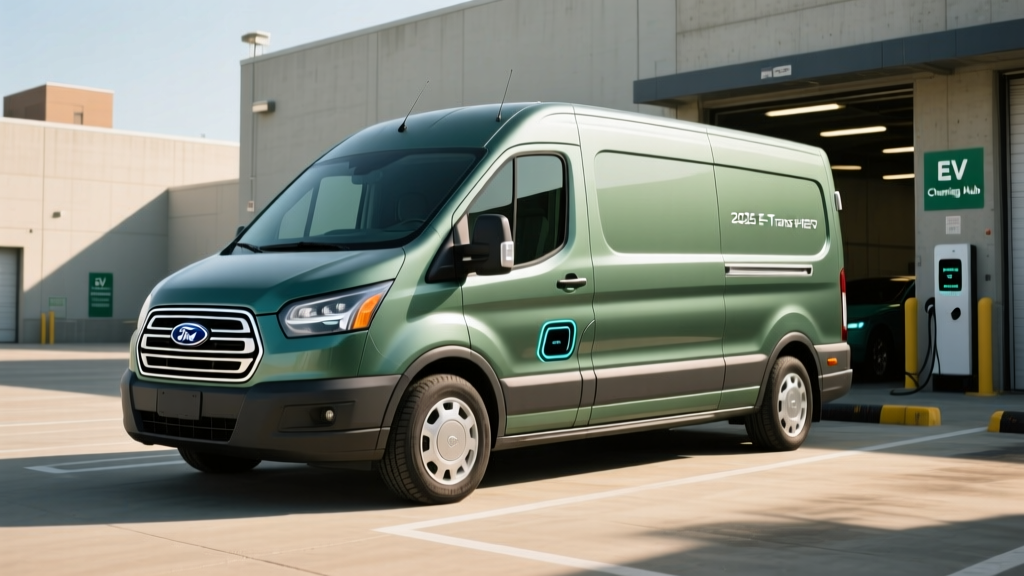
Ford's commercial van lineup has gone through a major electrification overhaul, and the hybrid Ford Transit nameplate now covers two distinct vehicles: the fully electric E-Transit (battery-electric, no gas engine) and the E-Transit Custom PHEV, a plug-in hybrid variant sold primarily in European and global markets. For US-based fleet managers and owner-operators searching for a hybrid Ford Transit, the reality is more nuanced than a simple spec sheet suggests.
This guide breaks down exactly what's available, what the real-world fuel economy looks like, how the plug-in hybrid powertrain works in daily route service, and whether a PHEV van makes more sense than a full BEV or a conventional gas Transit for your operation.
What "Hybrid Ford Transit" Actually Means in 2026
The term "hybrid Ford Transit" gets thrown around loosely, so let's establish precision. Ford currently offers electrified Transit variants in two categories:
HEV vs PHEV vs BEV — Transit Lineup Clarification
| Type | Model | Plug-In? | Electric-Only Range | Market |
|---|---|---|---|---|
| Mild Hybrid (MHEV) | Transit 2.0L EcoBlue Diesel | No | 0 miles | Europe/Global |
| Plug-In Hybrid (PHEV) | E-Transit Custom PHEV | Yes | ~37 miles (WLTP) | Europe/Global (announced for select markets) |
| Battery Electric (BEV) | E-Transit (full-size) | Yes (charge only) | 126 miles (EPA) | US, Europe, Global |
| Battery Electric (BEV) | E-Transit Custom | Yes (charge only) | ~205 miles (WLTP) | Europe/Global |
Critical note for US buyers: As of early 2026, Ford does not sell a plug-in hybrid or conventional hybrid Transit in the United States. The US-market Transit is available as either the traditional 3.5L EcoBoost gasoline V6 or the fully electric E-Transit BEV. The E-Transit Custom PHEV discussed below is currently a European/global-market product. If you're a US fleet operator, your electrified Transit option is the E-Transit BEV — covered in detail in the decision framework below.
E-Transit Custom PHEV: Powertrain, Battery & Electric Range
The E-Transit Custom PHEV pairs a 2.5-liter Atkinson-cycle gasoline engine with an electric motor and a 12.8 kWh (usable) lithium-ion battery pack. This is the same PHEV architecture Ford uses in updated passenger models, adapted for commercial duty cycles.
| Specification | Value |
|---|---|
| Engine | 2.5L Atkinson-cycle 4-cylinder gasoline |
| Electric Motor | Integrated, front-axle |
| Combined System Output | ~230 hp (estimated, final 2026 specs TBD) |
| Battery (Usable) | 12.8 kWh, lithium-ion (NMC chemistry) |
| Electric-Only Range (WLTP) | ~37 miles (60 km) |
| Estimated EPA-Equivalent EV Range | ~30-32 miles |
| Total Combined Range | ~370+ miles (gas + electric) |
| DC Fast Charging | No — AC charging only |
| AC Charge Rate (Level 2) | 7.4 kW (onboard charger) |
| Level 2 Charge Time (0-100%) | ~2.0 hours |
| Level 1 Charge Time (120V) | ~6-7 hours |
| Payload Capacity | Up to ~2,800 lbs (varies by config) |
| Cargo Volume | Up to 317 cu ft (long wheelbase) |
Real-World Electric Range vs. WLTP Sticker
The 37-mile WLTP electric range is the European testing standard, which tends to run 10-15% more optimistic than the US EPA cycle. Expect roughly 30-32 miles of real electric-only driving in mixed conditions. In cold weather (below 40°F) or with a full payload, that number can drop to 22-26 miles. For urban delivery routes under 25 miles round-trip, the PHEV can complete most days in electric mode — which is precisely its design intent.
Fuel Economy: MPG Breakdown and Real-World Expectations
Fuel economy for a PHEV commercial van depends heavily on whether you're driving within the electric range or relying on the gasoline engine. Here's what the data shows:
| Driving Mode | City | Highway | Combined |
|---|---|---|---|
| Charge-Sustaining (gas engine, battery depleted) | ~28 MPG | ~32 MPG | ~30 MPG |
| Charge-Depleting (within EV range) | N/A — electric | N/A — electric | ~90 MPGe |
| Blended (typical mixed driving, 40 mi/day) | ~38-45 MPG equivalent (varies by charging frequency) | ||
Real-world context: A fleet van that returns to a depot nightly and charges to full will see dramatically better fuel economy than one that drives 80 miles between charges. In fueleconomy.gov testing methodology, PHEV efficiency is highly sensitive to the ratio of electric miles to total miles. For a delivery route of 35 miles/day with nightly charging, you may burn less than 0.5 gallons of gasoline per day. For a 120-mile route without mid-day charging, you're essentially driving a 30 MPG hybrid after the first 30 miles.
Compared to the conventional 3.5L EcoBoost V6 gas Transit (rated at roughly 16-18 MPG combined), the PHEV represents a 65-80% fuel reduction on short routes and a 40-50% improvement on longer routes — provided the battery is charged regularly.
Pricing, Tax Credits & Fleet Incentives
Pricing for the E-Transit Custom PHEV varies significantly by market. In Europe, the PHEV variant carries a premium of approximately €8,000-€12,000 over the equivalent diesel Transit Custom, placing it in the €52,000-€62,000 range (roughly $56,000-$67,000 USD) before VAT and incentives.
US Federal Tax Credit Eligibility
If a PHEV Transit were sold in the US, §30D eligibility would require:
- MSRP at or below $80,000 (vans classified as SUVs/trucks for the cap)
- Buyer adjusted gross income under $150K (single) / $300K (joint)
- Battery capacity of at least 7 kWh (the 12.8 kWh pack qualifies)
- Critical minerals and battery component sourcing thresholds per IRS §30D rules
- Point-of-sale transfer available through participating dealers
Current status: Since Ford does not sell a PHEV Transit in the US market, federal §30D credit does not apply. US fleet buyers looking at the fully electric E-Transit BEV may qualify for the Commercial Clean Vehicle Credit (§45W), which offers up to $7,500 for qualifying commercial vehicles — a separate credit with different rules than the consumer §30D.
For European fleet operators, local incentives vary widely. The UK offers plug-in van grants, Germany's Umweltbonus has been restructured, and Norway provides VAT exemptions. Always verify current incentive availability with local authorities before purchase.
Battery Warranty, Reliability & Replacement Cost
PHEV Battery Warranty Coverage
Ford covers the E-Transit Custom PHEV high-voltage battery with an 8-year / 100,000-mile warranty (whichever comes first), consistent with Ford's global PHEV and BEV battery warranty policy. The warranty guarantees the battery will retain at least 70% of its original capacity during the coverage period.
Reliability outlook: Ford's PHEV architecture has been in service since 2019 (first deployed in the Transit Custom PHEV pilot in London). Real-world fleet data from those early units showed battery degradation of approximately 8-12% over 5 years / 80,000 miles — well within the warranty threshold. The Atkinson-cycle 2.5L engine is a proven, low-stress design with fewer moving parts than a turbocharged engine, which should translate to strong long-term reliability.
Battery replacement cost: If the high-voltage battery requires replacement out of warranty, expect a cost in the range of $5,500-$8,500 (parts and labor), based on current Ford PHEV battery pricing. However, given the 12.8 kWh pack size and Ford's degradation track record, most fleet vehicles will reach end-of-service life before needing a battery swap. The 12V auxiliary battery is a separate, conventional item (~$200-$300 replacement).
Hybrid vs PHEV vs Full EV: Which Transit Fits Your Fleet?
Choose the E-Transit Custom PHEV if:
- Your daily routes are 25-40 miles with predictable depot returns
- You operate in regions with limited DC fast-charging infrastructure
- You need the range security of a gas engine for occasional long-haul days
- Your depot has basic Level 2 (240V) charging but not high-power DC
- Cold-weather operation makes BEV range loss unacceptable
Choose the E-Transit BEV (US market) if:
- Your daily routes are under 100 miles round-trip (within the 126-mile EPA range)
- You want zero tailpipe emissions and the lowest per-mile fuel cost
- You have reliable depot or home Level 2 / DC fast-charging access
- You qualify for the §45W commercial clean vehicle credit
- You want minimal drivetrain maintenance (no oil changes, no gas engine)
Choose the conventional gas Transit if:
- Your routes exceed 150 miles daily with no mid-route charging
- You operate in rural areas with no charging infrastructure
- Upfront cost is the primary constraint and fuel cost is secondary
- You tow near maximum capacity regularly (payload/range trade-off)
| Attribute | E-Transit Custom PHEV | E-Transit BEV (US) | Gas Transit 3.5L V6 |
|---|---|---|---|
| EV Range | ~30-37 mi | 126 mi (EPA) | 0 mi |
| Total Range | ~370+ mi | 126 mi | ~350 mi |
| Fuel Economy | ~30 MPG (gas) / 90 MPGe | 2.0 kWh/mi | ~16-18 MPG |
| Charge Time (Level 2) | ~2 hours | ~8-10 hours | N/A |
| DC Fast Charge | No | Yes, up to 115 kW | N/A |
| Estimated Starting Price | ~$56,000 (Europe) | $58,995 (US MSRP) | ~$48,000 (US MSRP) |
| Maintenance Cost | Medium (gas + electric) | Low (electric only) | High (conventional) |
Charging Logistics for Fleet Operations
The E-Transit Custom PHEV's 7.4 kW onboard AC charger means a full charge in about two hours on a Level 2 (240V) station. This is practical for depot-based operations: vans return in the evening, plug in, and are fully charged by morning. There is no DC fast-charging capability — this is a deliberate engineering choice, as the 12.8 kWh battery is small enough that DC fast charging would add cost and weight without meaningful benefit.
Fleet charging infrastructure cost: A single Level 2 commercial charger (e.g., ChargePoint CT4000 or similar) runs approximately $2,500-$4,500 for hardware and $3,000-$7,000 for installation (depending on electrical panel capacity and conduit runs). For a 10-van fleet, budget $40,000-$80,000 for complete depot charging infrastructure. This is dramatically less than the DC fast-charging infrastructure a BEV fleet might need for mid-day top-ups.
Pros, Cons & Final Assessment
Pros
- 30+ miles of zero-emission electric driving covers most urban delivery routes
- Gas engine eliminates range anxiety for unexpected long runs
- 65-80% fuel savings on short routes vs. conventional gas Transit
- Modest Level 2 charging needs — no expensive DC infrastructure
- 8-year / 100,000-mile battery warranty provides fleet budget certainty
- Proven PHEV architecture from Ford's London pilot program
Cons
- Not available in the US market as of 2026
- No DC fast charging — not suited for multi-shift, continuous operations
- Premium pricing over diesel and gas variants ($8K-$12K more)
- Two powertrains to maintain (gas engine + electric motor)
- EV range drops significantly in cold weather and under heavy payload
- 37-mile WLTP range is modest — only works for short-route fleets
The hybrid Ford Transit concept — specifically the E-Transit Custom PHEV — fills a genuine operational niche: urban delivery fleets that want electric running costs without infrastructure risk. It's not a universal solution, and its unavailability in the US market limits its relevance for American buyers. But for European and global fleet operators running sub-40-mile daily routes, the math is compelling: charge nightly, drive electric daily, and keep the gas engine as insurance for the occasional long haul.
Frequently Asked Questions
How many MPG does the hybrid Ford Transit get?
The E-Transit Custom PHEV achieves approximately 30 MPG combined when running on gasoline (charge-sustaining mode) and about 90 MPGe when operating within its electric range. Real-world blended MPG depends on how often you charge — fleets that charge nightly and drive under 35 miles/day may see effective economy of 45+ MPG equivalent.
How far can the E-Transit Custom PHEV go on electric only?
The WLTP-rated electric range is 37 miles (60 km). In real-world conditions, expect 30-32 miles in moderate weather and 22-26 miles in cold weather or under full payload. This is sufficient for most urban delivery and service routes.
Does the hybrid Ford Transit qualify for a tax credit?
In the US market, Ford does not currently sell a hybrid or PHEV Transit, so §30D consumer credits don't apply. The all-electric E-Transit BEV may qualify for the §45W commercial clean vehicle credit (up to $7,500) for business use. European incentives vary by country — check local authority guidance before purchasing.
Is the PHEV Transit reliable, and what does battery replacement cost?
Ford's PHEV system has been in commercial service since 2019 with strong reliability data. The high-voltage battery is warrantied for 8 years / 100,000 miles at 70% capacity retention. Out-of-warranty replacement is estimated at $5,500-$8,500, though most fleet vehicles will retire before needing one.
Should I get the PHEV Transit or the full-electric E-Transit?
Choose the PHEV if your routes are under 35 miles/day and you lack DC fast-charging infrastructure or need gas-engine range security. Choose the full-electric E-Transit (126-mile EPA range) if your routes are under 100 miles, you have reliable depot charging, and you want the lowest operating cost and zero tailpipe emissions. The BEV has lower maintenance costs but requires more charging infrastructure investment.
Can the E-Transit Custom PHEV DC fast charge?
No. The PHEV variant supports only AC charging — Level 2 at up to 7.4 kW (full charge in ~2 hours) or Level 1 at 120V (~6-7 hours). This is intentional: the 12.8 kWh battery is small enough that DC fast charging would add unnecessary cost and weight.