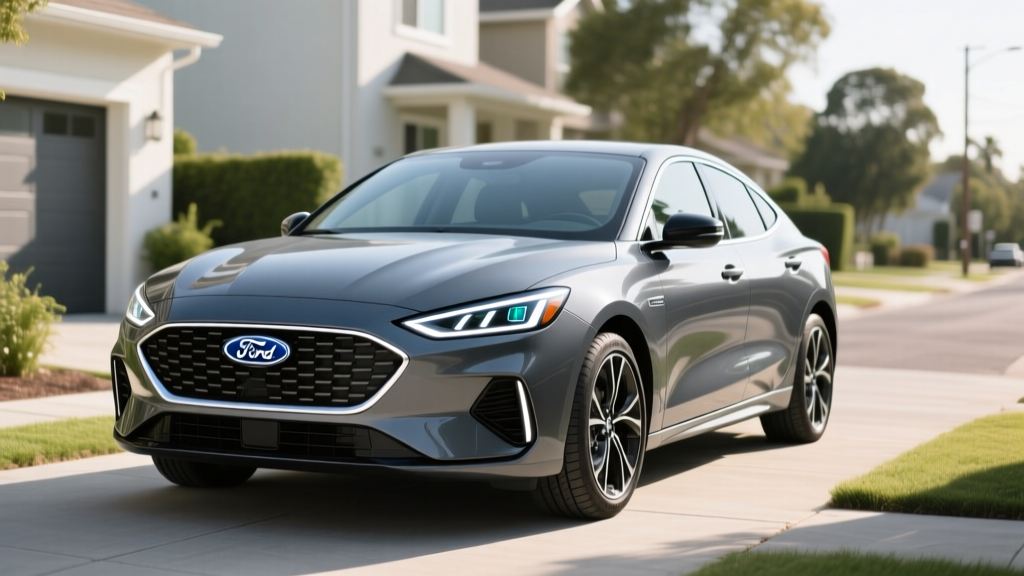
If you've been searching for a hybrid Ford Focus, you've likely noticed a frustrating reality: Ford hasn't sold a Focus in the United States since the 2018 model year, and it never offered a hybrid or plug-in hybrid variant of the Focus for the US market. Globally, Ford produced mild-hybrid versions of the Focus in Europe (badged as EcoBoost Hybrid with a 48-volt system), but those were never imported stateside and have since been discontinued as well.
So where does that leave you in 2026 if you want Focus-sized hybrid efficiency? The good news is that the compact hybrid and PHEV segment has expanded considerably. Below, we break down what the hybrid Focus could have been, why Ford exited the segment, and which current models deliver the MPG and practicality that Focus shoppers are actually looking for.
Why There Is No Hybrid Ford Focus in the US
Ford's decision to kill the Focus (along with the Fiesta, Fusion, and Taurus) in North America was driven by a strategic pivot toward trucks and SUVs. The company redirected investment toward the Bronco, Maverick, and expanded Explorer lineup. By the time hybrid powertrains became mainstream in compact cars, Ford's US car lineup had shrunk to essentially the Mustang.
In Europe, Ford did offer the Focus with a 48-volt mild-hybrid system (marketed as "EcoBoost Hybrid") starting around 2020. This was not a full hybrid (HEV) or plug-in hybrid (PHEV) — it was a belt-driven starter-generator that provided minor torque assist and improved stop-start behavior, yielding roughly a 5-8% fuel economy improvement over the standard 1.0L EcoBoost. Ford discontinued the European Focus entirely in 2025, ending any possibility of a hybrid variant.
HEV vs PHEV: Understanding Your Compact Hybrid Options
Since a hybrid Ford Focus isn't available, let's clarify the two hybrid architectures you'll encounter in today's compact segment, so you can evaluate alternatives effectively.
HEV vs PHEV — Key Differences
| Feature | Conventional Hybrid (HEV) | Plug-in Hybrid (PHEV) |
|---|---|---|
| Plugs in? | No — charges via regenerative braking and engine | Yes — charges from wall outlet or charger |
| Electric-only range | Less than 1 mile (motor assist only) | 25–50 miles typical (2026 models) |
| Battery size | 0.5–1.5 kWh | 10–20 kWh |
| Federal tax credit | None | Up to $7,500 under IRS §30D (eligibility varies) |
| Best for | Drivers without home charging; want simplicity | Drivers with home/work charging; short commutes |
Best Compact Hybrid Alternatives to the Ford Focus in 2026
These are the models that deliver what a hypothetical hybrid Focus would have offered: compact dimensions, strong fuel economy, and accessible pricing. Here's how they stack up on EPA fuel economy data from fueleconomy.gov.
| Model | City MPG | Highway MPG | Combined MPG | Type | Base MSRP |
|---|---|---|---|---|---|
| Toyota Corolla Hybrid | 53 | 46 | 50 | HEV | $24,400 |
| Hyundai Elantra Hybrid | 51 | 58 | 54 | HEV | $26,500 |
| Toyota Prius | 57 | 56 | 57 | HEV | $28,350 |
| Toyota Prius Prime | 52 (hybrid mode) | 48 (hybrid mode) | 44 mi EV range | PHEV | $33,445 |
| Ford Maverick Hybrid (closest Ford) | 42 | 33 | 37 | HEV | $28,345 |
Real-World MPG: What the Sticker Doesn't Tell You
Hybrids routinely exceed their EPA city ratings in stop-and-go traffic because regenerative braking recaptures energy that gas cars waste as heat. The Toyota Corolla Hybrid, rated at 53 city, often returns 55-60 MPG in urban driving based on owner-reported data. Highway MPG tends to run 2-4 MPG below the sticker at sustained 75+ mph speeds due to aerodynamic drag.
For PHEVs like the Prius Prime, real-world electric-only range varies significantly with temperature. Expect the rated 44 miles of EV range to drop to 32-36 miles in freezing weather, as the battery's usable capacity shrinks and cabin heating draws additional power. In mild conditions (55-75°F), some drivers report 46-48 miles before the engine kicks in.
Powertrain Specs: What Moves These Compact Hybrids
If Ford had built a hybrid Focus, it likely would have used a variant of the powertrain now found in the Maverick Hybrid — a 2.5L Atkinson-cycle four-cylinder paired with an electric motor through a planetary gearset. Here's what the top alternatives deliver:
| Model | Engine | Combined HP | 0-60 mph | Drivetrain |
|---|---|---|---|---|
| Corolla Hybrid | 1.8L I4 + 2 motors | 138 hp | ~9.2 sec | FWD / AWD |
| Elantra Hybrid | 1.6L I4 + 1 motor | 139 hp | ~8.5 sec | FWD |
| Prius | 2.0L I4 + 2 motors | 196 hp | 7.2 sec | FWD / AWD |
| Prius Prime (PHEV) | 2.0L I4 + 2 motors | 220 hp | 6.6 sec | FWD |
| Maverick Hybrid | 2.5L I4 + motor | 191 hp | ~7.8 sec | FWD |
The current Prius stands out here — its fifth-generation powertrain delivers 196 hp (220 in the Prime PHEV), making it genuinely quick while still returning class-leading MPG. This is a far cry from the underpowered reputation early hybrids earned.
PHEV Charging: Battery Size, Charge Time, and Electric Range
If you're considering a plug-in hybrid as your Focus replacement, here's what the charging picture looks like. PHEVs use much smaller batteries than full EVs, so charging is straightforward — and most do not support DC fast charging.
| PHEV Model | Battery (kWh) | EV Range | Level 1 (120V) | Level 2 (240V) | DC Fast Charge |
|---|---|---|---|---|---|
| Prius Prime | 13.6 kWh | 44 mi | ~11 hours | ~4 hours | No |
| Ford Escape PHEV | 14.4 kWh | 37 mi | ~12 hours | ~3.5 hours | No |
| Hyundai Tucson PHEV | 13.8 kWh | 33 mi | ~11 hours | ~2 hours | No |
Because PHEV batteries are 10-15 kWh (compared to 60-100 kWh in full EVs), overnight charging on a standard 120V household outlet is viable — you'll add roughly 3-4 miles of range per hour on Level 1. A Level 2 home charger (240V, typically 3.3-7.2 kW for PHEVs) will fully recharge the pack in 2-4 hours, meaning you can top up during the workday or between errands.
No mainstream compact PHEV currently supports DC fast charging. The battery packs are simply too small to justify the added cost and weight of DC hardware. For most PHEV owners, Level 2 at home or work is the entire charging strategy.
Tax Credits and Incentives: What Qualifies?
This is where the HEV vs PHEV distinction matters financially.
Federal §30D Tax Credit Rules for PHEVs (2026)
- Credit amount: Up to $7,500 for eligible new PHEVs (conventional HEVs do not qualify)
- Battery capacity: Vehicle must have at least 7 kWh of battery capacity
- MSRP cap: Vans/SUVs/trucks up to $80,000; sedans/cars up to $55,000
- Buyer income cap: Modified AGI must not exceed $150K (single), $225K (head of household), or $300K (joint)
- Battery sourcing: Critical minerals and battery components must meet phased-in domestic/free-trade sourcing requirements per IRS guidelines
- Point-of-sale transfer: Eligible buyers can transfer the credit to the dealer for an immediate price reduction
Conventional hybrids like the Corolla Hybrid, standard Prius, and Elantra Hybrid do not qualify for the federal §30D credit because they lack sufficient battery capacity and plug-in capability. However, some states offer separate rebates for HEVs — check your state's energy office or department of environmental quality for current programs.
The Prius Prime PHEV may qualify for up to $7,500 depending on battery component sourcing for the specific model year, your income, and the vehicle's MSRP (which at ~$33,445 is well under the $55,000 sedan cap). Always verify current eligibility on the IRS clean vehicle credit page before purchasing, as sourcing requirements tighten annually.
Battery Longevity, Warranty, and Replacement Costs
Hybrid Battery Warranty Coverage
Toyota: 10 years / 150,000 miles (hybrid battery)
Hyundai: 10 years / 100,000 miles (hybrid battery and EV components)
Ford: 8 years / 100,000 miles (hybrid/PHEV battery components)
Federal law mandates a minimum of 8 years / 80,000 miles for hybrid and EV battery coverage in emissions-related states, with California-emissions states requiring 10 years / 150,000 miles.
Hybrid battery replacement cost is a top concern for buyers, and it's worth putting in perspective. For the current-generation Corolla Hybrid or Prius, a replacement traction battery runs approximately $2,000–$4,000 (parts and labor) at a dealership. Third-party reconditioned batteries are available for $1,000–$2,500. For PHEVs with larger packs like the Prius Prime, expect $4,000–$7,000 for a new replacement.
In practice, modern hybrid batteries using nickel-metal-hydride (Toyota) or lithium-ion (Hyundai, Ford) chemistry are lasting well beyond warranty. Taxi fleets running Priuses routinely exceed 300,000 miles on the original battery. Degradation in HEVs is mitigated by the fact that the battery is never deeply cycled — the system keeps it between roughly 40-80% state of charge, which dramatically extends cycle life.
For PHEVs, the larger battery does experience deeper cycles during EV-mode driving, but the 10-year warranty provides substantial coverage. According to NHTSA and long-term owner data, catastrophic hybrid battery failures within the first 150,000 miles remain uncommon across all major manufacturers.
Hybrid vs PHEV vs Full EV: Which Should You Choose?
If you came here looking for a hybrid Ford Focus, you're clearly interested in fuel efficiency in a compact package. Here's a practical decision framework:
Choose a Conventional Hybrid (HEV) If:
- You don't have access to home or workplace charging
- You want the lowest purchase price ($24K-$28K)
- Your driving is a mix of city and highway
- You want zero behavior change — just fill up with gas
- You drive more than 15,000 miles/year and want proven reliability
Choose a Plug-in Hybrid (PHEV) If:
- You can install a Level 2 charger at home (or have workplace charging)
- Your daily commute is under 40 miles round-trip
- You want electric-only daily driving but gas flexibility for road trips
- You qualify for the federal tax credit (income under caps)
- You're not ready to commit to a full EV but want to reduce gas use
Choose a Full EV If:
- You have reliable home charging (Level 2 installed)
- Your daily driving is under 250 miles
- You want the lowest per-mile fuel cost (electricity vs gas)
- You want zero tailpipe emissions and minimal maintenance
- You're comfortable planning road-trip charging stops
The Closest Ford to a Hybrid Focus: The Maverick Hybrid
If brand loyalty keeps you in the Ford ecosystem, the Ford Maverick Hybrid is the closest analog to what a hybrid Focus would have been — efficient, practical, and affordably priced. It uses a 2.5L Atkinson-cycle engine with an electric motor producing 191 combined horsepower, achieving an EPA-rated 42 city / 33 highway / 37 combined MPG.
Yes, it's a compact pickup rather than a hatchback, but the Maverick Hybrid starts at $28,345 — competitive with compact hybrid sedans — and delivers a 33-foot turning circle, a 4.5-foot bed, and 42 MPG city. For many former Focus shoppers who've accepted the market's shift away from sedans, the Maverick Hybrid is the pragmatic Ford answer.
The Ford Escape PHEV is another option if you want plug-in capability from Ford, with 37 miles of electric range and a 14.4 kWh battery. However, it's a compact SUV with a starting price around $40,000 — a significant step up from Focus pricing.
Pros and Cons: Compact Hybrids as Focus Replacements
Pros
- 45-57 MPG combined — roughly double a gas-only Focus (30 MPG combined)
- 500+ mile total range on a single tank
- No charging required (HEVs); PHEVs charge on standard outlets overnight
- Lower maintenance than gas cars (no starter motor wear, less brake wear from regen)
- Strong resale value — hybrids command premiums in the used market
- 10-year/150,000-mile battery warranties standard
Cons
- No Ford compact sedan hybrid exists in 2026 — only truck/SUV options
- Higher upfront cost vs the used Focus market ($24K+ vs $8K-$15K used)
- HEVs don't qualify for federal tax credits
- CVT-style powertrain feel may not suit driving enthusiasts
- Compact hybrid sedan availability is limited (Toyota dominates)
- PHEVs add weight and complexity over simple HEVs
Frequently Asked Questions
Did Ford ever make a hybrid Focus?
No. Ford never produced a hybrid or plug-in hybrid Focus for any market. In Europe, a 48-volt mild-hybrid Focus EcoBoost Hybrid was sold from approximately 2020-2024, but this was a minor assist system — not a full hybrid — and was never available in the US. Ford discontinued the Focus globally by 2025.
How many MPG does the best compact hybrid get?
The 2026 Toyota Prius leads the segment at an EPA-rated 57 city / 56 highway / 57 combined MPG. The Corolla Hybrid achieves 53/46/50, and the Hyundai Elantra Hybrid posts 51/58/54. In real-world city driving, owners frequently exceed the EPA city figure by 2-5 MPG thanks to regenerative braking efficiency in stop-and-go traffic.
Does any compact hybrid qualify for a tax credit?
Conventional hybrids (HEVs) do not qualify for the federal §30D clean vehicle credit. Plug-in hybrids (PHEVs) with at least 7 kWh of battery capacity may qualify for up to $7,500, subject to MSRP caps ($55,000 for cars), buyer income limits, and battery sourcing requirements. The Toyota Prius Prime PHEV is the main compact PHEV contender. Always verify current eligibility at irs.gov.
How much does it cost to replace a hybrid battery?
Replacement costs range from $2,000-$4,000 for most compact HEVs (Corolla Hybrid, Prius) and $4,000-$7,000 for PHEVs with larger packs (Prius Prime). Third-party reconditioned batteries can reduce this to $1,000-$2,500. With 10-year/150,000-mile warranties and real-world data showing batteries lasting 200,000+ miles, most owners will never face this expense.
Is a hybrid more reliable than a gas car?
Historically, yes. Toyota's hybrid system has proven exceptionally reliable, with fewer moving parts than a conventional powertrain (no traditional starter, no alternator, reduced brake wear from regeneration). Consumer surveys consistently rank the Prius and Corolla Hybrid among the most reliable vehicles in their segments. Hyundai's hybrid system has also improved substantially, though long-term data is less extensive than Toyota's.
Should I buy a used Focus instead of a new hybrid?
A used 2016-2018 Focus can be had for $8,000-$15,000 and will deliver roughly 30 MPG combined. A new Corolla Hybrid at $24,400 will save approximately $1,200-$1,800 per year in fuel costs (at 15,000 miles/year and $3.50/gallon), paying back the price difference in roughly 5-8 years. Factor in the used Focus's higher maintenance costs as it ages, and the new hybrid's 10-year powertrain warranty, and the total-cost equation often favors the new hybrid for buyers planning to keep the vehicle 7+ years.