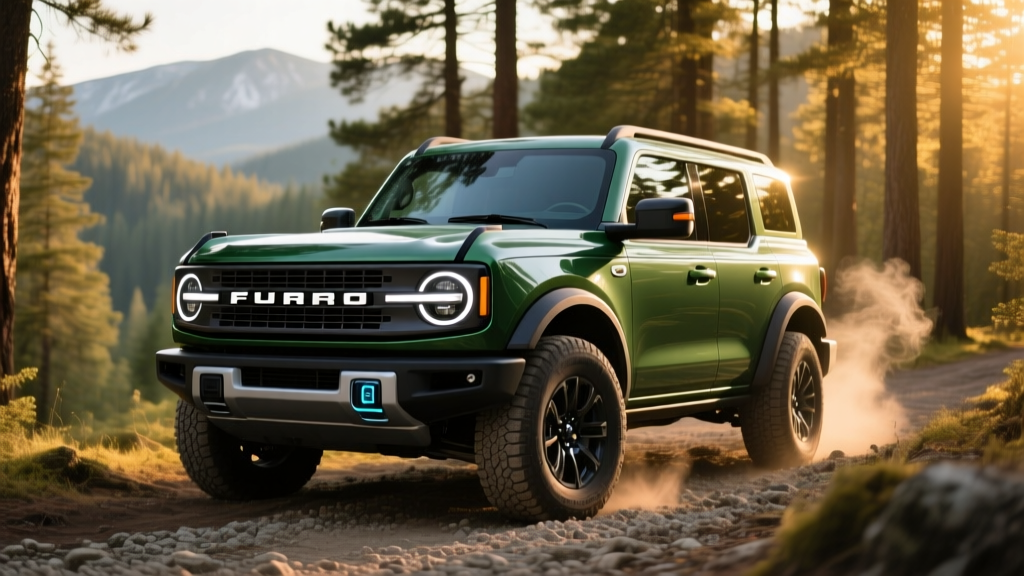
The Ford Bronco has long been a symbol of rugged, go-anywhere capability — but with rising fuel costs and tightening emissions standards, buyers are increasingly searching for a hybrid Ford Bronco that blends trail-ready performance with better fuel economy. For 2026, Ford offers the Bronco with a hybrid-assisted powertrain option, and the broader Bronco lineup includes electrified variants that deserve a close look before you sign the paperwork.
This guide breaks down exactly what's available, what the real-world MPG looks like, how the hybrid system works off-road, and whether a hybrid Bronco — or a plug-in alternative — is the right fit for your driveway.
2026 Ford Bronco Hybrid Powertrain: What Ford Actually Offers
For the 2026 model year, the Ford Bronco is available with a 2.3-liter EcoBoost inline-4 paired with a mild-hybrid system on select trims, as well as the higher-output 2.7-liter EcoBoost V6 on upper trims. The Bronco Sport — the smaller, unibody sibling — offers a 1.5-liter EcoBoost hybrid variant that delivers meaningful fuel economy gains over the standard gas models.
It's critical to understand that the current Bronco hybrid offerings are conventional hybrids (HEVs) or mild-hybrid systems — not plug-in hybrids. You do not plug them in. The battery recharges through regenerative braking and the gasoline engine. Ford has not announced a Bronco PHEV for the U.S. market as of early 2026, though the global Ford Ranger PHEV suggests the architecture exists within Ford's portfolio.
HEV vs. PHEV: What's the Difference for Bronco Buyers?
| Feature | HEV (Conventional Hybrid) | PHEV (Plug-In Hybrid) |
|---|---|---|
| Plug in to charge? | No — self-charging via regen & engine | Yes — plug in for electric-only miles |
| Battery size | ~1.0–1.5 kWh | ~15–20 kWh typical |
| Electric-only range | None (electric assist only) | 20–40 miles typical |
| Federal tax credit (§30D) | Not eligible | Up to $7,500 if eligible (see IRS rules) |
| Best for | Drivers who can't charge at home | Drivers with home charging & short commutes |
Fuel Economy: EPA MPG and Real-World Expectations
Fuel economy is the primary reason buyers search for a hybrid Bronco. Here's how the 2026 lineup breaks down according to EPA estimates at fueleconomy.gov:
| Model / Powertrain | City MPG | Highway MPG | Combined MPG |
|---|---|---|---|
| Bronco 2-Door, 2.3L EcoBoost (gas) | 20 | 22 | 21 |
| Bronco 4-Door, 2.3L EcoBoost (gas) | 20 | 21 | 20 |
| Bronco 4-Door, 2.7L EcoBoost V6 (gas) | 18 | 20 | 19 |
| Bronco Sport, 1.5L Hybrid (HEV) | 26 | 31 | 28 |
| Bronco Sport, 2.0L EcoBoost (gas) | 21 | 26 | 23 |
Real-World MPG vs. EPA Sticker
EPA Combined (Bronco Sport Hybrid): 28 MPG
Real-World Expectation: Hybrid SUVs typically exceed EPA city estimates because regenerative braking recaptures energy in stop-and-go traffic. Expect 29–32 MPG in city driving. Highway driving at 75+ MPH with a roof rack or 35-inch mud-terrain tires will drop efficiency to 22–25 MPG. The full-size Bronco's boxy aerodynamics and heavy curb weight (4,300–4,700 lbs depending on trim) work against highway efficiency regardless of powertrain.
Powertrain Specs: Horsepower, Torque, and Hybrid System Details
| Specification | Bronco Sport Hybrid (1.5L HEV) | Bronco 4-Door 2.7L V6 |
|---|---|---|
| Engine | 1.5L turbocharged I-3 + electric motor | 2.7L twin-turbo V6 |
| Combined Horsepower | ~198 hp | 330 hp |
| Combined Torque | ~290 lb-ft | 415 lb-ft |
| Transmission | CVT (continuously variable) | 10-speed automatic |
| Drivetrain | AWD (standard) | 4WD (part-time or full-time) |
| 0–60 MPH | ~8.2 sec (est.) | ~6.4 sec |
| Towing Capacity | 2,000 lbs | 3,500 lbs |
| Hybrid Battery | ~1.1 kWh (lithium-ion) | N/A (conventional gas) |
The Bronco Sport Hybrid uses a power-split hybrid architecture — similar to what Toyota pioneered with the Prius — where the electric motor and gasoline engine can independently or jointly drive the wheels. This means smooth, seamless transitions between electric assist and engine power, with no range anxiety and no plug required.
For the full-size Bronco, Ford's hybrid integration focuses on torque-fill at low RPMs. The mild-hybrid system smooths out turbo lag and provides a small efficiency bump, but the gains are modest compared to the Bronco Sport Hybrid's more substantial system.
Pricing, Trims, and Tax Credit Eligibility
Here's what the 2026 Bronco hybrid lineup costs at MSRP (destination charge included):
| Model & Trim | Starting MSRP |
|---|---|
| Bronco Sport Big Bend Hybrid | $32,690 |
| Bronco Sport Outer Banks Hybrid | $36,490 |
| Bronco Sport Badlands (2.0L, non-hybrid) | $38,990 |
| Bronco 4-Door Big Bend (2.3L) | $40,490 |
| Bronco 4-Door Wildtrak (2.7L V6) | $52,150 |
Federal Tax Credit: Does the Hybrid Bronco Qualify?
Conventional Hybrid (HEV): No. The IRS §30D Clean Vehicle Credit applies only to plug-in electric vehicles (BEVs and PHEVs) with a battery capacity of at least 7 kWh. The Bronco Sport Hybrid's ~1.1 kWh battery does not qualify.
Future PHEV Bronco: If Ford introduces a Bronco PHEV with ≥7 kWh battery, eligibility would depend on:
- MSRP under $80,000 (SUVs/vans/pickups)
- Buyer AGI under $150K (single) / $300K (joint)
- Battery components and critical minerals meeting U.S. sourcing requirements
- Final assembly in North America
Always verify current rules at irs.gov before purchasing. Point-of-sale transfer is available for eligible vehicles, allowing the credit to reduce your purchase price directly at the dealer.
Battery Warranty, Reliability, and Replacement Costs
Hybrid battery longevity is one of the most common concerns among first-time hybrid buyers. Here's what Ford provides:
Ford Hybrid Battery Warranty
- Coverage: 8 years / 100,000 miles (whichever comes first)
- Capacity threshold: Warranty covers defects and capacity loss below ~70% of original capacity
- California & CARB states: 10 years / 150,000 miles on hybrid battery components
- Powertrain warranty: 5 years / 60,000 miles
Ford's hybrid systems have been in production since the early 2000s (the Escape Hybrid debuted in 2004), and real-world data shows hybrid battery packs routinely lasting 150,000–200,000+ miles before significant degradation. The lithium-ion packs used in current Bronco Sport Hybrids are more chemically stable and thermally managed than early NiMH packs.
Replacement cost if out of warranty: A hybrid battery replacement for the Bronco Sport Hybrid is estimated at $2,500–$4,000 (parts and labor) based on comparable Ford hybrid platforms. This is far less than a full EV battery replacement ($10,000–$20,000+) because the pack is small (~1.1 kWh vs. 70+ kWh in a BEV).
Who Should Buy a Hybrid Bronco — And Who Shouldn't
Choose the Bronco Sport Hybrid If:
- You commute 20–40 miles daily in mixed city/highway driving
- You don't have access to home or workplace charging (no plug needed)
- You want better fuel economy without the complexity or cost of a full EV
- You prioritize city MPG — hybrids shine in stop-and-go traffic
- You want AWD capability for light trails and snow without the fuel penalty
Choose the Full-Size Gas Bronco If:
- You need serious off-road hardware (locking differentials, sway-bar disconnect, 35" tires)
- Towing capacity (3,500 lbs) and raw power (330 hp) are priorities
- You want a removable roof and doors — Bronco Sport doesn't offer this
- You do mostly highway driving where hybrid gains are minimal
Consider a Full EV (e.g., Ford Mustang Mach-E or Rivian R1S) If:
- You have reliable Level 2 home charging
- Your daily driving is under 250 miles and you want zero tailpipe emissions
- You qualify for the full $7,500 §30D tax credit
- You want instant torque and one-pedal driving
Pros: Hybrid Ford Bronco (Sport HEV)
- 28 MPG combined — 22% improvement over gas Bronco Sport
- No plug-in charging required
- Standard AWD with hybrid torque-fill for slippery conditions
- Lower operating cost: ~$0.12/mile fuel vs. ~$0.17/mile (gas model)
- Proven Ford hybrid architecture with 8-year/100K-mile battery warranty
Cons: Hybrid Ford Bronco (Sport HEV)
- No electric-only driving range — always uses gasoline
- Full-size Bronco hybrid options are limited (no PHEV yet)
- CVT transmission lacks the engagement of the 10-speed auto
- Lower towing capacity (2,000 lbs vs. 3,500 lbs)
- No federal tax credit eligibility
Hybrid Bronco vs. the Competition
The hybrid SUV segment for off-road-oriented vehicles is growing. Here's how the Bronco Sport Hybrid stacks up against key rivals:
| Vehicle | Type | Combined MPG | Starting MSRP | Tax Credit |
|---|---|---|---|---|
| Ford Bronco Sport Hybrid | HEV | 28 | $32,690 | None |
| Toyota RAV4 Hybrid | HEV | 39 | $33,575 | None |
| Jeep Wrangler 4xe | PHEV | 49 MPGe / 20 gas | $51,790 | Up to $7,500* |
| Toyota RAV4 Prime | PHEV | 94 MPGe / 38 gas | $44,560 | Up to $7,500* |
| Ford Escape PHEV | PHEV | 105 MPGe / 40 gas | $40,400 | Up to $7,500* |
*Tax credit eligibility subject to IRS §30D sourcing, income, and MSRP rules. Verify at irs.gov.
The Jeep Wrangler 4xe is the closest competitor offering genuine off-road capability with a plug-in hybrid system — 21 miles of electric-only range, locking differentials, and available 35-inch tires. If you need serious trail hardware and want electric commuting, the Wrangler 4xe fills a gap Ford hasn't yet addressed with the Bronco.
FAQ: Hybrid Ford Bronco
How many MPG does the hybrid Ford Bronco get?
The 2026 Ford Bronco Sport Hybrid achieves an EPA-estimated 26 city / 31 highway / 28 combined MPG. The full-size Bronco does not currently offer a full hybrid variant; its mild-hybrid assist provides marginal gains over the standard 2.3L EcoBoost (EPA 20 combined). Real-world city MPG for the Bronco Sport Hybrid often exceeds 30 thanks to regenerative braking.
Does the Ford Bronco come as a plug-in hybrid (PHEV)?
As of the 2026 model year, Ford does not offer a Bronco PHEV in the United States. The Bronco Sport is available as a conventional hybrid (HEV). If you need a plug-in hybrid with off-road capability, the Jeep Wrangler 4xe (21 miles electric-only, up to $7,500 tax credit) is the closest alternative.
Is the hybrid Ford Bronco reliable?
Ford's hybrid technology has been in production since 2004, and the current-generation hybrid systems benefit from two decades of refinement. The hybrid battery carries an 8-year/100,000-mile warranty (10 years/150,000 miles in CARB states). Independent reliability data from owner surveys shows Ford hybrid systems performing comparably to Toyota's well-regarded hybrid lineup.
What does it cost to replace the hybrid battery?
If the Bronco Sport Hybrid's battery fails outside of warranty, replacement is estimated at $2,500–$4,000 including parts and labor. This is significantly less than a full EV battery replacement because the pack is small (~1.1 kWh). Most hybrid batteries last 150,000–200,000+ miles before needing replacement.
Can I charge the hybrid Bronco at home?
No. The Bronco Sport Hybrid is a conventional hybrid (HEV) — it charges its small battery through regenerative braking and the gasoline engine. There is no plug and no charging port. You fuel it exactly like a conventional gas vehicle.
Hybrid vs. PHEV vs. full EV — which should I choose?
Choose a conventional hybrid (HEV) if you can't charge at home and want better MPG with zero lifestyle change. Choose a PHEV if you have home charging and a short commute (under 30 miles) — you'll drive mostly on electricity but have a gas engine for road trips. Choose a full EV (BEV) if you have reliable home charging, want the lowest per-mile cost, and your daily driving stays within the vehicle's range (typically 250–350 miles).
The hybrid Ford Bronco — specifically the Bronco Sport Hybrid — is a practical choice for buyers who want the Bronco nameplate, AWD capability, and meaningfully better fuel economy without the need for charging infrastructure. It's not a PHEV, it won't qualify for a federal tax credit, and it won't match a RAV4 Hybrid on pure MPG. But for the subset of buyers who want a rugged, adventure-ready compact SUV that sips fuel in city traffic, the Bronco Sport Hybrid occupies a compelling niche that Ford has carved out for 2026.