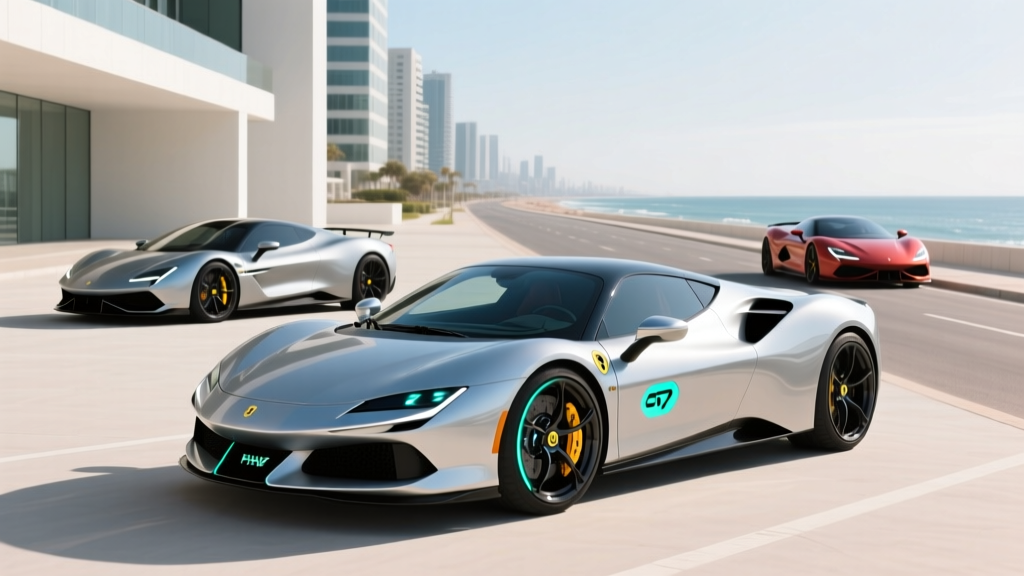
Ferrari doesn't build hybrids to save you money at the pump. The marque's electrified models exist to fill torque gaps, lower the center of gravity, and extract performance that internal combustion alone cannot deliver. If you're searching for a hybrid Ferrari, you're likely weighing exotic performance against daily usability — and wondering how plug-in hybrid technology behaves in a mid-engine Italian supercar.
As of the 2026 model year, Ferrari offers two primary plug-in hybrid (PHEV) models: the V6-powered 296 GTB/GTS and the flagship V8 SF90 Stradale/Spider. Neither is a conventional hybrid (HEV) like a Toyota Prius — both are full PHEVs with chargeable battery packs, electric-only driving modes, and meaningful electric range. Here's everything you need to know before putting one on your shortlist.
HEV vs PHEV: Where Ferrari Fits
Before examining specific models, it's worth clarifying the hybrid taxonomy, because Ferrari exclusively builds plug-in hybrids (PHEVs), not conventional self-charging hybrids (HEVs).
| Feature | Conventional Hybrid (HEV) | Plug-In Hybrid (PHEV) |
|---|---|---|
| Battery size | 0.5–2 kWh | 7–30+ kWh |
| Plug-in charging | No — charges via regen and engine | Yes — AC Level 2, some support DC fast charge |
| Electric-only range | 0–2 miles at low speed | 10–50+ miles |
| Fuel economy benefit | Moderate (city especially) | Major if charged regularly; gas-like if not |
| Ferrari examples | None in current lineup | 296 GTB, SF90 Stradale, 12Cilindri (mild-hybrid V12, HEV-adjacent) |
The 296 GTB and SF90 both require plug-in charging to access their full electric-only range. Drive them without ever plugging in, and they function as heavy performance cars with degraded efficiency — the electric system still assists, but you're leaving capability on the table.
Ferrari 296 GTB/GTS: The Accessible Hybrid Ferrari
The 296 GTB (coupe) and 296 GTS (retractable hardtop) represent Ferrari's volume PHEV offering. A 120-degree twin-turbocharged 3.0L V6 pairs with a single rear-axle electric motor mounted between the engine and the 8-speed dual-clutch transmission. The result is a combined 819 horsepower — more than enough to reframe any preconceptions about six-cylinder Ferraris.
| Specification | 296 GTB (2026) |
|---|---|
| Powertrain | 3.0L twin-turbo V6 + single electric motor |
| Combined output | 819 hp (654 hp engine + 165 hp motor) |
| Battery capacity | 7.45 kWh (usable) |
| Battery chemistry | Lithium-ion (NMC) |
| EPA electric-only range | ~16 miles (estimated) |
| Total combined range | ~430 miles (gas + electric) |
| EPA fuel economy (combined) | ~29 MPGe (gas + electric); ~20 MPG gas-only |
| 0–60 mph | 2.9 seconds |
| Top speed | 205 mph |
| Charging (AC Level 2) | ~2.5 hours (7.4 kW onboard charger) |
| DC fast charging | Not supported |
| Base MSRP | $338,000 (GTB); $368,000 (GTS) |
How Many MPG Does the 296 GTB Get?
Ferrari doesn't prioritize EPA fuel economy stickers, and the 296 GTB's numbers reflect its performance-first tuning. When the battery is depleted and you're running purely on gasoline:
| Mode | City | Highway | Combined |
|---|---|---|---|
| Charge-depleted (gas only) | ~17 MPG | ~23 MPG | ~20 MPG |
| With regular plug-in charging | ~29 MPGe combined (varies heavily by charging frequency) | ||
Real-world MPG for PHEVs depends entirely on how often you charge. Plug in nightly and drive less than 15 miles daily, and you'll rarely visit a gas station. Never plug in, and you're driving a ~3,600-pound twin-turbo V6 that returns roughly 17–20 MPG in mixed driving. Ferrari owners accustomed to V12 fuel bills may find this unremarkable.
Ferrari SF90 Stradale/Spider: The Flagship PHEV
The SF90 sits above the 296 in Ferrari's hierarchy — a twin-turbo V8 paired with three electric motors (one on the rear axle, two on the front axle) producing a staggering 986 combined horsepower. The front motors enable torque-vectoring all-wheel drive and an electric-only "eDrive" mode that powers only the front wheels.
| Specification | SF90 Stradale (2026) |
|---|---|
| Powertrain | 4.0L twin-turbo V8 + 3 electric motors |
| Combined output | 986 hp (769 hp engine + 217 hp motors) |
| Battery capacity | 7.9 kWh (usable) |
| Battery chemistry | Lithium-ion (NMC) |
| EPA electric-only range | ~15 miles (estimated) |
| Total combined range | ~440 miles |
| EPA fuel economy (combined) | ~30 MPGe (gas + electric); ~17 MPG gas-only |
| 0–60 mph | 2.0 seconds |
| Top speed | 211 mph |
| Charging (AC Level 2) | ~2.5 hours (7.4 kW onboard charger) |
| DC fast charging | Not supported |
| Base MSRP | $524,000 (Stradale); $575,000 (Spider) |
The SF90's additional electric motors and heavier battery push its curb weight above 3,600 lbs, making it the heaviest road-going Ferrari ever produced. That mass is well-managed by the chassis and torque-vectoring system, but it does suppress fuel economy when the battery is empty. Expect 15–18 MPG in real-world gas-only driving — comparable to a Lamborghini Huracán, which is to say, not the point.
Charging a Hybrid Ferrari: What You Need to Know
Neither the 296 GTB nor the SF90 supports DC fast charging. This is typical for PHEVs with small battery packs — the 7–8 kWh batteries simply don't warrant the thermal management and hardware cost of DC capability. All charging occurs via AC:
| Charging Level | Power | Time (0–100%) | Notes |
|---|---|---|---|
| Level 1 (120V outlet) | ~1.4 kW | ~5–6 hours | Emergency/top-up only |
| Level 2 (240V, 32A) | ~7.4 kW | ~2–2.5 hours | Standard home charging; fully replenishes overnight |
| DC Fast Charge | N/A | N/A | Not supported on any current Ferrari PHEV |
For owners with a Level 2 home charger (a standard 240V installation), a full charge takes roughly 2.5 hours — easily accomplished during a workday or overnight. The small battery is actually an advantage here: you don't need a high-amperage circuit to achieve fast charging relative to battery size.
Battery Warranty, Reliability, and Replacement Cost
Is a Hybrid Ferrari Reliable?
Ferrari's overall reliability reputation has improved substantially over the past decade, and the hybrid powertrains in the 296 and SF90 have proven robust in early ownership data. The electric motors and power electronics are largely carryover technology from Ferrari's Formula 1 and LaFerrari programs — well-developed systems with proven thermal management.
The primary reliability concern is complexity. These cars have a twin-turbocharged internal combustion engine, one to three electric motors, a high-voltage battery pack, power electronics, and an 8-speed dual-clutch transmission all working in concert. More systems mean more potential failure points out of warranty. Ferrari's 7-year maintenance program (included with purchase) covers scheduled service, but unscheduled repairs after the warranty period can be significant.
Battery Replacement Cost
Ferrari does not publish official high-voltage battery replacement pricing, but based on specialty service data and comparable exotic PHEV estimates, expect a full battery pack replacement to cost between $25,000 and $40,000 including parts and labor. This is a worst-case scenario — battery degradation in Ferrari PHEVs has been minimal in early reports, largely because the battery is rarely deeply cycled (most owners drive short distances and charge frequently).
Tax Credits and Incentives: Does a Hybrid Ferrari Qualify?
Under current IRS §30D Clean Vehicle Credit rules, the short answer is almost certainly no — and not because of the powertrain, but because of the price.
- MSRP cap: PHEV sedans and sports cars must have an MSRP under $55,000. SUVs, vans, and trucks have an $80,000 cap. Both the 296 GTB ($338,000+) and SF90 ($524,000+) exceed these limits by an order of magnitude.
- Income cap: Modified adjusted gross income must not exceed $150,000 (single) / $300,000 (joint). Many Ferrari buyers exceed these thresholds.
- Battery sourcing: Critical minerals and battery components must meet escalating domestic-content requirements. Even if a Ferrari PHEV were under the MSRP cap, its European-sourced battery would likely fail this test.
- Minimum battery capacity: The battery must be at least 7 kWh — both Ferraris meet this requirement.
Bottom line: no federal tax credit applies to any current Ferrari PHEV. Some states offer separate incentives for PHEVs, but most have MSRP caps as well. Check your state's specific programs for details, but plan your purchase without expecting incentive offsets.
Hybrid Ferrari vs Full EV vs Gas Exotic: Which Fits You?
Choose a hybrid Ferrari (296 GTB or SF90) if:
- You want instant electric torque fill and silent neighborhood departures
- You have home charging access (Level 2) and can plug in regularly
- You value performance enhancement over fuel savings
- You want a daily-drivable exotic with short electric-only range for urban errands
Choose a full EV (e.g., Lotus Eletre, Porsche Taycan Turbo GT) if:
- You want zero tailpipe emissions and no gasoline maintenance
- You drive primarily in urban or suburban areas with charging access
- You prioritize technology and over-the-air updates over engine sound
Choose a gas exotic (e.g., Ferrari 12Cilindri, Lamborghini Revuelto predecessor models) if:
- You have no home charging access
- You want the simplest mechanical package and lowest curb weight
- You value naturally aspirated engine character above all else
Pros and Cons: Hybrid Ferrari Ownership
Pros
- Electric torque fill eliminates turbo lag — acceleration is instantaneous
- Silent eDrive mode for residential areas and early-morning departures
- Combined output exceeds what the engine could produce alone (819 hp from a V6, 986 hp from a V8)
- 7-year hybrid battery warranty with no mileage limit
- Lower center of gravity from battery placement improves handling dynamics
- Regenerative braking reduces wear on carbon-ceramic brake rotors
Cons
- No DC fast charging — limited to AC Level 2 at ~2.5 hours
- Electric-only range is just 15–16 miles — not a commuter EV replacement
- Added weight (battery + motors) vs gas-only equivalents
- No federal or state tax credit eligibility due to MSRP
- High-voltage battery replacement cost: $25,000–$40,000 out of warranty
- Complexity: turbo engine + electric motors + power electronics = more potential service points
Frequently Asked Questions
How many MPG does a hybrid Ferrari get?
The 296 GTB returns approximately 20 MPG combined when running on gasoline alone (17 city / 23 highway), and up to 29 MPGe when regularly charged. The SF90 achieves roughly 17 MPG gas-only and around 30 MPGe with frequent charging. Real-world results vary significantly based on driving style and charging habits.
How far can a hybrid Ferrari go on electric only?
The 296 GTB delivers approximately 16 miles of EPA-estimated electric-only range; the SF90 about 15 miles. Real-world range is typically 10–14 miles at highway speeds or in cold weather, and up to 16 miles in mild city driving. Both cars can reach approximately 84 mph in electric-only mode.
Do I need to plug in a hybrid Ferrari?
Yes — Ferrari's hybrid models are plug-in hybrids (PHEVs). The gasoline engine can recharge the battery to a limited extent, but to access the full 15–16 miles of electric range, you must plug into a Level 1 or Level 2 AC charger. Without plugging in, the car functions as a performance hybrid with reduced efficiency benefits.
Is a hybrid Ferrari reliable, and what does battery replacement cost?
Early reliability data for the 296 GTB and SF90 is encouraging, with Ferrari's hybrid systems drawing on well-proven F1-derived technology. The high-voltage battery is covered for 7 years with no mileage limit. Out-of-warranty battery replacement is estimated at $25,000–$40,000. The 7-year included maintenance program covers scheduled service during the warranty period.
Does a hybrid Ferrari qualify for any tax credit?
No. Under IRS §30D rules, PHEVs must have an MSRP below $55,000 (cars) or $80,000 (SUVs/trucks) to qualify for the federal Clean Vehicle Credit. The 296 GTB starts at $338,000 and the SF90 at $524,000 — both far exceed the cap. State-level incentives similarly have MSRP caps that exclude these vehicles.
Can a hybrid Ferrari charge at a Tesla Supercharger or public DC fast charger?
No. Neither the 296 GTB nor the SF90 supports DC fast charging of any kind — including Tesla Superchargers, Electrify America, or CCS-equipped stations. Charging is limited to AC Level 1 (120V) and Level 2 (240V) using the car's J1772 inlet. This is standard for PHEVs with small battery packs.
What's the difference between the 296 GTB and SF90?
The 296 GTB uses a twin-turbo V6 with one electric motor (819 hp, ~$338,000), while the SF90 uses a twin-turbo V8 with three electric motors (986 hp, ~$524,000). The SF90 offers all-wheel drive via its front electric motors, faster acceleration (2.0s vs 2.9s to 60 mph), and a higher price. Both share similar battery capacity (~7.5 kWh) and electric-only range (~15–16 miles).