The Kia Telluride has dominated the three-row SUV segment since its debut, but one thing has been conspicuously absent: a hybrid powertrain. For the 2027 model year, Kia is finally expected to address that gap. If you've been searching for details on the 2027 Kia Telluride Hybrid interior, fuel economy, and whether it will arrive as a conventional hybrid (HEV) or plug-in hybrid (PHEV), this guide consolidates everything confirmed so far and flags what remains preliminary.
Because the 2027 Telluride Hybrid has been announced but is not yet on sale, specifications below marked as estimated are based on Kia's existing hybrid platforms (the Sorento HEV/PHEV architecture), industry reporting, and supply-chain filings. We'll update this article as Kia releases final EPA-certified numbers.
2027 Kia Telluride Hybrid Interior: Cabin Upgrades and Layout
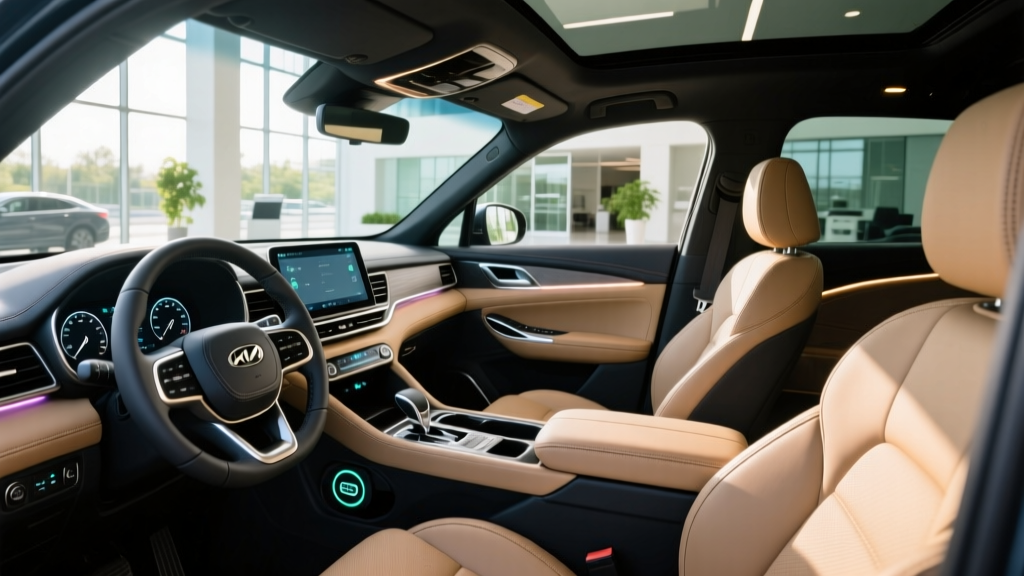
The current Telluride's interior is already a class benchmark, with available Nappa leather, dual 12.3-inch displays, and a flat-folding third row. For the hybrid variant, Kia is expected to carry over the same fundamental cabin architecture while adding hybrid-specific instrumentation.
What to expect inside the 2027 Telluride Hybrid:
- Gauge cluster: A dedicated energy-flow display showing real-time battery state of charge (SoC), regenerative braking contribution, and engine/motor power split
- Infotainment: The latest Kia Connect interface with hybrid-specific route planning that factors in battery charge (PHEV) or optimizes for fuel efficiency (HEV)
- Seating capacity: Seven or eight passengers depending on second-row captain's chairs vs. bench — no expected loss of seats due to hybrid packaging
- Cargo volume: Slight reduction from the gas model is possible. The current Telluride offers 21 cu ft behind the third row, 46 cu ft behind the second, and 87 cu ft with both rows folded. Expect a 1–3 cu ft penalty if the hybrid battery mounts under the cargo floor, though Kia's modular platform may minimize this
- Materials: SX-Prestige and a potential new "Eco" trim may feature recycled upholstery materials, consistent with Kia's sustainability push across its electrified lineup
The biggest interior question is whether the hybrid battery placement intrudes on cargo space. In the Sorento Hybrid, Kia managed to package the battery without meaningful cargo loss, and the Telluride's larger footprint should provide even more flexibility.
HEV vs PHEV: Which Telluride Hybrid Is Coming?
Conventional Hybrid (HEV): Charges its own battery through regenerative braking and the engine. You never plug it in. It improves MPG across all driving conditions, especially city traffic where the electric motor handles low-speed propulsion.
Plug-in Hybrid (PHEV): Has a larger battery you can charge at home or at a public Level 2 charger. It drives a set number of miles on electricity alone before the gas engine engages. Ideal if you have home charging and a short commute.
Industry reporting suggests Kia will launch both a conventional HEV and a PHEV version of the 2027 Telluride, mirroring the strategy used with the Sorento. Here's how they're expected to compare:
| Specification | HEV (Conventional Hybrid) | PHEV (Plug-in Hybrid) |
|---|---|---|
| Battery capacity | ~1.5 kWh (small, self-charging) | ~13.8–18 kWh (estimated, plug-in capable) |
| Plug-in charging required? | No — never plugs in | Optional but recommended for max benefit |
| Electric-only range | N/A (electric assist only) | ~30–38 miles (estimated) |
| Combined horsepower | ~260–290 hp (estimated) | ~290–320 hp (estimated) |
| DC fast charging | N/A | Unlikely — most Kia PHEVs are Level 2 AC only |
| Level 2 charge time (0–100%) | N/A | ~3–4 hours at 7.2 kW (estimated) |
Critical distinction: The conventional HEV does not need a charger or a plug. It generates all its electricity internally. The PHEV benefits enormously from home Level 2 charging — without plugging in, a PHEV operates as a slightly heavier conventional hybrid and sacrifices its efficiency advantage.
Fuel Economy: Estimated EPA MPG and Real-World Expectations
The current gas-only Telluride with the 3.8L V6 and AWD returns an EPA-rated 20 mpg combined (18 city / 24 highway) per fueleconomy.gov. The hybrid should deliver a substantial improvement.
| Powertrain | City MPG | Highway MPG | Combined MPG | MPGe (PHEV EV mode) |
|---|---|---|---|---|
| Gas V6 AWD (current baseline) | 18 | 24 | 20 | N/A |
| HEV AWD (estimated) | 27–30 | 28–31 | 28–30 | N/A |
| PHEV AWD (estimated, charge-depleting) | 30–33 | 30–33 | 31–33 | ~75–85 MPGe |
Real-world MPG reality check: Conventional hybrids typically exceed their EPA city rating in stop-and-go traffic because regenerative braking recaptures energy that gas cars waste as heat. Highway driving is where hybrids lose their advantage — at sustained 70–80 mph speeds, the engine does most of the work. Expect the HEV Telluride to deliver 30+ mpg in suburban driving but closer to 26–28 mpg on long highway road trips.
For the PHEV, the electric-only range is most useful for daily commutes under 35 miles. Once the battery depletes, the PHEV operates as a conventional hybrid with an MPG figure similar to (or slightly below, due to added battery weight) the HEV variant.
Powertrain Specs: Engine, Motors, and Horsepower
Kia is expected to use a version of its turbocharged 1.6-liter four-cylinder hybrid powertrain, scaled up for the Telluride's 4,500+ lb curb weight. Here's the anticipated setup:
| Component | HEV | PHEV |
|---|---|---|
| Engine | 1.6L turbo I4 + electric motor | 1.6L turbo I4 + larger electric motor |
| Combined system output | ~260–290 hp | ~290–320 hp |
| Transmission | 6-speed automatic | 6-speed automatic |
| Drivetrain | AWD standard | AWD standard |
| Towing capacity | ~4,500–5,000 lbs (estimated) | ~4,000–4,500 lbs (estimated) |
| 0–60 mph | ~7.0–7.5 sec (estimated) | ~6.5–7.0 sec (estimated) |
The PHEV's larger electric motor provides more torque off the line, which is why it should be quicker despite carrying more battery weight. Towing capacity may decrease slightly from the gas model's 5,500-lb rating due to the hybrid system's thermal management limits under sustained heavy loads — a factor buyers who tow frequently should monitor when final specs drop.
Pricing, Tax Credits, and Total Cost of Ownership
The current 2026 Telluride starts around $37,500 (S trim) and climbs to $54,000+ for the SX-Prestige X-Pro. The hybrid variant will carry a premium over the gas model.
Estimated pricing:
- HEV: ~$41,000–$57,000 MSRP (depending on trim)
- PHEV: ~$47,000–$62,000 MSRP (depending on trim)
Federal Tax Credit Eligibility (§30D)
The conventional HEV does not qualify for the federal §30D clean vehicle credit — that credit applies only to plug-in vehicles (BEVs and PHEVs) that meet battery-sourcing and critical-mineral requirements.
The PHEV may qualify for up to $7,500, but eligibility depends on multiple factors under current IRS rules:
- MSRP cap: SUVs must be under $80,000 — the Telluride PHEV should clear this
- Buyer income cap: AGI must not exceed $150,000 (single) / $300,000 (joint)
- Battery sourcing: Critical minerals and battery components must meet escalating domestic-content thresholds. Kia's battery supply chain will determine the exact credit amount ($3,750 or $7,500)
- Point-of-sale transfer: Eligible buyers can apply the credit as a down-payment reduction at the dealer
Check current rules at irs.gov before purchasing. Credit amounts and sourcing requirements change, and a tax professional can confirm your specific eligibility.
Total cost of ownership context: At 28–30 mpg combined (HEV) vs. 20 mpg (gas), a Telluride HEV driven 15,000 miles/year at $3.50/gallon saves roughly $1,050–$1,310 annually in fuel. The HEV premium over the gas model pays back in roughly 3–4 years for most drivers. The PHEV's savings depend heavily on how much you drive within electric-only range and your local electricity rate.
Battery Warranty, Reliability, and Replacement Cost
Hybrid battery longevity is consistently a top concern for buyers moving from a gas vehicle. Here's what to expect:
| Item | HEV | PHEV |
|---|---|---|
| Hybrid battery warranty | 10 years / 100,000 miles | 10 years / 100,000 miles |
| Capacity retention threshold | Typically ~60–70% of original | Typically ~60–70% of original |
| Powertrain warranty | 10 years / 100,000 miles | 10 years / 100,000 miles |
| Estimated battery replacement cost (out of warranty) | $2,000–$4,000 | $5,000–$8,000 |
Reliability context: Kia's hybrid system in the Sorento has demonstrated strong durability in early model years, though long-term (10+ year) data is still accumulating. Hyundai-Kia's hybrid architecture is simpler than some competitors — it uses a conventional six-speed automatic rather than a planetary e-CVT, which some mechanics consider easier to service.
Modern hybrid batteries rarely fail catastrophically before 150,000+ miles. Gradual capacity loss is the norm: expect 85–90% state of health (SoH) at 100,000 miles under normal use. The 10-year/100,000-mile warranty provides strong protection during the ownership period most buyers care about.
Who Should Choose the Telluride Hybrid vs. a Full EV or Gas Model?
Choose the Telluride HEV if:
- You want better MPG without changing your fueling habits at all
- You don't have access to home or workplace charging
- You take frequent long road trips and don't want to plan around charging stops
- You tow regularly and want simpler thermal management
Choose the Telluride PHEV if:
- You have Level 2 home charging (or can install it)
- Your daily commute is under 35 miles round-trip
- You want electric-only daily driving with gas-engine flexibility for road trips
- You want to potentially claim the §30D federal tax credit
Choose a full EV (e.g., Kia EV9) instead if:
- You have reliable home charging and want zero tailpipe emissions
- Your daily driving is under 250 miles and you rarely tow
- You want to eliminate oil changes, spark plugs, and transmission fluid entirely
- You want the maximum available federal tax credit and lower per-mile fuel cost
Stick with the gas Telluride if:
- You prioritize the lowest upfront purchase price
- You plan to keep the vehicle under 4 years and the hybrid premium won't pay back
- You frequently tow near the 5,500-lb maximum and want proven V6 thermal headroom
Pros and Cons at a Glance
Pros
- Significant MPG improvement over the V6 gas model (28–30 vs. 20 combined)
- Three-row seating retained with minimal cargo compromise
- Kia's 10-year/100,000-mile hybrid battery warranty
- PHEV variant enables gas-free daily commuting under ~35 miles
- Strong resale value trajectory — Telluride demand remains high
- AWD standard on hybrid trims for all-weather capability
Cons
- Hybrid premium adds $3,500–$5,000+ over equivalent gas trims
- Towing capacity may decrease vs. the V6 gas model
- PHEV likely won't support DC fast charging (Level 2 only)
- Third-row space remains tight for adults on long trips (same as gas model)
- Final EPA numbers not yet certified — estimates may shift
- Turbo four-cylinder may lack the V6's linear power delivery feel
Frequently Asked Questions
How many MPG does the 2027 Kia Telluride Hybrid get?
Based on Kia's existing hybrid platforms, the conventional HEV is estimated at 28–30 mpg combined (with higher city figures, lower highway). The PHEV should achieve 31–33 mpg combined once the battery depletes, plus an estimated 75–85 MPGe while operating in electric mode. Final EPA numbers are pending.
How far can the Telluride PHEV go on electric only?
We estimate 30–38 miles of electric-only range, based on the Sorento PHEV's 32-mile EPA rating and the Telluride's larger battery and heavier weight. This is enough for most daily commutes but will decrease in cold weather (expect 20–25% range loss below freezing) and at highway speeds.
Does the conventional Telluride Hybrid need to be plugged in?
No. The HEV charges its small battery entirely through regenerative braking and the gasoline engine. You fuel it exactly like a gas car — at the pump. Only the PHEV variant benefits from plug-in charging.
Does the 2027 Telluride Hybrid qualify for a federal tax credit?
The conventional HEV does not qualify for the §30D federal clean vehicle credit. The PHEV may qualify for up to $7,500, subject to buyer income caps ($150K single / $300K joint AGI), the $80,000 SUV MSRP cap, and battery-sourcing requirements. Always verify current eligibility at irs.gov and consult a tax professional.
Is the hybrid Telluride reliable, and what does battery replacement cost?
Kia covers the hybrid battery for 10 years / 100,000 miles, and modern hybrid batteries typically retain 85–90% capacity at 100,000 miles. Out-of-warranty replacement is estimated at $2,000–$4,000 for the HEV and $5,000–$8,000 for the PHEV (larger battery). Catastrophic failures before 150,000 miles are rare in current-generation Kia-Hyundai hybrid systems.
When will the 2027 Kia Telluride Hybrid be available?
Kia has signaled a hybrid Telluride is in development, with a likely reveal in late 2026 and dealer arrivals in early-to-mid 2027 as a 2027 model-year vehicle. Pricing and final EPA specs will be confirmed closer to launch.
Should I get the Telluride Hybrid or the Kia EV9?
The EV9 is a fully electric three-row SUV with an EPA-estimated range of up to 304 miles and eligibility for the full $7,500 federal credit. It eliminates gas entirely but requires home charging infrastructure and route planning for road trips over 250 miles. If you can charge at home and don't tow heavily, the EV9 offers lower running costs. If you need towing flexibility, take long trips frequently, or lack home charging, the Telluride Hybrid (HEV or PHEV) is the more practical choice.
This article will be updated with final EPA-certified specifications, confirmed pricing, and tax credit eligibility once Kia releases official 2027 Telluride Hybrid data. All figures marked as estimated are based on Kia's current hybrid platform specifications and may change.