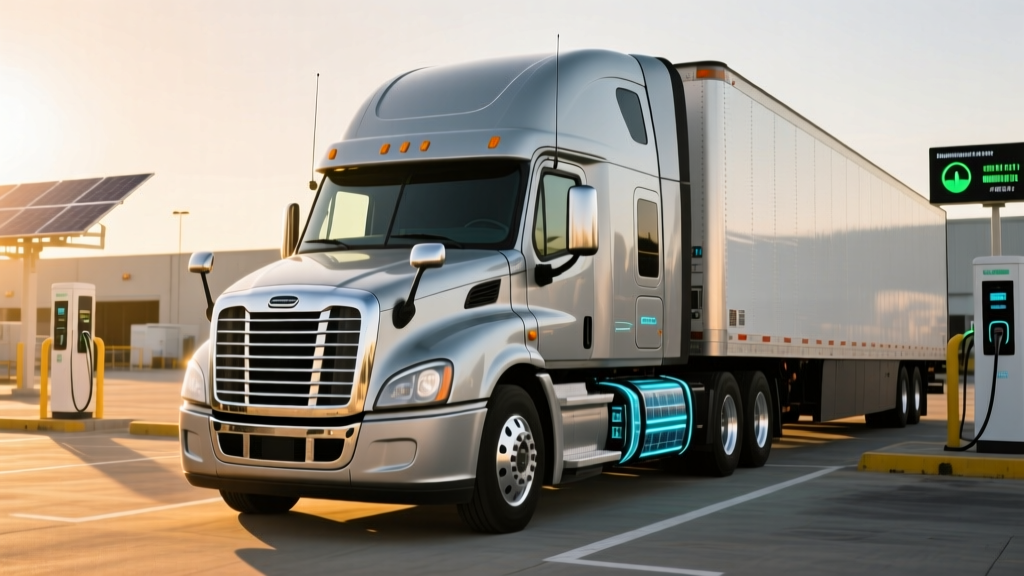
The heavy-duty trucking industry faces an uncomfortable math problem in 2026: zero-emission mandates tighten while battery-electric Class 8 trucks still struggle with range, payload penalties, and charging infrastructure gaps along freight corridors. The hybrid electric semi truck has emerged as a pragmatic bridge — pairing a diesel engine with an electric motor and battery pack to cut fuel consumption 15–40% without stranding drivers in charging deserts.
This guide covers the current state of hybrid and plug-in hybrid (PHEV) technology in Class 7 and Class 8 semi trucks, examining real powertrain specs, fuel economy data, battery durability, and the fleet economics that determine whether a hybrid rig makes sense for your operation.
HEV vs. PHEV: Two Paths to Hybrid Trucking
Before evaluating specific models, fleet buyers need to understand the fundamental split in hybrid semi truck architecture. The distinction determines fuel savings potential, infrastructure requirements, and regulatory compliance.
Conventional Hybrid (HEV)
- No plug-in required. The battery recharges through regenerative braking and the diesel engine.
- Battery size: Typically 2–5 kWh, small enough to add minimal weight.
- Electric-only range: None or negligible (under 1 mile at low speed).
- Fuel savings: 10–20% diesel reduction through regen capture, engine load optimization, and electric-assist launch.
- Infrastructure: Zero — fuel at any diesel pump.
- Best for: Long-haul and regional routes where plug-in access is unreliable.
Plug-In Hybrid (PHEV)
- Requires plug-in charging (Level 2 AC or DC fast charge) to unlock full electric range.
- Battery size: Typically 30–100+ kWh, enabling meaningful zero-emission operation.
- Electric-only range: 30–150 miles depending on battery size and payload.
- Fuel savings: 30–60% diesel reduction on routes within electric range; operates as conventional HEV beyond that.
- Infrastructure: Depot charging required — Level 2 (240V/40–80A) minimum.
- Best for: Drayage, regional haul, and last-mile freight with predictable depot returns.
2026 Hybrid Electric Semi Truck Models: Spec Comparison
The Class 8 hybrid market remains smaller than the battery-electric or diesel segments, but several manufacturers now offer production or near-production hybrid powertrains. Below is a snapshot of the most relevant platforms available or announced for the 2026 model year.
| Specification | Daimler Freightliner eCascadia PHEV (Announced) | Volvo VNR PHEV Concept | Kenworth T680 Hybrid (HEV) | Peterbilt 579EV PHEV Variant |
|---|---|---|---|---|
| Class | Class 8 | Class 8 | Class 8 | Class 8 |
| Type | PHEV | PHEV | HEV | PHEV |
| Diesel Engine | Detroit DD13, 12.8L, ~450 hp | Volvo D13, 12.8L, ~455 hp | PACCAR MX-13, 12.9L, ~455 hp | PACCAR MX-13, 12.9L, ~455 hp |
| Electric Motor | ~200 kW integrated | ~200 kW e-axle | ~100 kW belt-driven | ~180 kW integrated |
| Combined Output | ~550 hp | ~560 hp | ~505 hp | ~540 hp |
| Battery Capacity | ~60 kWh (NMC) | ~80 kWh (NMC) | ~3 kWh (NMC) | ~55 kWh (NMC) |
| Electric-Only Range | ~40–60 mi (est.) | ~60–80 mi (est.) | N/A (assist only) | ~35–55 mi (est.) |
| Combined Range (Diesel + Electric) | ~700+ mi | ~750+ mi | ~800+ mi | ~650+ mi |
| Charge Time (Level 2) | ~3–4 hours | ~4–5 hours | N/A | ~3–4 hours |
| DC Fast Charge | Yes, ~80 kW peak | Yes, ~100 kW peak | N/A | Yes, ~75 kW peak |
| Base MSRP (Est.) | ~$230,000 | ~$250,000 | ~$185,000 | ~$225,000 |
Note: Several PHEV Class 8 models listed above are announced or in limited fleet trials as of early 2026. Specs are preliminary and subject to change. Confirm availability with your dealer.
Fuel Economy: What MPG Does a Hybrid Semi Truck Get?
Class 8 fuel economy is measured differently than passenger vehicles. The EPA's Green Vehicle framework and SAE J1321 testing protocols apply, and results vary enormously with payload, terrain, speed, and idling patterns. Here's what the data shows for 2026 hybrid platforms:
| Powertrain Type | City/Stop-Start MPG | Highway (65 mph) MPG | Combined MPG | MPGe (PHEV Electric Mode) |
|---|---|---|---|---|
| Conventional Diesel (baseline) | 5.0–6.0 | 6.5–7.5 | 6.0–7.0 | N/A |
| HEV Semi (Kenworth T680 Hybrid) | 6.5–8.0 | 7.0–8.0 | 7.0–7.8 | N/A |
| PHEV Semi (charge-depleting) | 8.0–12.0 (electric mode: 0 diesel) | 7.0–8.5 (hybrid mode) | 7.5–10.0 | ~8–12 MPGe |
Real-world vs. EPA reality check: Hybrid semi trucks, like their passenger-car counterparts, tend to exceed EPA city estimates in stop-start drayage and urban delivery because regenerative braking recovers enormous kinetic energy from an 80,000-lb vehicle. On the highway at sustained 65–70 mph, the hybrid advantage narrows to 5–10% over diesel because aero drag dominates and regen opportunities are minimal. PHEV fuel economy is highly route-dependent — a 50-mile drayage run returns to depot on electric only could burn zero diesel, while a 400-mile highway run operates almost entirely on diesel with modest hybrid assist.
Electric-Only Range and Charging Infrastructure
For PHEV semi trucks, electric-only range is the metric that determines daily diesel displacement. A 60 kWh battery in a Class 8 tractor consumes energy at roughly 1.5–2.5 kWh per mile depending on payload and grade, yielding 25–40 miles of zero-emission range under loaded conditions. Lighter loads or empty backhauls can stretch this to 50–60 miles.
Charging a PHEV semi truck at a depot requires commercial-grade infrastructure:
| Charging Level | Power (kW) | Miles of Range Added per Hour | 0–100% Time (60 kWh Battery) |
|---|---|---|---|
| Level 1 (120V) | ~1.4 kW | ~0.5–1 mi | Impractical (40+ hours) |
| Level 2 (240V, 40A) | ~9.6 kW | ~4–6 mi | ~6–7 hours |
| Level 2 (240V, 80A) | ~19.2 kW | ~8–12 mi | ~3–4 hours |
| DC Fast Charge (80 kW) | ~80 kW | ~35–50 mi | ~45–60 min (10–80%) |
Most fleet operators installing PHEV semi trucks invest in Level 2 depot chargers rated at 19.2 kW (240V/80A) per truck, enabling overnight replenishment. DC fast charging at 80–100 kW is available on select models for mid-shift top-ups but requires significant electrical infrastructure — typically a 480V three-phase service with dedicated transformers. Installation costs for a commercial depot charger range from $15,000 to $45,000 per unit depending on trenching, panel upgrades, and utility demand charges.
Hybrid Semi Truck Battery Longevity and Warranty
Battery degradation is a top concern for fleet buyers investing $200,000+ in a hybrid rig. Class 8 hybrid batteries use NMC (nickel manganese cobalt) chemistry for its energy density, which trades some cycle life compared to LFP. However, fleet-duty batteries are engineered with larger thermal management systems and conservative state-of-charge windows to maximize lifespan.
Battery Warranty & Replacement
- Warranty period: 5–8 years or 300,000–500,000 miles (varies by OEM), covering capacity retention above 70–80% of original.
- Expected lifespan: 8–12 years / 500,000–800,000 miles before capacity drops below 80%, based on current NMC cycle data.
- Replacement cost: $25,000–$50,000 for a Class 8 hybrid battery pack (60–80 kWh), significantly less than a full BEV pack replacement ($80,000–$150,000+).
- HEV advantage: The small 2–5 kWh battery in a conventional hybrid faces far fewer deep cycles and typically lasts the life of the truck with negligible replacement concern.
Fleet managers should monitor State of Health (SoH) via telematics — most OEM platforms (Detroit Connect, Volvo Connect, PACCAR Connect) provide battery degradation dashboards. Keeping charge between 20–80% SoC when possible and avoiding repeated DC fast charging in extreme heat extends pack life.
Tax Credits and Incentives for Hybrid Semi Trucks
Federal incentives for hybrid commercial vehicles are narrower than for passenger EVs, but several programs apply:
- IRA §45W Clean Vehicle Credit (Commercial): Up to $40,000 for qualified commercial clean vehicles (Class 8 qualifies). PHEV semi trucks with ≥15 kWh battery capacity and meeting domestic content/sourcing rules may qualify. This is a business credit — consult IRS guidelines and a tax professional for eligibility.
- IRA §30C Alternative Fuel Vehicle Refueling Property Credit: Up to $100,000 per item of charging infrastructure installed in eligible census tracts — relevant for depot charger installation.
- State programs: California's Advanced Clean Trucks regulation and HVIP (Hybrid and Zero-Emission Truck and Bus Voucher Incentive Project) offer point-of-sale vouchers of $50,000–$120,000 for qualifying hybrid and zero-emission Class 8 trucks. Other states including New York, New Jersey, and Oregon have adopted similar frameworks.
- Depreciation: Section 179 and bonus depreciation may allow full write-off in the first year — consult your tax advisor.
Important caveat: the conventional HEV semi truck (non-plug-in, small battery) generally does not qualify for the §45W credit, which requires a minimum battery capacity and plug-in capability. The HEV value proposition rests on fuel savings alone.
Total Cost of Ownership: Hybrid vs. Diesel vs. Full BEV
Fleet purchasing decisions hinge on total cost of ownership (TCO) over a 5–7 year holding period. Here's a simplified comparison for a regional-haul Class 8 truck averaging 80,000 miles/year:
| Cost Category | Diesel (Baseline) | HEV Semi | PHEV Semi | Full BEV |
|---|---|---|---|---|
| Purchase Price | $155,000 | $185,000 | $230,000 | $350,000 |
| Federal/State Incentives | $0 | $0–$5,000 | $40,000–$100,000 | $40,000–$120,000 |
| Net Acquisition | $155,000 | $180,000–$185,000 | $130,000–$190,000 | $230,000–$310,000 |
| Fuel (5 years, 400K mi) | $228,000 (diesel @ $4.50/gal, 7 MPG) | $196,000 (est. 15% savings) | $145,000–$175,000 (varies by electric-mode %) | $68,000–$90,000 (electricity) |
| Maintenance (5 years) | $45,000 | $42,000 | $38,000 | $28,000 |
| Charging Infrastructure | $0 | $0 | $20,000–$40,000 | $40,000–$80,000 |
| Estimated 5-Year TCO | $428,000 | $418,000–$423,000 | $333,000–$433,000 | $366,000–$498,000 |
The PHEV semi truck's TCO range is wide because it depends critically on how often the truck operates in electric mode. A drayage truck running 40 miles/day and charging nightly at the depot could save $80,000+ in fuel over five years. A regional truck running 300 miles/day will use diesel for most of its operation, narrowing the advantage over a conventional HEV.
Decision Framework: Hybrid vs. PHEV vs. Full EV Semi Truck
Choose a Conventional HEV Semi Truck If:
- Your routes are long-haul or unpredictable with no depot charging access.
- You want 10–20% fuel savings with zero infrastructure investment.
- Payload capacity is paramount — HEV adds only 200–500 lbs vs. 2,000–5,000+ lbs for PHEV/BEV batteries.
- You operate in regions with no state incentive programs for plug-in trucks.
Choose a PHEV Semi Truck If:
- Your routes are regional (under 150 miles/day) with predictable depot returns.
- You face zero-emission zone mandates (e.g., California drayage, port operations) but need diesel range for occasional longer hauls.
- You qualify for §45W credits and state HVIP vouchers that bring net acquisition near diesel parity.
- You want to future-proof against tightening emissions rules without full BEV range risk.
Choose a Full BEV Semi Truck If:
- Your routes are under 250 miles with access to depot and en-route DC fast charging.
- You operate in jurisdictions with aggressive zero-emission truck mandates and strong incentive stacking.
- Electricity rates are low and diesel prices are high in your operating region.
- Payload penalty (2,000–5,000 lbs for batteries) is acceptable for your freight profile.
Reliability and Maintenance Considerations
Hybrid semi trucks carry the reputation of their diesel platforms — the Freightliner Cascadia, Volvo VNR, and Kenworth T680 are among the most proven Class 8 tractors on the road. The hybrid system adds an electric motor, power electronics, and battery pack but eliminates or reduces wear on some diesel components (the engine runs fewer hours, brakes last longer due to regen).
Key reliability considerations:
- Power electronics cooling: Inverters and converters generate heat; coolant system maintenance is critical.
- Regenerative braking: Extends foundation brake life by 30–50% — a meaningful savings for stop-heavy routes.
- Diesel particulate filter (DPF): Hybrid operation with more engine on/off cycles can increase DPF regeneration frequency; fleet maintenance schedules should account for this.
- Software updates: Hybrid powertrain calibration receives OTA updates — ensure your fleet IT can manage this.
Pros
- 15–40% fuel reduction with no range anxiety
- Regenerative braking extends brake life significantly
- PHEV qualifies for up to $40,000 federal + state incentives
- Operates on existing diesel infrastructure for long hauls
- Lower battery replacement cost vs. full BEV
- Meets partial zero-emission requirements in regulated zones
Cons
- Higher upfront cost: $30,000–$75,000 premium over diesel
- PHEV requires depot charging investment ($20,000–$45,000 per truck)
- Added battery weight reduces payload by 1,000–4,000 lbs (PHEV)
- Fewer models available vs. diesel or full BEV — limited dealer inventory
- HEV (non-plug-in) does not qualify for most clean-vehicle credits
- Maintenance complexity: two powertrains require dual expertise
Frequently Asked Questions
How many MPG does a hybrid electric semi truck get?
A conventional hybrid (HEV) Class 8 semi truck achieves approximately 7.0–7.8 MPG combined, compared to 6.0–7.0 MPG for a standard diesel — a 10–20% improvement. A plug-in hybrid (PHEV) semi truck can achieve 7.5–10.0+ MPG combined depending on how frequently it operates in electric mode. In city drayage with nightly charging, diesel consumption can drop by 40–60%. On the highway, expect 7.0–8.5 MPG regardless of hybrid type because aerodynamic drag dominates at 65+ mph.
How far can a PHEV semi truck go on electric only?
Current PHEV Class 8 platforms with 55–80 kWh battery packs deliver an estimated 35–80 miles of electric-only range under loaded conditions (gross vehicle weight ~80,000 lbs). Empty or lightly loaded operation can extend this to 50–100 miles. Range drops 15–25% in cold weather (below 32°F) due to battery chemistry limitations and cabin/climate heating demands.
Is a hybrid semi truck reliable, and what does battery replacement cost?
Hybrid semi trucks are built on proven diesel platforms (Cascadia, VNR, T680) with well-established service networks. The hybrid components — electric motor, inverter, battery — add complexity but are warranted for 5–8 years / 300,000–500,000 miles. Battery replacement costs $25,000–$50,000 for a PHEV pack and $3,000–$8,000 for a conventional HEV pack. Real-world data from early fleet deployments suggests NMC packs retain 80%+ capacity at 500,000 miles when properly managed.
Does a hybrid electric semi truck qualify for any tax credits?
Plug-in hybrid (PHEV) semi trucks with ≥15 kWh battery capacity may qualify for the federal §45W Clean Vehicle Credit of up to $40,000 for commercial vehicles, subject to battery sourcing and domestic content requirements. Conventional HEV trucks (non-plug-in) generally do not qualify. State incentives like California's HVIP can add $50,000–$120,000 in vouchers. Always verify current-year rules with the IRS and your state air resources board, as eligibility criteria change annually.
Can a hybrid semi truck DC fast charge?
Select PHEV semi truck models support DC fast charging at 75–100 kW peak, enabling a 10–80% charge in roughly 45–60 minutes. However, charging curves taper significantly above 80% SoC to protect the battery — plan for 60–90 minutes for a full charge at a DC station. Conventional HEV trucks do not plug in at all; their small batteries recharge exclusively through regenerative braking and the diesel engine.
Hybrid vs. full electric semi truck — which is better for my fleet?
If your routes are under 250 miles with reliable depot and en-route charging, a full BEV (like the Freightliner eCascadia or Volvo VNR Electric) offers the lowest operating cost and full zero-emission compliance. If your routes exceed 300 miles, include remote destinations without charging infrastructure, or require maximum payload, a PHEV or HEV semi truck provides fuel savings without range risk. The hybrid electric semi truck is the pragmatic choice for fleets that need operational flexibility while reducing emissions incrementally.