If you've searched "hybrid cars use only one distinct power source," you've likely encountered conflicting answers. The short answer is no — hybrid vehicles, by definition, use two distinct power sources: a gasoline internal combustion engine (ICE) and an electric motor driven by a battery pack. What differs is how those two sources work together, whether you can plug the vehicle in, and how much of your driving can be done on electricity alone.
This guide clarifies exactly how hybrid powertrains function, the critical differences between conventional hybrids (HEVs) and plug-in hybrids (PHEVs), and how to decide which — if either — is the right fit for your commute, budget, and charging access. We'll use current 2026 model-year data from the EPA and IRS to ground every claim in real numbers.
Two Power Sources, One Drivetrain: How Hybrid Systems Actually Work
Every hybrid on the road pairs a gasoline engine with at least one electric motor. The motor can drive the wheels directly, assist the engine under load, or act as a generator to recharge the battery. Energy is captured through regenerative braking — converting kinetic energy that would otherwise be lost as heat into electricity stored in the battery.
The distinction that matters most to buyers is whether the battery can be recharged from the grid:
| Feature | Conventional Hybrid (HEV) | Plug-In Hybrid (PHEV) |
|---|---|---|
| Power Sources | Gasoline engine + electric motor | Gasoline engine + electric motor |
| Plug-In Charging | No — self-charging via regen & engine | Yes — Level 1 (120V) or Level 2 (240V) |
| Battery Capacity | ~0.6–1.6 kWh (small buffer) | ~13–25 kWh usable |
| Electric-Only Range | 0–1 mile at very low speed | 25–50+ miles (EPA rated) |
| DC Fast Charging | N/A | Rare; some models (e.g., Mitsubishi Outlander PHEV) support CHAdeMO |
| Federal Tax Credit (§30D) | No | Up to $7,500 if eligible (sourcing/income/MSRP rules apply) |
| Driving Without Plugging In | Yes — operates like a gas car | Yes — operates as a conventional hybrid when battery is depleted |
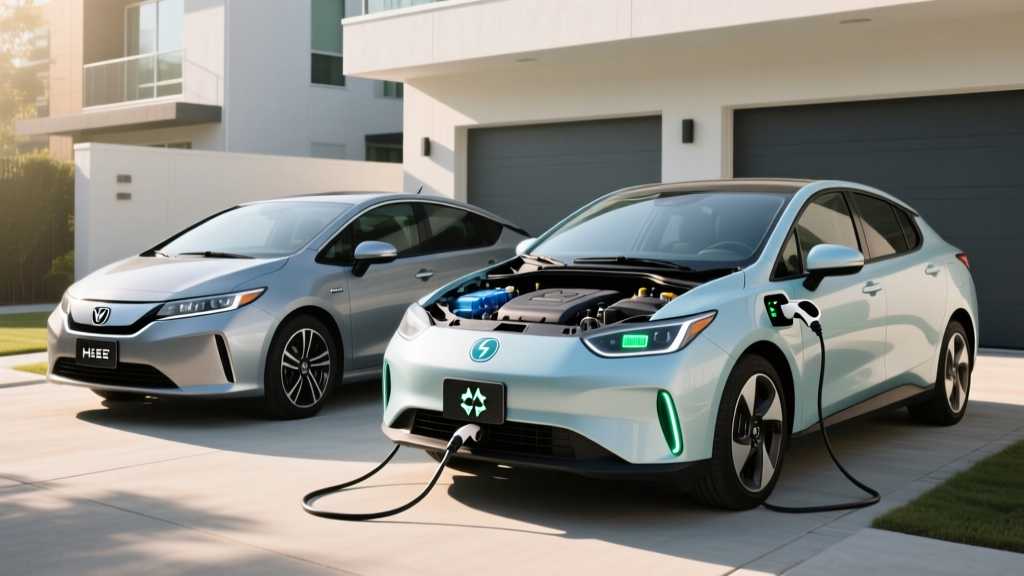
Both types use two power sources. The HEV simply never draws energy from an external electrical source, while the PHEV gives you the option to pre-fill the battery from the grid before driving.
Fuel Economy: Real-World MPG vs EPA Estimates
Hybrids consistently deliver their best efficiency in stop-and-go city driving, where regenerative braking recaptures the most energy and the electric motor handles low-speed propulsion. Highway MPG is often lower than city MPG — the opposite of most gas-only cars.
Here's how three popular 2026 models stack up on the EPA's fueleconomy.gov database:
| Model | Type | City MPG | Highway MPG | Combined MPG | Combined MPGe (PHEV) | Electric-Only Range |
|---|---|---|---|---|---|---|
| Toyota Prius (LE) | HEV | 57 | 56 | 57 | — | — |
| Toyota RAV4 Hybrid (XLE) | HEV | 41 | 38 | 39 | — | — |
| Toyota RAV4 Prime (SE) | PHEV | 40 (hybrid mode) | 36 (hybrid mode) | 38 | 94 MPGe | 42 miles |
| Hyundai Tucson PHEV (SEL) | PHEV | 36 (hybrid mode) | 35 (hybrid mode) | 35 | 80 MPGe | 33 miles |
Real-world caveat: HEVs routinely exceed their EPA city rating in mild weather with moderate driving because the EPA test cycle doesn't fully capture the benefit of frequent regenerative stops. The Prius LE, for example, can return 60+ MPG in suburban driving at 30–45 mph. However, sustained highway driving above 70 mph, cold weather (below 35°F), and aggressive acceleration will reduce those figures by 5–15%. PHEV electric-only range follows the same pattern: expect 85–90% of the EPA-rated miles in real-world mixed driving, and as little as 60–70% in freezing temperatures when cabin heating draws additional power.
PHEV Deep Dive: Electric-Only Range, Battery Size, and Charging
The PHEV's defining feature is its ability to cover daily commutes entirely on electricity, with the gasoline engine as a seamless backup for longer trips. Let's examine the two most popular PHEV platforms in 2026:
| Specification | Toyota RAV4 Prime | Hyundai Tucson PHEV |
|---|---|---|
| Battery (Usable) | 18.1 kWh (lithium-ion, NMC) | 13.8 kWh (lithium-ion, NMC) |
| EPA Electric-Only Range | 42 miles | 33 miles |
| Total Range (Electric + Gas) | ~600 miles | ~440 miles |
| Combined Horsepower | 302 hp (2.5L 4-cyl + 2 electric motors) | 261 hp (1.6L turbo 4-cyl + electric motor) |
| 0–60 mph | 5.7 seconds | 7.0 seconds |
| Level 1 Charging (120V) | ~12 hours (0–100%) | ~9 hours (0–100%) |
| Level 2 Charging (240V) | ~2.5 hours (0–100%) | ~2 hours (0–100%) |
| DC Fast Charging | No | No |
| MSRP (Starting) | $45,450 | $39,950 |
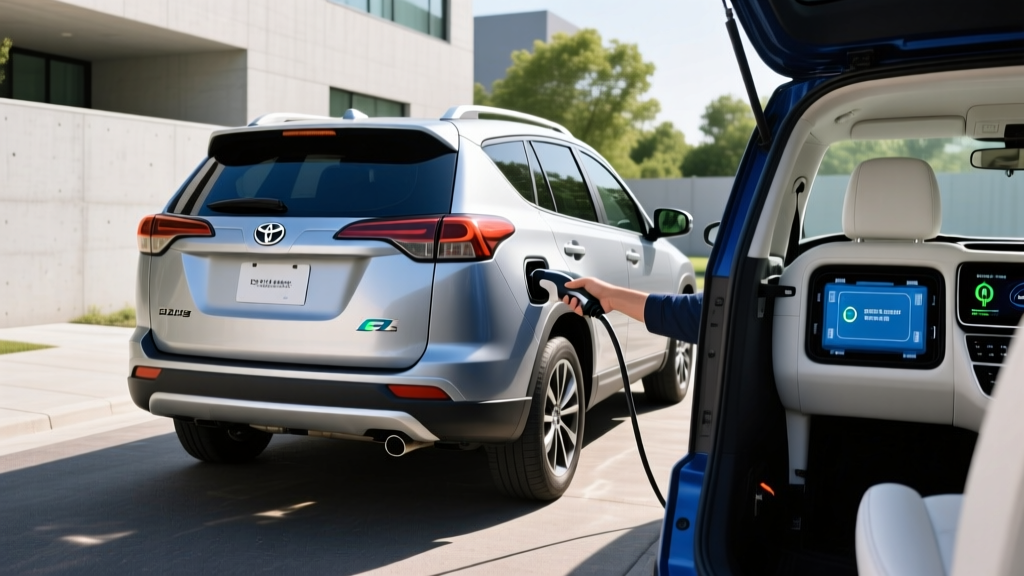
Charging reality check: Most PHEVs do not support DC fast charging. The RAV4 Prime and Tucson PHEV both charge exclusively via Level 1 (standard 120V outlet) or Level 2 (240V, requiring a home charging station). Because PHEV batteries are small (13–18 kWh), Level 2 charging fully replenishes them in 2–3 hours — adequate for overnight or workplace top-ups. If you need DC fast charging for road-trip flexibility, a full battery-electric vehicle (BEV) is the better choice.
Hybrid & PHEV Battery Warranty: What to Expect
Federal law mandates that hybrid and PHEV battery packs carry a minimum warranty of 8 years / 100,000 miles. In California Air Resources Board (CARB) states — which include CA, CO, CT, ME, MA, NJ, NY, OR, RI, VT, and WA — that extends to 10 years / 150,000 miles for emission-related components including the hybrid battery.
Toyota, Hyundai, and Kia all match or exceed these minimums. Real-world data from fleet studies shows modern nickel-metal-hydride (NiMH) and NMC lithium-ion hybrid batteries retaining 85–92% capacity after 150,000 miles. Full replacement costs, if needed out of warranty, range from $2,500–$5,500 depending on the model.
Hybrid vs PHEV vs Full EV: Which Fits Your Life?
Choosing between an HEV, PHEV, or BEV depends on three variables: your daily mileage, your charging access, and your willingness to manage plug-in routines.
Choose a Conventional Hybrid (HEV) If:
- You have no access to plug-in charging at home or work
- Your daily driving is under 50 miles but you take frequent road trips
- You want maximum MPG simplicity with zero behavior change
- You want the lowest purchase price among electrified options
Choose a Plug-In Hybrid (PHEV) If:
- You can install a Level 2 charger at home or have workplace charging
- Your commute is under 40 miles round-trip (most PHEVs cover this electrically)
- You want electric daily driving but gas-engine backup for road trips
- You may qualify for the §30D federal tax credit (up to $7,500)
Decision Framework: HEV vs PHEV vs BEV
- Daily miles < 30 + home charging: PHEV (electric commute, gas backup)
- Daily miles < 30 + no charging: HEV (57 MPG combined, no plug needed)
- Daily miles 30–100 + home charging: BEV (250–350 mi range, lowest running cost)
- Daily miles > 100 + frequent long trips: HEV or diesel — PHEV electric range is negligible here
- One-car household, mixed use: PHEV gives the most flexibility
Tax Credits: Does a Hybrid or PHEV Qualify?
Under IRS §30D rules current for the 2026 tax year, conventional hybrids (HEVs) do not qualify for any federal purchase tax credit. They are not plug-in vehicles and do not meet the statute's battery-capacity threshold.
PHEVs may qualify for up to $7,500, but eligibility is narrow and depends on three requirements:
- Battery sourcing: A percentage of critical minerals and battery components must be sourced from the U.S. or free-trade-agreement partners. This requirement has tightened annually since 2024. As of 2026, many PHEVs from Japanese and Korean automakers have partially compliant supply chains.
- MSRP cap: Vans, SUVs, and pickups must have an MSRP ≤ $80,000; sedans ≤ $55,000. The RAV4 Prime ($45,450) clears this threshold; some luxury PHEVs do not.
- Buyer income cap: Modified adjusted gross income (MAGI) must not exceed $300,000 (joint), $225,000 (head of household), or $150,000 (single).
Point-of-sale transfer: Eligible buyers can now transfer the credit to the dealer at purchase, reducing the out-of-pocket price immediately rather than waiting to claim it on their tax return. Confirm eligibility with your dealer and consult a tax professional — the IRS updates sourcing-compliance lists periodically.
Reliability, Battery Lifespan, and Long-Term Ownership Costs
Hybrid powertrains have a two-decade track record. The Toyota Prius, introduced in the U.S. for the 2001 model year, has demonstrated that hybrid battery packs routinely last 150,000–200,000+ miles before significant degradation. Modern lithium-ion packs in PHEVs are expected to follow a similar trajectory, though long-term fleet data is still accumulating.
Key reliability factors:
- Brake wear: Hybrids typically experience 30–50% less brake pad wear because regenerative braking handles most deceleration. Many owners report original brake pads lasting 80,000–100,000 miles.
- Engine longevity: The Atkinson-cycle engines used in most hybrids run lower peak loads and fewer cold starts (the electric motor handles initial movement), contributing to extended engine life.
- Transmission: Most Toyota and Hyundai hybrids use planetary gearsets (e-CVT) rather than belt-driven CVTs or traditional automatics, reducing mechanical complexity and failure points.
- Battery replacement cost: Out-of-warranty replacement runs $2,500–$5,500 depending on the model. Refurbished or aftermarket packs are increasingly available for $1,500–$3,000.
Pricing and Total Cost of Ownership: A Five-Year Snapshot
| Cost Factor | Toyota Prius (HEV) | RAV4 Prime (PHEV) | RAV4 Gas (AWD LE) |
|---|---|---|---|
| MSRP (approx.) | $29,450 | $45,450 | $32,900 |
| Federal Tax Credit | $0 | Up to $7,500* | $0 |
| Fuel / Electricity (5 yr) | ~$4,200 | ~$3,100 (if charging daily) | ~$8,100 |
| Maintenance (5 yr) | ~$2,400 | ~$2,200 | ~$3,500 |
| Insurance (5 yr avg) | ~$6,500 | ~$7,200 | ~$6,300 |
| Estimated Depreciation | ~$12,000 | ~$16,500 | ~$14,800 |
| 5-Year Total (approx.) | ~$34,550 | ~$38,950 | ~$45,600 |
*Tax credit eligibility depends on battery sourcing, buyer income, and MSRP caps. Verify at purchase.
The HEV wins on upfront price. The PHEV closes the gap substantially when the tax credit applies and home charging keeps electricity costs low. Both dramatically undercut the gas-only equivalent on fuel and maintenance.
Frequently Asked Questions
How many MPG does a hybrid car get in 2026?
The most efficient conventional hybrid, the 2026 Toyota Prius LE, achieves an EPA-rated 57 MPG combined (57 city / 56 highway). SUV hybrids like the RAV4 Hybrid return 39 MPG combined. Real-world city driving often exceeds these figures by 3–5 MPG thanks to regenerative braking, while sustained highway driving above 70 mph may reduce them by 5–10%.
How far can a PHEV go on electric power only?
The 2026 Toyota RAV4 Prime delivers an EPA-rated 42 miles of electric-only range. The Hyundai Tucson PHEV provides 33 miles. In mild weather at suburban speeds, expect to match or slightly exceed these numbers. In freezing temperatures or at sustained highway speeds, expect 25–30 miles and 22–25 miles respectively.
Do hybrid cars use only one distinct power source?
No. All hybrids — both HEV and PHEV — use two distinct power sources: a gasoline engine and an electric motor powered by a battery pack. The HEV recharges its battery solely through regenerative braking and the engine, while the PHEV can also recharge from an external electrical source (a wall outlet or charging station).
Is a hybrid battery reliable, and what does replacement cost?
Hybrid battery packs are among the most reliable components in the vehicle. Federal law requires a minimum warranty of 8 years / 100,000 miles (10 years / 150,000 miles in CARB states). Fleet data shows modern packs retaining 85%+ capacity at 150,000 miles. Out-of-warranty replacement costs $2,500–$5,500 depending on the model, with refurbished options available for less.
Does a hybrid qualify for any tax credit in 2026?
Conventional hybrids (HEVs) do not qualify for any federal purchase tax credit. Plug-in hybrids (PHEVs) may qualify for up to $7,500 under IRS §30D, subject to battery-sourcing requirements, MSRP caps ($80,000 for SUVs/trucks, $55,000 for sedans), and buyer income limits. The credit can be transferred to the dealer at point of sale. Always verify current eligibility on IRS.gov before purchasing.
Can I charge a conventional hybrid at home?
No. Conventional hybrids (HEVs) have no charging port. Their small battery (typically under 2 kWh) is recharged exclusively through regenerative braking and the gasoline engine. Only PHEVs have a charging port and can accept Level 1 or Level 2 power from the grid.
Should I buy an HEV, PHEV, or a full electric vehicle?
If you have reliable home or workplace charging and your daily commute is under 40 miles, a PHEV lets you drive electrically most days while keeping gas-engine range for road trips — and you may qualify for up to $7,500 in federal tax credits. If you have no charging access, an HEV delivers 40–57 MPG with zero behavioral change. If you can charge at home and rarely drive more than 250 miles in a day, a full BEV offers the lowest per-mile cost and the least maintenance.