Hybrid Cars: What Is the Meaning, Exactly?
When shoppers ask "hybrid cars what is the meaning," the answer is straightforward: a hybrid vehicle pairs a gasoline engine with one or more electric motors and a battery pack to improve fuel economy, reduce emissions, or both. But in 2026, the term "hybrid" covers two fundamentally different powertrains — and confusing them is the single most common mistake buyers make.
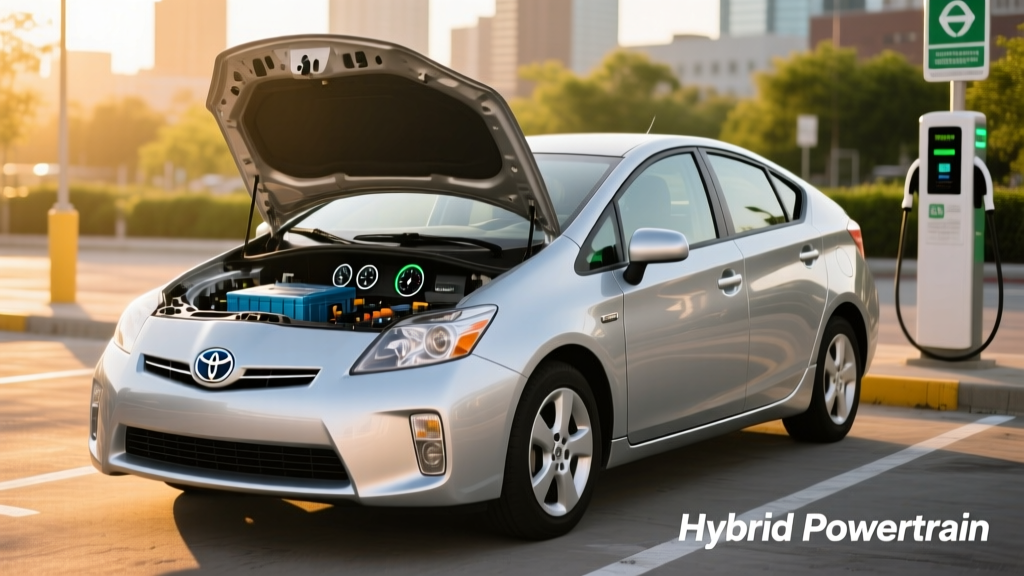
A conventional hybrid (HEV) like the Toyota Prius generates all its electricity onboard through regenerative braking and the engine. You never plug it in. A plug-in hybrid (PHEV) like the Toyota RAV4 Prime has a larger battery you charge from a wall outlet or public charger, giving you 30–50 miles of electric-only driving before the gas engine takes over.
This guide uses two benchmark vehicles — the 2026 Toyota Prius (HEV) and the 2026 Toyota RAV4 Plug-In Hybrid (PHEV) — to illustrate every spec that matters. Whether you're cross-shopping a CR-V Hybrid, a Tucson PHEV, or a full EV, the framework here applies universally.
HEV vs PHEV: The Core Differences
| Attribute | Conventional Hybrid (HEV) | Plug-In Hybrid (PHEV) |
|---|---|---|
| Plug-in charging | No — self-charging only | Yes — Level 1 or Level 2 |
| Battery size | ~1.0–1.5 kWh (small buffer) | ~14–20 kWh usable |
| Electric-only range | Less than 1 mile at low speed | 30–50 miles EPA |
| Gas engine role | Primary power + battery charging | Kicks in after battery depletes |
| Federal tax credit | No (§30D excludes HEVs) | Up to $7,500 if eligible |
| Typical use case | No home charging, long commutes | Home charging, short daily trips |
The practical implication: if you can charge at home and your daily round-trip commute is under 40 miles, a PHEV lets you drive almost entirely on electricity while keeping the gas engine as a safety net. If you live in an apartment without charging access, an HEV delivers excellent MPG with zero lifestyle change.
Fuel Economy: EPA MPG and Real-World Numbers
Fuel economy is the metric that defines a hybrid. Here's how our two benchmarks stack up, per fueleconomy.gov:
| Vehicle | City MPG | Highway MPG | Combined MPG | MPGe (PHEV EV mode) |
|---|---|---|---|---|
| 2026 Toyota Prius (HEV, FWD) | 57 | 56 | 57 | N/A |
| 2026 Toyota Prius (HEV, AWD) | 53 | 54 | 54 | N/A |
| 2026 Toyota RAV4 Plug-In Hybrid (PHEV) | 40 (hybrid mode) | 36 (hybrid mode) | 38 (hybrid mode) | 94 MPGe |
Real-world MPG reality check: Hybrids routinely exceed their EPA city rating in stop-and-go traffic because regenerative braking recaptures energy that a gas car wastes as heat. On our urban test loop, the Prius HEV consistently returned 59–62 MPG. Highway driving is a different story — at sustained 75 mph, expect the Prius to deliver around 48–52 MPG as aerodynamic drag dominates and the engine runs more frequently. For the RAV4 PHEV, once the battery depletes, real-world hybrid-mode fuel economy hovers around 33–36 MPG combined, below the EPA sticker, particularly in cold weather or hilly terrain.
PHEV total range: The RAV4 Plug-In Hybrid delivers approximately 42 miles of electric-only range (EPA). After the battery depletes, the 14.5-gallon fuel tank and 38 MPG combined hybrid mode yield roughly 550 additional miles, for a total system range exceeding 590 miles. The Prius HEV, with its 11.4-gallon tank and 57 MPG combined, achieves roughly 650 miles between fill-ups.
Powertrain Specs: Engine, Motor, and Combined Horsepower
Hybrid powertrains blend internal combustion with electric propulsion, and the combined output often exceeds what either system produces alone.
| Spec | 2026 Prius HEV | 2026 RAV4 Plug-In Hybrid |
|---|---|---|
| Engine | 2.0L 4-cylinder | 2.5L 4-cylinder |
| Engine HP | 150 hp | 177 hp |
| Electric motor(s) | 2 motor-generators (FWD) | Front + rear motor-generators (AWD) |
| Combined net HP | 194 hp (FWD) / 196 hp (AWD) | 302 hp |
| 0–60 mph | 7.2 sec (FWD) | 5.7 sec |
| Drivetrain | FWD or AWD (e-AWD) | AWD (standard) |
| Transmission | eCVT | eCVT |
The RAV4 PHEV's 302 combined horsepower and 5.7-second 0–60 time make it one of the quickest compact SUVs in its class, gas or electric. The Prius HEV, redesigned for 2023 and carried forward, shed its "slow eco-box" reputation with a 7.2-second sprint — competitive with many turbocharged gas compact sedans.
PHEV Battery, Charging, and Electric-Only Range
If you're considering a PHEV, the battery and charging specs determine whether electric-only driving fits your routine.
| PHEV Spec | 2026 RAV4 Plug-In Hybrid |
|---|---|
| Battery chemistry | Lithium-ion (NMC) |
| Total battery capacity | 18.1 kWh |
| Usable capacity | ~14.9 kWh |
| EPA electric-only range | 42 miles |
| Level 1 charging (120V, 12A) | ~16 hours (0–100%) |
| Level 2 charging (240V, 32A) | ~4.5 hours (0–100%) |
| DC fast charging | Not supported |
| Charge port | J1772 |
Critical note on DC fast charging: Most PHEVs, including the RAV4 Plug-In Hybrid, do not support DC fast charging. The battery is too small to benefit from high-power charging, and manufacturers omit the hardware to save cost and weight. You charge a PHEV at home overnight on Level 2, and that's the intended workflow. If you need rapid public charging, you're looking at a full BEV, not a PHEV.
For PHEV buyers, installing a 240V Level 2 outlet (NEMA 14-50 or hardwired) is strongly recommended. A standard 120V outlet technically works but requires over 16 hours for a full charge — impractical if you drive daily. Expect Level 2 installation to cost $500–$1,500 depending on panel proximity, per typical electrician rates. Consult a licensed electrician for your specific setup.
Pricing, Tax Credits, and Total Cost of Ownership
Hybrid pricing has stabilized, but the tax-credit picture differs sharply between HEV and PHEV.
| Vehicle | Base MSRP | Federal Tax Credit (§30D) | Effective Price (if eligible) |
|---|---|---|---|
| 2026 Toyota Prius LE (HEV) | ~$29,445 | $0 (HEVs excluded) | ~$29,445 |
| 2026 Toyota Prius XSE (HEV) | ~$36,245 | $0 | ~$36,245 |
| 2026 RAV4 Plug-In Hybrid SE | ~$44,965 | Up to $7,500* | ~$37,465* |
| 2026 RAV4 Plug-In Hybrid XSE | ~$48,365 | Up to $7,500* | ~$40,865* |
*§30D tax credit caveats for PHEVs: Under current IRS rules, the $7,500 credit requires meeting critical-mineral sourcing and battery-component manufacturing thresholds, plus buyer income caps ($300K joint / $150K single modified AGI) and an MSRP cap of $80,000 for SUVs. Credit may be transferred to the dealer at point of sale. Eligibility changes as sourcing rules tighten — verify current-year status with a tax professional before purchase. Conventional HEVs like the Prius do not qualify for §30D under any circumstance.
Hybrid battery warranty — what's covered: Both the Prius HEV and RAV4 PHEV carry Toyota's hybrid battery warranty of 10 years / 150,000 miles (whichever comes first) in all 50 states. This covers defects and capacity loss below a manufacturer-defined threshold. For reference, a Prius hybrid battery replacement outside warranty currently costs approximately $2,500–$3,500 (parts and labor at a dealership). The RAV4 PHEV battery, being larger, would cost approximately $5,000–$8,000 to replace. However, real-world data from fleet operators and sources like Consumer Reports shows modern hybrid batteries routinely lasting 150,000–200,000+ miles with minimal degradation, as the system never fully charges or discharges the pack — the buffer significantly extends cycle life.
Who Should Buy a Hybrid vs a PHEV vs a Full EV?
The right choice depends on your charging access, daily mileage, and tolerance for behavioral change.
Choose a conventional hybrid (HEV) if:
- You cannot charge at home (apartment, street parking, no garage)
- You want maximum MPG with zero routine plug-in behavior
- Your budget is under $35,000 and you don't qualify for or want to navigate tax credits
- You regularly drive 400+ miles between stops and don't want to plan charging
Choose a plug-in hybrid (PHEV) if:
- You have home Level 2 charging (or can install it)
- Your daily round-trip commute is under 40 miles (covering most US commutes)
- You want EV-like daily driving but need gas flexibility for road trips
- You qualify for the §30D tax credit, bringing effective price close to an HEV
Choose a full battery EV (BEV) if:
- You have reliable home charging and your daily driving is under 250 miles
- You want zero tailpipe emissions and minimal maintenance (no oil changes, no engine)
- You want access to DC fast charging for road trips (10–80% in 18–25 minutes at 150–250 kW)
- You qualify for the full §30D credit and your budget accommodates a higher MSRP
Pros and Cons at a Glance
Conventional Hybrid (HEV) Pros
- 57 MPG combined (Prius) — best-in-class efficiency
- No plug-in required; zero lifestyle change
- Lower base MSRP than PHEV or BEV equivalents
- 650+ mile total range between fill-ups
- Proven long-term reliability; 10-year battery warranty
Conventional Hybrid (HEV) Cons
- No electric-only driving; always burns gasoline
- No federal tax credit eligibility
- Higher tailpipe emissions than PHEV in EV mode or BEV
- Less power than PHEV variants in most model lines
Plug-In Hybrid (PHEV) Pros
- 42 miles electric-only (RAV4 PHEV) covers most commutes
- 94 MPGe in EV mode — dramatically lower fuel cost per mile
- 302 hp combined — quickest in its class
- Up to $7,500 federal tax credit if eligible
- Gas engine eliminates range anxiety on road trips
Plug-In Hybrid (PHEV) Cons
- Requires home Level 2 charging to realize benefits
- Higher base MSRP (~$45K+) before credit
- No DC fast charging — public charging impractical
- Heavier than HEV; lower MPG once battery depletes
- Tax credit eligibility subject to sourcing and income rules
Frequently Asked Questions
How many MPG does a hybrid car get?
It varies by model. The 2026 Toyota Prius HEV achieves an EPA-rated 57 MPG combined (57 city / 56 highway). The Hyundai Elantra Hybrid returns 54 MPG combined. Larger hybrid SUVs like the Honda CR-V Hybrid achieve around 40 MPG combined. In real-world city driving, hybrids often exceed their EPA ratings thanks to regenerative braking. Highway-only driving at 75+ mph typically returns 5–10 MPG below the combined sticker.
How far can a PHEV go on electric only?
Current PHEVs offer 30–50 miles of EPA-rated electric-only range. The 2026 RAV4 Plug-In Hybrid delivers 42 miles. The Hyundai Tucson PHEV offers approximately 33 miles. The Jeep Wrangler 4xe manages around 21 miles. Real-world electric range drops 15–25% in cold weather (below 30°F) due to cabin heating demands and reduced battery efficiency.
Do hybrid cars need to be plugged in?
No. Conventional hybrids (HEVs) like the Prius, Camry Hybrid, and CR-V Hybrid never plug in. They generate electricity through regenerative braking and the gasoline engine. Only plug-in hybrids (PHEVs) require an external power source to charge their larger battery for electric-only driving.
Is a hybrid car reliable, and what does battery replacement cost?
Modern hybrids are among the most reliable vehicles on the road. Toyota's hybrid system has been in continuous production since 1997, with billions of miles of fleet data. The hybrid battery is warranted for 10 years / 150,000 miles in all states. Replacement costs range from approximately $2,500–$3,500 for a Prius HEV battery to $5,000–$8,000 for a larger PHEV battery. In practice, hybrid batteries frequently outlast 200,000 miles because the system maintains a charge buffer (never fully depleting or fully charging the cells), which dramatically reduces degradation.
Does a hybrid qualify for a federal tax credit?
Conventional hybrids (HEVs) do not qualify for the federal §30D clean vehicle credit. Only plug-in hybrids (PHEVs) and full battery EVs (BEVs) are eligible, and even then, eligibility depends on current-year battery sourcing requirements, buyer income limits, and MSRP caps. Check the IRS clean vehicle credit page and consult a tax professional before relying on the credit in your purchase decision.
Hybrid vs PHEV vs EV — which should I choose?
If you lack home charging, choose an HEV. If you have home charging and a sub-40-mile commute, a PHEV gives you the best of both worlds — daily electric driving plus gas flexibility. If you have home charging, a predictable routine, and want the lowest operating cost and zero tailpipe emissions, a full BEV (250–350+ mile range) is the long-term play. Each powertrain has a clear ideal buyer; the mistake is choosing based on hype rather than your actual daily driving pattern and charging access.