If you've been researching fuel-efficient vehicles, you've likely asked: hybrid cars, how does it work? The answer depends on which type of hybrid you're considering. In 2026, the hybrid market has matured into two distinct categories — conventional hybrids (HEVs) and plug-in hybrids (PHEVs) — each with different powertrains, fuel economy profiles, charging needs, and tax-credit eligibility. This guide explains the engineering behind both, with real-world MPG data, battery longevity facts, and a practical framework to decide which (if either) beats a full EV for your situation.
The Two Types of Hybrid Powertrains Explained
Conventional Hybrid (HEV)
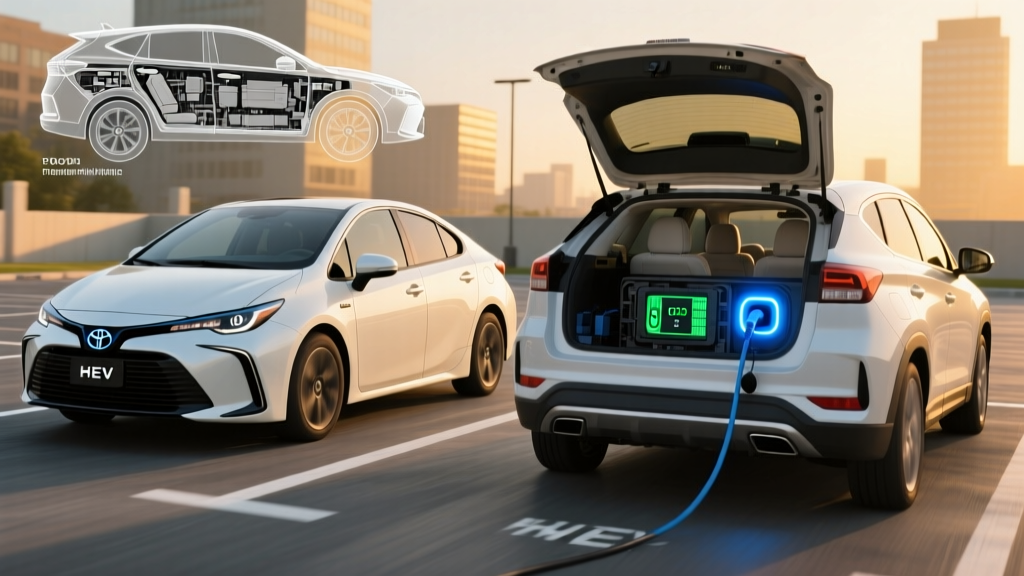
A conventional hybrid pairs a gasoline engine with a small electric motor and a battery typically between 1.0 and 2.0 kWh. The battery charges exclusively through regenerative braking and the engine — you never plug it in. The electric motor assists during acceleration and enables brief electric-only driving at low speeds (usually under 1 mile). Examples: Toyota Prius, Honda Accord Hybrid, Hyundai Tucson Hybrid.
Plug-In Hybrid (PHEV)
A PHEV uses a larger battery — typically 13 to 25 kWh — that you plug in to charge (Level 1 or Level 2). It delivers meaningful electric-only range (25–50+ miles) before the gas engine engages. Once the battery depletes, it operates like a conventional hybrid. Examples: Toyota RAV4 Prime, Jeep Wrangler 4xe, Hyundai Tucson PHEV.
Both architectures use a power-split device or clutch system to blend power from the engine and motor seamlessly. The key difference is energy capacity: an HEV's tiny battery provides short bursts of electric assist, while a PHEV's larger pack enables genuine daily electric commuting.
How Hybrid Powertrains Actually Work: The Engineering
At the core of most modern hybrids is a power-split device (often a planetary gearset) that continuously varies the ratio of power delivered by the engine versus the electric motor. Here's the sequence:
- Starting from stop: The electric motor propels the vehicle alone, drawing from the battery. The engine stays off.
- Light acceleration: The motor handles most of the load; the engine may remain off or run at its most efficient RPM.
- Hard acceleration: Both engine and motor deliver combined power for maximum output.
- Cruising: The engine runs at its optimal efficiency point, with excess energy diverted to charge the battery via a generator.
- Braking and deceleration: The motor reverses role, becoming a generator that captures kinetic energy and stores it in the battery — this is regenerative braking.
This system eliminates the inefficiency of a conventional gas car, where the engine operates across a wide RPM range regardless of efficiency. A hybrid keeps the engine near its sweet spot (typically 2,000–3,000 RPM under moderate load) and supplements with electric power when needed.
Fuel Economy: EPA MPG and Real-World Results
Hybrid fuel economy varies dramatically by model, but here's how several popular 2026 HEVs and PHEVs compare on the official EPA cycle:
| Model (2026) | Type | City MPG | Highway MPG | Combined MPG | PHEV EV Range |
|---|---|---|---|---|---|
| Toyota Prius (HEV) | HEV | 57 | 56 | 57 | — |
| Toyota Prius PHEV | PHEV | 52 (hybrid mode) | 48 | 50 | 44 mi |
| Honda Accord Hybrid | HEV | 51 | 44 | 48 | — |
| Toyota RAV4 Hybrid | HEV | 41 | 38 | 39 | — |
| Toyota RAV4 PHEV (Prime) | PHEV | 40 (hybrid mode) | 36 | 38 | 42 mi |
| Hyundai Tucson Hybrid | HEV | 38 | 38 | 38 | — |
| Hyundai Tucson PHEV | PHEV | 35 (hybrid mode) | 35 | 35 | 33 mi |
| Jeep Wrangler 4xe | PHEV | 20 (hybrid mode) | 20 | 20 | 22 mi |
Real-World MPG vs. EPA Sticker
HEVs often exceed EPA city ratings in stop-and-go traffic because regenerative braking captures more energy at low speeds. On highway-only trips, HEVs typically fall 2–5 MPG below their combined rating. PHEVs are highly variable: if you charge daily and drive under the EV range, your effective "MPG" can be 100+ MPGe. If you never plug in, you'll get only the hybrid-mode MPG (often 5–10 MPG less than a comparable HEV due to the heavier battery).
PHEV Electric-Only Range and Charging Details
For PHEV buyers, the electric-only range is the headline number. Here's what to expect from the larger-battery models in 2026:
| Model | Battery (kWh) | EV Range (mi) | Total Range (mi) | L2 Charge Time | DC Fast Charge? |
|---|---|---|---|---|---|
| Toyota Prius PHEV | 13.6 | 44 | ~510 | ~4 hrs (3.3 kW) | No |
| Toyota RAV4 PHEV | 18.1 | 42 | ~520 | ~2.5 hrs (6.6 kW) | No |
| Hyundai Tucson PHEV | 13.8 | 33 | ~400 | ~2 hrs (7.2 kW) | No |
| Chrysler Pacifica PHEV | 16.0 | 32 | ~460 | ~2 hrs (6.6 kW) | No |
| Jeep Wrangler 4xe | 17.3 | 22 | ~370 | ~2 hrs (6.6 kW) | No |
A critical point: virtually no PHEVs support DC fast charging. The batteries are too small to absorb high charge rates safely, and manufacturers have opted for Level 2 (240V) AC charging only. Most PHEVs charge fully overnight on a standard 120V outlet (Level 1) in 8–14 hours, or in 2–4 hours on a Level 2 home charger.
Powertrain Output: Combined Horsepower
Hybrid systems don't just save fuel — they often deliver more combined power than their gas-only counterparts:
- Toyota Prius HEV: 194 hp (2.0L 4-cyl + motor)
- Toyota Prius PHEV: 220 hp combined
- Honda Accord Hybrid: 204 hp (2.0L + dual motors)
- Toyota RAV4 Hybrid: 219 hp (2.5L + 3 motors, AWD)
- Toyota RAV4 PHEV: 302 hp — the fastest RAV4 in the lineup
- Jeep Wrangler 4xe: 375 hp / 470 lb-ft (2.0L turbo + motor)
The RAV4 PHEV's 302 hp is a perfect example of hybrid advantage: the electric motor's instant torque fills in the gaps during gear shifts and low-RPM operation, producing a combined output that neither the engine nor motor could achieve alone.
Pricing, Tax Credits, and Incentives
Hybrid pricing spans a wide range. Conventional HEVs typically add $1,000–$2,500 over a gas-only trim, while PHEVs command a $5,000–$10,000 premium due to the larger battery:
- Toyota Prius HEV: from ~$29,500 MSRP
- Toyota Prius PHEV: from ~$34,000 MSRP
- Toyota RAV4 Hybrid: from ~$33,500 MSRP
- Toyota RAV4 PHEV: from ~$44,500 MSRP
- Hyundai Tucson PHEV: from ~$39,500 MSRP
Federal Tax Credit for PHEVs (§30D)
Conventional HEVs do not qualify for federal EV tax credits. PHEVs may qualify for up to $7,500 under IRS §30D Clean Vehicle Credit, but eligibility is strict in 2026:
- Battery capacity must be ≥7 kWh (most PHEVs qualify)
- MSRP cap: $55,000 for sedans, $80,000 for SUVs/vans/pickups
- Buyer income cap: $150K single / $300K joint (modified AGI)
- Battery components and critical minerals must meet phased-in domestic sourcing thresholds
- Credit can be transferred to the dealer as a point-of-sale rebate
Important: Several popular PHEVs (including some Toyota and Jeep models) have lost partial or full credit eligibility due to battery-sourcing rules. Always verify current status on fueleconomy.gov before purchasing. Consult a tax professional for your specific situation.
Battery Longevity, Warranty, and Replacement Cost
Hybrid Battery Warranty Standards
Federal law mandates that hybrid and EV battery warranties cover at least 8 years / 100,000 miles. In California Air Resources Board (CARB) states, the requirement extends to 10 years / 150,000 miles. Most manufacturers match or exceed these minimums:
- Toyota: 10 years / 150,000 miles (nationwide, all 2026 hybrids)
- Honda: 8 years / 100,000 miles (10/150K in CARB states)
- Hyundai/Kia: 10 years / 100,000 miles (original owner)
Regarding degradation: conventional hybrid batteries are small and rarely cycle deeply, so they tend to last the life of the vehicle. Toyota's nickel-metal hydride (NiMH) and newer lithium-ion packs have a well-documented track record — many Prius taxis have exceeded 300,000 miles on the original battery.
Replacement cost if needed out of warranty:
- HEV battery (Prius, Accord Hybrid): $2,000–$4,000 installed
- PHEV battery (RAV4 Prime, Tucson PHEV): $6,000–$10,000 installed
Third-party refurbishers offer reconditioned hybrid batteries for 40–60% less than OEM replacements, a viable option for older vehicles.
Reliability: What the Data Shows
Hybrids consistently rank among the most reliable vehicle categories. According to long-term reliability surveys, Toyota's hybrid system is one of the least failure-prone powertrains in the industry — simpler in some ways than a conventional automatic transmission (no torque converter, fewer friction clutch packs). The planetary gearset in Toyota's e-CVT has no belts or pulleys to wear.
PHEVs introduce slightly more complexity (larger battery, onboard charger, charge port), but failure rates remain low for established models. The Jeep Wrangler 4xe has faced more reported issues than Toyota or Hyundai PHEVs, largely related to software and electrical integration rather than the battery itself.
Hybrid vs. PHEV vs. Full EV: Which Fits You?
Choose a Conventional Hybrid (HEV) If:
- You have no access to home or workplace charging
- You want maximum fuel efficiency with zero behavior change
- Your budget is tight (lowest upfront premium over gas)
- You drive a mix of city and highway with no predictable short commute
Choose a Plug-In Hybrid (PHEV) If:
- You can charge at home (Level 1 or 2) and your commute is under 30–40 miles round trip
- You want electric daily driving but need gas flexibility for road trips
- You live in a region with frequent charging deserts or extreme cold
- You want to reduce fuel consumption without full EV commitment
Choose a Full EV (BEV) If:
- You have reliable home Level 2 charging
- Your daily driving is within the vehicle's real-world range (with cold-weather buffer)
- You want the lowest per-mile fuel cost and minimal maintenance
- You qualify for the full $7,500 federal credit, narrowing the price gap
Hybrid Pros
- No charging infrastructure needed (HEV)
- 30–50% better city MPG vs. gas-only
- Proven long-term reliability
- Lower battery replacement risk vs. BEV
- No range anxiety in any climate
Hybrid Cons
- Still burns gasoline (maintenance, emissions, fuel cost)
- Higher upfront cost than gas-only equivalent
- PHEVs lose efficiency if never plugged in
- No federal credit for HEVs; PHEV credit uncertain
- Two powertrains to maintain long-term
Frequently Asked Questions
How many MPG does a hybrid get?
Conventional hybrids range from 35–57 MPG combined depending on the model. The 2026 Toyota Prius leads at 57 MPG combined. PHEVs achieve similar MPG in hybrid mode after the battery is depleted, but effective fuel consumption is far lower if you charge regularly and stay within EV range.
How far can a PHEV go on electric only?
Most 2026 PHEVs deliver 22–44 miles of electric-only range. The Toyota Prius PHEV leads at 44 miles. This covers the majority of American daily commutes (the average is ~35 miles round trip per FHWA data). Once depleted, the vehicle continues as a conventional hybrid with full gas range.
Do conventional hybrids need to be plugged in?
No. Conventional hybrids (HEVs) charge their battery entirely through regenerative braking and the gasoline engine. You fuel them like any other gas car. Only PHEVs require plugging in to access their electric-only range.
Is a hybrid reliable, and what does battery replacement cost?
Hybrids are among the most reliable vehicles on the road, particularly Toyota and Honda models. Hybrid batteries are warranted for 8–10 years / 100,000–150,000 miles. Out-of-warranty replacement runs $2,000–$4,000 for HEVs and $6,000–$10,000 for PHEVs, but many batteries last well beyond 200,000 miles.
Does a hybrid qualify for any tax credit?
Conventional hybrids (HEVs) do not qualify for any federal tax credit. PHEVs may qualify for up to $7,500 under IRS §30D, subject to MSRP caps, buyer income limits, and battery-sourcing requirements. Eligibility changes frequently — verify on fueleconomy.gov and consult a tax professional.
Hybrid vs. PHEV vs. EV — which is best for me?
If you can't charge at home, choose an HEV. If you can charge at home and commute under 40 miles but take road trips, a PHEV offers the best of both. If you have home charging, a predictable commute, and want the lowest operating cost, a full BEV is the most economical long-term choice.
Do hybrids cost more to maintain than gas cars?
Generally no. Hybrids still require oil changes, brake service (though regenerative braking extends pad life significantly), and standard maintenance. The electric motor and power-split device have proven highly durable. The only unique cost risk is eventual battery replacement, which is rare within the warranty period.