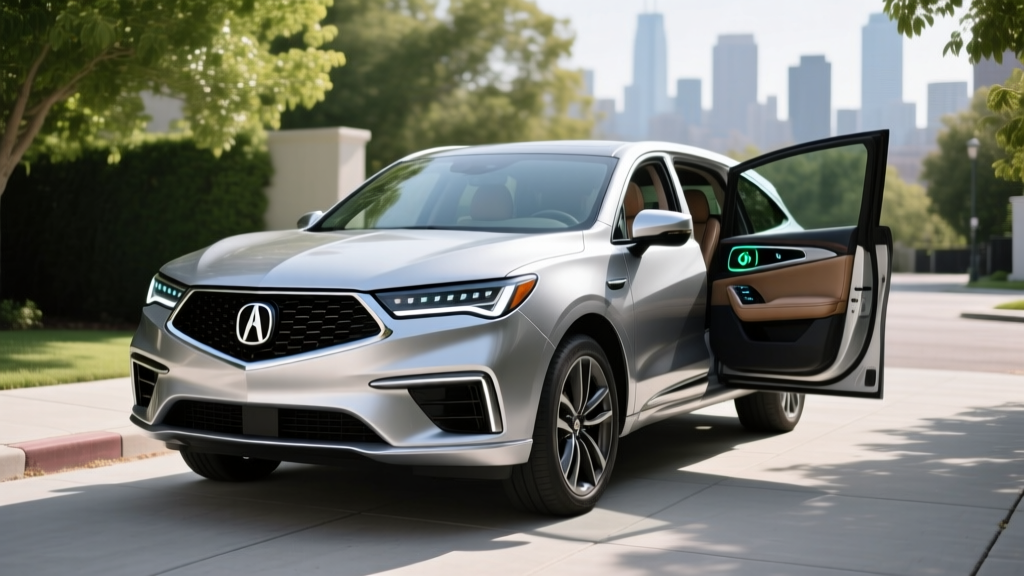
The Acura MDX sits in a crowded midsize luxury SUV segment, and buyers increasingly ask whether a hybrid version exists. For 2026, Acura continues the MDX exclusively as a conventional hybrid (HEV) — not a plug-in hybrid (PHEV). That means no charging cord, no electric-only range, and no federal EV tax credit. But it also means a simpler ownership proposition: you fill up at the pump, and the hybrid system recovers energy during braking to boost fuel economy.
This guide breaks down the 2026 Acura MDX hybrid powertrain, EPA fuel economy figures, real-world efficiency expectations, battery longevity, pricing, and whether it makes sense versus a full EV or a gas-only competitor.
Does a Hybrid Acura MDX Actually Exist for 2026?
Yes — but with an important caveat. The 2026 Acura MDX uses a mild-hybrid-assisted turbocharged V6 powertrain. Acura calls this a "hybrid" in marketing, but it's a conventional hybrid (HEV) system that cannot be plugged in. There is no plug-in hybrid (PHEV) variant of the MDX for the 2026 model year.
HEV vs PHEV: What's the Difference?
| Feature | Conventional Hybrid (HEV) | Plug-in Hybrid (PHEV) |
|---|---|---|
| Plugs in? | No | Yes |
| Electric-only range | None (motor assists engine) | Typically 20-45 miles |
| Battery size | ~1-2 kWh | ~15-30 kWh |
| Federal tax credit | No | Potentially up to $7,500 (§30D) |
| Refueling | Gas only | Gas + electricity |
If you're searching for a "hybrid Acura MDX" expecting plug-in capability, you'll need to adjust expectations. The MDX HEV is designed for drivers who want improved fuel economy without changing their refueling habits.
2026 Acura MDX Hybrid Powertrain Specs
The 2026 MDX pairs a 3.5-liter turbocharged V6 with a hybrid-assist electric motor integrated into the transmission. Here's the complete powertrain breakdown:
| Specification | 2026 Acura MDX Hybrid |
|---|---|
| Engine | 3.5L Turbocharged V6 |
| Combined Horsepower | 355 hp |
| Combined Torque | 350 lb-ft |
| Transmission | 10-speed automatic |
| Drivetrain | SH-AWD (standard) |
| 0-60 mph | ~6.0 seconds |
| Hybrid Battery | ~1.5 kWh (lithium-ion) |
| Towing Capacity | 5,000 lbs |
The SH-AWD (Super Handling All-Wheel Drive) system uses a rear-axle electric motor to torque-vector power between the rear wheels. This isn't just a fuel-economy play — it genuinely improves cornering grip and all-weather traction, which matters for buyers in snow-belt states.
Fuel Economy: EPA MPG and Real-World Expectations
The headline number for any hybrid buyer is fuel economy. Here's what the EPA rates the 2026 MDX Hybrid at, per fueleconomy.gov:
| Driving Cycle | EPA MPG |
|---|---|
| City | 26 MPG |
| Highway | 28 MPG |
| Combined | 27 MPG |
Real-World MPG: What to Actually Expect
EPA city ratings for hybrids tend to be generous because the test cycle includes frequent stops where regenerative braking recovers energy. In real-world driving:
- City / suburban (stop-and-go): Expect 25-28 MPG. Regenerative braking shines here, and some drivers report exceeding the EPA city number in light traffic.
- Highway (70+ mph sustained): Expect 24-26 MPG. Hybrids lose their advantage at sustained high speeds where the electric motor provides minimal assist and aerodynamic drag dominates.
- Cold weather (below 30°F): Expect a 10-15% drop to roughly 22-24 MPG combined. The engine runs more frequently to heat the cabin and maintain battery temperature.
- Mixed driving (realistic annual average): Most owners report 25-27 MPG combined, which aligns closely with the EPA figure.
For comparison, the gas-only 2026 Acura MDX (non-hybrid, 2.0L turbo 4-cylinder) earns an EPA 22 MPG combined. The hybrid's 27 MPG represents a meaningful 23% improvement — roughly 75 fewer gallons per year at 12,000 miles driven, or about $225-$300 in annual fuel savings depending on local gas prices.
Pricing and Tax Credit Eligibility
The 2026 Acura MDX Hybrid is positioned as a premium trim within the MDX lineup. Here's the MSRP breakdown by trim:
| Trim Level | MSRP |
|---|---|
| MDX Hybrid (base SH-AWD) | $56,200 |
| MDX Hybrid Technology Package | $59,400 |
| MDX Hybrid A-Spec | $61,800 |
| MDX Hybrid Advance | $65,500 |
Does the Hybrid Acura MDX Qualify for a Federal Tax Credit?
No. The 2026 MDX Hybrid is a conventional hybrid (HEV), not a plug-in hybrid or battery-electric vehicle. It does not qualify for the IRS §30D Clean Vehicle Credit (up to $7,500 for new PHEVs and EVs). It also does not qualify for the §25E Used Clean Vehicle Credit.
Some states offer their own incentives for conventional hybrids, but these are increasingly rare as state programs shift focus to PHEVs and BEVs. Check your state's environmental or energy agency website for current programs. A few states historically offered hybrid rebates (Oregon, Colorado at various points), but most have sunset these as PHEV and EV options have proliferated.
Battery Warranty Coverage
Acura covers the MDX Hybrid's lithium-ion battery pack with a 10-year / 150,000-mile warranty (8 years / 100,000 miles in states that don't follow California emissions standards). This covers defects and capacity loss below a specified threshold. The hybrid system components, including the electric motor and power control unit, carry the same coverage period.
Battery Longevity and Replacement Cost
The ~1.5 kWh hybrid battery in the MDX is far smaller than an EV battery (typically 60-100 kWh), and it operates within a narrow state-of-charge window — typically between 40% and 80%. This shallow cycling dramatically reduces stress on the cells.
How Long Will the Hybrid Battery Last?
Based on data from Honda/Acura hybrid platforms (the MDX shares architecture with the Honda Pilot Hybrid), hybrid batteries routinely last 150,000-200,000 miles before significant degradation. Many first-generation Honda hybrids from the mid-2000s have exceeded 200,000 miles on original battery packs.
The key factors affecting hybrid battery lifespan:
- Temperature extremes: Prolonged exposure to heat above 100°F accelerates degradation more than cold. Garage parking helps in hot climates.
- Driving patterns: Frequent short trips with many charge/discharge cycles are actually ideal for hybrid battery health. Long highway drives with minimal cycling are fine but provide less benefit.
- Time: Calendar aging occurs regardless of mileage. Expect some capacity loss after 10-12 years even at low mileage.
Hybrid Battery Replacement Cost
If the hybrid battery does fail outside warranty, replacement costs for the MDX Hybrid battery pack typically range from $2,000 to $4,000 (parts and labor). This is substantially less than an EV battery replacement ($10,000-$20,000+) because the pack is much smaller. Refurbished or aftermarket hybrid battery packs are increasingly available for $1,200-$2,500 from third-party suppliers.
Hybrid MDX vs. Full EV vs. Gas: Which Should You Choose?
The decision between a hybrid, plug-in hybrid, full EV, or gas-only SUV depends on your driving patterns, charging access, and budget. Here's a practical framework:
Choose the Hybrid MDX If:
- You don't have reliable home or workplace charging access
- You regularly drive 300+ miles between stops (road trips, rural routes)
- You want better fuel economy without changing any habits
- You need a three-row SUV with 5,000-lb towing capacity
- You live in an area with limited DC fast-charging infrastructure
Consider a Full EV Instead If:
- You can install a Level 2 home charger (240V)
- Your daily commute is under 80 miles round-trip
- You want to eliminate gasoline costs entirely
- You qualify for the $7,500 federal tax credit (§30D) on eligible EVs
- You prioritize lowest per-mile "fuel" cost (electricity is typically $0.04-$0.06/mile vs. $0.18-$0.24/mile for gas)
A competitive full-EV alternative in this segment is the 2026 BMW iX or the 2026 Genesis Electrified GV70, both offering 250-300 miles of EPA range, three-row or two-row layouts, and federal tax credit eligibility. However, neither matches the MDX's combination of SH-AWD, towing capacity, and price point.
Annual Cost Comparison: Hybrid MDX vs. Gas MDX vs. Comparable EV
| Metric | MDX Hybrid (27 MPG) | MDX Gas (22 MPG) | EV (3 mi/kWh, $0.15/kWh) |
|---|---|---|---|
| Annual fuel cost (12,000 mi) | $1,556 | $1,909 | $600 |
| 5-year fuel cost | $7,780 | $9,545 | $3,000 |
| Oil changes/year | 1-2 | 2-3 | 0 |
| Federal tax credit | $0 | $0 | Up to $7,500* |
*EV tax credit subject to IRS §30D eligibility: buyer income caps ($150K single / $300K joint), MSRP caps ($80K for SUVs), battery sourcing requirements. Verify at irs.gov.
Reliability and Safety Ratings
Acura (Honda's luxury division) has a strong long-term reliability reputation, and the MDX platform has been in production since 2001 with continuous refinement. The hybrid system adds complexity but uses proven Honda hybrid components shared across the Accord Hybrid and CR-V Hybrid — two of the highest-volume hybrid nameplates in the US.
The National Highway Traffic Safety Administration (NHTSA) rates the MDX with a 5-star overall safety score, and the Insurance Institute for Highway Safety (IIHS) has awarded it a Top Safety Pick+ designation in recent model years. The hybrid variant shares the same body structure and safety systems.
Common reliability considerations for the MDX platform:
- The 10-speed automatic transmission has been generally reliable since its 2022 refresh, though some early-model-year units required software updates for shift smoothness.
- SH-AWD rear differential fluid should be changed at 60,000-mile intervals — a $150-$250 service that owners sometimes overlook.
- The infotainment system (12.3-inch touchscreen in 2026) has improved significantly over Acura's earlier touchpad-based systems but still draws some owner complaints for menu complexity.
Frequently Asked Questions
How many MPG does the hybrid Acura MDX get?
The 2026 Acura MDX Hybrid earns an EPA-estimated 26 MPG city, 28 MPG highway, and 27 MPG combined. Real-world mixed driving typically yields 25-27 MPG. City-heavy driving can push slightly higher thanks to regenerative braking, while sustained highway driving at 75+ mph drops efficiency to 24-26 MPG.
Can I plug in the hybrid Acura MDX to charge it?
No. The 2026 MDX Hybrid is a conventional hybrid (HEV), not a plug-in hybrid (PHEV). It charges its small battery pack exclusively through regenerative braking and the gasoline engine. There is no charging port and no electric-only driving range.
Is the Acura MDX available as a plug-in hybrid (PHEV)?
Not for the 2026 model year. Acura has not announced a PHEV variant of the MDX. If plug-in capability is a priority, competitors like the BMW X5 xDrive50e (38 miles electric-only range) or the Lincoln Corsair Grand Touring (27 miles electric-only) offer PHEV powertrains in the luxury midsize SUV segment.
How much does it cost to replace the hybrid battery?
Outside of warranty, a replacement hybrid battery for the Acura MDX costs approximately $2,000-$4,000 installed. Refurbished packs from aftermarket suppliers can reduce this to $1,200-$2,500. However, Honda/Acura hybrid batteries typically last 150,000-200,000 miles, and the factory warranty covers 10 years / 150,000 miles (in CARB states).
Does the hybrid Acura MDX qualify for any tax credit?
No federal tax credit applies to conventional hybrids. The IRS §30D Clean Vehicle Credit requires a plug-in vehicle (PHEV or BEV) with a battery capacity of at least 7 kWh. The MDX Hybrid's ~1.5 kWh battery does not meet this threshold. Some states may offer minor hybrid incentives — check your state energy office for current programs.
Is the hybrid MDX better than the gas-only MDX?
The hybrid delivers 27 MPG combined versus 22 MPG for the gas model — a 23% improvement — plus 355 hp versus 290 hp. If you drive 12,000+ miles per year and plan to keep the vehicle 5+ years, the fuel savings ($1,700-$2,000 over five years) partially offset the hybrid's higher MSRP. The hybrid also provides smoother acceleration from the electric motor's instant torque.
How does the hybrid MDX compare to the Lexus RX Hybrid?
The 2026 Lexus RX 500h (33 MPG combined, 366 hp, ~$57,000 base) offers notably better fuel economy in a two-row configuration. The MDX Hybrid's advantage is its standard third row (7-passenger seating) and higher towing capacity (5,000 lbs vs. 3,500 lbs for the RX). If you need three rows, the MDX Hybrid and the Volvo XC90 Recharge (PHEV, 35 miles electric) are the primary options.
Bottom Line: Who Should Buy the Hybrid Acura MDX?
The 2026 hybrid Acura MDX makes sense for a specific buyer: someone who needs a three-row luxury SUV with all-wheel drive, wants better fuel economy than a gas-only competitor offers, but either can't or doesn't want to deal with plug-in charging. It's a pragmatic choice — no behavior change required, no range anxiety, and a proven hybrid system backed by a 10-year battery warranty.
It's not the most efficient hybrid in its class (the Lexus RX Hybrid beats it by 6 MPG), and it doesn't qualify for any federal tax credit. But for buyers prioritizing third-row space, SH-AWD capability, and Acura's reliability track record, the MDX Hybrid occupies a narrow but defensible niche in the 2026 luxury SUV market.