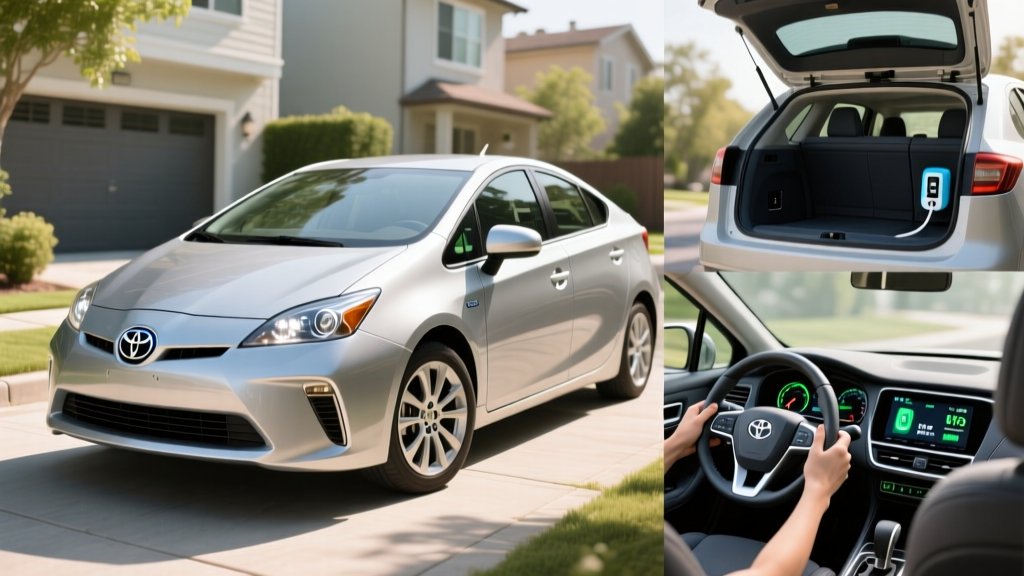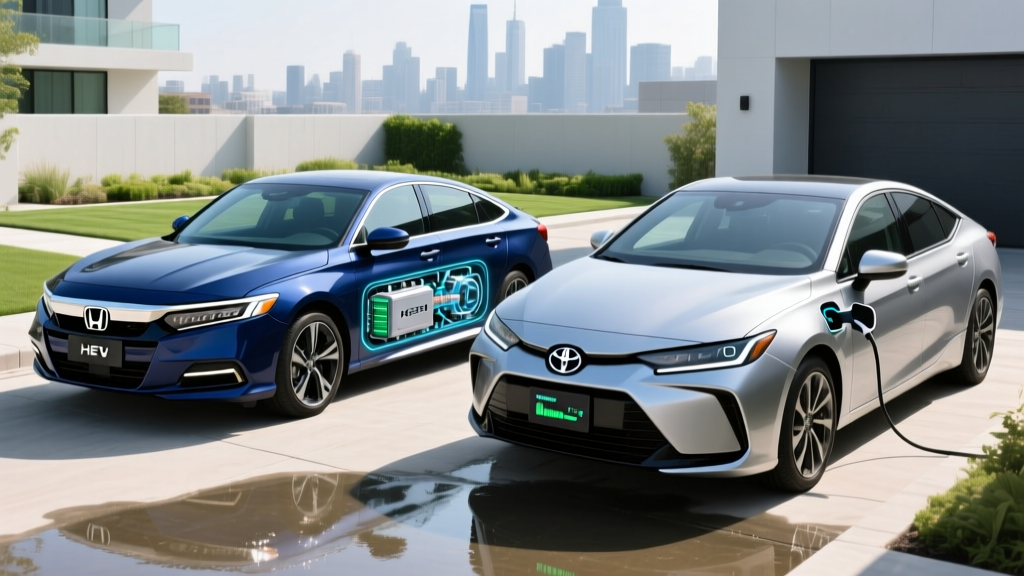
If you've ever wondered how a car can sip fuel in stop-and-go traffic yet still hit the highway without plugging in, you're asking the right question. Hybrid powertrains have evolved significantly over the past decade, and the 2026 lineup spans everything from mild hybrids that barely move the needle to plug-in hybrids (PHEVs) offering 40+ miles of electric-only driving. Understanding how hybrids work — and the critical difference between a conventional hybrid (HEV) and a plug-in hybrid (PHEV) — is the key to picking the right electrified vehicle for your lifestyle.
This guide breaks down the engineering, the real-world efficiency data, battery longevity, tax-credit eligibility, and the decision framework you need to choose between an HEV, a PHEV, or a full battery-electric vehicle (BEV).
HEV vs PHEV: The Fundamental Difference
Before comparing specs, it's essential to separate the two hybrid categories. Conflating them is the single most common mistake shoppers make.
Conventional Hybrid (HEV)
An HEV has a small battery (typically 1–2 kWh) that is charged exclusively by the gasoline engine and regenerative braking. You never plug it in. The electric motor assists the engine during acceleration and enables brief low-speed electric driving, but the gas engine remains the primary energy source. Examples: Toyota Prius, Honda CR-V Hybrid, Hyundai Tucson Hybrid.
Plug-In Hybrid (PHEV)
A PHEV carries a much larger battery (typically 13–25+ kWh usable) and can be plugged into a Level 1 or Level 2 charger. It delivers meaningful electric-only range (25–50+ miles) before the gasoline engine engages. Once the battery depletes, it operates as a conventional hybrid. Examples: Toyota RAV4 Prime, Jeep Wrangler 4xe, Hyundai Tucson PHEV.
| Attribute | HEV (Conventional Hybrid) | PHEV (Plug-In Hybrid) |
|---|---|---|
| Battery Size (usable) | 1–2 kWh | 13–25+ kWh |
| Plugs In? | No | Yes (Level 1 / Level 2) |
| Electric-Only Range | <1 mile at low speed | 25–50+ miles |
| DC Fast Charging | N/A | Rare; most are AC-only |
| Federal Tax Credit (§30D) | Not eligible | Up to $7,500 (varies) |
| Typical Combined MPG (gas mode) | 40–57 MPG | 30–40 MPG (after battery depletes) |
How Hybrid Powertrains Actually Work
At its core, a hybrid pairs an internal combustion engine (ICE) with one or more electric motors and a battery pack. The powertrain control module decides in real time which source provides propulsion based on speed, throttle input, battery state of charge (SoC), and driving conditions.
Series, Parallel, and Series-Parallel Architectures
Parallel hybrids (the most common layout) allow both the engine and the electric motor to drive the wheels directly. Toyota's Hybrid Synergy Drive, used in the Prius and RAV4 Hybrid, is a series-parallel system using a planetary gearset to blend power seamlessly. At low speeds, the motor can drive alone; under hard acceleration, both sources combine; at cruising speeds, the engine dominates while the motor fine-tunes efficiency.
Series hybrids use the engine solely as a generator to charge the battery or power the electric motor — the engine never drives the wheels directly. This is rarer in passenger vehicles but used in some range-extended EVs.
Regenerative Braking: The Free Energy Loop
Every hybrid captures kinetic energy during deceleration. The electric motor reverses its function, acting as a generator to convert braking force into electricity stored in the battery. This is why hybrids dramatically outperform gas cars in city driving — every stop light becomes a micro-charging event. On the highway, where braking is infrequent, the efficiency gap narrows.
Real-World MPG: EPA Sticker vs What You'll Actually See
Hybrids frequently exceed their EPA city ratings in real-world driving because stop-and-go conditions maximize regenerative braking. Highway MPG, however, can fall short of the sticker, especially at sustained speeds above 70 mph or in cold weather when the engine runs more often for cabin heat.
| Vehicle | Type | City MPG | Highway MPG | Combined MPG | Real-World Expectation |
|---|---|---|---|---|---|
| Toyota Prius (FWD) | HEV | 57 | 56 | 57 | 52–60 city; 48–54 hwy |
| Toyota Prius (AWD) | HEV | 53 | 54 | 54 | 48–56 city; 46–52 hwy |
| Honda CR-V Hybrid | HEV | 43 | 36 | 40 | 40–48 city; 32–36 hwy |
| Hyundai Tucson Hybrid | HEV | 38 | 38 | 38 | 36–42 city; 34–38 hwy |
| Toyota RAV4 Prime | PHEV | 94 MPGe (EV mode) | 84 MPGe | 94 MPGe / 38 MPG gas | 36–42 MPG gas mode |
| Jeep Wrangler 4xe | PHEV | 49 MPGe (EV mode) | 45 MPGe | 49 MPGe / 20 MPG gas | 18–22 MPG gas mode |
Real-World MPG Note: City drivers who brake frequently and drive under 45 mph will often beat EPA city estimates by 3–5 MPG in an HEV. Highway-heavy commuters cruising at 75+ mph should expect to fall 3–6 MPG below the EPA highway figure. Cold weather (below 32°F) can reduce hybrid efficiency by 10–20% due to increased engine idling for heat and reduced battery performance.
PHEV Electric-Only Range and Charging Specs
For PHEV shoppers, electric-only range is the headline number. This is how far you can drive on battery power alone — zero gasoline — before the engine kicks in. Here's how the leading 2026 PHEVs stack up:
| Vehicle | Battery (usable kWh) | EPA EV Range | Total Range (EV + Gas) | Level 2 Charge Time (0–100%) | DC Fast Charge |
|---|---|---|---|---|---|
| Toyota RAV4 Prime | 18.1 kWh | 42 mi | ~600 mi | ~2.5 hr (3.3 kW onboard) | No |
| Chrysler Pacifica PHEV | 16.0 kWh | 32 mi | ~520 mi | ~2 hr (7.2 kW onboard) | No |
| Jeep Wrangler 4xe | 17.3 kWh | 21 mi | ~370 mi | ~2 hr (7.2 kW onboard) | No |
| Hyundai Tucson PHEV | 13.8 kWh | 33 mi | ~420 mi | ~2 hr (7.2 kW onboard) | No |
| BMW X5 xDrive50e | 25.7 kWh | 38 mi | ~440 mi | ~3.5 hr (7.4 kW onboard) | No |
A key limitation: nearly all PHEVs lack DC fast charging. They use onboard AC chargers rated between 3.3 kW and 7.4 kW, meaning a full charge takes 2–4 hours on a Level 2 home station. This is by design — PHEV batteries are small enough that overnight Level 1 charging (120V, ~1.4 kW) can replenish most of the pack in 8–12 hours, which covers the daily commute for many owners.
Powertrain Output: Combined Horsepower
PHEVs often deliver significantly more power than their gas-only siblings because the electric motor adds torque instantly. The RAV4 Prime produces 302 combined horsepower (2.5L engine + dual motors), versus 203 hp in the gas RAV4. The Wrangler 4xe cranks out 375 hp and 470 lb-ft of torque — making it the quickest Wrangler ever sold. This performance bump is a frequently overlooked PHEV advantage.
Battery Longevity, Warranty, and Replacement Costs
Hybrid battery anxiety is the top concern for first-time buyers. The data, however, is reassuring: modern hybrid batteries are engineered for the life of the vehicle, and failure before 150,000 miles is uncommon.
Hybrid Battery Warranty Standard
Federal law mandates that hybrid and EV battery warranties cover at minimum 8 years / 100,000 miles. In California Air Resources Board (CARB) states (CA, CO, CT, ME, MD, MA, NJ, NY, OR, RI, VT, WA), the warranty extends to 10 years / 150,000 miles. This covers capacity loss below a defined threshold (typically 60–70% of original capacity) and complete failure.
Real-world lifespan data: Toyota Prius taxis routinely exceed 300,000 miles on the original hybrid battery. Nickel-metal hydride (NiMH) packs in older Toyota hybrids and lithium-ion (NMC) packs in newer models and most PHEVs have demonstrated excellent cycle-life durability. Degradation in an HEV is minimal because the battery is small and operates within a narrow state-of-charge window (typically 40–80% SoC), avoiding the deep cycles that stress batteries.
Replacement cost if out of warranty:
- HEV battery (Toyota Prius): $2,000–$4,000 (refurbished or new OEM)
- HEV battery (Honda CR-V Hybrid): $2,500–$4,500
- PHEV battery (RAV4 Prime): $8,000–$12,000
- PHEV battery (Wrangler 4xe): $10,000–$15,000
Third-party refurbishers and independent hybrid shops have driven replacement costs down considerably. Many owners will never face this expense.
Pricing, Tax Credits, and Total Cost of Ownership
Hybrid pricing has become highly competitive, with many HEVs starting under $30,000 and PHEVs qualifying for significant federal incentives.
| Vehicle | Base MSRP | Federal §30D Credit | Est. Effective Price |
|---|---|---|---|
| Toyota Prius LE (HEV) | $28,550 | $0 | $28,550 |
| Honda CR-V Hybrid Sport (HEV) | $35,350 | $0 | $35,350 |
| Toyota RAV4 Prime SE (PHEV) | $44,715 | Up to $7,500* | ~$37,215 |
| Jeep Wrangler 4xe (PHEV) | $50,790 | Up to $3,750* | ~$47,040 |
| Hyundai Tucson PHEV SEL (PHEV) | $38,725 | Up to $3,750* | ~$34,975 |
*Federal §30D tax credit caveats: PHEV credit amounts depend on battery capacity, critical-mineral sourcing, and battery-component manufacturing requirements. For 2026, the maximum is $7,500 for vehicles meeting both sourcing thresholds, $3,750 for meeting one, and $0 for meeting neither. The credit is subject to MSRP caps ($80,000 for SUVs/pickups/vans; $55,000 for sedans), buyer income limits ($300K joint / $225K head of household / $150K single), and can be applied as a point-of-sale rebate. Conventional HEVs do not qualify for §30D. Always verify current eligibility on IRS.gov and consult a tax professional. Source: irs.gov.
5-Year Cost of Ownership: Hybrid vs Gas vs EV
Hybrids save money primarily through fuel. Assuming 15,000 miles/year and $3.50/gallon gas:
- Gas-only compact SUV (28 MPG combined): ~$9,375 in fuel over 5 years
- HEV compact SUV (40 MPG combined): ~$6,563 in fuel over 5 years — saving ~$2,812
- PHEV (35 mi EV range, 35 MPG gas, charging at $0.14/kWh): ~$4,200 in combined energy over 5 years — saving ~$5,175
The PHEV advantage grows dramatically if your daily commute is within the electric-only range and you charge at home. According to fueleconomy.gov, the RAV4 Prime costs roughly $1.17 per gallon-equivalent when running on electricity versus $3.50+ for gasoline.
Reliability: What the Data Shows
Hybrids consistently rank among the most reliable vehicle categories. According to Consumer Reports' 2025 Annual Auto Reliability Survey data, Toyota and Lexus hybrids dominate long-term reliability rankings, with the Prius and RAV4 Hybrid earning top marks. Honda's hybrid system (used in the CR-V and Accord Hybrid) also scores well above average.
The hybrid powertrain actually reduces certain failure points: there's no traditional starter motor (the hybrid motor starts the engine), no alternator (the hybrid battery system handles charging), and regenerative braking reduces wear on friction brake pads — many hybrid owners report original brake pads lasting 80,000–100,000+ miles.
The primary reliability risk is the hybrid inverter (the power electronics that convert DC battery power to AC motor power). Inverter failures are rare but costly ($2,000–$4,000 out of warranty). Toyota's track record here is excellent; other brands have had isolated inverter recalls.
Who Should Choose a Hybrid, PHEV, or Full EV?
Choose a Conventional Hybrid (HEV) If:
- You cannot charge at home (apartment, street parking, no garage)
- You want zero behavior change — just buy gas like always
- Your budget is under $35,000 and you want maximum fuel savings per dollar
- You drive a mix of city and highway with no predictable short commute
Choose a Plug-In Hybrid (PHEV) If:
- You can charge at home (Level 1 or Level 2) and your daily commute is under 40 miles
- You want electric daily driving but need gas flexibility for road trips
- You want to qualify for the federal tax credit but aren't ready for full EV range limitations
- You live in a region with extreme cold that significantly reduces BEV range
Choose a Full BEV If:
- You have reliable home Level 2 charging
- Your daily driving is predictable and within the vehicle's real-world range
- You want the lowest per-mile energy cost and zero tailpipe emissions
- You want minimal maintenance (no oil changes, no engine-related service)
Hybrid Advantages
- 40–57 MPG combined with no plug-in required (HEV)
- Proven long-term reliability (20+ year track record)
- Lower purchase price than BEVs
- No range anxiety — gas stations everywhere
- Regenerative braking extends brake pad life
- Strong resale value, especially Toyota/Lexus
Hybrid Limitations
- HEVs don't qualify for the federal §30D tax credit
- Still requires oil changes, engine maintenance, and emissions service
- Highway MPG advantage over gas cars is modest (5–10 MPG)
- PHEVs carry a weight penalty from dual powertrains
- PHEV gas-mode MPG is often worse than a comparable HEV
- Two systems to maintain long-term (engine + electric)
Frequently Asked Questions
How many MPG does a hybrid really get?
It depends on the model and your driving. The 2026 Toyota Prius FWD achieves an EPA-rated 57 MPG combined (57 city / 56 highway). Real-world city driving often exceeds the EPA estimate — many owners report 55–62 MPG in mixed urban conditions. Highway-only driving at 75+ mph may drop to 48–52 MPG. Compact SUV hybrids like the Honda CR-V Hybrid average 40 MPG combined, with real-world results of 36–45 MPG depending on conditions.
How far can a PHEV go on electric only?
Current 2026 PHEVs offer 21–42 miles of EPA-rated electric-only range. The Toyota RAV4 Prime leads mainstream PHEVs at 42 miles; the Hyundai Tucson PHEV delivers 33 miles; the Jeep Wrangler 4xe manages 21 miles due to its heavy body-on-frame construction. Once the battery depletes, the gasoline engine takes over and the vehicle operates as a conventional hybrid with 20–40 MPG depending on the model.
Do hybrids need to be plugged in?
No. Conventional hybrids (HEVs) charge their battery entirely through the gasoline engine and regenerative braking. You fuel them like any gas car. Only plug-in hybrids (PHEVs) benefit from being plugged in, and even PHEVs can operate without plugging in — they simply function as less-efficient conventional hybrids if you never charge.
Is a hybrid battery expensive to replace?
Out-of-warranty HEV battery replacement costs $2,000–$4,500 depending on the model. PHEV batteries cost $8,000–$15,000 due to their larger size. However, most hybrid batteries last 150,000–250,000+ miles, and the federally mandated warranty covers at least 8 years / 100,000 miles (10 years / 150,000 miles in CARB states). Many owners never replace the battery.
Does a hybrid qualify for a tax credit?
Conventional hybrids (HEVs) do not qualify for the federal §30D clean vehicle tax credit. Plug-in hybrids (PHEVs) may qualify for up to $7,500, depending on battery sourcing requirements, MSRP caps ($80,000 SUV/pickup; $55,000 sedan), and buyer income limits. The credit can be applied at the point of sale as a rebate. Check IRS §30D guidelines for current eligibility. Some states offer additional rebates for PHEVs — check your state energy office.
Hybrid vs PHEV vs EV — which is right for me?
If you can't charge at home, choose an HEV for effortless fuel savings. If you can charge at home and your daily commute is under 40 miles, a PHEV gives you electric daily driving with gas road-trip flexibility and a potential tax credit. If you have home charging, predictable driving, and want the lowest operating cost with zero tailpipe emissions, a full BEV is the most efficient long-term choice. See the decision framework above for detailed guidance.
Are hybrids reliable long-term?
Yes. Toyota and Lexus hybrids have a 25+ year track record of exceptional reliability. The hybrid system eliminates several common failure points (starter, alternator) and reduces brake wear. Hybrid battery failures before 150,000 miles are uncommon. Consumer Reports and J.D. Power data consistently rank Toyota/Lexus hybrids at or near the top of long-term reliability surveys. Check NHTSA.gov for model-specific safety and recall data.