Quick Verdict: A Bargain-Basement Hybrid Sedan That Still Commutes Well
The 2015 Kia Optima Hybrid EX occupies a specific niche in the 2026 used-car market: a midsize hybrid sedan you can pick up for $7,000–$11,000 that delivers genuinely competitive fuel economy without requiring a plug. It is a conventional hybrid (HEV), not a plug-in hybrid (PHEV), meaning you never need to search for a charger — it refuels at any gas station and recovers energy through regenerative braking.
For budget-conscious commuters who lack home charging access and aren't ready to commit to a full battery-electric vehicle (BEV), the 2015 Optima Hybrid EX remains a practical daily driver. Its combined EPA rating of 35 MPG still holds up against newer hybrids, though its electric-only capability is limited to low-speed, short-distance crawling. If you're cross-shopping this against a used Toyota Camry Hybrid or Ford Fusion Hybrid, the Kia undercuts both on price while offering comparable efficiency.
| Spec | Value |
|---|---|
| Powertrain Type | Conventional Hybrid (HEV) |
| Engine | 2.4L inline-4 Atkinson cycle |
| Engine Output | 169 hp / 156 lb-ft torque |
| Electric Motor Output | 47 hp / 151 lb-ft torque |
| Combined System Output | 199 hp |
| Transmission | 6-speed automatic |
| Hybrid Battery | 1.62 kWh (47.2 kW peak output), Lithium-Polymer |
| EPA City / Highway / Combined | 36 / 40 / 35 MPG* |
| Fuel Tank | 17.2 gallons |
| Total Driving Range | ~602 miles (EPA combined) |
| 0–60 mph | ~8.7 seconds |
| Original MSRP (2015) | $26,950 (EX trim, incl. delivery) |
| Typical Used Price (2026) | $7,000–$11,000 |
| Hybrid Battery Warranty (original) | 10 years / 100,000 miles |
*EPA revised rating; original window sticker may show 34 combined. Source: fueleconomy.gov
Fuel Economy: How Many MPG Does the 2015 Optima Hybrid Actually Get?
| Driving Condition | EPA Rating | Real-World Expectation |
|---|---|---|
| City | 36 MPG | 37–41 MPG (hybrids often exceed EPA in stop-and-go) |
| Highway | 40 MPG | 36–39 MPG (aerodynamic drag, higher sustained speeds) |
| Combined | 35 MPG | 34–38 MPG depending on commute mix |
The 2015 Optima Hybrid EX carries an EPA combined rating of 35 MPG. However, real-world results diverge from the sticker in a pattern common to parallel hybrids: city driving tends to yield better numbers than highway driving. In stop-and-go traffic, the electric motor handles low-speed propulsion while regenerative braking recaptures kinetic energy that a gas-only car would waste as heat. Owners on Fuelly and similar tracking platforms consistently report 36–40 MPG in urban commuting, with highway-heavy road trips dropping to 34–37 MPG.
Cold weather introduces another variable. In freezing temperatures (below 32°F), expect a 5–10% fuel economy reduction. The gasoline engine runs longer to maintain cabin heat and reach operating temperature, reducing the electric motor's share of propulsion. This is less severe than the 20–30% range loss a full BEV experiences in winter, but it's measurable.
At $3.30/gallon (2026 national average for regular unleaded) and 12,000 miles/year, the Optima Hybrid EX costs roughly $1,130 annually in fuel. A comparable 2015 Optima with the 2.4L non-hybrid engine (rated at 27 MPG combined) would cost about $1,467/year — a difference of ~$337 annually in the hybrid's favor.
HEV vs PHEV vs EV: Where Does the Optima Hybrid Fit?
Understanding the distinction between hybrid types is essential before evaluating this car.
| Feature | HEV (this car) | PHEV (e.g., 2017 Optima PHEV) | BEV (e.g., Tesla Model 3) |
|---|---|---|---|
| Plug-in Required? | No | Yes (Level 1 or 2) | Yes (Level 2 or DC fast) |
| Electric-Only Range | < 1 mile at low speed | ~27 miles (Optima PHEV) | 250–350+ miles |
| Gas Engine | Yes, primary power | Yes, backup after battery depletes | None |
| Fuel/Charging | Gas station only | Gas station + home/public charger | Home/public charger only |
| Federal Tax Credit (new) | None (expired long ago) | Up to $7,500 (§30D, if eligible) | Up to $7,500 (§30D, if eligible) |
| Annual Fuel Cost (12k mi) | ~$1,130 | ~$600–$900 (varies by electric share) | ~$450–$650 (varies by electricity rate) |
| Home Charging Needed? | No | Strongly recommended | Essential |
Who should choose this HEV: Renters without charging access, apartment dwellers, drivers in areas with sparse public charging infrastructure, and buyers on a tight budget who want better fuel economy without lifestyle changes.
Who should look at a PHEV instead: Homeowners or renters who can install a Level 2 charger and have a commute under 30 miles round-trip — you'd drive mostly on electricity and rarely visit a gas station.
Who should go full BEV: Drivers with home charging, predictable routes, and a willingness to invest more upfront for dramatically lower per-mile energy costs and zero tailpipe emissions.
Powertrain Deep Dive: Engine, Motor, and the 1.62 kWh Battery
The 2015 Optima Hybrid EX pairs a 2.4-liter inline-4 gasoline engine running the Atkinson cycle with a 47-hp electric motor integrated into the transmission housing. The Atkinson cycle sacrifices some low-end torque for greater thermal efficiency — a tradeoff the electric motor compensates for during acceleration.
The combined system output is 199 horsepower, delivered through a conventional 6-speed automatic transmission rather than the continuously variable transmission (CVT) found in most Toyota and Honda hybrids. This gives the Optima Hybrid a more natural driving feel — shifts are perceptible and the engine doesn't drone at a fixed RPM under hard acceleration the way CVT-equipped hybrids can. The tradeoff is marginally lower efficiency in some driving conditions.
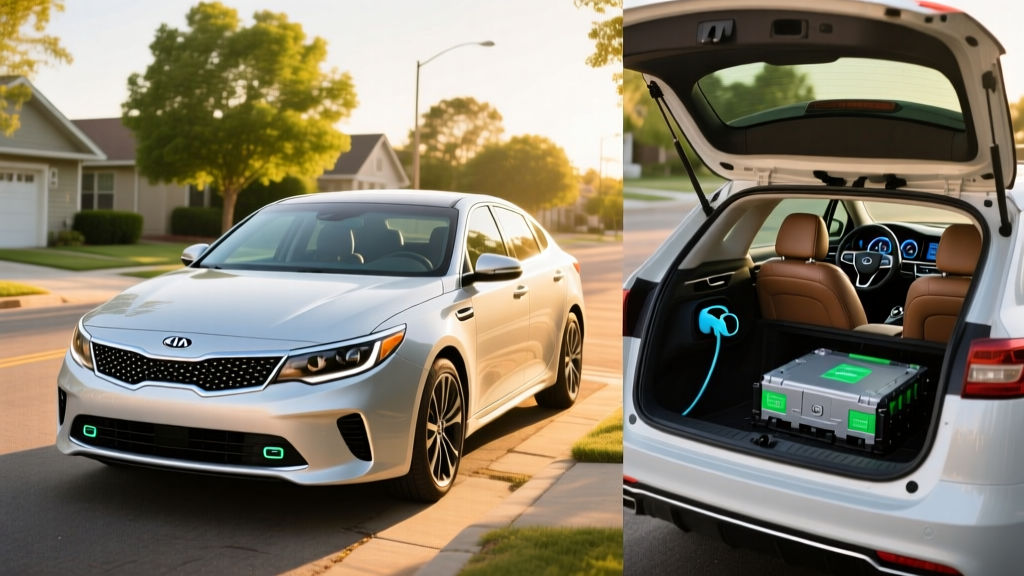
The hybrid battery pack is a 1.62 kWh lithium-polymer unit located behind the rear seat, reducing trunk capacity from 15.4 cubic feet (gas model) to 9.9 cubic feet. This is a meaningful compromise for anyone who regularly hauls luggage or groceries. The pack's peak power output is 47.2 kW, which is sufficient for electric-only propulsion up to approximately 25 mph for very short distances (under one mile). This is not a vehicle you can drive in EV mode on the highway — the battery is too small, and the system is designed for electric assist, not electric dominance.
Because this is an HEV, there is no charging port. The battery replenishes through regenerative braking and engine-driven generation. You will never need to plug it in, and there is no Level 1, Level 2, or DC fast-charging capability.
Battery Longevity, Warranty, and Replacement Cost
Original Hybrid Battery Warranty: 10 years / 100,000 miles (whichever comes first), covering defects and capacity loss below a manufacturer-defined threshold. Kia's hybrid battery warranty is transferable to subsequent owners but is prorated after the initial coverage period in some states.
Current Status (2026): A 2015 model is now 11 years old. The original 10-year/100,000-mile warranty has expired unless the vehicle has extremely low mileage and you are in a state with extended emissions-related coverage provisions.
Hybrid battery degradation in the 2015 Optima Hybrid is generally modest. Lithium-polymer chemistry in this generation has proven durable, with most owner reports showing 5–10% capacity loss over 100,000+ miles. Unlike a full BEV where battery degradation directly reduces your driving range, an HEV's small battery primarily affects the frequency and duration of electric-assist engagement — the gasoline engine compensates seamlessly, so you may not notice degradation day-to-day.
If the hybrid battery does fail, replacement costs range from $2,000 to $3,500 for a refurbished or aftermarket pack, and $3,500 to $5,000 for a new OEM unit from a Kia dealer, including labor. Independent hybrid specialists often offer reconditioned packs with 1–3 year warranties at the lower end of that range. Given that a used 2015 Optima Hybrid EX sells for $7,000–$11,000, a full OEM battery replacement represents a significant percentage of the vehicle's value — a factor to weigh when inspecting any specific example.
Pre-purchase tip: Have a qualified mechanic or hybrid specialist perform a battery health check using an OBD-II scanner that can read hybrid battery state-of-health (SoH) metrics. Look for individual cell voltage variance — large discrepancies between cells suggest imbalance that may precede failure.
Reliability and Ownership Costs
The 2015 Optima Hybrid's reliability record is mixed but acceptable for its age. The hybrid powertrain itself — the electric motor, inverter, and battery — has proven robust, with few widespread failure patterns. The conventional components are where issues tend to surface:
- Transmission: The 6-speed automatic has drawn some complaints for rough shifts and hesitation, particularly when transitioning between electric and gas power. Kia issued software updates that improved shift logic in later model years.
- Brakes: Regenerative braking reduces wear on the friction brakes, and many owners report original brake pads lasting 80,000+ miles. However, the brake actuator (which blends regen and friction braking) has been a known failure point on Hyundai/Kia hybrids of this era, with replacement costing $800–$1,200.
- 12V auxiliary battery: Like any car, the Optima Hybrid has a standard 12V battery for electronics. If it dies, the hybrid system cannot start — a common point of confusion for new hybrid owners.
Insurance costs are typically lower than the gasoline Optima due to the hybrid's lower performance profile, averaging $1,200–$1,500/year depending on your state and driving record. Maintenance is straightforward: regular oil changes (the engine still uses conventional oil), cabin air filter, and tire rotations. There are no spark plugs to replace on the Atkinson-cycle schedule as frequently as some turbocharged engines, and the timing chain (not belt) is designed to last the engine's lifetime.
Pricing, Tax Credits, and the Used-Buyer Math
The 2015 Kia Optima Hybrid EX originally carried an MSRP of $26,950. In the 2026 used market, examples with 80,000–130,000 miles typically sell for $7,000–$11,000 depending on condition, mileage, and region. Clean-title examples from private sellers cluster around $8,000–$9,500.
Federal Tax Credit Status:
- The §30D new clean vehicle credit does NOT apply — this vehicle is used and was manufactured long before current sourcing rules existed.
- The Used Clean Vehicle Credit (§25E) allows up to $4,000 (or 30% of the sale price, whichever is less) for qualifying used EVs and fuel-cell vehicles. Hybrids (HEV) do NOT qualify. Only battery-electric and plug-in hybrid vehicles with at least 7 kWh of battery capacity are eligible under §25E. The Optima Hybrid's 1.62 kWh pack falls well below this threshold.
- No federal tax credit is available for this vehicle.
- Some states offer registration fee reductions or HOV lane access for hybrids — check your state's DMV for current programs.
Despite the lack of tax incentives, the total cost of ownership can be compelling for a budget buyer. At $8,500 purchase price, $1,130/year in fuel, $1,350/year in insurance, and ~$400/year in maintenance, your annual operating cost is roughly $2,880 (excluding depreciation, which is minimal on a car this old). Compare this to a $25,000 new compact car getting 30 MPG combined: higher purchase price, similar or slightly higher fuel cost, and steeper depreciation.
Pros
- 35+ MPG combined with no plug-in requirement
- Low used-car entry price ($7,000–$11,000)
- Conventional 6-speed automatic avoids CVT drone
- Strong city MPG from regenerative braking
- Hybrid battery proven durable past 100k miles
- Low brake wear from regen blending
Cons
- Trunk space reduced to 9.9 cu ft (battery placement)
- Electric-only mode limited to < 1 mile at low speed
- No federal tax credit eligibility (used or new)
- Original hybrid battery warranty has expired
- Some transmission shift hesitation reported
- Brake actuator replacement can be costly
- 2015 infotainment lacks Apple CarPlay/Android Auto
Frequently Asked Questions
How many MPG does the 2015 Kia Optima Hybrid EX get?
The EPA rates it at 36 city / 40 highway / 35 combined MPG. Real-world results typically range from 34–41 MPG depending on driving conditions. City commuting with frequent stops maximizes regenerative braking and yields the best numbers; sustained highway driving at 70+ mph reduces efficiency.
Can I drive the 2015 Optima Hybrid on electric power only?
Only marginally. The electric motor can propel the car at speeds up to about 25 mph for distances under one mile on a fully charged hybrid battery. This is useful for creeping through parking lots or stop-and-go traffic, but it is not a practical electric-only commute vehicle. The system is designed for electric assist, not electric propulsion.
Is the 2015 Optima Hybrid reliable, and what does a battery replacement cost?
The hybrid powertrain is generally reliable, with the lithium-polymer battery showing modest degradation over 100,000+ miles. The main concerns are the brake actuator ($800–$1,200 replacement) and occasional transmission shift quality. A hybrid battery replacement runs $2,000–$5,000 depending on whether you choose refurbished or new OEM. Most examples on the used market still have their original batteries functioning adequately.
Does the 2015 Kia Optima Hybrid qualify for any tax credit?
No. The federal §30D new vehicle credit does not apply to used purchases, and the §25E used clean vehicle credit requires a battery-electric or plug-in hybrid with at least 7 kWh of battery capacity. The Optima Hybrid's 1.62 kWh pack disqualifies it. Some states may offer minor hybrid incentives — check your local DMV or energy office.
Hybrid vs PHEV vs EV — which should I buy?
Choose this HEV if you cannot charge at home, want zero lifestyle change from a gas car, and are on a tight budget. Choose a PHEV (like the later 2017+ Optima PHEV with 27 miles of electric range) if you can install a Level 2 home charger and have a short commute. Choose a full BEV if you want the lowest per-mile energy cost, have reliable home charging, and are ready to plan around charging infrastructure for road trips. Each step up the electrification ladder trades convenience for efficiency.
How does the 2015 Optima Hybrid compare to a Camry Hybrid of the same year?
The 2015 Toyota Camry Hybrid LE is rated at 41 MPG combined (vs. 35 for the Kia) and has a stronger reliability reputation, but typically commands $2,000–$4,000 more on the used market. The Optima Hybrid trades a few MPG for a lower entry price and a more conventional driving feel thanks to its 6-speed automatic vs. Toyota's CVT. If maximum fuel economy is your priority, the Camry wins. If value is paramount, the Kia makes a strong case.
Does regenerative braking mean I rarely need new brake pads?
Correct — many Optima Hybrid owners report original brake pads lasting 80,000–100,000 miles because regenerative braking handles much of the deceleration. However, the friction brakes are still essential for hard stops and low-speed braking where regen is less effective, and the brake actuator that manages the blend between regen and friction braking can fail independently.
Sources: EPA fueleconomy.gov — 2015 Kia Optima Hybrid, IRS Used Clean Vehicle Credit (§25E), Kia Motors America