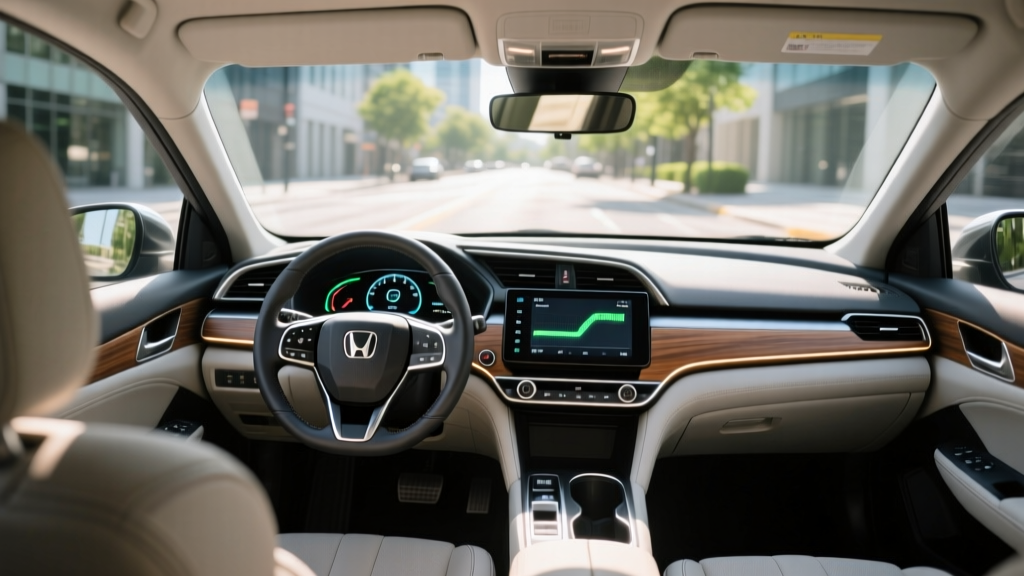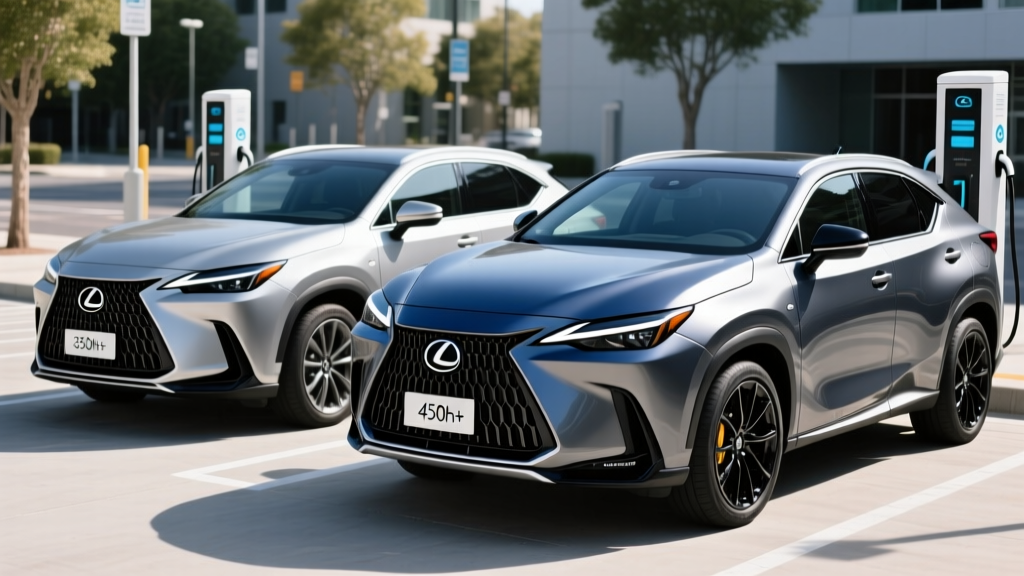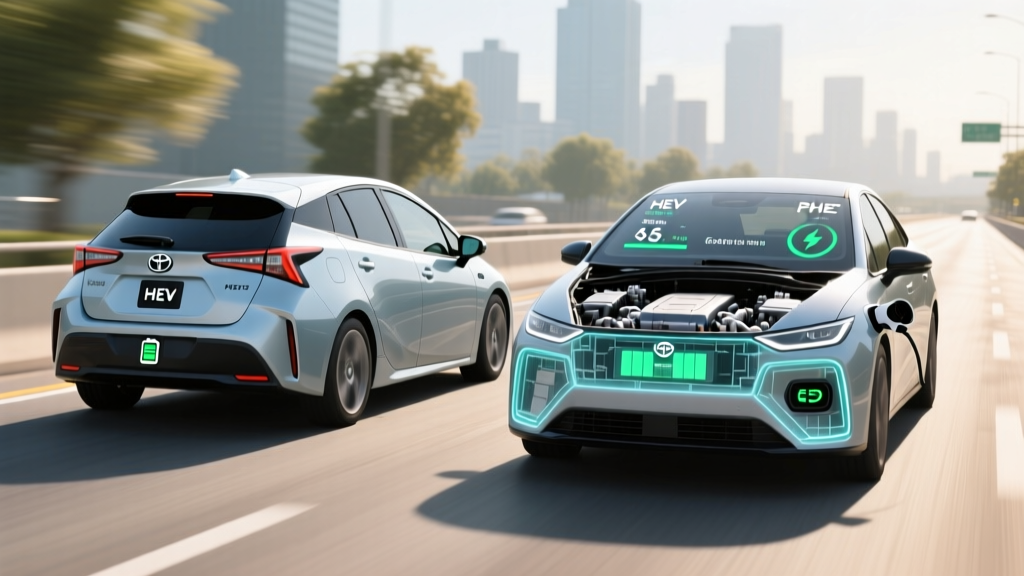
The Short Answer: How Hybrid Powertrains Actually Work
A hybrid vehicle pairs a gasoline engine with one or more electric motors and a battery pack. The system automatically decides when to use the engine, the motor, or both — optimizing for fuel efficiency in stop-and-go traffic while retaining gasoline range for longer trips. Unlike a pure battery-electric vehicle (BEV), a conventional hybrid never needs to be plugged in. It recovers energy through regenerative braking and the engine itself to keep its small battery charged.
But not all hybrids are the same. The two architectures on the market today — conventional hybrids (HEVs) and plug-in hybrids (PHEVs) — serve very different use cases, have different battery sizes, different tax-credit eligibility, and different real-world efficiency profiles. Understanding the distinction is the single most important step before you buy.
HEV vs PHEV: The Fundamental Difference
Conventional Hybrid (HEV)
- Battery size: 0.5–2.0 kWh (small, self-charging)
- Plug in? No — charges via regen braking and the engine
- Electric-only driving: Brief, low-speed bursts only (typically under 1 mile)
- Best for: Drivers without home charging access who want better MPG with zero behavior change
- Federal tax credit: None (does not qualify under IRS §30D)
Plug-In Hybrid (PHEV)
- Battery size: 10–25 kWh (much larger, plug-in capable)
- Plug in? Yes — Level 1 (120V) or Level 2 (240V) charging
- Electric-only driving: 25–50+ miles on most 2026 models
- Best for: Drivers with home charging who want EV-like daily commuting plus gas-engine range for road trips
- Federal tax credit: Up to $7,500 under §30D if the vehicle meets battery sourcing, MSRP, and buyer income requirements
The core mechanical idea is the same in both: an electric motor assists or temporarily replaces the gas engine. The difference is scale. A PHEV carries a battery large enough to handle most daily driving on electricity alone, then seamlessly switches to hybrid mode once that battery is depleted.
Hybrid Powertrain Architecture: Engine, Motor, and Battery Working Together
Modern hybrids use one of three powertrain configurations, and the choice affects how the car drives, its efficiency, and its complexity.
Series Hybrid
The gasoline engine never drives the wheels directly. It acts solely as a generator, producing electricity to charge the battery or feed the electric motor, which provides all propulsion. This is the architecture used in vehicles like the Nissan e-Power system (available in select markets). It delivers smooth, EV-like acceleration at all times.
Parallel Hybrid
Both the engine and the electric motor can drive the wheels, either independently or together. This is the most common architecture — used by Toyota, Hyundai, Kia, and Honda in their mainstream hybrid lineups. The system's computer blends power sources based on speed, throttle input, and battery state of charge (SoC).
Series-Parallel (Power-Split) Hybrid
A combination of both. A planetary gearset (Toyota's Hybrid Synergy Drive is the best-known example) allows the engine to drive the wheels directly at highway speeds while also generating electricity, and lets the motor handle low-speed propulsion. This architecture extracts the most efficiency across the widest range of driving conditions and dominates the 2026 hybrid market.
Regenerative Braking: The Hidden Efficiency Source
Every hybrid recaptures kinetic energy during deceleration. When you lift off the accelerator or press the brake pedal, the electric motor reverses direction, acting as a generator to slow the vehicle and send electricity back into the battery. This is why hybrids achieve dramatically better city MPG than highway MPG — stop-and-go traffic generates constant regen opportunities that a conventional gas car wastes as heat in the brake pads.
Real-World MPG: What Hybrids Actually Deliver
Hybrids, especially conventional HEVs, frequently exceed their EPA combined rating in real-world city driving because regenerative braking is so effective in urban conditions. Highway driving is a different story — at sustained 70–80 mph speeds, the electric motor contributes less, and aerodynamic drag dominates.
| Vehicle | Type | EPA City | EPA Hwy | EPA Combined | Real-World Note |
|---|---|---|---|---|---|
| Toyota Prius (LE AWD) | HEV | 53 | 54 | 54 | Owners commonly report 55–60 MPG in city driving; ~48–50 MPG sustained highway at 75 mph |
| Honda Accord Hybrid (Sport-L) | HEV | 51 | 44 | 48 | City-biased efficiency; highway drops noticeable at speed |
| Hyundai Tucson Hybrid (SEL Convenience) | HEV | 38 | 38 | 38 | Consistent city/highway; AWD system adds slight drag |
| Toyota RAV4 Prime (SE) | PHEV | 94 MPGe | 84 MPGe | 94 MPGe (EV mode) / 38 MPG (hybrid mode) | 42 mi electric-only range; hybrid mode delivers ~36–38 MPG after battery depletes |
| Chrysler Pacifica Hybrid (Pinnacle) | PHEV | 82 MPGe | — | 82 MPGe (EV mode) / 30 MPG (hybrid mode) | 32 mi electric-only range; heavy minivan sees ~28 MPG in hybrid mode on highway |
| Ford Escape PHEV (Premium) | PHEV | 105 MPGe | 93 MPGe | 101 MPGe (EV mode) / 40 MPG (hybrid mode) | 37 mi electric-only range; excellent commuter efficiency when charged daily |
Source: fueleconomy.gov — EPA estimates. Real-world figures based on owner-reported data and independent testing. MPGe (miles per gallon equivalent) measures energy efficiency in electric mode; standard MPG applies in hybrid/gasoline mode.
PHEV Electric-Only Range and Charging: The Daily-Commute Advantage
The defining advantage of a PHEV over a conventional hybrid is electric-only range. In 2026, most mainstream PHEVs deliver between 30 and 50 miles of zero-emission driving before the gasoline engine activates. For many commuters with a round-trip under 40 miles, this means months can pass between fill-ups — provided you charge at home nightly.
| Vehicle | Battery (kWh usable) | EV-Only Range | Total Range (EV + Gas) | Level 2 Charge Time (0–100%) | DC Fast Charge? |
|---|---|---|---|---|---|
| Toyota RAV4 Prime | 14.9 kWh | 42 mi | ~600 mi | ~2.5 hr (240V, 6.6 kW) | No |
| Ford Escape PHEV | 14.4 kWh | 37 mi | ~520 mi | ~3.5 hr (240V, 3.6 kW) | No |
| Jeep Wrangler 4xe | 15.0 kWh | 22 mi | ~370 mi | ~2.5 hr (240V, 7.2 kW) | No |
| BMW X5 xDrive50e | 25.7 kWh | 38 mi | ~440 mi | ~3.5 hr (240V, 7.4 kW) | No |
| Hyundai Tucson PHEV | 13.8 kWh | 33 mi | ~440 mi | ~2.0 hr (240V, 7.2 kW) | No |
Note: Almost no PHEVs support DC fast charging. The battery packs are small enough that Level 2 (240V) charging fully replenishes them in 2–4 hours, making overnight home charging the practical standard. Level 1 (120V standard outlet) charging works but takes 8–14 hours for a full charge.
Understanding MPGe vs MPG
When a PHEV operates in electric mode, efficiency is measured in MPGe (miles per gallon equivalent) — a metric the EPA uses to compare electricity consumption to the energy content of a gallon of gasoline (33.7 kWh = 1 gallon gas equivalent). A PHEV rated at 100 MPGe in EV mode is using roughly 33.7 kWh of electricity per 100 miles. Once the battery depletes and the engine engages, the vehicle reverts to standard MPG ratings, typically 30–40 MPG combined depending on the model.
Battery Longevity, Warranty, and Replacement Costs
Hybrid Battery Warranty: The Baseline
Federal law mandates that hybrid and PHEV battery packs carry a minimum warranty of 8 years or 100,000 miles (whichever comes first). In California Air Resources Board (CARB) states — including California, New York, Massachusetts, and several others — the requirement extends to 10 years or 150,000 miles.
Most manufacturers meet or exceed these minimums. Toyota, Hyundai, and Kia typically warranty their hybrid batteries for 10 years/100,000 miles nationwide, exceeding the federal floor.
How Long Do Hybrid Batteries Actually Last?
The data is reassuring. Toyota Prius taxi fleets have logged 300,000+ miles on original battery packs. The key factor is that hybrid batteries are shallow-cycled — they operate between roughly 40% and 80% state of charge, never fully depleting or fully charging. This partial-cycling dramatically reduces degradation compared to a phone or laptop battery that cycles 0–100% daily.
Nickel-metal hydride (NiMH) batteries, used in older Toyota hybrids, have proven exceptionally durable over 15–20 year lifespans. Modern PHEVs use lithium-ion (NMC chemistry) packs, which are more energy-dense and carry similar projected lifespans of 12–15 years under normal use.
Battery Replacement Cost: What to Budget
If a hybrid battery does fail outside warranty, replacement costs in 2026 range from:
- Conventional HEV (Prius, Accord Hybrid): $2,000–$4,000 for a new OEM pack; $1,000–$2,000 for a refurbished unit
- PHEV (RAV4 Prime, Escape PHEV): $5,000–$8,000 for a new OEM pack due to larger capacity
Third-party refurbishers and independent hybrid specialists have brought costs down significantly. For most buyers who plan to own a hybrid for 8–12 years, the battery will outlast the vehicle's economic life without requiring replacement.
Pricing, Tax Credits, and Total Cost of Ownership
Hybrid and PHEV pricing in 2026 reflects a widening gap between the two categories.
Conventional Hybrids (HEV)
HEVs typically carry a $1,000–$3,000 premium over their gasoline-only counterparts. A 2026 Toyota Prius LE starts at approximately $29,500 MSRP. A Toyota Camry Hybrid LE starts around $30,000. No federal tax credit applies to conventional hybrids — they do not meet the plug-in requirement under IRS §30D.
Plug-In Hybrids (PHEV)
PHEVs command a larger premium — typically $5,000–$10,000 over their HEV or gas equivalents — due to the larger battery pack and onboard charger. A 2026 Toyota RAV4 Prime SE starts at approximately $44,500 MSRP. A Ford Escape PHEV starts around $39,500.
Federal Tax Credit Eligibility (§30D)
PHEVs may qualify for up to $7,500 in federal tax credits under the Inflation Reduction Act's §30D provision, but eligibility depends on several requirements that change and tighten over time. As of 2026, the key criteria include:
- MSRP cap: Vans, SUVs, and trucks must be under $80,000; sedans under $55,000
- Buyer income cap: Modified adjusted gross income (MAGI) must not exceed $150,000 (single), $225,000 (head of household), or $300,000 (joint filers)
- Battery sourcing: Increasing percentages of critical minerals and battery components must be sourced from the US or free-trade-agreement countries — this requirement tightens annually and disqualifies some models
- Point-of-sale transfer: Eligible buyers can transfer the credit to the dealer at purchase, reducing the purchase price directly rather than waiting for a tax refund
- Minimum battery capacity: At least 7 kWh for PHEVs
Always verify current eligibility on IRS.gov before purchasing — the list of qualifying vehicles updates regularly as manufacturers adjust supply chains.
5-Year Cost of Ownership: Hybrid vs Gas vs EV
For a driver covering 15,000 miles annually with a 20-mile daily commute:
- Gas car (30 MPG combined, $3.50/gal): ~$8,750 in fuel over 5 years
- HEV (50 MPG combined, $3.50/gal): ~$5,250 in fuel over 5 years — saving ~$3,500
- PHEV (charged nightly, 35 mi EV range, then 38 MPG hybrid): ~$1,800 electricity + ~$1,400 gas = ~$3,200 over 5 years — saving ~$5,550 vs gas
- BEV (250 mi range, $0.13/kWh): ~$2,925 in electricity over 5 years — saving ~$5,825 vs gas
The PHEV savings assume consistent home charging. Without regular charging, a PHEV operates as a heavier, less efficient hybrid and may return worse MPG than a dedicated HEV.
Hybrid vs PHEV vs EV: Which Powertrain Fits You?
Choose a Conventional Hybrid (HEV) If:
- You cannot install a home charger (apartment, street parking, landlord restrictions)
- You want maximum MPG with zero change to your driving or fueling habits
- You drive a mix of city and highway with no predictable daily mileage cap
- You want the lowest upfront cost among electrified options
- You prioritize proven long-term reliability with minimal new technology risk
Choose a Plug-In Hybrid (PHEV) If:
- You have reliable home Level 2 charging (or can install it)
- Your daily round-trip commute is under 40–50 miles
- You take road trips several times a year and don't want to plan around charging stations
- You want to drive on electricity daily but aren't ready to commit to a full EV
- You qualify for the §30D tax credit, which can offset the PHEV price premium significantly
Choose a Battery-Electric Vehicle (BEV) If:
- You have home charging and your daily driving is under 200 miles
- You want the lowest per-mile energy cost and minimal maintenance (no oil changes, no engine)
- You're comfortable with DC fast-charging on road trips (300+ mi range models with 150+ kW charging)
- You want to eliminate tailpipe emissions entirely and reduce long-term operating costs
- You qualify for the full $7,500 federal credit plus any state incentives
Reliability: What the Data Shows
Hybrids consistently rank among the most reliable vehicle categories. According to long-term reliability surveys, Toyota's hybrid systems — with over 25 years of continuous production since the original 1997 Prius — have failure rates well below those of conventional automatic transmissions. The hybrid system eliminates the traditional starter motor, alternator, and in many designs the conventional transmission, removing common failure points.
Consumer Reports and J.D. Power data frequently place the Toyota Prius, Camry Hybrid, and RAV4 Hybrid at or near the top of their respective segments for predicted reliability. Hyundai and Kia's hybrid systems, while newer, have shown strong reliability since the 2020 model-year refresh of their powertrains.
PHEVs introduce slightly more complexity (larger battery, onboard charger, charge port) but share the same fundamental architecture. The RAV4 Prime and Pacifica Hybrid have shown solid reliability records, though the Pacifica Hybrid had early-model-year recalls related to battery-pack wiring that were addressed by Chrysler under warranty.
Safety ratings are equally strong. The IIHS rates most mainstream hybrids as Top Safety Pick or Top Safety Pick+ in their respective classes, and NHTSA 5-star ratings are common across hybrid variants.
Pros and Cons: Hybrid Ownership at a Glance
Pros
- 30–50% better city fuel economy vs equivalent gas car
- No range anxiety — refuel at any gas station in 5 minutes
- No home charging infrastructure required (HEV)
- Proven long-term reliability with 8–10 year battery warranties
- Lower brake wear (regen braking extends pad life significantly)
- PHEVs offer EV-like commuting with road-trip flexibility
- Lower total cost of ownership over 5+ years vs gas equivalents
Cons
- $1,000–$10,000 higher upfront cost vs gas-only models
- Highway MPG advantage is smaller than city (less regen benefit)
- PHEVs require home charging to realize full value — uncharged PHEVs underperform HEVs
- HEVs do not qualify for federal tax credits
- Battery replacement, while rare, costs $2,000–$8,000 out of warranty
- Some hybrids have reduced cargo space due to battery packaging
- PHEV availability is limited — high-demand models like the RAV4 Prime still carry dealer markups in some markets
Frequently Asked Questions
How many MPG does a hybrid get?
It depends on the model and driving conditions. The 2026 Toyota Prius achieves an EPA-estimated 54 MPG combined (53 city / 54 highway). The Honda Accord Hybrid delivers 48 MPG combined (51 city / 44 highway). Compact SUV hybrids like the Hyundai Tucson Hybrid return around 38 MPG combined. In real-world city driving with frequent stops, many owners report exceeding EPA estimates by 5–10% thanks to regenerative braking.
How far can a PHEV go on electric only?
Most 2026 PHEVs offer between 22 and 50 miles of electric-only range. The Toyota RAV4 Prime delivers 42 miles, the Ford Escape PHEV offers 37 miles, and the BMW X5 xDrive50e provides 38 miles. This covers most daily commutes entirely on electricity. Once the battery depletes, the vehicle seamlessly switches to hybrid mode and continues as a conventional hybrid with no interruption.
Do conventional hybrids need to be plugged in?
No. A conventional hybrid (HEV) charges its battery entirely through regenerative braking and the gasoline engine. You never plug it in — you simply refuel at a gas station as normal. Only plug-in hybrids (PHEVs) require or benefit from external charging.
Is a hybrid reliable, and what does battery replacement cost?
Hybrids are among the most reliable vehicles on the road, with Toyota's hybrid system backed by over 25 years of production data. Hybrid batteries carry a minimum 8-year/100,000-mile warranty (10 years/150,000 miles in CARB states), and many last 15+ years. If replacement is needed out of warranty, expect $2,000–$4,000 for a conventional HEV battery and $5,000–$8,000 for a PHEV battery. Refurbished options cost 40–60% less.
Does a hybrid qualify for a federal tax credit?
Conventional hybrids (HEVs) do not qualify for the federal §30D clean vehicle tax credit — only plug-in vehicles are eligible. Plug-in hybrids (PHEVs) may qualify for up to $7,500, subject to MSRP caps ($55,000 for sedans, $80,000 for SUVs/trucks/vans), buyer income limits, and battery component/critical mineral sourcing requirements. Check the current qualifying vehicle list on IRS.gov before purchasing, as eligibility changes throughout the year.
What happens if my hybrid battery dies while driving?
A hybrid battery failure while driving is extremely rare. The vehicle's computer monitors battery health continuously and will alert you well in advance of any critical issue. If the battery does fail, the gasoline engine can still propel the vehicle in most designs (though with reduced performance and efficiency). You would not be stranded — you'd be directed to a dealer for service.
Are hybrids good for highway driving?
Hybrids are good on the highway, but they don't shine the way they do in city traffic. At sustained 70–80 mph speeds, the electric motor contributes less, and the efficiency advantage over a fuel-efficient gas car narrows. A Prius at 54 MPG combined still delivers strong highway numbers (~50–54 MPG), but a diesel or efficient turbocharged gas sedan can approach similar highway-only figures. The hybrid advantage is overwhelmingly in stop-and-go and suburban driving.
Can I tow with a hybrid or PHEV?
Yes, but capacity varies significantly. The Toyota RAV4 Hybrid can tow up to 1,750 lbs; the RAV4 Prime (PHEV) is not rated for towing in the US. The Ford F-150 PowerBoost hybrid (HEV) can tow up to 12,700 lbs when properly equipped. The Jeep Wrangler 4xe (PHEV) is rated for 3,500 lbs. Always check the specific model's tow rating — hybrid batteries add weight and some manufacturers reduce tow capacity to account for it.