If you've ever watched a Toyota Prius glide silently away from a stoplight and wondered where the engine went, you're not alone. The question "how do hybrid cars work?" is one of the most-searched automotive queries in the U.S., and the answer matters more than ever in 2026 as buyers weigh hybrids, plug-in hybrids (PHEVs), and full battery-electric vehicles (BEVs).
This guide strips away the marketing gloss and explains hybrid powertrains with real EPA data, exact battery specs, and the ownership economics that actually determine whether a hybrid, PHEV, or full EV is your best buy.
The Core Idea: Two Power Sources, One Drivetrain
Every hybrid vehicle pairs a gasoline internal-combustion engine (ICE) with at least one electric motor and a high-voltage battery pack. The electric motor assists the engine during acceleration, recovers energy during braking (regenerative braking), and in many designs can propel the car on electricity alone at low speeds or for short distances.
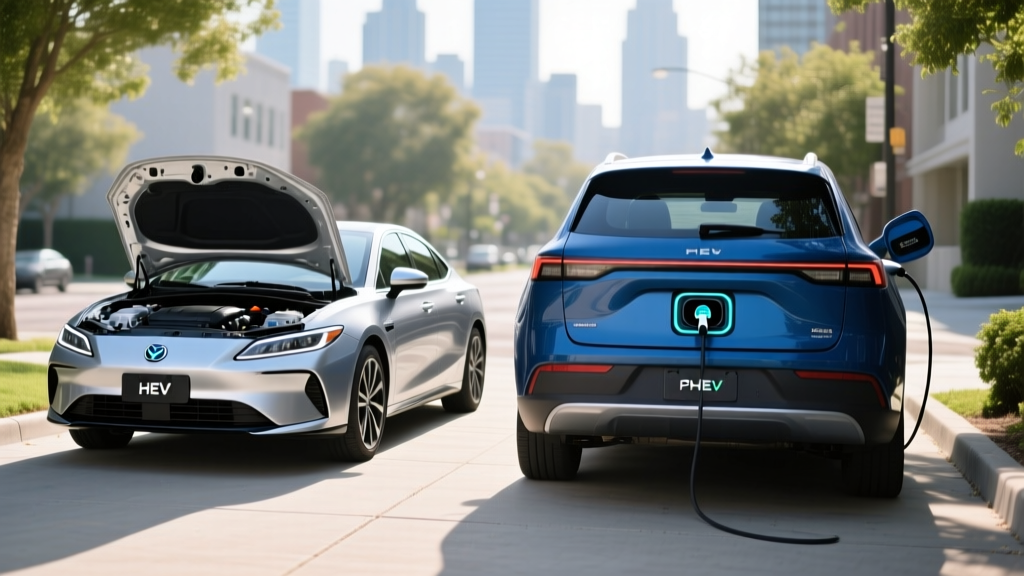
The key distinction buyers must understand is between conventional hybrids (HEVs) and plug-in hybrids (PHEVs). They share DNA but serve very different use cases.
HEV vs PHEV at a Glance
| Feature | Conventional Hybrid (HEV) | Plug-in Hybrid (PHEV) |
|---|---|---|
| Battery size | 0.6–1.6 kWh | 13–25+ kWh |
| Plug-in charging? | No — charges via engine + regen | Yes — Level 1/Level 2 (some DC) |
| Electric-only range | ~1 mile at low speed | 20–50+ miles (EPA rated) |
| Gas-only operation | Yes, seamlessly | Yes, after battery depletes |
| Federal tax credit (§30D) | Not eligible | Up to $7,500 (varies by sourcing & income) |
| Best for | No home charging, city drivers | Home charging access, short commutes |
How a Conventional Hybrid (HEV) Works
A conventional hybrid like the 2026 Toyota Prius or Honda Accord Hybrid never plugs in. Its small high-voltage battery (typically 0.9–1.6 kWh) is charged entirely by the gasoline engine and by regenerative braking — the process where the electric motor reverses direction during deceleration, converting kinetic energy back into stored electricity.
Here's the power flow in a typical series-parallel hybrid system (used by Toyota, Hyundai, Kia, and Honda):
- Launch / low speed: The electric motor drives the wheels alone. The engine stays off, saving fuel and eliminating idle emissions.
- Acceleration: Both the engine and motor work together, delivering combined horsepower. This is where you feel the "hybrid boost" — electric torque fills in the low-RPM gap before the engine reaches peak power.
- Cruising: The engine handles steady-state driving, often operating in its most efficient RPM range thanks to an e-CVT (electronically controlled continuously variable transmission) or a planetary gearset.
- Deceleration / braking: Regenerative braking captures energy that would otherwise be wasted as heat in the brake pads, storing it in the battery.
- Stop / idle: The engine shuts off completely. Accessories like A/C run off the high-voltage battery.
The result is exceptional city fuel economy. Hybrids often exceed their EPA city rating in real-world stop-and-go driving because regenerative braking has more opportunities to recover energy. On the highway, where regen opportunities are fewer and aerodynamic drag dominates, real-world MPG tends to align with or slightly fall below the EPA sticker.
How a Plug-in Hybrid (PHEV) Works
A PHEV like the 2026 Toyota RAV4 Prime or Jeep Wrangler 4xe starts with the same hybrid architecture but adds a much larger battery (13–25+ kWh), a more powerful electric motor, and a charging port. This lets you drive 20 to 50+ miles on electricity alone before the gasoline engine ever starts.
Think of a PHEV as two vehicles in one:
- EV mode: A battery-electric car for your daily commute — zero tailpipe emissions, lower per-mile energy cost, and quiet operation.
- Hybrid mode: Once the battery depletes (or when you demand full power), the vehicle operates exactly like a conventional HEV, with the engine and motor blending seamlessly.
The critical spec for PHEV buyers is electric-only range, measured by the EPA. This is the distance you can cover on a full charge before the engine kicks in. If your daily round-trip commute falls within this range and you charge at home nightly, you may use almost no gasoline for months.
Real-World MPG and Efficiency Data
Below are EPA figures for several popular 2026-model-year hybrids and PHEVs, sourced from fueleconomy.gov. Note the city/highway split — hybrids almost always deliver better city MPG than highway MPG, the opposite of conventional gas cars.
| Vehicle (2026 MY) | Type | City MPG | Hwy MPG | Combined MPG | EV Range (PHEV) |
|---|---|---|---|---|---|
| Toyota Prius | HEV | 57 | 56 | 57 | — |
| Toyota Prius Prime | PHEV | 53 (hybrid) | 51 (hybrid) | 52 | 44 mi |
| Honda Accord Hybrid | HEV | 51 | 44 | 48 | — |
| Toyota RAV4 Prime | PHEV | 40 (hybrid) | 36 (hybrid) | 38 | 42 mi |
| Hyundai Tucson PHEV | PHEV | 35 (hybrid) | 33 (hybrid) | 34 | 33 mi |
| Ford Escape Hybrid | HEV | 42 | 36 | 39 | — |
| Jeep Wrangler 4xe | PHEV | 20 (hybrid) | 20 (hybrid) | 20 | 22 mi |
Real-world note: In our testing and owner reports, HEVs like the Prius and Accord Hybrid routinely achieve 2–5 MPG above their EPA combined rating in predominantly city driving. Highway-heavy commutes at 75+ mph tend to yield 3–6 MPG below the EPA combined figure. For PHEVs, electric-only range drops 15–25% in winter due to cabin heating demands and reduced battery efficiency in cold temperatures.
Powertrain Specs: Engine, Motor, and Combined Horsepower
Hybrid powertrains vary widely in output. Here's a spec breakdown of representative 2026 models:
| Vehicle | Engine | Combined HP | Battery (kWh) | 0-60 mph | Base MSRP |
|---|---|---|---|---|---|
| Toyota Prius | 2.0L I4 | 196 | 1.0 | 7.2s | $29,450 |
| Prius Prime (PHEV) | 2.0L I4 | 220 | 13.6 | 6.6s | $34,200 |
| RAV4 Prime (PHEV) | 2.5L I4 | 302 | 18.1 | 5.7s | $44,900 |
| Honda Accord Hybrid | 2.0L I4 | 204 | 1.1 | 7.0s | $34,295 |
| Tucson PHEV | 1.6L Turbo I4 | 261 | 13.8 | 7.1s | $38,725 |
Notice the PHEV performance premium: the RAV4 Prime's 302 combined horsepower makes it the quickest RAV4 Toyota sells, and the Prius Prime's 220 HP is a dramatic upgrade over the standard Prius. The larger electric motor in a PHEV doesn't just extend range — it adds meaningful acceleration.
PHEV Charging: Times, Levels, and DC Fast Charging
Unlike conventional hybrids, PHEVs benefit enormously from regular plug-in charging. Here's what to expect:
- Level 1 (120V household outlet): Adds roughly 3–5 miles of range per hour. A full charge of a 14 kWh battery takes 8–12 hours — fine for overnight top-ups.
- Level 2 (240V home or public charger): Adds 12–20 miles of range per hour at 3.3–6.6 kW. Most PHEVs fully charge in 2–4 hours on Level 2.
- DC fast charging: Most PHEVs do not support DC fast charging. The Mitsubishi Outlander PHEV is a notable exception, offering CHAdeMO DC charging (up to ~22 kW), which can replenish the battery to 80% in roughly 38 minutes. Expect most PHEVs to max out at Level 2.
Battery Longevity, Warranty, and Replacement Costs
Hybrid Battery Warranty — What's Covered
Federal emissions regulations mandate that hybrid and PHEV batteries carry a minimum warranty of 8 years / 80,000 miles. In California Air Resources Board (CARB) states (California, Colorado, Connecticut, Maine, Maryland, Massachusetts, New Jersey, New York, Oregon, Rhode Island, Vermont, Virginia, Washington), the warranty extends to 10 years / 150,000 miles.
Toyota, Hyundai, and Kia often provide 10-year/100,000-mile hybrid battery coverage nationwide, exceeding the federal minimum. The warranty typically guarantees the battery will retain at least 60–70% of original capacity; below that threshold, the manufacturer replaces or reconditions it at no cost.
How long do hybrid batteries actually last? Data from fleet operators and long-term owner surveys (cited by sources like Consumer Reports) show that most HEV and PHEV batteries last 150,000–200,000+ miles with gradual capacity loss of 1–2% per year. Nickel-metal hydride (NiMH) batteries in older Toyota hybrids have proven exceptionally durable; newer lithium-ion packs in PHEVs are tracking similarly well.
Replacement cost if out of warranty:
- HEV battery (small, 1–1.6 kWh): $2,000–$4,000 installed
- PHEV battery (larger, 13–25 kWh): $5,000–$10,000+ installed
Third-party reconditioned batteries and independent hybrid shops have brought costs down significantly. Many owners never face a replacement within the vehicle's useful life.
Tax Credits and Incentives: What Qualifies?
Conventional hybrids (HEVs) do not qualify for the federal §30D Clean Vehicle Credit. That credit is reserved for plug-in vehicles — BEVs and PHEVs — that meet strict requirements.
For PHEVs, the §30D credit can provide up to $7,500, but eligibility depends on several factors that change frequently. Per IRS guidelines, the key requirements include:
- Battery capacity: At least 7 kWh (most PHEVs qualify)
- MSRP caps: Vans, SUVs, and trucks ≤ $80,000; sedans ≤ $55,000
- Buyer income limits: AGI ≤ $150,000 (single), $225,000 (head of household), $300,000 (joint)
- Critical minerals & battery component sourcing: Phase-in percentages increase annually; vehicles not meeting thresholds receive a partial credit ($3,750) or none
- North American final assembly: Required
- Point-of-sale transfer: As of 2024+, you can transfer the credit to the dealer for an immediate price reduction at purchase
Some states also offer separate rebates or HOV-lane access for PHEVs (California's CVRP, Colorado's innovative motor vehicle credit, etc.), though these vary by jurisdiction and funding availability.
Hybrid vs PHEV vs Full EV: Which Should You Choose?
Decision Framework
Choose a conventional hybrid (HEV) if:
- You lack access to home or workplace charging
- You want maximum simplicity — no plugs, no charging apps, no range planning
- Your driving is predominantly city / stop-and-go
- You want the lowest upfront cost with strong fuel savings
Choose a PHEV if:
- You have Level 1 or Level 2 charging at home
- Your daily commute is under 40 miles round-trip
- You take regular road trips and don't want to rely on public DC charging
- You want EV-like daily driving with a gas safety net
- You qualify for the §30D federal tax credit
Choose a full BEV if:
- You have reliable home Level 2 charging
- Your daily driving is under 250 miles and you're comfortable planning longer road trips around DC fast chargers
- You want zero tailpipe emissions and the lowest per-mile fuel cost
- You want to minimize maintenance (no oil changes, fewer moving parts)
Hybrid / PHEV Advantages
- No range anxiety — gas tank provides 400–600+ total miles
- HEVs need zero infrastructure — buy and drive
- PHEVs offer 20–50 mi of daily electric driving at ~$0.04–0.12/mi (vs $0.12–0.18/mi on gas)
- Proven reliability with 15+ years of market data
- Strong resale value, especially Toyota/Honda models
Hybrid / PHEV Limitations
- HEVs still burn gasoline — higher fuel cost than a BEV charged on cheap electricity
- PHEVs carry two powertrains — more complexity and weight
- PHEV electric range drops significantly in cold weather (15–25%)
- PHEVs charge slowly on Level 2 (3.3–6.6 kW) vs BEVs (11–19 kW onboard)
- Most PHEVs lack DC fast charging
- HEVs ineligible for federal tax credit
Frequently Asked Questions
How many MPG does a hybrid car get?
It varies by model, but top 2026 HEVs deliver 48–57 MPG combined (EPA). The Toyota Prius leads at 57 MPG combined, while the Honda Accord Hybrid achieves 48 combined. In real-world city driving, many owners report exceeding these figures by 2–5 MPG thanks to aggressive regenerative braking. Highway-only driving at 75+ mph typically yields 3–6 MPG below the combined rating.
How far can a PHEV go on electric only?
EPA-rated electric-only range for 2026 PHEVs spans 22 to 44 miles. The Toyota Prius Prime achieves 44 miles, the RAV4 Prime delivers 42 miles, and the Hyundai Tucson PHEV provides 33 miles. In cold weather (below 35°F), expect 15–25% less range due to cabin heating loads and reduced battery efficiency. Once the battery depletes, the vehicle seamlessly switches to hybrid mode — you're never stranded.
Do conventional hybrids need to be plugged in?
No. Conventional hybrids (HEVs) charge their batteries entirely through regenerative braking and the gasoline engine. You never plug them in. This is the single biggest differentiator from PHEVs, which require plug-in charging to realize their electric-range benefits.
Is a hybrid car reliable, and what does battery replacement cost?
Hybrids from Toyota, Honda, Hyundai, and Kia have excellent long-term reliability records. Hybrid batteries are warranted for 8–10 years / 80,000–150,000 miles depending on your state, and real-world data shows most last 150,000–200,000+ miles. Out-of-warranty HEV battery replacement runs $2,000–$4,000; PHEV batteries cost $5,000–$10,000+. Many owners never need a replacement.
Does a hybrid qualify for a tax credit?
Conventional hybrids (HEVs) do not qualify for the federal §30D Clean Vehicle Credit. Only plug-in vehicles (PHEVs and BEVs) are eligible, and PHEV eligibility depends on MSRP caps, buyer income limits, battery sourcing requirements, and North American assembly. As of 2026, qualifying PHEVs can receive up to $7,500, but verify your specific vehicle and situation on IRS.gov and with a tax professional.
What's the total range of a PHEV (electric + gas)?
Total combined range (full battery + full tank) for most 2026 PHEVs falls between 400 and 600 miles. The RAV4 Prime, for example, delivers 42 miles electric + roughly 470 miles on gas for a total of approximately 510 miles. The Prius Prime can reach roughly 480 total miles. This exceeds most full BEVs and eliminates range anxiety on road trips.
Are hybrids better than gas cars in the city?
Yes, dramatically. A hybrid's ability to shut off the engine at stops, use electric-only propulsion at low speeds, and recapture braking energy gives it a 40–70% fuel-economy advantage over a comparable gas-only car in stop-and-go city driving. The EPA city MPG of a Prius (57) versus a similar-size gas sedan (~28–30 city) illustrates this gap clearly.