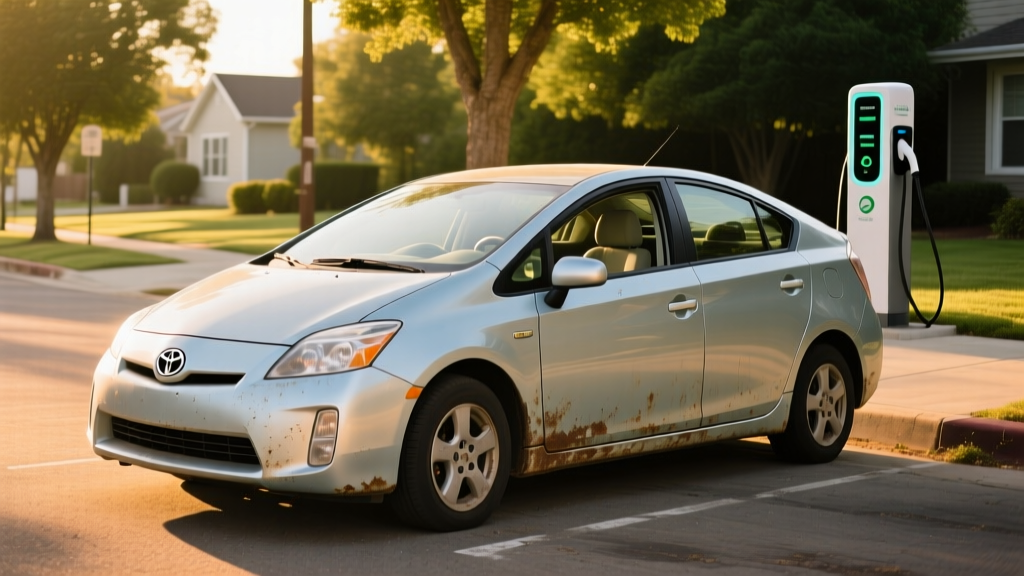
The second-generation Toyota Prius (model years 2004–2009) remains one of the most recognizable hybrids on American roads. Even in 2026, buyers searching for a cheap, ultra-efficient commuter still ask the same core question: what is the 2009 Prius hybrid MPG in the real world, and does this 17-year-old car still hold up? This guide breaks down the EPA numbers, real-world fuel economy, hybrid battery longevity, replacement costs, and how the 2009 Prius stacks up against modern hybrids, PHEVs, and full EVs.
| Spec | Value |
|---|---|
| Powertrain | 1.5L 4-cylinder + electric motor (HEV, no plug) |
| Combined Horsepower | 110 hp (net system output) |
| Engine | 76 hp @ 5,000 rpm / 82 lb-ft torque |
| Electric Motor | 67 hp / 295 lb-ft torque |
| Hybrid Battery | 1.3 kWh NiMH (nickel-metal hydride), sealed |
| Transmission | CVT (planetary gearset, e-CVT) |
| EPA MPG (City / Hwy / Combined) | 48 / 45 / 46 |
| 0–60 mph | ~9.8 seconds |
| Cargo Volume | 14.4 cu ft (rear seats up) |
| Drivetrain | FWD |
| Curb Weight | ~2,932 lbs |
2009 Prius Hybrid MPG: EPA Ratings vs. Real-World Results
The EPA rates the 2009 Toyota Prius at 48 mpg city, 45 mpg highway, and 46 mpg combined according to fueleconomy.gov. These figures were revised under the EPA's updated testing methodology, so older window stickers from 2009 may show slightly different numbers (originally 48/45/46 under the pre-2008 cycle, later adjusted).
In real-world driving, the 2009 Prius consistently delivers on its promises — and often exceeds them in city traffic. Here is what owners and testers typically report:
| Driving Scenario | Expected MPG | Notes |
|---|---|---|
| EPA City | 48 mpg | Stop-and-go favors regenerative braking |
| EPA Highway | 45 mpg | Aerodynamic drag reduces advantage at 75+ mph |
| EPA Combined | 46 mpg | 55% city / 45% highway blend |
| Real-World City (mixed traffic) | 44–50 mpg | Hybrids often beat EPA city; gentle driving pushes 50+ |
| Real-World Highway (70 mph) | 38–43 mpg | Sustained high speed erodes hybrid advantage |
| Real-World Highway (80 mph) | 34–38 mpg | Aero penalty significant above 75 mph |
| Cold Weather (below 32°F) | 36–42 mpg combined | Engine runs more for cabin heat; battery less efficient |
| Hot Weather (A/C on, 95°F+) | 40–44 mpg combined | A/C compressor load reduces electric-only operation |
The key insight: the 2009 Prius is at its most efficient in city driving, where regenerative braking recaptures energy and the electric motor handles low-speed movement. Highway driving, especially above 70 mph, narrows the gap between this hybrid and a conventional compact car. Cold weather hits all hybrids hard — expect a 10–15% fuel economy penalty in winter months because the gasoline engine must run more frequently to provide cabin heat and maintain battery temperature.
How the 2009 Prius Hybrid System Works (HEV, Not PHEV)
It is critical to understand that the 2009 Prius is a conventional hybrid electric vehicle (HEV), not a plug-in hybrid (PHEV). It has no charging port, no electric-only driving range beyond about 1 mile at very low speeds, and no ability to accept external electricity. The 1.3 kWh nickel-metal hydride (NiMH) battery is charged exclusively through regenerative braking and the gasoline engine.
| Feature | 2009 Prius (HEV) | Modern PHEV (e.g., 2026 Prius Prime) |
|---|---|---|
| Plug-in Charging | No — no charge port | Yes — Level 1/Level 2 AC charging |
| Battery Capacity | 1.3 kWh (NiMH) | 13.6 kWh (Li-ion) |
| Electric-Only Range | ~1 mile at <25 mph | 44 miles (EPA est.) |
| DC Fast Charging | No | No (AC only, ~4 hr on Level 2) |
| Federal Tax Credit (§30D) | Not eligible | Up to $7,500 (subject to eligibility) |
| Fuel Required | Regular unleaded (87 octane) | Regular unleaded (87 octane) |
| Total Range | ~480 miles (11.9-gal tank) | ~600+ miles (EV + gas combined) |
Toyota did not introduce the Prius plug-in variant (later called Prius Prime) until the 2012 model year. If you need electric-only commuting capability, the 2009 Prius cannot provide it. However, for drivers who lack home charging access and simply want excellent fuel economy without changing their habits, the HEV architecture remains a practical choice.
Powertrain Details: Engine, Motor, and Combined Output
The 2009 Prius uses Toyota's Hybrid Synergy Drive system, pairing a 1.5-liter Atkinson-cycle four-cylinder engine (76 hp, 82 lb-ft) with a permanent-magnet electric motor (67 hp, 295 lb-ft). Through a planetary gearset that functions as a continuously variable transmission (e-CVT), the system produces a net combined output of 110 horsepower.
The Atkinson-cycle engine sacrifices low-RPM torque in favor of thermal efficiency — it stays in its most efficient operating range more often than a conventional Otto-cycle engine. The electric motor fills in the torque gap at low speeds, providing strong initial acceleration from a stop. This synergy is why the Prius feels peppy around town despite modest peak horsepower.
Performance is adequate but not quick: 0–60 mph takes approximately 9.8 seconds. Merging onto fast-moving highways requires planning, and passing at highway speed demands a full-throttle downshift that sends the engine RPM soaring. This car prioritizes efficiency over performance, and that trade-off is deliberate.
Hybrid Battery Lifespan, Warranty, and Replacement Cost
The single biggest concern for any used Prius buyer is the hybrid battery. The 2009 model uses a nickel-metal hydride (NiMH) pack — proven technology but one that degrades with age and heat exposure. Here is what you need to know:
- 8 years / 100,000 miles (most states)
- 10 years / 150,000 miles (California and states adopting CARB emissions standards: CT, ME, MA, NJ, NY, OR, RI, VT, WA, and others)
- Coverage: battery capacity below a defined threshold or complete failure
Note: As of 2026, original warranty coverage has expired for all 2009 Prius vehicles regardless of mileage.
Real-world battery lifespan: Most 2009 Prius NiMH batteries last between 120,000 and 180,000 miles before showing meaningful degradation. Some units fail earlier (especially in hot climates like Arizona or Texas, where sustained heat accelerates cell deterioration), while well-maintained examples exceed 200,000 miles. Age is also a factor — even low-mileage examples from 2009 are now 17 years old, and NiMH cells degrade with calendar time regardless of use.
Battery replacement costs in 2026:
| Option | Approximate Cost (Installed) | Warranty | Notes |
|---|---|---|---|
| New OEM Toyota battery | $2,200–$2,800 | 1 year / unlimited miles (Toyota) | Available through dealerships; best longevity |
| Refurbished / reconditioned battery | $800–$1,500 | 1–3 years (varies by vendor) | Replaced weak modules; shorter lifespan than new |
| Aftermarket new battery (e.g., Green Bean, Dorman) | $1,500–$2,200 | 2–5 years (varies) | Quality varies; some match OEM longevity |
| Individual module replacement (DIY or specialist) | $200–$600 | None–1 year | Requires diagnostic skill; temporary fix if multiple cells are weak |
For context, a $2,000 battery replacement on a car you purchased for $4,000–$6,000 is a meaningful expense but still keeps total cost of ownership far below a comparable new vehicle. Many owners report the replacement battery lasting another 8–12 years.
Reliability and Common Issues Beyond the Battery
The 2009 Prius earns strong reliability marks overall. The 1.5L 1NZ-FXE engine is under-stressed and routinely reaches 250,000+ miles with basic maintenance. The e-CVT transmission has no belts, clutches, or bands to wear out — it is a simple planetary gearset with proven durability. Key items to inspect on a used 2009 Prius:
- Inverter coolant pump: A known failure point. If the pump fails, the inverter can overheat, triggering a warning light and reduced power. Replacement runs $400–$800.
- Brake actuator / regenerative braking system: Some 2004–2009 Prius models experienced premature brake actuator wear. Listen for unusual buzzing from the brake system at startup.
- Combustion chamber oil consumption: Higher-mileage examples (150,000+ miles) may burn oil due to piston ring carbon buildup. Check oil level regularly.
- 12V auxiliary battery: Located in the rear cargo area, this small battery powers electronics and must be replaced every 4–6 years. A dead 12V battery will prevent the car from starting, even if the hybrid battery is fully charged.
- Headlight HID ballasts: HID-equipped trims may need ballast or bulb replacement ($150–$400 per side).
For safety ratings, the 2009 Prius received a Good rating in frontal offset and side crash tests from the Insurance Institute for Highway Safety (IIHS), though it lacks modern active safety features like automatic emergency braking, lane-keeping assist, or blind-spot monitoring.
Does the 2009 Prius Qualify for Any Tax Credit?
No. The 2009 Toyota Prius does not qualify for the federal §30D new clean vehicle tax credit (up to $7,500) because it is a conventional hybrid (HEV), not a plug-in vehicle. It also does not qualify for the Used Clean Vehicle Credit (§25E, up to $4,000) because that credit applies only to used battery-electric vehicles (BEVs) and plug-in hybrids (PHEVs) with a battery capacity of at least 7 kWh. The 2009 Prius's 1.3 kWh NiMH pack falls far below this threshold.
Some states offer their own incentives for used hybrid purchases or for scrapping older vehicles in exchange for cleaner transportation. Check your state's energy office or department of environmental quality for current programs. These vary widely by jurisdiction and change frequently.
2009 Prius vs. Modern Hybrids, PHEVs, and EVs: Which Should You Buy?
The 2009 Prius occupies a specific niche in 2026: ultra-low-cost, high-MPG transportation for buyers who cannot or will not plug in. Here is how it compares to the alternatives:
Choose the used 2009 Prius (HEV) if:
- Your budget is under $6,000–$7,000
- You lack access to home or workplace charging
- You drive primarily in city or suburban traffic (where hybrid MPG shines)
- You want proven, simple hybrid tech with wide mechanic familiarity
- You drive fewer than 12,000 miles per year (fuel savings are modest at low mileage)
Choose a modern hybrid (e.g., 2026 Toyota Prius LE, ~$29,000) if:
- You want 57 EPA combined MPG with modern safety tech (Toyota Safety Sense 3.0)
- You want a warranty and don't want to gamble on a 17-year-old battery
- You drive 15,000+ miles per year (the MPG improvement pays off faster)
Choose a PHEV (e.g., 2026 Prius Prime, ~$34,000) if:
- You can charge at home (Level 1 or Level 2)
- Your daily commute is under 44 miles (covering most trips on electricity alone)
- You want to reduce gasoline consumption dramatically while retaining road-trip flexibility
- You may qualify for the §30D federal tax credit (income and sourcing requirements apply — consult IRS guidelines)
Choose a full EV (e.g., 2026 Hyundai Ioniq 6, ~$38,000) if:
- You have reliable home charging (Level 2 strongly recommended)
- You want zero tailpipe emissions and minimal maintenance
- Your daily driving is under 250 miles and you can plan for longer trips
- You want the lowest per-mile fuel cost (electricity at $0.14/kWh ≈ $4.50 per 100 miles vs. ~$9.50 per 100 miles in the 2009 Prius at $3.30/gallon)
Ownership Economics: What Does a 2009 Prius Actually Cost to Drive?
Let's run the numbers for a typical 2026 owner driving 12,000 miles per year:
| Vehicle | Efficiency | Annual Fuel/Energy Cost | Cost Per Mile |
|---|---|---|---|
| 2009 Prius (HEV) | 46 mpg combined | $861 (gas at $3.30/gal) | $0.072 |
| 2026 Toyota Corolla (gas) | 34 mpg combined | $1,165 (gas at $3.30/gal) | $0.097 |
| 2026 Prius Prime (PHEV, 50% EV driving) | 127 MPGe / 52 mpg gas | ~$520 (mixed electricity + gas) | $0.043 |
| 2026 Tesla Model 3 RWD (BEV) | 27 kWh/100mi | $504 (at $0.14/kWh home charging) | $0.042 |
The 2009 Prius saves roughly $300 per year in fuel compared to a modern non-hybrid compact car. Over five years, that is $1,500 — meaningful but not transformative. The real financial advantage of the 2009 Prius is its low purchase price: at $4,000–$6,500 in 2026 used markets, the total cost of ownership (purchase + fuel + insurance + maintenance) over a five-year period is extremely competitive, even factoring in a potential battery replacement.
Insurance costs are low (typically $800–$1,200/year depending on state and driver profile) because the vehicle value is low. Maintenance is inexpensive — oil changes, tire rotations, and brake service are standard Toyota Corolla-level costs, and regenerative braking extends brake pad life significantly (many owners report 80,000+ miles on original brake pads).
Pros and Cons of the 2009 Prius in 2026
Pros
- Proven 46 mpg combined EPA — often exceeded in city driving
- Very low purchase price ($4,000–$6,500 used)
- Strong reliability record for engine and e-CVT
- Widely understood by independent mechanics
- Low insurance and maintenance costs
- Regenerative braking extends brake pad life dramatically
- Hatchback versatility with 14.4 cu ft cargo area
Cons
- Hybrid battery is 17 years old — replacement likely needed if not already done
- No modern safety features (no AEB, lane assist, blind-spot monitoring)
- Slow acceleration (9.8 sec 0–60) — highway merging requires patience
- Highway MPG drops significantly above 70 mph
- Cold-weather fuel economy penalty of 10–15%
- No plug-in capability — cannot access EV tax credits or electric-only driving
- Dated interior technology (no standard Bluetooth audio, basic navigation)
- NIHS battery chemistry less energy-dense than modern lithium-ion
Frequently Asked Questions
How many MPG does the 2009 Prius hybrid get?
The EPA rates the 2009 Toyota Prius at 48 mpg city, 45 mpg highway, and 46 mpg combined. In real-world driving, owners typically see 44–50 mpg in city conditions and 38–43 mpg at sustained highway speeds of 70 mph. Cold weather can reduce combined fuel economy to 36–42 mpg.
Does the 2009 Prius need to be plugged in?
No. The 2009 Prius is a conventional hybrid (HEV), not a plug-in hybrid. It has no charging port. The hybrid battery is charged entirely through regenerative braking and the gasoline engine. You fuel it like any other car — with regular 87-octane gasoline.
How long does the 2009 Prius hybrid battery last?
Most 2009 Prius NiMH batteries last 120,000–180,000 miles or 12–15 years. At 17 years old in 2026, many original batteries are near end-of-life or have already been replaced. Hot climates accelerate degradation. Budget $1,500–$2,800 for a replacement if the current battery has not been swapped.
What does it cost to replace a 2009 Prius hybrid battery?
A new OEM Toyota battery costs approximately $2,200–$2,800 installed at a dealership. Refurbished or aftermarket batteries range from $800–$2,200 depending on source and warranty. Individual module replacement can cost as little as $200–$600 but is a temporary fix if multiple cells are degraded.
Is the 2009 Prius reliable?
Yes, with caveats. The engine and e-CVT transmission are exceptionally durable. The hybrid battery is the main wear item at this age. Other known issues include the inverter coolant pump, potential oil consumption at high mileage, and 12V auxiliary battery replacement. Overall, it remains one of the most reliable vehicles Toyota has built.
Does the 2009 Prius qualify for any tax credit?
No. The 2009 Prius does not qualify for the federal §30D new vehicle credit or the §25E used clean vehicle credit. Both require plug-in capability and minimum battery capacity thresholds that the 2009 Prius does not meet. Check your state's programs for any local incentives.
How does the 2009 Prius compare to the current-generation Prius?
The 2026 Toyota Prius LE achieves 57 mpg combined (11 mpg more than the 2009 model), produces 194 hp (84 hp more), includes Toyota Safety Sense 3.0 (AEB, lane-keeping, adaptive cruise), and starts at approximately $29,000. If you can afford the higher purchase price, the modern Prius is dramatically better in every measurable dimension except upfront cost.
Can I convert a 2009 Prius to a plug-in hybrid?
Aftermarket plug-in conversion kits existed in the early 2010s (notably from Enginer and Plug-In Supply), but most companies have ceased operations, parts are scarce, and the conversions were never EPA-certified. In 2026, a PHEV conversion is not recommended — the cost ($5,000–$8,000+), complexity, and lack of support make buying a factory PHEV a far better option.