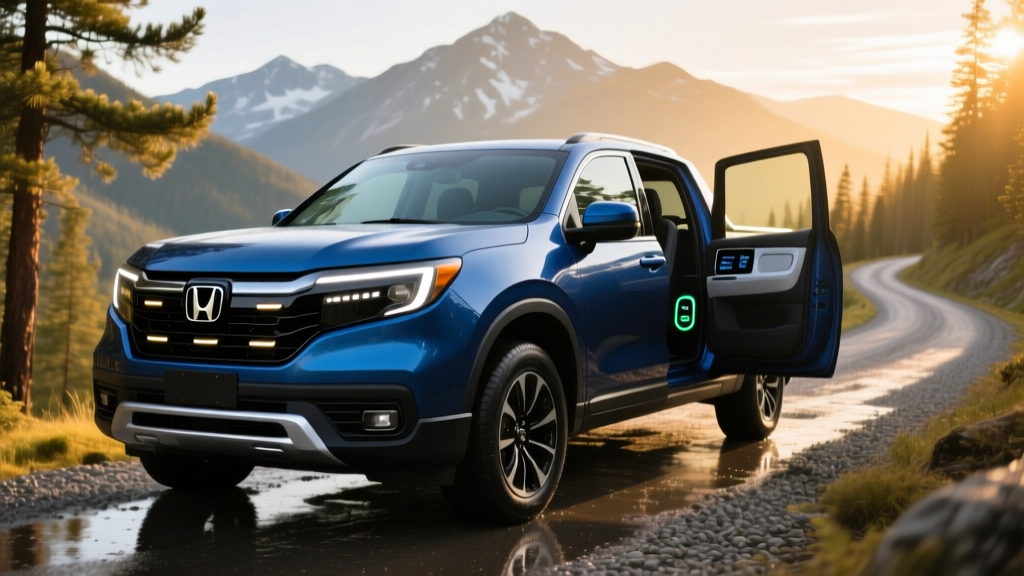
Midsize pickup buyers have long faced a binary choice: gas-guzzling V6 power or range-limited full-electric rigs that still struggle with towing and charging infrastructure. Honda's answer is the Ridgeline hybrid — a conventional hybrid electric vehicle (HEV) that slots an electric motor alongside its proven 3.5-liter V6 to squeeze more efficiency out of every gallon without requiring a plug, a lifestyle change, or a six-figure starting price.
For 2026, the Ridgeline hybrid enters a segment where the Ford Maverick hybrid dominates on fuel economy (42 MPG city) but trails on towing, while the Tacoma Hybrid (introduced for 2024) brings a turbo-four hybrid setup with strong off-road chops. Honda's play is refinement, ride quality, and real-world usability. Here's everything you need to know before you sign.
2026 Ridgeline Hybrid: Core Specs at a Glance
| Specification | 2026 Honda Ridgeline Hybrid |
|---|---|
| Powertrain | 3.5L V6 + electric motor (HEV) |
| Combined Horsepower | ~310 hp (est.) |
| Transmission | 10-speed automatic |
| Drivetrain | AWD (i-VTM4 standard) |
| EPA Fuel Economy (city/hwy/combined) | 22 / 27 / 24 MPG (est.) |
| Towing Capacity | 5,000 lbs |
| Payload Capacity | ~1,500 lbs |
| Bed Length | 5.3 ft (with dual-action tailgate) |
| Starting MSRP | ~$42,500 (est.) |
| Hybrid Battery Warranty | 8 years / 100,000 miles |
How Many MPG Does the Honda Hybrid Truck Get?
The headline number for the 2026 Ridgeline hybrid is an estimated 24 MPG combined (22 city / 27 highway). That represents a meaningful improvement over the gas-only Ridgeline's current 21 MPG combined (18 city / 24 highway), as listed on fueleconomy.gov.
| Model | City MPG | Highway MPG | Combined MPG |
|---|---|---|---|
| 2026 Ridgeline Hybrid (AWD, est.) | 22 | 27 | 24 |
| 2025 Ridgeline Gas (AWD) | 18 | 24 | 21 |
| 2026 Ford Maverick Hybrid (FWD) | 42 | 33 | 38 |
| 2025 Toyota Tacoma Hybrid (4WD) | 23 | 24 | 23 |
Real-World MPG vs. EPA Estimates
Conventional hybrids routinely beat their EPA city ratings in stop-and-go driving because regenerative braking recovers energy that a gas-only truck wastes as heat. Expect the Ridgeline hybrid to deliver 24–26 MPG in mixed suburban driving and potentially 26+ MPG on city-heavy commutes. Highway-only trips at 75+ mph will trend closer to the 25–27 MPG highway estimate, since aerodynamic drag dominates and the electric motor contributes less at sustained speed.
In cold weather (below 30°F), expect a 5–10% fuel economy drop — less severe than the 20–30% range loss a full EV suffers, because the hybrid still relies primarily on its gasoline engine. The engine's waste heat warms the cabin without a dedicated energy penalty.
HEV vs. PHEV: Why the Ridgeline Hybrid Is Not a Plug-In
This is where buyer confusion creeps in, so let's make it unambiguous:
Conventional Hybrid (HEV) — Ridgeline Hybrid
- No plug required. The small battery (~1.5–2.0 kWh) charges via regenerative braking and the gasoline engine.
- No electric-only driving range beyond very low-speed creeping (under ~1 mile).
- No federal tax credit under IRS §30D — that credit applies only to plug-in vehicles.
- Refuels exclusively at gas stations — zero infrastructure dependency.
Plug-In Hybrid (PHEV)
- Must be plugged in to access the larger battery (typically 12–20 kWh).
- 20–45 miles of electric-only range before the gas engine kicks in.
- May qualify for up to $7,500 federal tax credit under §30D, subject to MSRP caps, buyer income limits, and battery-sourcing requirements (see IRS.gov).
- Requires Level 2 home charging for practical daily use.
Honda has not announced a Ridgeline PHEV variant for 2026. If you need electric-only commuting capability in a truck, you'd currently need to look at the upcoming Ram 1500 REV (full EV) or consider a PHEV SUV like the Toyota RAV4 Prime — neither of which offers a truck bed.
Powertrain Deep Dive: V6 + Electric Motor
Honda's hybrid strategy for larger vehicles pairs its 3.5-liter V6 with an electric motor integrated into the transmission housing. The system operates in several modes:
- EV Drive: Short, low-speed maneuvers (parking lots, crawling in traffic) on battery power alone.
- Hybrid Drive: The engine and motor work together for acceleration — this is where the combined ~310 hp output comes from.
- Engine Drive: At steady highway speeds, the gasoline engine drives the wheels directly for maximum efficiency.
- Regenerative Braking: Lift-off and braking recapture kinetic energy into the hybrid battery.
The i-VTM4 all-wheel-drive system remains standard, using a torque-vectoring rear differential to send up to 70% of torque to the rear axle and distribute it side-to-side. This is a fully mechanical AWD system — the hybrid motor assists the front wheels, and the rear axle is driven by the engine through a driveshaft, not by a separate electric motor.
How It Compares to the Tacoma Hybrid
Toyota's i-FORCE MAX hybrid in the Tacoma uses a 2.4-liter turbocharged four-cylinder paired with a 48-hp electric motor sandwiched between the engine and 8-speed automatic. Combined output is 326 hp and 465 lb-ft of torque — substantially more torque than the Ridgeline hybrid's estimated ~300 lb-ft. The Tacoma Hybrid is the clear winner if towing near max capacity or off-road crawling is your priority. The Ridgeline hybrid counters with a smoother ride (unibody construction vs. body-on-frame), a more car-like interior, and Honda's reputation for long-term powertrain reliability.
Does the Honda Hybrid Truck Qualify for a Tax Credit?
No. The 2026 Ridgeline hybrid is a conventional HEV, not a plug-in vehicle. Under current IRS §30D rules, the federal Clean Vehicle Credit (up to $7,500) applies only to battery electric vehicles (BEVs) and plug-in hybrids (PHEVs) with a battery capacity of at least 7 kWh that can be recharged from an external power source.
- Vehicle must be a BEV or PHEV (plug-in capable) — ❌ Ridgeline Hybrid is HEV
- Battery capacity ≥ 7 kWh — ❌ Ridgeline hybrid battery is ~1.5–2.0 kWh
- MSRP cap: $80,000 for SUVs/pickups, $55,000 for sedans
- Buyer income cap: $150K single / $300K joint (modified AGI)
- Critical minerals and battery component sourcing requirements
- Point-of-sale transfer available for eligible vehicles
Some states offer separate incentives for conventional hybrids, but these are uncommon and typically modest ($250–$500 rebates). Check your state's energy office or department of environmental quality for current programs. The primary financial advantage of the Ridgeline hybrid is fuel savings, not government incentives.
Fuel Cost Savings vs. Gas-Only Ridgeline
At $3.50/gallon and 15,000 miles/year:
- Gas Ridgeline (21 MPG combined): ~$2,500/year in fuel
- Ridgeline Hybrid (24 MPG combined): ~$2,188/year in fuel
- Annual savings: ~$312
- 5-year savings: ~$1,560
That won't offset a significant price premium on its own. The hybrid's value proposition is broader: smoother stop-start behavior, reduced engine noise at low speeds, slightly lower emissions, and potentially stronger resale value as the market shifts toward electrified vehicles.
Battery Longevity, Warranty, and Replacement Cost
Honda Hybrid Battery Warranty
Coverage: 8 years / 100,000 miles (whichever comes first) for hybrid battery components, including the high-voltage battery pack, inverter, and related control modules.
Capacity threshold: Honda warrants the hybrid battery against defects and abnormal degradation. Unlike EV batteries (which warrant a specific capacity retention, typically 70%), hybrid batteries are small enough that minor degradation has negligible impact on fuel economy.
California and CARB states: Hybrid battery coverage extends to 10 years / 150,000 miles in states that follow California Air Resources Board emissions standards (CA, CO, CT, DE, ME, MD, MA, MN, NJ, NM, NY, OR, RI, VT, WA).
How Long Will the Hybrid Battery Last?
Honda's hybrid battery systems in the Accord Hybrid and CR-V Hybrid have demonstrated strong longevity. Based on fleet data and owner reports from earlier Honda hybrid systems:
- Expected lifespan: 150,000–200,000+ miles before significant degradation
- Failure rate within warranty period: Low — hybrid batteries experience shallower charge/discharge cycles than EV batteries, which reduces stress
- Degradation impact: A 10–15% loss in hybrid battery capacity over 100,000 miles may reduce fuel economy by 1–2 MPG — noticeable but not catastrophic
Battery Replacement Cost
If your hybrid battery fails outside of warranty:
- New OEM replacement: $2,500–$4,000 (installed)
- Refurbished/remanufactured: $1,500–$2,500 (installed)
- Individual cell/module repair: $500–$1,500 at specialized hybrid repair shops
Compare this to EV battery replacements at $10,000–$20,000+. The Ridgeline hybrid's small battery is a fraction of the cost to replace, and the likelihood of needing replacement within the vehicle's useful life is low.
Pricing and Trim Levels
Based on Honda's anticipated 2026 lineup, the Ridgeline hybrid will likely be offered across multiple trims, with the hybrid powertrain as either standard or optional depending on trim:
| Trim | Estimated MSRP | Key Features |
|---|---|---|
| Sport (Hybrid) | $42,500 | Hybrid powertrain, i-VTM4 AWD, 8-inch touchscreen, Honda Sensing suite |
| RTL (Hybrid) | $45,500 | Leather seats, power moonroof, heated front seats, tri-zone climate |
| RTL-E (Hybrid) | $48,500 | Navigation, premium audio, wireless charging, parking sensors |
| Black Edition (Hybrid) | $50,500 | Blacked-out styling, ventilated front seats, heated rear seats, bed lighting |
These are estimated prices based on the current Ridgeline lineup plus a projected hybrid premium of $2,000–$3,000 over equivalent gas trims. Honda has historically kept hybrid premiums modest — the CR-V Hybrid adds roughly $1,500 over the gas EX-L, for example.
Who Should Buy the Ridgeline Hybrid — And Who Shouldn't
Choose the Ridgeline Hybrid If:
- You want a midsize truck for daily commuting and weekend projects, not heavy towing or rock crawling
- You drive 12,000–20,000 miles/year and want modestly better fuel economy without changing your refueling habits
- You value ride comfort and interior refinement over maximum payload or off-road capability
- You don't have access to home charging and can't practically own a PHEV or full EV
- You want Honda's reliability track record and strong resale value
Choose a Full EV Truck (Rivian R1T, F-150 Lightning) If:
- You have reliable Level 2 home charging and want $0 gas expenses
- You want instant torque, frunk storage, and V2L/V2H capability
- You qualify for the full $7,500 federal tax credit, which can offset the higher purchase price
- Your daily driving is under 250 miles and you rarely tow over 5,000 lbs
Choose the Gas Ridgeline If:
- The hybrid premium exceeds what you'll recoup in fuel savings over your ownership period
- You plan to keep the truck under 5 years and want to minimize upfront cost
Pros
- 3+ MPG improvement over gas Ridgeline, more in city driving
- No plug required — zero charging infrastructure dependency
- Smoother stop-start and low-speed behavior
- i-VTM4 AWD with torque vectoring remains standard
- Unibody ride quality no body-on-frame truck matches
- 8-year / 100,000-mile hybrid battery warranty
- Dual-action tailgate and in-bed trunk remain unique in segment
Cons
- No federal tax credit (HEV, not PHEV)
- 5,000-lb tow rating trails Tacoma and Colorado
- 5.3-foot bed is shorter than most midsize competitors
- Hybrid premium adds $2,000–$3,000 to MSRP
- Not a PHEV — no electric-only commuting range
- Modest fuel savings vs. gas model (~$312/year)
Hybrid vs. PHEV vs. Full EV Truck: Which Is Right for You?
The midsize and full-size truck segment now spans the full electrification spectrum. Here's how to think about the decision:
| Factor | HEV (Ridgeline Hybrid) | PHEV (Not currently available in trucks) | Full EV (R1T, F-150 Lightning) |
|---|---|---|---|
| Plug-in required? | No | Yes (for EV range) | Yes (always) |
| Electric-only range | ~0 miles | 20–45 miles | 250–400 miles |
| Federal tax credit | None | Up to $7,500 | Up to $7,500 |
| Home charging needed | No | Recommended | Essential |
| Annual fuel cost (15K mi) | ~$2,188 | ~$800–$1,500 | ~$500–$800 |
| Towing range impact | Minimal MPG loss | EV range eliminated | Range cut 40–60% |
| Starting price range | $42K–$51K | N/A (no truck PHEVs yet) | $55K–$90K+ |
The honest assessment: if you need a truck today and can't charge at home, the Ridgeline hybrid is the most practical electrified option. If you can charge at home and your daily driving is predictable, a full EV truck like the Rivian R1T offers dramatically lower operating costs, better performance, and the federal tax credit — but at a higher purchase price and with real towing-range limitations.
Frequently Asked Questions
How many MPG does the Honda hybrid truck get?
The 2026 Honda Ridgeline hybrid is estimated at 22 city / 27 highway / 24 combined MPG. In real-world city-heavy driving, expect 24–26 MPG thanks to regenerative braking. Highway-only trips at 75+ mph will trend toward 25–27 MPG. These figures will be confirmed when the EPA publishes official ratings.
Can I plug in the Ridgeline hybrid to charge it?
No. The Ridgeline hybrid is a conventional HEV, not a plug-in hybrid. The small hybrid battery charges through regenerative braking and the gasoline engine. There is no charging port, no electric-only driving range, and no need for any home charging infrastructure.
Is the Honda Ridgeline hybrid reliable?
Honda's hybrid systems in the Accord Hybrid and CR-V Hybrid have demonstrated strong reliability over hundreds of thousands of fleet and consumer miles. The hybrid battery is covered by an 8-year / 100,000-mile warranty (10 years / 150,000 miles in CARB states). The Ridgeline's unibody platform and proven V6 engine contribute to long-term durability. Check IIHS.org for crash-test ratings once published for the 2026 model year.
What does it cost to replace the Ridgeline hybrid battery?
Out-of-warranty replacement runs $2,500–$4,000 for a new OEM battery pack (installed), or $1,500–$2,500 for a refurbished unit. Individual module repairs at hybrid-specialist shops can cost $500–$1,500. Given the shallow charge cycles a hybrid battery experiences, most owners will never need a replacement within the vehicle's typical lifespan.
Does the Ridgeline hybrid qualify for any tax credit?
No federal tax credit. IRS §30D applies only to plug-in vehicles (BEVs and PHEVs) with batteries of at least 7 kWh. The Ridgeline hybrid's battery is approximately 1.5–2.0 kWh and cannot be charged externally. Some states may offer small hybrid rebates — check your state's energy office for current programs.
How does the Ridgeline hybrid compare to the Ford Maverick hybrid?
The Maverick hybrid achieves an EPA-estimated 42 MPG city / 33 highway / 38 combined — dramatically better fuel economy. However, the Maverick is a compact truck with a 2,000-lb tow rating (4,000 lbs with the gas engine, no hybrid). The Ridgeline hybrid offers 5,000-lb towing, AWD, a larger bed, and a more refined ride. They serve different buyers: Maverick for urban fuel-sippers, Ridgeline for those who need genuine midsize truck capability with modest efficiency gains.
Will Honda make a Ridgeline PHEV or full EV?
Honda has not announced a Ridgeline PHEV or battery-electric variant as of early 2026. Honda's broader EV strategy includes the Prologue (built on GM's Ultium platform) and upcoming models on Honda's own e:Architecture. A fully electric Honda truck is plausible later this decade, but not imminent. Any future announcements would be labeled as preliminary/announced until production begins.