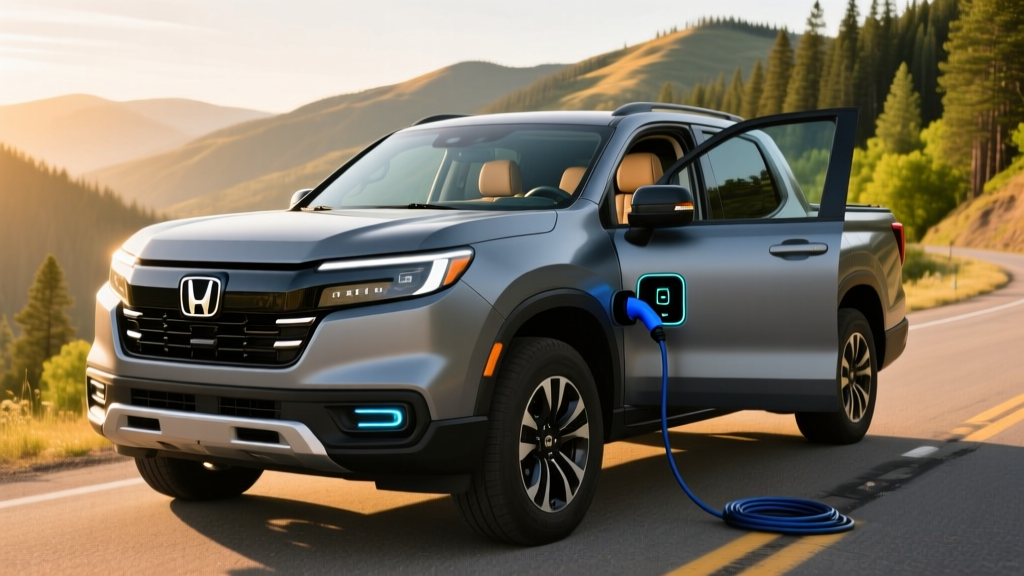
The midsize truck segment has gone hybrid. Toyota offers the Tacoma Hybrid, Ford pairs a turbo-four with an electric motor in the Maverick, and Ram is pushing electrified powertrains in the 1500. That leaves one notable holdout: Honda. Searches for the 2026 Honda Ridgeline hybrid have surged as buyers wonder whether Honda's unibody truck will finally ditch its V6-only formula. Here's what we know, what's plausible, and what truck shoppers should expect if Honda brings an electrified Ridgeline to market.
Why a Hybrid Ridgeline Makes Sense Now
Honda's U.S. lineup is rapidly electrifying — but not exclusively through battery-electric vehicles. The automaker has committed to offering hybrid variants across its core models, leveraging its fourth-generation two-motor hybrid system. The CR-V Hybrid, Accord Hybrid, and Civic Hybrid all use variations of this architecture, and it's proven capable of scaling to larger vehicles.
The Ridgeline's current 3.5L V6 produces 285 hp and 262 lb-ft of torque, paired with a 9-speed automatic and standard all-wheel drive. It returns an EPA-estimated 18 city / 24 highway / 21 combined MPG — respectable for a midsize truck but increasingly outclassed by hybrid competitors. A hybridized Ridgeline would address Honda's most glaring efficiency gap while preserving the towing and payload capability buyers expect.
HEV vs PHEV: Which Ridgeline Hybrid Is Coming?
This is the critical distinction. Honda could pursue either path — or both across trim levels.
Conventional Hybrid (HEV)
- No plug-in required — the battery charges via regenerative braking and the engine
- Smaller battery (~1.0–1.5 kWh)
- No electric-only driving range to speak of
- Significant MPG improvement over gas-only, especially in city driving
- Lower cost, simpler ownership
Plug-In Hybrid (PHEV)
- Requires plug-in charging to realize full benefit
- Larger battery (~15–20 kWh)
- 25–40 miles of electric-only range for daily commuting
- Gas engine kicks in for longer trips and towing
- Higher cost, may qualify for federal tax credit
Honda's most likely first move is a conventional hybrid (HEV), mirroring the approach used in the CR-V Hybrid. Honda's two-motor system is well-suited to this application, and an HEV avoids the packaging challenges of a larger PHEV battery in a truck platform. A PHEV variant could follow, but Honda has historically reserved plug-in tech for its passenger cars in the U.S. market.
Projected MPG: How Many Miles Per Gallon?
Using Honda's existing hybrid powertrains as a benchmark, here's what a hybrid Ridgeline could deliver compared to the current gas model and key competitors:
| Vehicle | City | Highway | Combined | Powertrain |
|---|---|---|---|---|
| 2026 Honda Ridgeline (current V6) | 18 | 24 | 21 | 3.5L V6 Gas |
| Ridgeline Hybrid (projected HEV) | 24–27 | 27–30 | 25–28 | 2.0L Turbo + 2-Motor HEV |
| Toyota Tacoma Hybrid (i-FORCE MAX) | 23 | 24 | 23 | 2.4L Turbo HEV |
| Ford Maverick Hybrid (FWD) | 40 | 37 | 38 | 2.5L HEV |
Sources: fueleconomy.gov (EPA estimates). Projected Ridgeline Hybrid figures are analyst estimates based on Honda's hybrid architecture scaled to a ~4,500-lb truck.
Honda's hybrid systems tend to deliver strong real-world results, particularly in stop-and-go city driving where the electric motor handles low-speed propulsion. CR-V Hybrid owners routinely report matching or slightly exceeding EPA city estimates. A hybrid Ridgeline could see similar real-world behavior — expect to beat the EPA city number by 1–2 MPG in urban commutes, while highway towing will pull fuel economy down to the mid-teens regardless of powertrain.
Powertrain: What's Under the Hood?
Honda's most potent hybrid system currently powers the Accord Hybrid and CR-V Hybrid: a 2.0-liter Atkinson-cycle four-cylinder engine paired with two electric motors in a series-parallel configuration. In the Accord Hybrid, this produces a combined 204 hp and 247 lb-ft of torque.
For a truck application, Honda would likely need to scale up. The most plausible configuration:
Projected Ridgeline Hybrid Powertrain Specs
| Engine | 2.0L turbocharged 4-cylinder (Atkinson cycle) |
| Electric Motors | Dual-motor hybrid system (drive + generator) |
| Combined Output (projected) | 280–310 hp / 300–340 lb-ft torque |
| Hybrid Battery (HEV) | ~1.0–1.5 kWh lithium-ion |
| Drivetrain | AWD (torque-vectoring rear unit expected) |
| Towing Capacity (target) | 5,000 lbs (matching current Ridgeline) |
| Transmission | e-CVT (Honda's direct-drive hybrid system) |
Honda's e-CVT isn't a traditional belt-and-pulley CVT. It uses a planetary gearset and the two motor/generators to manage power flow, delivering smooth, stepless acceleration without the rubber-band feel of older CVTs. For truck duty, the instant electric torque at low RPM would improve off-the-line responsiveness and low-speed trail maneuvering.
Could a PHEV Ridgeline Happen? Electric-Only Range & Charging
A plug-in hybrid Ridgeline is technically feasible but faces packaging and cost hurdles. If Honda pursued a PHEV variant, here's what the specs might look like based on competitor benchmarks:
- Battery size: 15–18 kWh (lithium-ion, likely NMC chemistry)
- Electric-only range: 28–35 miles EPA (enough for most daily commutes)
- Total combined range: 450+ miles (electric + gas tank)
- Level 2 charging time: ~2.5–3 hours at 7.2 kW (240V)
- DC fast charging: Unlikely — most PHEVs in this class omit DCFC to control cost
Without DC fast charging, a PHEV Ridgeline would rely entirely on Level 1 (120V household outlet, ~8–10 hours for a full charge) or Level 2 (240V home charger) for battery replenishment. That's fine for overnight home charging but limits the usefulness of the electric range on road trips.
Toyota's RAV4 Prime PHEV offers 42 miles of electric range from an 18.1 kWh battery and does support DC fast charging — a useful benchmark if Honda decides to compete directly.
Pricing & Tax Credit Eligibility
The current 2026 Honda Ridgeline starts around $41,000 (RTL trim) and climbs to approximately $49,000 for the Black Edition. A hybrid variant would carry a premium, consistent with Honda's pricing strategy across the CR-V and Accord lineups.
| Trim (Projected) | Est. MSRP | Hybrid Premium vs Gas |
|---|---|---|
| RTL Hybrid | $43,500–$45,000 | +$2,500–$3,500 |
| RTL-E Hybrid | $46,500–$48,000 | +$2,500–$3,500 |
| Touring Hybrid | $49,000–$51,000 | +$2,500–$3,500 |
Does the Ridgeline Hybrid Qualify for a Federal Tax Credit?
This depends entirely on which powertrain Honda chooses:
- Conventional HEV: No federal tax credit. The IRS §30D Clean Vehicle Credit applies only to plug-in electric vehicles (BEVs and PHEVs) with sufficient battery capacity. Standard hybrids do not qualify.
- PHEV: Potentially eligible for up to $7,500 under §30D, but only if the vehicle meets all current requirements — including battery component manufacturing, critical mineral sourcing, MSRP caps ($80,000 for trucks/vans/SUVs), and buyer income limits ($300,000 joint / $150,000 single). Honda's current PHEV models (like the Clarity, now discontinued) have historically struggled with the sourcing requirements. Check IRS.gov for the current eligible vehicle list before assuming credit qualification.
Battery Warranty, Reliability & Replacement Cost
Hybrid battery longevity is the number-one concern for first-time hybrid buyers. Here's the reassuring data:
Honda Hybrid Battery Warranty
Honda covers its hybrid battery packs for 8 years / 100,000 miles (10 years / 150,000 miles in CARB states including California, New York, Massachusetts, and others). This applies to all current Honda hybrid models and would extend to a Ridgeline Hybrid.
The warranty covers battery capacity loss below a defined threshold (typically 60–70% of original capacity) and any manufacturing defects.
Honda's hybrid system has proven highly reliable across the Accord, CR-V, and Insight platforms. The two-motor design places less stress on the battery than some competitors' systems, because the battery operates in a narrow state-of-charge window — Honda's battery management system never lets it fully charge or fully deplete, which dramatically slows degradation.
Battery Replacement Cost
For a conventional HEV Ridgeline with a ~1.5 kWh battery, out-of-warranty replacement would likely cost $2,000–$3,500 (parts and labor). For a hypothetical PHEV with a ~17 kWh pack, expect $6,000–$9,000. These are estimates based on current Honda hybrid battery pricing and industry averages. In practice, hybrid battery failures before 150,000 miles are rare — most data from Toyota and Honda hybrids shows batteries lasting 200,000+ miles with gradual capacity loss rather than sudden failure.
Who Should Choose a Hybrid Ridgeline vs a Full EV or Gas Truck?
The right powertrain depends on your driving pattern, charging access, and budget. Here's a decision framework:
Choose the Hybrid Ridgeline If:
- You want better MPG without changing habits
- No home charging access (apartment, street parking)
- You tow regularly (hybrid maintains towing capacity)
- You want proven reliability with minimal new tech risk
Choose a PHEV If Available:
- You can charge at home (Level 2, 240V)
- Daily commute is under 30 miles
- You want electric commuting + gas flexibility for trips
- You may qualify for the §30D tax credit
Choose a Full EV Truck Instead:
- You rarely tow heavy loads
- Home + workplace charging available
- Daily driving under 250 miles
- You want maximum fuel savings + lowest maintenance
For most midsize truck buyers — who use their truck for daily commuting, weekend projects, and occasional towing — a conventional hybrid is the lowest-friction upgrade. You get a meaningful MPG bump (roughly 25–30% improvement), retain full towing and payload capability, and never need to think about charging. The gas engine still does the heavy lifting on highway passes and towing, while the electric motor fills in the torque gaps at low speed.
Pros & Cons at a Glance
Projected Pros
- 5–7 MPG improvement over current V6 (25–28 combined projected)
- Strong low-RPM electric torque for city driving and trail crawling
- Same 5,000-lb towing capacity expected
- Ridgeline's class-best ride quality (independent rear suspension) retained
- Proven Honda hybrid reliability with 8yr/100k-mi battery warranty
- Standard AWD with potential torque-vectoring rear axle
Projected Cons
- $2,500–$3,500 price premium over gas-only Ridgeline
- No federal tax credit for HEV variant
- PHEV variant unlikely in initial launch
- Towing fuel economy still drops to mid-teens (physics of pulling 5,000 lbs)
- Still no conventional body-on-frame option for heavy-duty buyers
- Honda's hybrid system not yet proven at truck duty cycles
Frequently Asked Questions
How many MPG does the 2026 Honda Ridgeline hybrid get?
The current gas-only Ridgeline returns 18 city / 24 highway / 21 combined. A hybrid variant is projected to achieve 24–27 city / 27–30 highway / 25–28 combined — a 25–30% improvement. Real-world city MPG could exceed the EPA estimate thanks to Honda's hybrid system favoring electric propulsion at low speeds.
Will the 2026 Ridgeline hybrid be a plug-in?
Most likely not initially. Honda's current strategy favors conventional hybrids (HEVs) that don't require plug-in charging. A PHEV variant with 28–35 miles of electric-only range is possible for a later model year but hasn't been confirmed. The conventional HEV would charge its small battery through regenerative braking and the engine — no outlet needed.
Does a hybrid Ridgeline qualify for any tax credit?
A conventional HEV does not qualify for the federal §30D Clean Vehicle Credit — that credit is reserved for plug-in vehicles. A PHEV variant could potentially qualify for up to $7,500, subject to MSRP caps ($80,000 for trucks), buyer income limits, and battery sourcing requirements. Always check the IRS eligible vehicle list before purchase.
Is a hybrid truck reliable? What about battery replacement?
Honda's hybrid systems have demonstrated strong reliability across the Accord, CR-V, and Insight. The hybrid battery is warrantied for 8 years / 100,000 miles (10 years / 150,000 miles in CARB states). Out-of-warranty HEV battery replacement is estimated at $2,000–$3,500. Real-world data from Honda and Toyota hybrids shows most batteries lasting well beyond 200,000 miles.
Can a hybrid Ridgeline still tow 5,000 pounds?
Honda is expected to maintain the Ridgeline's 5,000-lb towing rating in a hybrid variant. The combined output of a turbocharged engine plus electric motors should produce equal or greater torque than the current V6. However, towing fuel economy will still drop significantly — expect 14–17 MPG while pulling a loaded trailer, similar to the current gas model under load.
When will the Honda Ridgeline hybrid be available?
Honda has not confirmed a release date for a hybrid Ridgeline as of early 2026. Industry speculation points to a potential reveal alongside the next-generation Ridgeline platform, expected for the 2027 or 2028 model year. Until Honda makes an official announcement, the current V6 Ridgeline remains the only option.
For the latest EPA ratings on all midsize trucks, visit fueleconomy.gov. For current federal EV/PHEV tax credit eligibility, consult IRS.gov.