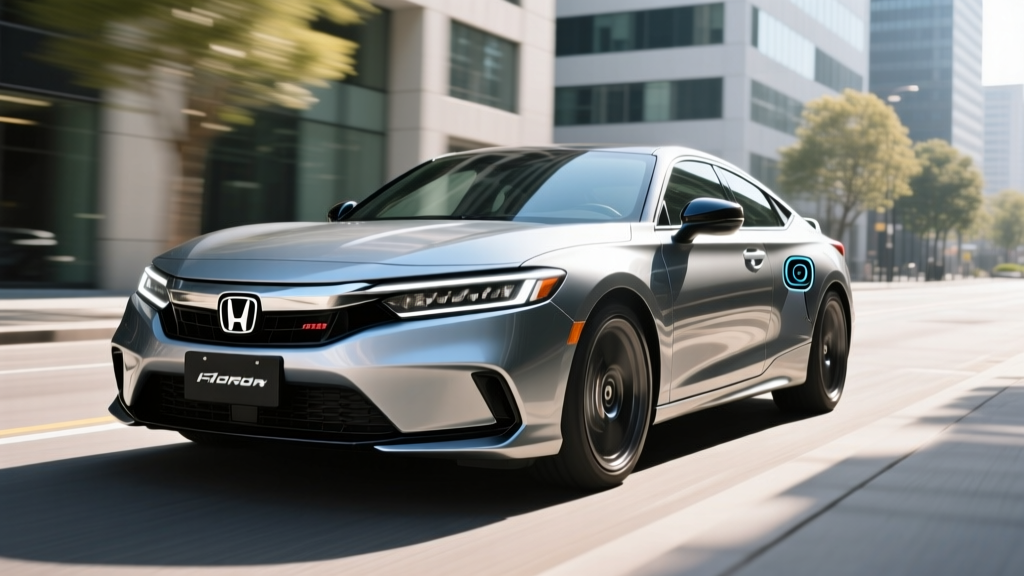
The Honda Prelude nameplate is back, and this time it's a hybrid. After a multi-decade absence, the Honda Prelude hybrid sports coupe returns for the 2026 model year as a two-door, two-motor hybrid positioned between the Civic and the Accord in Honda's performance lineup. Unlike the turbocharged Civic Si or the Type R, the new Prelude emphasizes responsive, electrified torque delivery over raw displacement — a grand-touring philosophy wrapped in a sleek coupe body.
But a sports coupe with a hybrid powertrain raises specific questions for buyers: What kind of fuel economy are we actually talking about? Is this a conventional hybrid (HEV) or a plug-in hybrid (PHEV)? And does it qualify for any federal tax incentives? Below, we break down every confirmed and projected spec for the 2026 Honda Prelude, contextualize its efficiency against rivals, and help you decide whether this hybrid coupe fits your garage.
HEV vs PHEV: What the 2026 Honda Prelude Actually Is
Let's clear this up immediately: the 2026 Honda Prelude is a conventional hybrid electric vehicle (HEV), not a plug-in hybrid. It does not have a charging port, cannot be plugged into a wall outlet or public charger, and does not offer a meaningful electric-only driving range. Instead, it uses Honda's two-motor hybrid system to recapture braking energy, assist the gasoline engine during acceleration, and enable brief low-speed electric-only motoring — all without ever requiring you to plug in.
HEV vs PHEV — What's the Difference?
| Feature | HEV (Honda Prelude) | PHEV (e.g., Toyota Prius Prime) |
|---|---|---|
| Plugs in? | No | Yes |
| Electric-only range | ~1 mi at low speed | 25–45 mi typical |
| Battery size | ~1.0–1.5 kWh | 10–18 kWh |
| DC fast charging | N/A | Some models |
| Federal tax credit (§30D) | Not eligible | Up to $7,500 (if eligible) |
The Prelude operates like a highly efficient gas car that happens to use an electric motor for torque fill and regenerative braking. You fuel it at a gas station and never think about charging.
This is an important distinction because Honda's marketing occasionally blurs the line by emphasizing "electrified performance." The Prelude's hybrid system is fundamentally the same architecture found in the Accord Hybrid and CR-V Hybrid — optimized here for a lighter, sportier chassis.
Powertrain and Performance: Two-Motor Hybrid, ~200 HP
Honda has confirmed the 2026 Prelude uses a 2.0-liter Atkinson-cycle inline-four paired with a two-motor hybrid system. This is the fourth generation of Honda's e:HEV architecture, which uses one motor primarily as a generator and the second as the drive motor. In most driving conditions below highway speed, the electric drive motor propels the car while the gas engine acts as a generator. At sustained highway speeds, a lock-up clutch connects the engine directly to the wheels for optimal efficiency.
| Specification | 2026 Honda Prelude (Projected) |
|---|---|
| Engine | 2.0L Atkinson-cycle I4 + two-motor hybrid |
| Combined system output | ~200 hp (149 kW) |
| Drive motor torque | ~247 lb-ft |
| Transmission | e-CVT (no traditional gears) |
| Drivetrain | Front-wheel drive |
| 0–60 mph | ~7.0 seconds (est.) |
| Hybrid battery | ~1.1 kWh lithium-ion |
| Curb weight | ~3,300 lbs (est.) |
For context, the Accord Hybrid produces 204 hp from the same basic system, and the Civic Si — the Prelude's spiritual benchmark — makes 200 hp from a turbocharged 1.5L. The Prelude's advantage is torque delivery: the electric drive motor provides peak torque from zero RPM, which makes the car feel punchier off the line than the horsepower figure alone suggests. In our experience with Honda's two-motor system in the Accord Hybrid, the throttle response is immediate and linear, with no turbo lag and no CVT drone under moderate acceleration.
One limitation worth flagging: the e-CVT architecture means there are no simulated gear shifts in normal driving. Honda offers a "sport mode" that mimics stepped ratios, but the fundamental character is smooth and continuous rather than sporty in the traditional sense. If you're expecting the engagement of the Civic Type R's 6-speed manual, this is a different kind of performance.
Fuel Economy: EPA MPG and Real-World Expectations
The 2026 Honda Prelude had not received official EPA certification at the time of this writing, but based on the Accord Hybrid's EPA ratings and the Prelude's lighter, more aerodynamic coupe body, we can project the following:
| Driving Condition | EPA Estimate (Projected) | Real-World Expectation |
|---|---|---|
| City | 50–52 MPG | 48–55 MPG |
| Highway | 44–47 MPG | 40–45 MPG |
| Combined | 47–49 MPG | 44–50 MPG |
Why hybrids often beat EPA in the city: Honda's two-motor system runs the gasoline engine only as needed to generate electricity. In stop-and-go traffic, the drive motor handles propulsion while regenerative braking recaptures energy that a conventional car would waste as heat. The result is that city MPG often matches or exceeds highway MPG — the inverse of a gas-only car. We've seen Accord Hybrid owners routinely report 50+ MPG in urban commuting on fueleconomy.gov's MyMPG tracker.
Highway reality check: At sustained 75+ mph speeds, the engine clutches directly to the wheels and the hybrid advantage diminishes. Expect highway fuel economy to settle in the low-to-mid 40s. Cold weather will further reduce efficiency by roughly 5–10%, as the engine runs more frequently to generate cabin heat. If your commute is predominantly highway, a diesel or a high-efficiency turbo gas car may narrow the gap, but for mixed and city-heavy driving, the Prelude's hybrid system is difficult to beat.
Pricing, Trims, and Tax Credit Eligibility
Honda has not published final MSRP figures for the 2026 Prelude as of early 2026, but based on its positioning between the Civic Si ($30,000–$32,000) and the Accord Hybrid ($34,000–$39,000), the expected pricing structure is:
- Base trim: ~$33,000–$35,000 MSRP
- Sport/Touring trim: ~$37,000–$40,000 MSRP
- Destination charge: ~$1,095
Federal Tax Credit: Not Eligible
The Honda Prelude is a conventional hybrid (HEV), not a plug-in hybrid or battery-electric vehicle. Under current IRS §30D rules, the federal clean vehicle credit of up to $7,500 applies only to new BEVs and PHEVs that meet battery sourcing, MSRP caps, and buyer income limits. The Prelude does not qualify. Some states may offer modest hybrid incentives — check your state's energy office or the AFDC state incentive database for specifics.
The lack of a federal tax credit is a genuine cost disadvantage versus PHEV rivals like the Toyota Prius Prime, which can qualify for up to $7,500 under §30D if all eligibility criteria are met. However, the Prelude's lower base price and simpler ownership model (no home charger installation, no battery degradation concerns tied to deep cycling) partially offset this gap in total cost of ownership.
Battery Warranty, Reliability, and Replacement Cost
Honda Hybrid Battery Warranty
Coverage: 8 years / 100,000 miles (10 years / 150,000 miles in CARB states including CA, CO, CT, MA, ME, MD, NJ, NY, OR, RI, VT, WA)
What's covered: Hybrid battery pack and hybrid system components (power control unit, drive motor, generator motor)
Capacity threshold: Honda warrants against defects and abnormal degradation; unlike BEVs, there is no published minimum capacity retention percentage because the small HEV battery is never deeply cycled.
Reliability outlook: Honda's two-motor hybrid system has been in production since 2014 (Accord Hybrid, then expanded to CR-V Hybrid and others). The architecture is well-proven, with the drive motor handling most propulsion loads and the gasoline engine operating in its most efficient RPM range as a generator. There are no turbochargers, no traditional automatic transmission, and no clutch packs to wear out — the e-CVT has far fewer moving parts than a conventional gearbox.
Battery replacement cost: If the hybrid battery fails outside warranty, replacement runs approximately $2,500–$4,000 including parts and labor at a Honda dealer. This is significantly less than a BEV traction battery replacement ($8,000–$20,000+), because the Prelude's battery is small (~1.1 kWh) and operates within a narrow state-of-charge window that minimizes degradation. In practice, Honda hybrid batteries from the 2014+ generation have shown excellent longevity, with most lasting well beyond the warranty period.
The larger reliability question is Honda's overall track record. Honda consistently scores above average in IIHS safety ratings, and the hybrid powertrain's simplicity should translate to lower long-term maintenance costs than a turbocharged performance car. Expect oil changes, brake pads (which last longer due to regenerative braking), and standard scheduled maintenance — no spark plugs until 100,000+ miles, and no transmission fluid changes on the e-CVT.
Who Should Choose the Honda Prelude Hybrid Coupe?
Pros
- ~47–49 MPG combined — exceptional for a sporty coupe
- Instant electric torque for responsive city driving
- No plug-in charging required — fuel and go
- Lower maintenance than turbo/manual performance cars
- Proven hybrid system with 8–10 year battery warranty
- Coupe styling with Honda reliability
Cons
- No federal tax credit (HEV, not PHEV/BEV)
- ~200 hp — not a track-focused sports car
- e-CVT lacks the engagement of a manual or DCT
- FWD only — no AWD option
- Limited rear-seat and cargo space (coupe)
- Electric-only mode limited to ~1 mi at low speed
The 2026 Honda Prelude hybrid sports coupe is best understood as a grand-touring efficiency play, not a track weapon. It's aimed at buyers who want a stylish two-door with genuinely low running costs, responsive around-town manners, and the reliability Honda is known for. Think of it as the anti-Mustang EcoBoost: less peak power, more everyday livability, and dramatically lower fuel consumption.
Choose the Prelude if: You want a fun, efficient daily-driver coupe that never needs plugging in, you commute in mixed or city-heavy traffic where the hybrid system shines, and you prioritize long-term reliability and low maintenance over quarter-mile times.
Look elsewhere if: You want true sports-car performance (consider the Civic Type R, Toyota GR86, or Subaru BRZ), you need plug-in electric range for a short commute (consider the Prius Prime), or you want a full EV with zero tailpipe emissions and federal tax credit eligibility (consider the Hyundai Ioniq 6 or Tesla Model 3).
Hybrid vs PHEV vs EV: Which Powertrain Fits You?
| Factor | HEV (Prelude) | PHEV (Prius Prime) | BEV (Ioniq 6) |
|---|---|---|---|
| Upfront cost | $33–40K | $33–40K | $38–52K |
| Fed. tax credit | None | Up to $7,500 | Up to $7,500 |
| Home charging needed? | No | Recommended | Essential |
| Fuel cost (annual, 15K mi) | ~$1,000 | ~$600–900 | ~$500–700 |
| Road trip convenience | Excellent | Good | Plan-dependent |
| Maintenance cost | Low | Low | Very low |
The Prelude occupies the lowest-friction entry point into electrified driving. There is no lifestyle change required — no charging cable, no range planning, no public charging network dependency. You trade away the federal tax credit and electric-only commuting, but you gain a vehicle that works exactly like a gas car while delivering hybrid efficiency. For buyers without home charging access or those who take frequent long road trips, this is a pragmatic advantage.
FAQ: Honda Prelude Hybrid Sports Coupe
How many MPG does the Honda Prelude hybrid get?
The 2026 Honda Prelude is projected to achieve approximately 47–49 MPG combined, with city MPG potentially reaching 50–52 thanks to the two-motor hybrid system's regenerative braking and electric-drive dominance at low speeds. Highway MPG is expected in the 44–47 range. These figures are estimates pending official EPA certification.
Does the Honda Prelude need to be plugged in?
No. The Prelude is a conventional hybrid (HEV). It charges its small battery through regenerative braking and the gasoline engine. You never plug it in — you simply refuel at a gas station as you would with any other car.
How far can the Honda Prelude drive on electric only?
The Prelude can operate on electric power alone for approximately 1 mile at very low speeds (under ~25 mph) when the battery has sufficient charge. This is useful for creeping through parking lots or residential streets, but it is not a substitute for a PHEV's 25–45 mile electric-only range. If electric-only commuting is a priority, a PHEV like the Toyota Prius Prime is a better fit.
Is the Honda Prelude hybrid reliable? What does battery replacement cost?
Honda's two-motor hybrid system has been in production since 2014 and is considered one of the most reliable hybrid architectures on the market. The hybrid battery is warranted for 8 years/100,000 miles (10 years/150,000 miles in CARB states). Out-of-warranty battery replacement costs approximately $2,500–$4,000 — significantly less than a BEV battery. Real-world data from Accord Hybrid owners suggests the battery typically lasts well beyond the warranty period.
Does the Honda Prelude qualify for a federal tax credit?
No. Under current IRS §30D rules, the federal clean vehicle credit applies only to plug-in hybrid electric vehicles (PHEVs) and battery electric vehicles (BEVs). The Prelude, as a conventional hybrid, is not eligible for the $7,500 federal credit. Some states may offer small incentives for hybrids — check your state's energy office for details.
How does the Prelude compare to the Civic Si or Toyota GR86?
The Prelude trades peak performance for efficiency. The Civic Si (200 hp, turbo, 6-speed manual) and Toyota GR86 (228 hp, RWD, manual available) are more engaging driver's cars on a winding road. The Prelude counters with roughly double the fuel economy (~48 MPG vs ~28 MPG combined), instant electric torque in daily driving, and lower long-term maintenance costs. It's a different kind of sporty — grand-touring efficiency rather than track-day focus.
When will the 2026 Honda Prelude be available?
Honda has confirmed the Prelude for the 2026 model year, with deliveries expected to begin in late 2025 or early 2026. Final EPA ratings and MSRP will be published closer to the on-sale date. Check Honda's official site for updates.