If you've been searching for a Honda hybrid minivan, you're likely weighing the family-hauling practicality of the Odyssey against the fuel-cost savings of electrification. Honda has brought hybrid technology across much of its lineup — the Accord, CR-V, and Civic all offer hybrid variants — and the minivan segment is no exception. But the details matter: is the Odyssey a conventional hybrid (HEV) or a plug-in hybrid (PHEV)? What real-world MPG can you expect with three rows loaded? And does it qualify for any federal tax credits?
This guide breaks down the 2026 Honda Odyssey Hybrid powertrain, EPA fuel economy, battery longevity, pricing, and ownership economics — with the exact numbers you need to decide whether this hybrid minivan beats a full EV or a gas-only rival for your family's needs.
HEV vs PHEV: What Kind of Hybrid Is the Honda Odyssey?
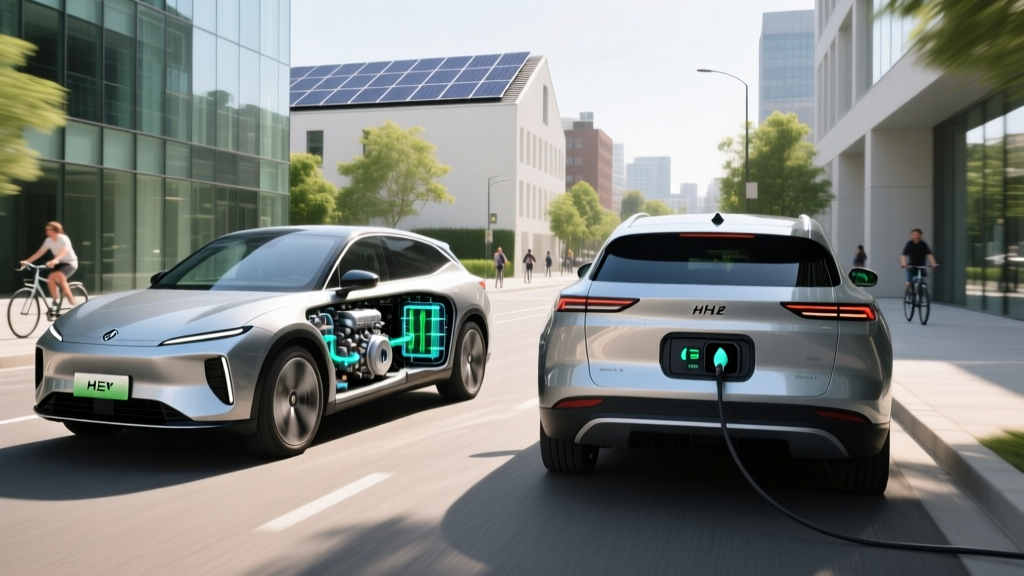
Before diving into specs, it's critical to understand the distinction between the two hybrid architectures on the market, because they affect how you fuel, what you pay, and what incentives apply.
Conventional Hybrid (HEV)
- No plug required. The gasoline engine and regenerative braking recharge a small battery (typically 1–2 kWh).
- No electric-only range beyond very low-speed crawling.
- No federal EV tax credit eligibility under IRS §30D.
- Best for: Drivers who want better MPG without changing fueling habits.
Plug-In Hybrid (PHEV)
- Plugs in to a wall outlet or Level 2 charger; larger battery (typically 10–20 kWh).
- 20–45 miles of electric-only driving before the gas engine kicks in.
- May qualify for a federal tax credit (up to $7,500) if battery sourcing and income rules are met.
- Best for: Drivers with home charging and short commutes who want EV-like daily driving with gas-engine range for road trips.
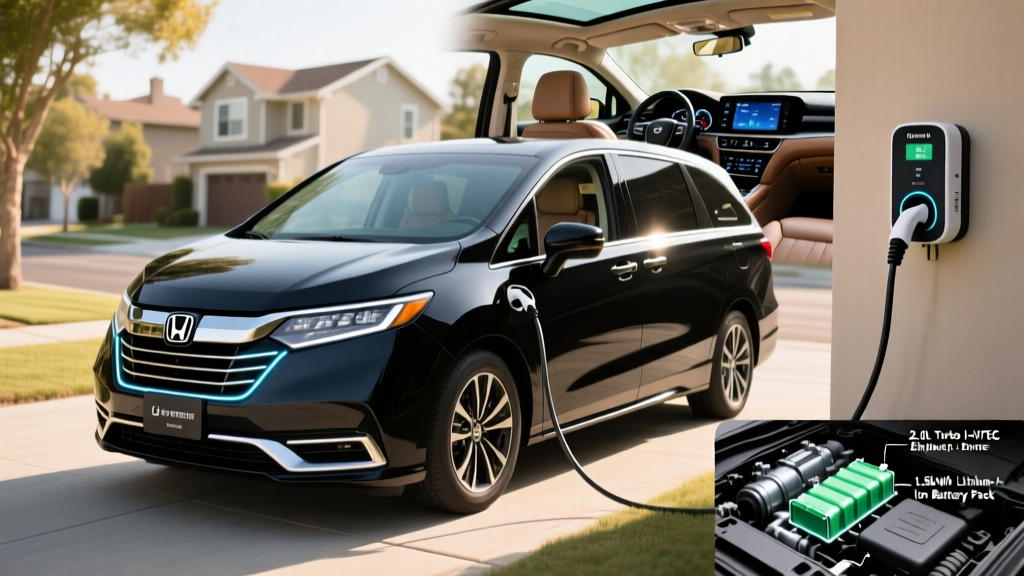
The 2026 Honda Odyssey Hybrid is a conventional hybrid (HEV). It does not plug in. There is no electric-only driving range to speak of. Honda has not announced a PHEV version of the Odyssey for the 2026 model year. If plug-in capability is a must-have for your minivan, you'll need to look at competitors like the Chrysler Pacifica Hybrid (PHEV) or consider a three-row EV such as the Kia EV9.
Powertrain Specs: Engine, Motors, and Horsepower
The 2026 Odyssey Hybrid uses Honda's two-motor hybrid system, pairing a 2.0-liter Atkinson-cycle four-cylinder engine with twin electric motors integrated into the transmission. This is the same architecture found in the Accord Hybrid and CR-V Hybrid, retuned for the Odyssey's larger mass.
| Specification | 2026 Honda Odyssey Hybrid |
|---|---|
| Engine | 2.0L Atkinson-cycle 4-cylinder |
| Electric Motors | Twin-motor hybrid system |
| Combined System Horsepower | 204 hp |
| Combined System Torque | 247 lb-ft |
| Transmission | e-CVT (direct-drive) |
| Drivetrain | Front-wheel drive (FWD) |
| Hybrid Battery Type | Lithium-ion (approx. 1.3 kWh usable) |
| Plug-In Capable? | No (conventional HEV) |
| 0–60 mph (est.) | ~7.6 seconds |
| Towing Capacity | 3,500 lbs |
The 204-hp combined output is modest for a 4,600-pound minivan, but the electric motors deliver torque instantly from low RPM, which makes around-town acceleration feel more responsive than the horsepower figure suggests. The e-CVT avoids the rubber-band effect of traditional CVTs by using a lock-up clutch at highway speeds, creating a more direct connection between engine and wheels.
Fuel Economy: EPA Ratings and Real-World MPG
Fuel economy is the primary reason buyers cross-shop hybrid minivans. Here's how the Odyssey Hybrid stacks up according to EPA estimates on fueleconomy.gov:
| Driving Cycle | EPA MPG |
|---|---|
| City | 38 MPG |
| Highway | 33 MPG |
| Combined | 35 MPG |
Real-World MPG: What to Actually Expect
Honda's two-motor hybrid system excels in city driving, where regenerative braking and low-speed electric assist reduce engine load. In real-world suburban and city driving with frequent stops, many owners report 36–40 MPG, sometimes exceeding the EPA city estimate. This is a common trait of conventional hybrids — the EPA city test cycle doesn't fully capture the stop-and-go regen advantage.
Highway driving tells a different story. At sustained 70–80 mph speeds, the hybrid system's advantage shrinks because there's minimal braking to recapture energy. Expect 30–33 MPG on the highway, especially when loaded with passengers and cargo. Cold weather further reduces efficiency by roughly 5–10% as the engine runs more frequently to generate cabin heat.
Compared to the gas-only Odyssey: The conventional 2026 Odyssey with its 3.5L V6 and 10-speed automatic is EPA-rated at 22 MPG combined (19 city / 28 highway). The hybrid's 35 MPG combined represents a ~59% improvement in overall fuel economy — translating to roughly $600–$800 per year in fuel savings for a driver covering 15,000 miles annually at $3.50/gallon.
Pricing, Trims, and Tax Credit Eligibility
The 2026 Honda Odyssey Hybrid is available across multiple trims. Here's the MSRP breakdown at launch:
| Trim Level | MSRP |
|---|---|
| EX-L Hybrid | $42,355 |
| Sport Hybrid | $43,855 |
| Touring Hybrid | $46,255 |
| Elite Hybrid | $49,155 |
All trims include Honda Sensing (adaptive cruise control, lane-keeping assist, automatic emergency braking), an 8-passenger cabin, and the Magic Slide second-row seats.
Does the Odyssey Hybrid Qualify for a Federal Tax Credit?
No. Under current IRS §30D rules, the federal clean vehicle credit applies only to plug-in electric vehicles (BEVs and PHEVs) with batteries meeting specific capacity, critical-mineral sourcing, and component-manufacturing thresholds. Because the Odyssey Hybrid is a conventional HEV with no plug-in capability and a battery far below the 7 kWh minimum, it does not qualify for the $7,500 federal tax credit.
Some states offer their own incentives for conventional hybrids, but these vary widely by jurisdiction and change frequently. Check your state's energy or environmental agency website for current programs. Honda also occasionally offers manufacturer loyalty or financing incentives that can reduce effective cost.
Battery Longevity, Warranty, and Replacement Costs
Battery lifespan is the top concern for hybrid buyers. Unlike full EVs with 75–100 kWh batteries, the Odyssey Hybrid uses a small lithium-ion pack (~1.3 kWh usable) that undergoes shallow charge-discharge cycles — the hybrid system keeps the battery in a narrow state-of-charge window (roughly 40–60%) to maximize longevity.
Honda Hybrid Battery Warranty
- Coverage: 10 years / 150,000 miles (in CARB states); 8 years / 100,000 miles (non-CARB states)
- What's covered: Battery capacity loss below functional threshold, manufacturing defects
- Replacement cost (out of warranty): Estimated $2,500–$4,000 including labor — significantly less than EV battery replacement due to the small pack size
In practice, Honda's hybrid batteries have demonstrated strong longevity. Data from fleet operators and long-term owners of the Accord Hybrid and CR-V Hybrid — which share this powertrain architecture — shows minimal degradation over 150,000+ miles. The shallow-cycling strategy means the battery rarely sees the deep discharges that accelerate wear. Most hybrid owners will never need a battery replacement during their ownership.
Is the Honda Odyssey Hybrid Reliable?
Honda's hybrid powertrain has a strong reliability track record. The e-CVT design eliminates the complex planetary gearsets and clutch packs found in traditional automatics, reducing potential failure points. The 2.0L Atkinson-cycle engine operates under less thermal stress than a turbocharged engine. The Insurance Institute for Highway Safety (IIHS) has rated recent Odyssey models highly for crashworthiness, and the hybrid variant carries the same structural safety ratings.
Hybrid vs PHEV vs EV: Which Minivan Fits Your Family?
The minivan market now spans three powertrain philosophies. Here's a decision framework to determine which fits your situation:
Choose the Honda Odyssey Hybrid (HEV) if:
- You don't have access to home or workplace charging
- You want a simple ownership experience — no plug, no charging apps, no range planning
- Your driving is a mix of city and highway with 15,000+ miles per year
- You value Honda's resale value, dealer network, and proven reliability
- You want 8-passenger seating with the Magic Slide second row
Consider a PHEV (Chrysler Pacifica Hybrid) if:
- You can install a Level 2 home charger
- Your daily driving is under 32 miles (the Pacifica's electric-only range)
- You want to drive mostly on electricity during the week but need gas-engine range for road trips
- You want to potentially qualify for a federal tax credit (check current IRS §30D eligibility)
Or consider a full EV (Kia EV9, Tesla Model X) if:
- You have reliable home charging (Level 2) and access to DC fast chargers for road trips
- You want zero tailpipe emissions and the lowest per-mile fuel cost
- You're comfortable with route planning on longer trips
- You want the maximum federal tax credit benefit (up to $7,500 point-of-sale, subject to income and sourcing rules)
Pros and Cons at a Glance
Pros
- 35 MPG combined — a massive improvement over the V6's 22 MPG
- No plug-in required; fuel exactly like a gas car
- Strong city MPG; often exceeds EPA in stop-and-go driving
- 10-year/150,000-mile hybrid battery warranty (CARB states)
- Proven Honda hybrid powertrain shared with Accord/CR-V
- Full 8-passenger seating and Magic Slide flexibility
- 3,500-lb towing capacity retained
Cons
- No federal tax credit eligibility (HEV, not PHEV)
- No electric-only driving range
- 204 hp is adequate but not quick for a loaded minivan
- Highway MPG advantage over the V6 is smaller than city advantage
- FWD only — no AWD option (the Toyota Sienna Hybrid offers AWD)
- Hybrid trims start ~$3,000–$4,000 above equivalent gas trims
Frequently Asked Questions
How many MPG does the Honda Odyssey Hybrid get?
The 2026 Honda Odyssey Hybrid is EPA-rated at 38 MPG city, 33 MPG highway, and 35 MPG combined. Real-world city driving often yields 36–40 MPG thanks to regenerative braking. Highway MPG typically falls between 30–33 MPG, especially when loaded or in cold weather.
Does the Honda Odyssey Hybrid need to be plugged in?
No. The Odyssey Hybrid is a conventional hybrid (HEV), not a plug-in hybrid (PHEV). The battery recharges through regenerative braking and the gasoline engine. You fuel it exactly like a standard gas car — at the pump.
Does the Honda hybrid minivan qualify for any tax credit?
Under current IRS §30D rules, the Odyssey Hybrid does not qualify for the federal clean vehicle tax credit because it is a conventional HEV with no plug-in capability. Some states may offer separate hybrid incentives — check your state's environmental or energy agency for current programs.
How long will the Honda Odyssey Hybrid battery last?
Honda covers the hybrid battery for 10 years/150,000 miles in CARB states and 8 years/100,000 miles elsewhere. Because the system uses shallow charge cycles (keeping the battery near 50% state of charge), real-world degradation is minimal. Many Honda hybrid owners exceed 150,000 miles with no battery issues. Out-of-warranty replacement is estimated at $2,500–$4,000 — far less than an EV battery swap.
How does the Odyssey Hybrid compare to the Toyota Sienna Hybrid?
The Toyota Sienna Hybrid is the Odyssey's direct competitor and is also a conventional HEV. The Sienna offers standard AWD (the Odyssey is FWD only) and similar combined MPG (around 35–36). The Odyssey counters with Honda's Magic Slide second-row seats, a more car-like driving feel, and a slightly more spacious cargo area behind the third row. Both are strong choices — test-drive both to compare seating comfort and visibility.
Is a hybrid minivan worth the extra cost over a gas minivan?
If you keep the vehicle for 5+ years and drive 12,000–15,000 miles annually, the fuel savings typically offset the hybrid premium. At 35 MPG combined vs. 22 MPG, you'd save roughly $600–$800 per year in fuel at $3.50/gallon. Over 8 years, that's $4,800–$6,400 in savings — plus the hybrid's typically stronger resale value. For low-mileage drivers, the payback period is longer.
Hybrid vs PHEV vs EV — which minivan should I choose?
Choose the Odyssey Hybrid (HEV) if you want maximum simplicity, no charging infrastructure, and proven reliability. Choose a PHEV like the Pacifica Hybrid if you have home charging and a short daily commute but still want gas-engine road-trip range. Choose a full EV like the Kia EV9 if you want the lowest operating costs, zero tailpipe emissions, and have reliable charging access. Your home-charging situation is usually the deciding factor.
Bottom Line: Who Should Buy the Honda Odyssey Hybrid?
The 2026 Honda Odyssey Hybrid is the right minivan for families who want significant fuel savings without altering their fueling routine. With 35 MPG combined, 8-passenger seating, and a hybrid battery backed by up to 10 years of warranty coverage, it delivers the practicality Honda minivans are known for with a meaningful reduction in fuel cost. It won't qualify for federal EV tax credits and doesn't offer electric-only range — but it also won't require you to install a home charger, plan road trips around charging stations, or worry about range in winter weather. For families who drive 15,000+ miles per year and want a straightforward path to better MPG, the Odyssey Hybrid is one of the most compelling minivans on the market.